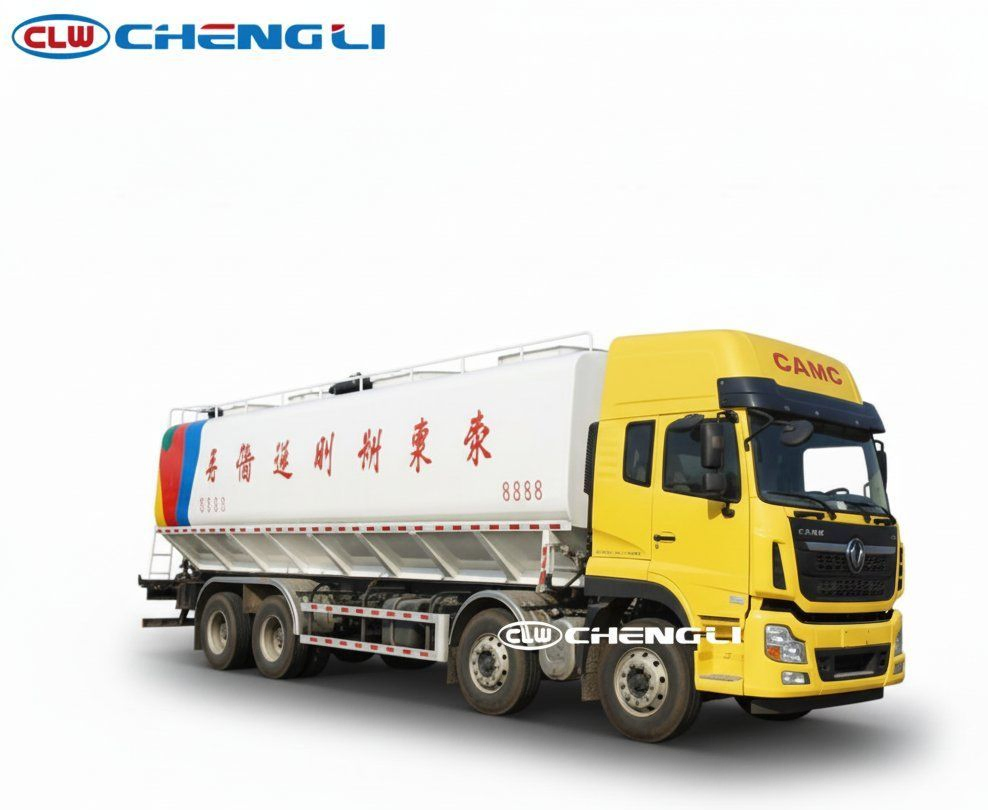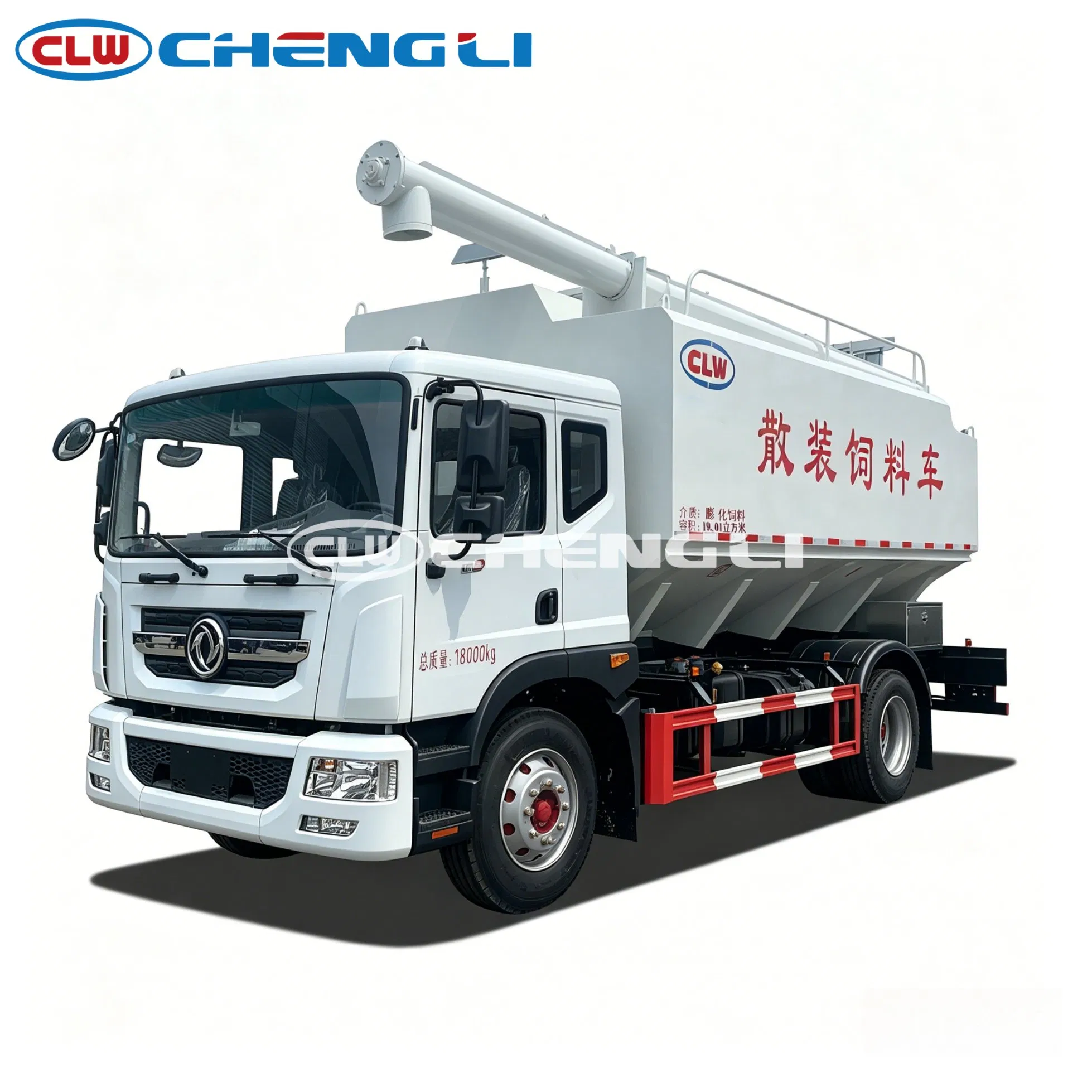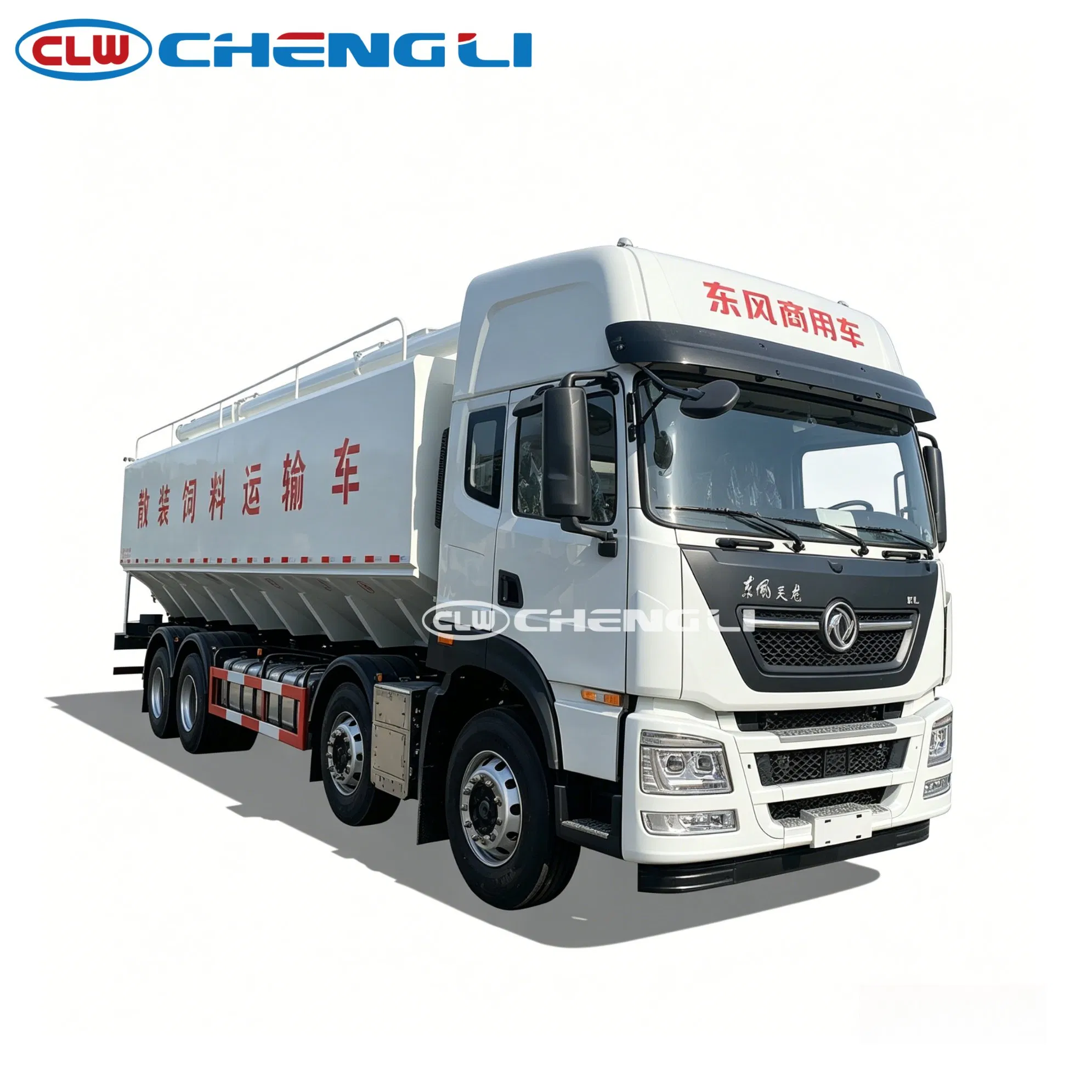
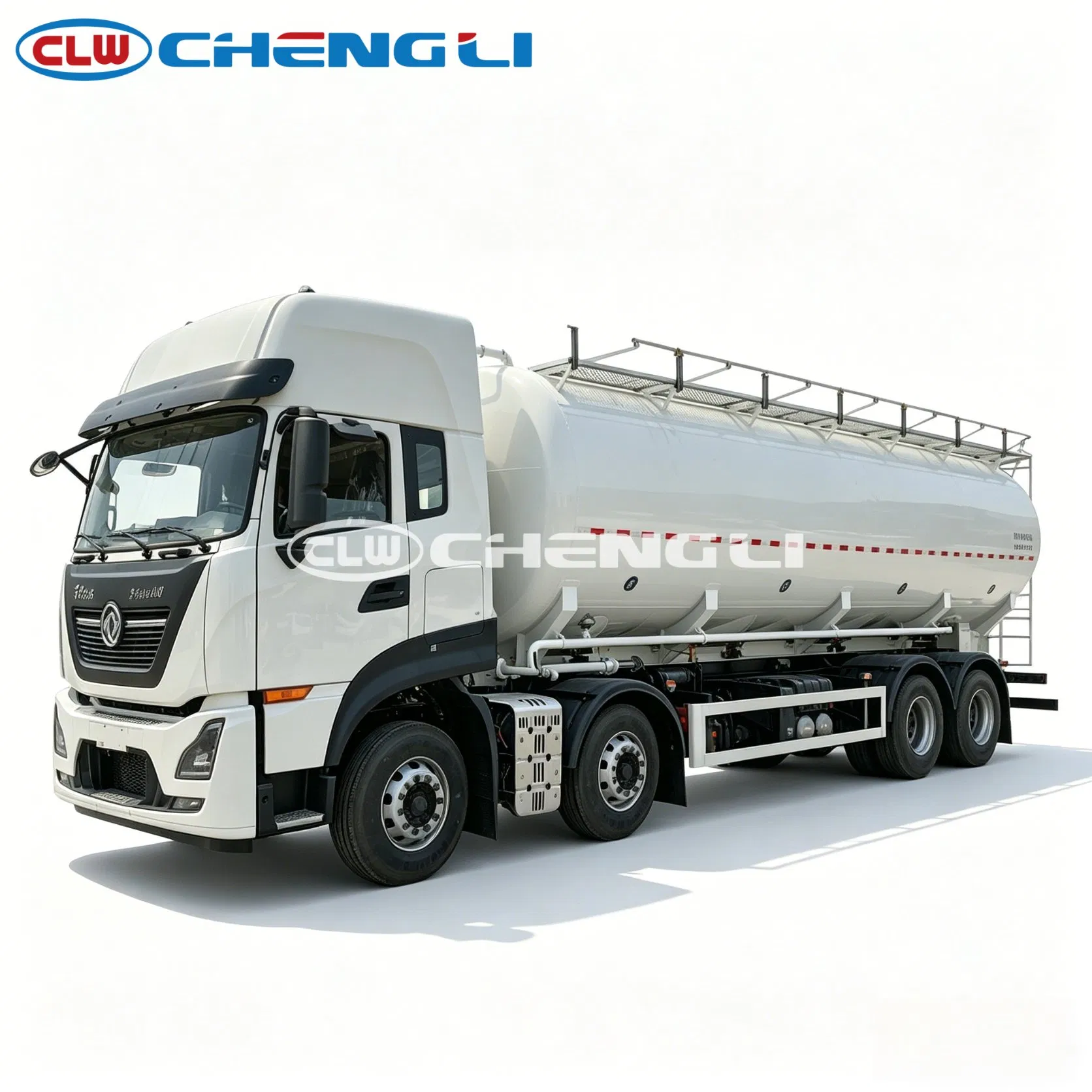
A bulk feed truck carries pelleted or mash feed from the mill to farm silos in a sealed tank and unloads it with either an auger or compressed air. Our current range runs from 17.44 m³ on a 4x2 chassis to 55 m³ on an 8x4, plus a 59.3 m³ semi-trailer.
What a Bulk Feed Truck Does on a Farm Route
A typical day starts at the feed mill. The truck loads through top hatches under the mill bins, drives to one or more farms, and discharges into each silo without anyone handling a bag. The tank stays closed in transit, which keeps rain, dust, birds and rodents away from the feed and helps farms keep their biosecurity rules.
Feed trucks are one part of the equipment we supply for agriculture and livestock operations. Three choices decide which one fits: how it unloads, how the tank is divided and how much feed it can legally carry.
Auger vs Pneumatic Discharge: Which Unloading System Fits?
Most of our feed trucks unload with a screw auger. Feed drops from the tank floor into a bottom auger, which passes it to an upper discharge auger that swings out to the silo inlet. On several models, including the 20 m³ 4x2 and the 44 m³ 8x4, the upper auger rotates through 180°, so the driver can reach silos on either side of the truck. The augers are driven electrically or hydraulically, and the electric-auger CL5312ZSL6SS unloads at 500–550 kg/min, which empties a 16 t load in about 30 minutes.
Pneumatic discharge works differently. A screw air compressor pressurizes the tank and blows feed through a hose into the silo. Our 38 m³ pneumatic feed truck on a DFH 8x4 chassis discharges at 0.2 MPa through a 4 m hose, uses a multi-cone tank interior to guide feed toward the outlets, and has an inspection window so the operator can watch the flow.
| Factor | Auger discharge | Pneumatic discharge |
|---|---|---|
| Pellet breakage | Low when the auger runs full at moderate speed | Higher; air velocity and hose bends can create fines |
| Unloading speed | 500–550 kg/min on our CL5312ZSL6SS | Depends on compressor output, hose size and feed type |
| Discharge height | Limited by upper auger length and lift angle | Hose reaches higher or more distant inlets, within compressor pressure limits |
| Truck position | Parks close to the silo | Can park farther away; hoses of 4 m to 7 m on our models |
| Upkeep | Flights, bearings and seals | Compressor, filters and valves; extra weight |
| Best fit | Pellets and mash into standard farm silos | Tall silos, poor access, stainless hygiene-sensitive work |
Choose pneumatic discharge when silo height or yard access demands it, or when the feed calls for a sealed stainless system. For most pelleted feed going into standard farm silos, an auger is simpler, lighter and easier to service.
Compartments and Multi-Drop Routes
A single open tank suits one farm taking one ration, but a pig unit may need starter, grower and finisher feed on the same visit, or the truck may drop different rations at three farms before it returns to the mill. Separate compartments let you load several feeds in one trip and keep them apart until each silo is filled.
Across our range, compartment options run from three to four. The 26 m³ FAW and the 20 m³ Dongfeng 4x2 offer three compartments, the 32 m³ HOWO aluminum tanker offers three or four, and the 44 m³ Dongfeng 8x4 and the CL5312ZSL6SS offer four. Our pneumatic models use partitioned, multi-cone tanks for the same purpose.
Every extra compartment adds a bulkhead, a discharge gate and more controls, and each bulkhead costs a little volume and tare weight. For multi-drop work, also check that each compartment empties completely before the next gate opens, so rations do not mix in the auger.
Capacity: Cubic Meters vs Tonnes of Feed
Tank volume is usually the first number buyers ask about, but the axles decide how much feed you can carry. Feed bulk density varies with feed type, typically about 0.5–0.7 t/m³, with pellets toward the upper end and mash toward the lower. Moisture, fat content and pellet size all shift the figure, so weigh a known volume of your own feed before you choose a tank.
Our 38.23 m³ Dongfeng 8x4 carries up to 18,270 kg, enough to fill the tank with feed of about 0.48 t/m³. Our 55 m³ FAW Jiefang 8x4 is rated for up to 15,790 kg; filled with 0.6 t/m³ pellets, its tank would hold about 33 t, more than double what the chassis may carry. The large tank makes sense for light, bulky feed. For dense pellets, a smaller tank reaches the weight limit with less empty space and less steel.
Across our current trucks and trailers, volume and payload scale with axle count:
| Configuration | Tank volume | Rated payload | Typical use |
|---|---|---|---|
| 4x2, 2 axles | 17.44–24 m³ | 8,525–10,270 kg | Small farms, narrow roads, short routes |
| 6x2 and 6x4, 3 axles | 26–32 m³ | 12,805–15,600 kg | Regional multi-farm routes |
| 8x4, 4 axles | 30–55 m³ | 15,070–18,795 kg | High-volume routes and large farms |
| Semi-trailer, 3 axles | 59.3 m³ | 28,250–28,700 kg | Mill transfers and long hauls to large farms |
Rigid Truck or Semi-Trailer?
A rigid truck is the default for farm delivery. It turns tighter on farm tracks, parks more easily beside a silo, and a 4x2 fits narrow yards and roads with low weight limits. Three-axle 6x2 and 6x4 trucks are the usual step up for regional routes, and 8x4 trucks carry the heaviest loads in our rigid range.
A semi-trailer carries about 1.5–1.6 times the rated payload of our heaviest 8x4. Our CLW 59.3 m³ feed semi-trailer is rated for 28,250–28,700 kg with an electric auger, and the CLW 59.3 m³ feed semi-trailer uses an electric auger with a rated payload of 28,250–28,700 kg, depending on configuration. The trade-off is maneuvering: a tractor and trailer needs more room to turn and to line up with a silo, so semi-trailers suit mill-to-mill transfers, large integrated farms and long hauls on good roads.
Hygiene and Tank Material: Carbon Steel, Aluminum or Stainless
Most of our feed tanks are carbon steel, such as the Q235A tank on the 24 m³ Dongfeng 4x2. Carbon steel is strong and easy to repair in local workshops, and it suits standard pelleted feed when the interior is kept clean and dry.
Aluminum alloy saves tare weight: our FAW 27.5 m³ and HOWO 32 m³ feed tankers use aluminum bodies. Stainless steel stands up to moist feed and cleaning agents and is the easiest of the three to clean thoroughly. Our 38 m³ pneumatic 8x4 uses stainless steel, while the published 59.3 m³ semi-trailer uses carbon steel; the 30 m³ Dongfeng 8x4 auger truck offers a stainless tank or an optional aluminum one.
Material is only part of hygiene. Ask for smooth internal welds, cone or sloped floors that leave little residue, and hatches and inspection covers that let the crew clean and dry the tank between loads. If you haul medicated feed or supply breeding farms, full emptying of each compartment matters as much as the metal.
How to Specify a Bulk Feed Truck
Confirm these points before you ask for a quotation:
- Feed type and density: pellets, crumbles or mash, plus a measured weight per cubic meter.
- Payload and axle limits: the maximum gross and axle weights on your routes, which set the useful tank size.
- Discharge system: auger with electric or hydraulic drive, or pneumatic, and the unloading rate you need at each farm.
- Silo inlets: height of the highest inlet, which side of the truck it faces and how close the truck can park.
- Compartments: the number of rations per trip and whether each compartment needs its own gate.
- Tank material: carbon steel, aluminum or 304 stainless steel, based on your feed and hygiene rules.
- Chassis and market: preferred brand, drive type, left- or right-hand drive and the emission level required at destination.
FAQ
Is a feed delivery truck the same as a bulk feed truck?
Usually, yes. Both terms refer to a sealed tank on a truck chassis that unloads feed straight into farm silos. Some buyers use "feed delivery truck" for bagged feed on a flatbed or box body, so state bulk discharge clearly in your inquiry.
How much feed does a 30 m³ feed tanker carry?
At a typical bulk density of 0.5–0.7 t/m³, a full 30 m³ tank holds roughly 15–21 t of feed. The chassis sets the real limit: our 30 m³ Dongfeng 8x4 is rated for 15,070 kg, so with dense pellets it reaches its payload before the tank is full. Always compare feed tanker capacity in cubic meters with rated payload and your local axle limits.
Can an auger feed truck reach tall silos?
Yes, within the reach of its upper auger. Outlet height depends on auger length, lift angle and how close the truck can park, so measure your highest silo inlet and the clear distance from the truck before ordering. Where silos are too tall or access is poor, a pneumatic truck with a discharge hose is the usual alternative.
Can a bulk feed trailer deliver directly to farm silos?
Yes. Our feed semi-trailers carry their own discharge equipment, an electric auger on the 59.3 m³ model, so they unload without a separate conveyor. Check that the farm entrance, turning space and ground near the silo can take a loaded tractor and trailer, which weighs far more than a rigid truck.
Start with the feed, not the tank: its density and the axle limits on your routes set the useful volume, your silos set the discharge system, and your rations set the compartments. You can compare every configuration on our bulk feed trucks page. Send your feed type, target payload, silo heights and destination market to our engineering team and we will propose a truck or trailer to match.