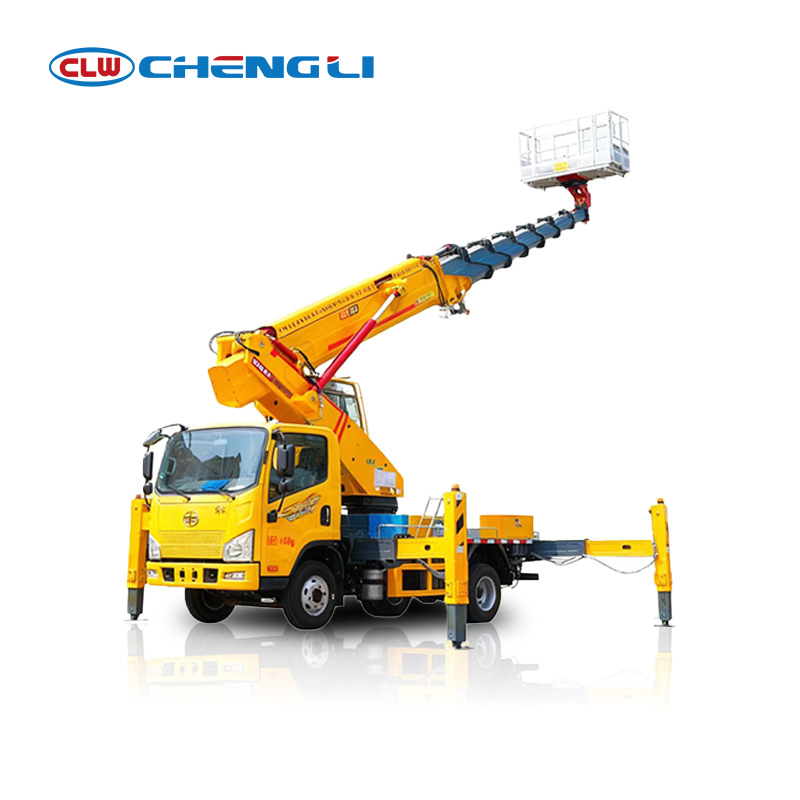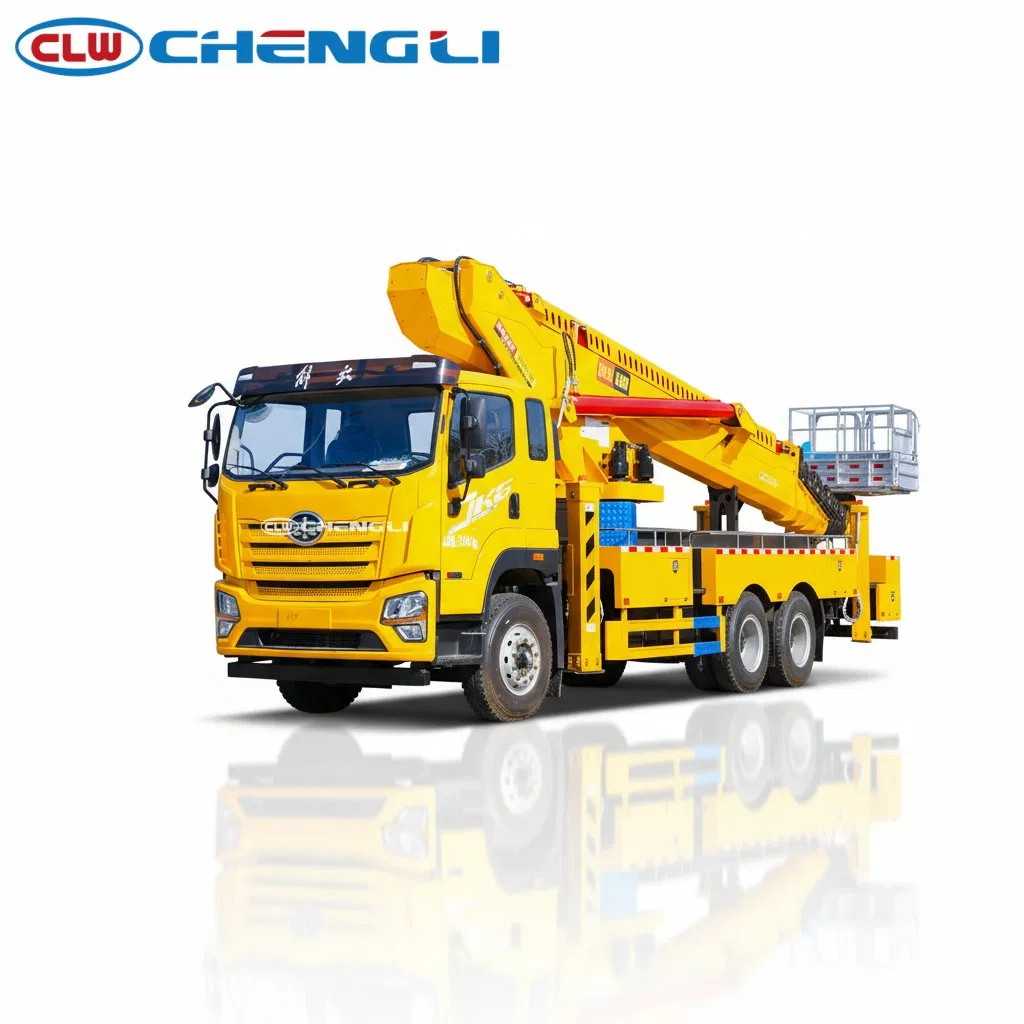
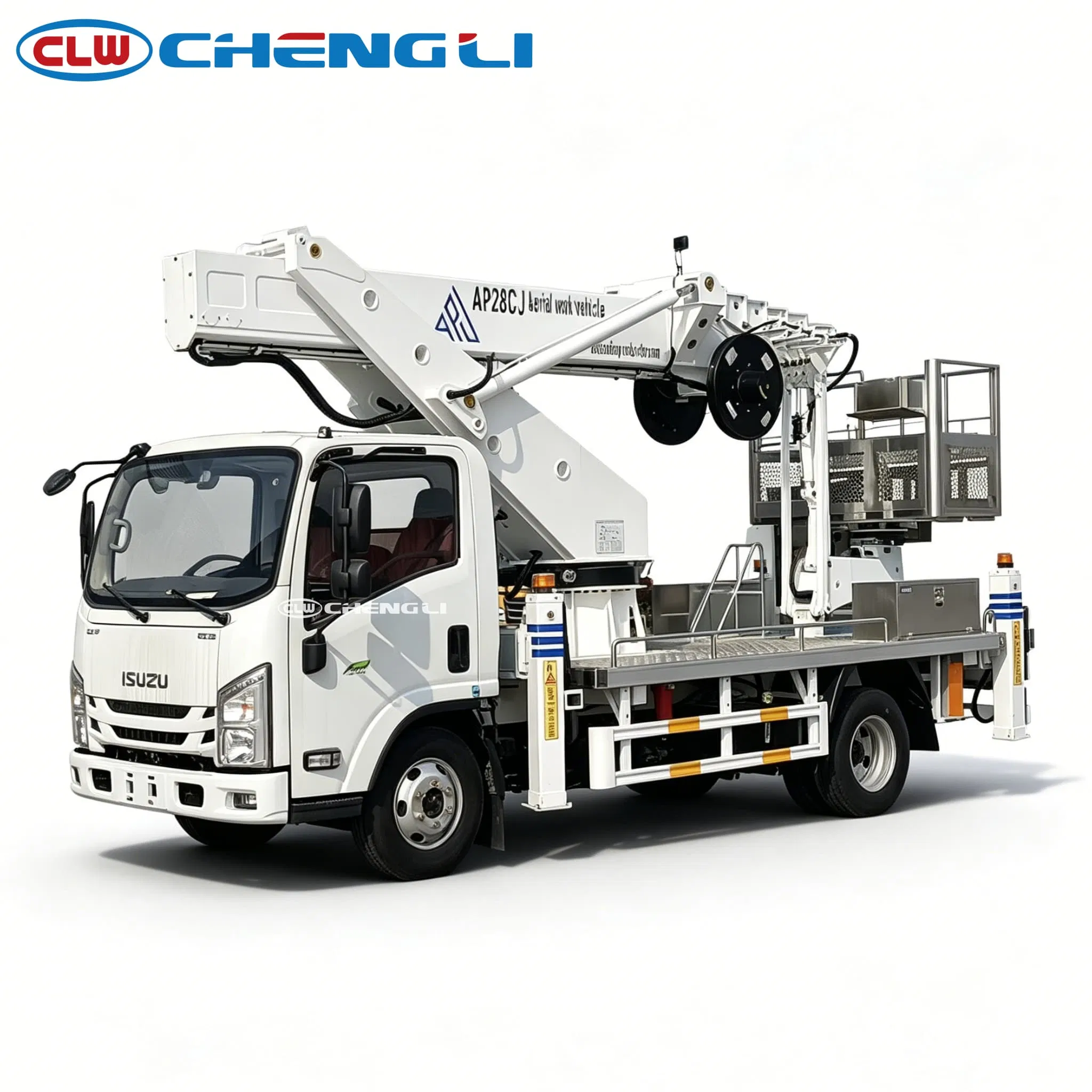
Working height is the platform floor height plus about 2 m for the operator's reach; platform height is how high the basket floor rises; outreach is the horizontal distance the basket travels from the turntable center. Buyers often confuse the three. Choose an aerial work platform truck by the outreach you need at the working height of the job, then confirm basket load and chassis.
Platform Height vs Working Height vs Outreach
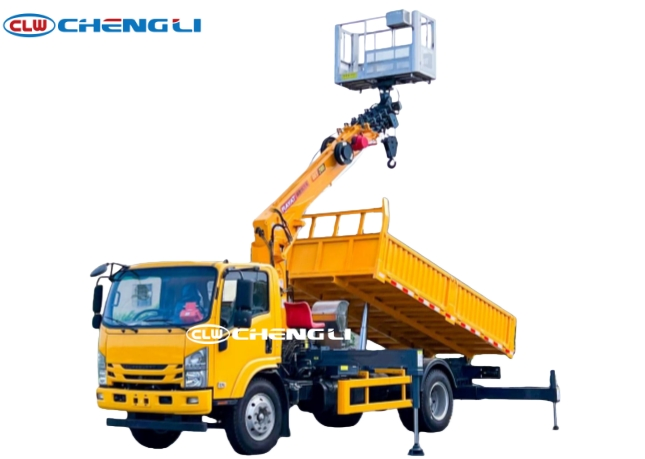
The gap between working height and platform height is not a fixed number across the industry. On our 18 m truck with a tipper body, the basket floor reaches 16.3 m, so the 18 m figure includes 1.7 m of assumed reach. Other makers add a full 2 m. When two quotes differ by a meter or two, check that both use the same definition.
Outreach matters more than height for most street work. A light pole set back from the curb or a sign gantry over a road needs horizontal reach at moderate height. Every boom trades one for the other: at full height the basket sits close to the turntable, and at full outreach it sits low. Compare load charts, not headline figures.
How the Three Figures Compare on Our Trucks
The table shows why two trucks with the same headline height can do different jobs. Both 36 m trucks lift a 200 kg basket to the same height, but the Dongfeng reaches 18 m sideways against 11 m for the Isuzu, and it carries 4,000 kg more vehicle mass to do it.
| Working height | Maximum outreach | Outreach at maximum height | Basket rating | Chassis and drive |
|---|---|---|---|---|
| 14 m | 10 m | 2.8 m | 200 kg | 4x2, 4,495 kg GVW |
| 17.5 m | 9 m | 2.8 m | 200 kg | JMC 4x2, 4,495 kg GVW |
| 24 m | 11 m | 5 m | 200 kg | JMC 4x2, 4,495 kg GVW |
| 36 m | 11 m | 5 m | 200 kg | Isuzu 4x2, 9,495 kg GVW |
| 36 m | 18 m | 5 m | 200 kg | Dongfeng 4x2, 13,495 kg GVW |
Also ask for the height at maximum outreach. Our 28 m Isuzu platform still works at 17 m when its boom is at full radius, and the 36 m Dongfeng at 15 m. The 17.5 m JMC, by contrast, reaches its full 9 m only at about 5 m height, which suits shop-front work but not a tree canopy over a road.
Telescopic, Folding and Hybrid Booms
A telescopic (straight) boom extends in sections from a single pivot. It gives a simple, predictable envelope and fast positioning. In our range, three-section booms cover 14 m to 21 m, four-section booms cover 23 m to 36 m, and long-reach booms use more sections: seven on the 36 m Dongfeng and nine on the 65 m FAW. More sections mean a longer reach from a shorter stowed length, at the cost of more wear points to inspect.
A folding (knuckle) boom uses two or three hinged arms. It can reach up and over a wall, parked vehicle or tree line, and it stows short on a light chassis. Our folding trucks sit on 4,495 kg to 5,450 kg GVW chassis and cover a 15 m to 20 m height range, with the exact figure set by the arm build. The trade-off is less outreach at height and slower positioning than a straight boom.
Hybrid booms combine a folding lower arm with a telescopic upper section, and some of our compact trucks use this layout. They suit utility crews who need to clear an obstacle and then extend. Ask for the load chart of the exact build, because the envelope changes with the arm combination.
Basket Rated Load and People Count
Most of our trucks are rated at 200 kg in the basket, from the 14 m unit up to the 65 m FAW. The exceptions are the 21 m Isuzu at 220 kg and the 18 m tipper-body truck at 280 kg. The rating covers workers, tools and parts together. A common planning figure is about 80 kg per worker plus tools, so a 200 kg basket suits two workers with light hand tools, or one worker with a heavier kit.
Load also changes outreach. Our 18 m truck reaches 11.6 m with 100 kg in the basket but 10.6 m at its full 280 kg, so a heavier load costs a full meter of reach. Size the basket rating for the heaviest job, such as cable drums or luminaires, and check the outreach at that load.
Basket size matters too. Our 24 m JMC platform uses a 1,400 × 700 mm basket, while the 14 m unit and the 65 m FAW use 1,600 mm baskets. A 1,600 mm basket gives two workers room to turn with tools; a smaller basket is easier to place between branches or cables.
Chassis Choice, Outrigger Span and Stability
Outriggers and chassis mass resist the tipping moment of an extended boom, so height and outreach set the chassis size.
| Truck | GVW | Drive | Outrigger span, side to side |
|---|---|---|---|
| 14–24 m telescopic | 4,495 kg | 4x2 | 4,200 mm front, 4,000 mm rear |
| 21 m Isuzu | 7,300 kg | 4x2 | 4,050 mm |
| 28 m Isuzu | 7,200 kg | 4x2 | 5,400 mm |
| 36 m Isuzu | 9,495 kg | 4x2 | 5,900 mm front, 6,200 mm rear |
| 36 m Dongfeng | 13,495 kg | 4x2 | 6,300 mm front, 5,600 mm rear |
| 45 m FAW J6P | 18,000 kg | 4x2 | 8,200 mm |
| 65 m FAW | 25,000 kg | 6x4 | 8,500 mm front, 9,200 mm rear |
Outrigger span is the figure site crews notice first. A 4,200 mm spread lets a light truck set up on a narrow street, while an 8,200 mm spread on a 45 m truck usually means closing more of the road. Our larger trucks use individually adjustable outriggers, which helps on cambered streets. Ask whether the chart allows reduced-span setups and what outreach remains in that mode.
On drive type, most of our range, including the 45 m FAW J6P, runs on 4x2 chassis. The 65 m FAW platform moves to a 6x4 chassis to carry its 25,000 kg GVW, not for off-road traction. If your routes include unpaved access roads, tell us so we can check axle loads and ground clearance.
Insulated vs Non-Insulated Booms
An insulated aerial device puts a tested insulating section between the basket and the chassis, so a worker near energized lines is not grounded through the truck. The insulating section, hydraulic lines and controls are proven by a dielectric test on each unit, repeated at set intervals. In North America these devices are rated under ANSI A92.2; other markets use their own rules. Specify the standard and voltage class your utility requires and confirm it at quotation.
A non-insulated boom is the right choice for most road and utility maintenance jobs: street lighting on de-energized circuits, signage, facades, trees away from lines and telecom work. We do not rate any truck in our current range as an insulated aerial device. Our 18 m tipper-body truck has an FRP basket with a PE liner, but an FRP basket alone does not make the boom insulated. For work near live conductors, tell us the voltage and standard and we will state in writing what the build can and cannot do.
What Drives Bucket Truck Price
Bucket truck price depends on the full build, not the headline height. The main cost drivers are:
- Working height and boom sections. Each extra section adds steel, hydraulics and synchronizing hardware, and taller booms need a heavier chassis.
- Outreach at height. A wider envelope needs a stiffer boom, a larger turntable and wider outriggers.
- Chassis. Brand, engine power, emission level and GVW class all change the base cost.
- Basket rating and material. A higher rated load, a larger basket or an FRP basket adds cost.
- Insulation. A tested insulated build costs more than a standard boom and carries test paperwork.
- Extra bodies and cab. A double cab for a crew, a tipper body or an electric chassis change both price and payload.
- Shipping. Tall and long units may need flat-rack or RoRo shipping, which changes landed cost.
How to Specify an Aerial Work Platform Truck
Before you order, confirm these points in writing:
- The highest work point and its horizontal distance from where the truck can park.
- Whether your tender specifies working height or platform height, and by which convention.
- The heaviest basket load: number of workers, tools and parts, plus the outreach needed at that load.
- The narrowest setup width on your routes, compared with the outrigger span.
- Chassis brand preference, GVW limit, emission level and left- or right-hand drive for your market.
- Insulation requirement, voltage class and standard, or confirmation that a non-insulated boom is acceptable.
- Extras such as a double cab, tipper body, basket material or electric chassis.
- Destination port and any local registration rules on overall height and length.
FAQ
Is a bucket truck the same as an aerial work platform truck?
In everyday use, yes. Bucket truck is the common North American name for a truck-mounted boom with a personnel basket, often used by utilities. Aerial work platform truck and truck work platform are the terms more common in export tenders. What matters is the boom type, the load chart and the basket rating, not the name on the tender.
How high can a truck work platform reach?
In our current range, working heights run from 14 m (about 46 ft) on a light 4x2 truck to 65 m (about 213 ft) on a 6x4 chassis, with 17.5 m, 18 m, 21 m, 23 m, 24 m, 28 m, 36 m and 45 m steps between. Folding trucks cover 15 m to 20 m.
Can an aerial platform truck lift materials as well as people?
Only within the basket rating, and only if the manufacturer permits it for that model. The platform is built for people and hand-carried tools. Hanging loads from the basket or boom changes the stability calculation and is not covered by a standard load chart. For regular material lifting, use a crane rated for the load and radius.
What does insulated aerial platform mean in a tender?
It means the tender requires a boom tested to carry workers near energized lines, usually with a named standard, voltage class and test report. A fiberglass basket or liner alone does not meet that requirement. If the tender asks for an insulated aerial platform, send us the clause so we can say clearly whether a compliant build can be offered and what documents would come with it.
How often should the boom and basket be inspected?
Follow the manufacturer's manual and your local work-at-height rules. As a working practice, crews check controls, emergency lowering, outriggers, hoses and the basket before each shift, and a competent person inspects the boom structure, pins and hydraulics at intervals set by those rules. Keep the load chart and rating plate legible, and record every inspection against the truck's serial number.
Start from the job, not the brochure: the highest work point, the outreach to reach it, the heaviest basket load and the narrowest street you set up on. Those four figures pick the boom and the chassis almost on their own. Browse our aerial work platform trucks to compare builds, then send us your job profile and destination market and our team will propose a configuration and a matching load chart.