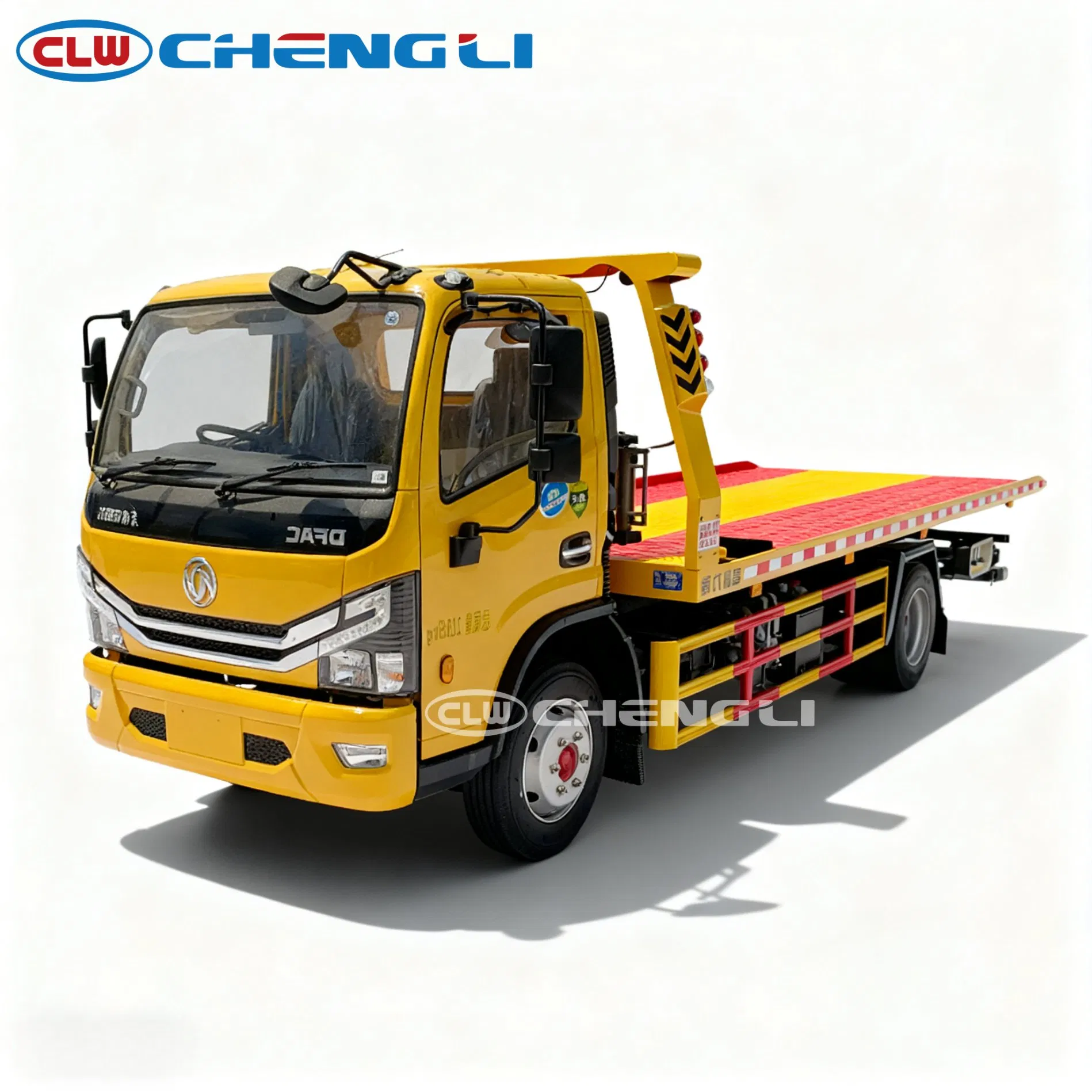
Choose a tow truck by the heaviest vehicle you expect to recover, then by how it must be moved: carried fully on a deck, towed with one axle lifted, or winched and lifted out of a ditch first. That gives four main types: flatbed (rollback) carriers, wheel-lift trucks, integrated boom-and-underlift wreckers and heavy rotators.
Flatbed (Rollback) Carriers
A flatbed tow truck, also called a rollback, tilts and slides its deck to the ground so the vehicle is winched up and carried with all wheels off the road. Nothing drags on the damaged car's driveline, steering or tires, which makes a flatbed the safe default for all-wheel-drive cars, low sports cars, electric vehicles and anything with a locked transmission.
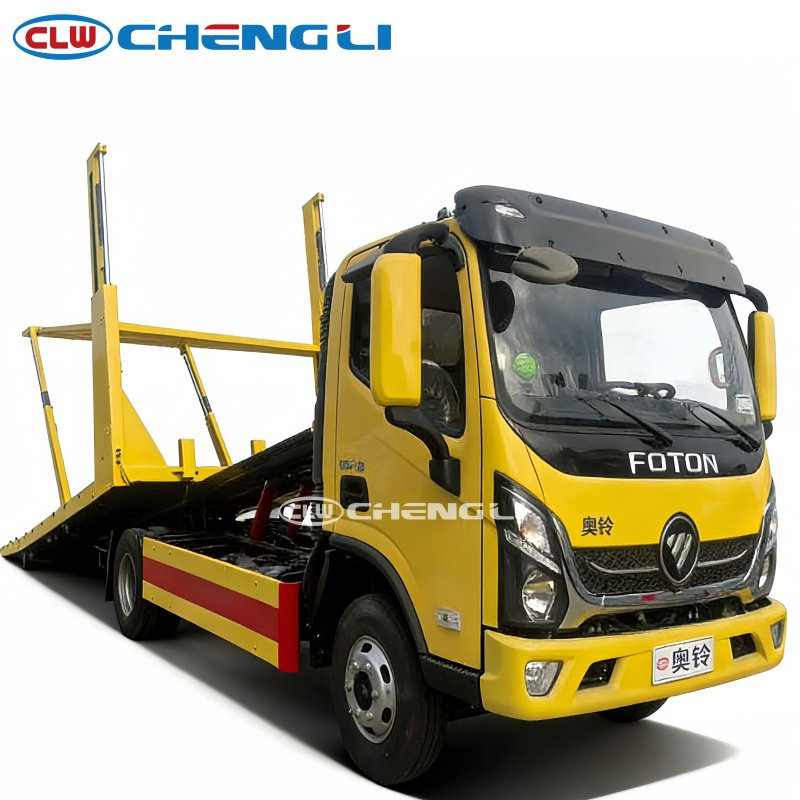
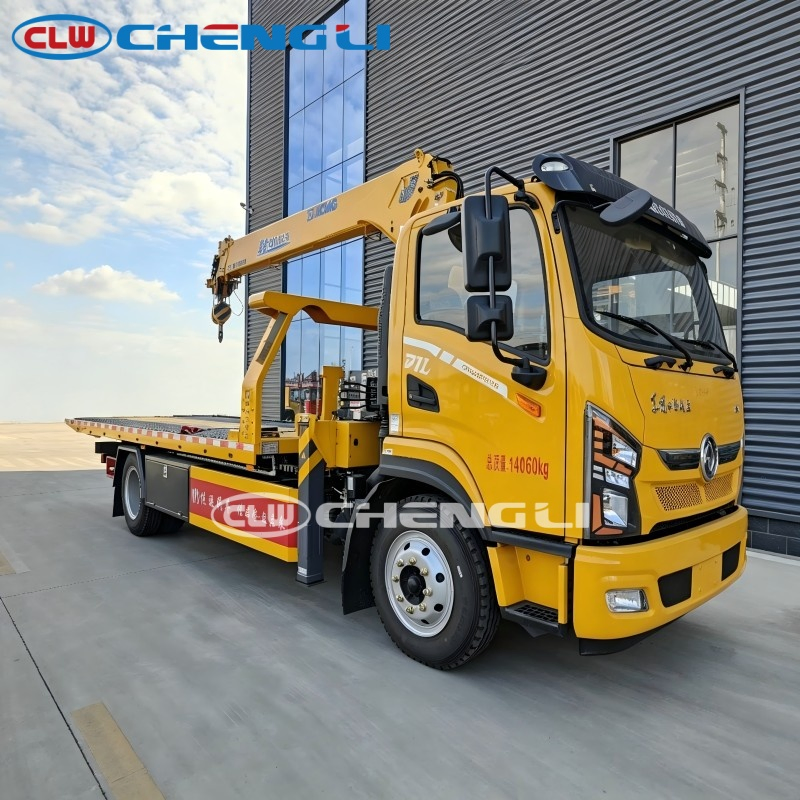
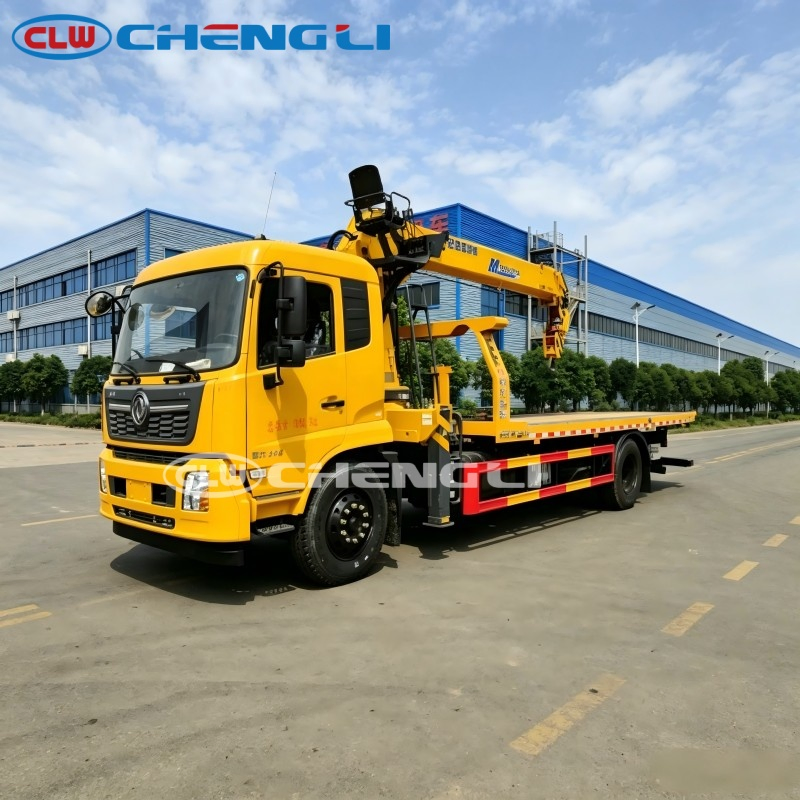
Our flatbeds cover three load classes on 4x2 chassis. The Dongfeng 1.5 t flatbed with a 6.5 m patterned-steel deck handles passenger cars in city breakdown work. The Foton 6 t unit uses a two-position deck and a 4 t winch. The Dongfeng 10 t rollback carries a 7.2 m bed plus an 8 t crane and 8 t winch, so one truck can recover a light truck and lift loose cargo at the scene.
The trade-off is length. A 7.2 m bed on a 5,800 mm wheelbase makes a 10,680 mm truck that needs room to back up, tilt and load. A flatbed carries one vehicle on the deck; the rear wheel-lift on our 1.5 t unit can tow a second car only where the final vehicle rating permits.
Wheel-Lift Trucks
A wheel-lift truck slides a hydraulic cradle under the front or rear tires, lifts that axle and tows the vehicle on its remaining wheels. Because the frame and bumper are never touched, it is quick to hook up and gentle on modern plastic bodywork, which is why parking-enforcement and roadside crews favor it in dense city streets.
The limit is that two wheels stay on the road. A car with all-wheel drive, a damaged axle or a locked gearbox either needs dollies under the other axle or belongs on a flatbed.
We do not currently list a standalone wheel-lift truck. In our range the wheel-lift appears as a rear underlift on flatbeds and wreckers: the Dongfeng 10 t rollback has a rear trailing arm rated at 10,000 kg, and the Dongfeng 8 t wrecker, which pairs a 6.2 m bed with a 4,780 kg boom, has an 8,000 kg rear tow arm.
Integrated Boom-and-Underlift Wreckers
An integrated wrecker builds the boom, underlift and winches into one body on a heavy chassis. It is the truck for buses, loaded trucks and construction vehicles: the winches pull the casualty back onto firm ground, the boom lifts it, and the underlift picks up one axle for the tow home. Controls on both sides and a wireless remote let the operator stand where the rigging is in view.
We offer two integrated wreckers. The Shacman 4x2 heavy wrecker with a 16 t boom (13 t option) pairs a two-section hexagonal boom with a three-section underlift and an 8 t double hydraulic winch carrying 35 m of cable, on a 350 hp chassis. At the top of the range, the HOWO 8x4 wrecker rated for 80 t towing uses a 20 t integrated wrecker body, twin 10 t hydraulic winches with 45 m of wire rope and a 350 hp Sinotruk engine.
The 80 t figure is a towing rating: the weight of the casualty being towed with one axle on the underlift and the rest rolling. It is not what the boom can lift or what the underlift can hold. Mixing these figures up is a common specification error on heavy wreckers, so we separate them below.
Heavy Rotators
A rotator is a heavy wrecker whose boom sits on a turntable and slews through 360 degrees, with outriggers set before the lift. It can lift an overturned tractor-trailer from the side of the road without repositioning the truck, which matters where a fixed-boom wrecker cannot get square to the casualty.
We do not currently list this type. If your contracts include rollovers of loaded heavy vehicles on highways, tell us the job profile and we will say plainly whether an integrated wrecker from our range is enough.
Matching the Truck to the Vehicles You Recover
Start from the heaviest vehicle you expect to recover in a normal month, not the heaviest one you have ever seen, then add a margin for cargo still on board or mud packed under the chassis. The table below maps that weight to a truck type and chassis from our current range.
| Heaviest vehicle to recover | Recommended type | Option in our range | Chassis |
|---|---|---|---|
| Up to 1.5 t | Light flatbed with rear wheel-lift | 1.5 t flatbed, 6.5 m deck | Dongfeng 4x2, 150 hp |
| 1.5 to 6 t | Two-position flatbed | 6 t flatbed, 4 t winch | Foton 4x2, 160 hp |
| 6 to 8 t | Flatbed wrecker with lifting boom | 8 t wrecker, 4,780 kg boom, 6 t winch | Dongfeng 4x2, 162 kW |
| 8 to 10 t | Rollback with crane and rear trailing arm | 10 t rollback, 8 t crane, 8 t winch | Dongfeng 4x2, 180 kW |
| 10 to 16 t | Integrated boom-and-underlift wrecker | 16 t boom (13 t option), 8 t winch | Shacman 4x2, 350 hp |
| Above 16 t | Heavy integrated wrecker | 80 t towing rating, twin 10 t winches | HOWO 8x4, 350 hp |
| Overturned heavy vehicles | Rotator | We do not currently list this type | Not applicable |
The bands follow each truck's headline rating, so confirm the specific towing, underlift and boom limits for the final build before assigning a truck to a contract. For mixed work, a split fleet often fits better than one oversized truck: a 16 t wrecker can tow a car, but it needs more street space and fuel than a 1.5 t flatbed doing the same job.
Rated Capacities That Matter
A tow truck carries up to five separate ratings, and each limits a different operation. They never add together.
Rated deck load
On a flatbed this is the heaviest vehicle the deck may carry. Check it against the chassis weights: our 1.5 t flatbed has a 4,495 kg gross vehicle weight and a 2,800 kg curb weight, leaving 1,695 kg for the car on the deck plus two or three crew. A vehicle heavier than the deck rating overloads the chassis even if the winch pulls it up easily.
Underlift rating
The underlift, wheel-lift or rear tow arm rating is the load the arm can hold on one lifted axle, not the weight of the whole towed vehicle. Ratings usually fall as the arm extends, so ask for the figure at working extension. On any underlift tow, check that the front axle of the tow truck keeps enough weight to steer and brake.
Boom lifting capacity
A headline boom or crane figure applies at the shortest radius with the boom retracted. Ours include 4,780 kg on the 8 t wrecker, 8,000 kg on the 10 t rollback's crane and 16 t on the Shacman wrecker, and each one falls as the boom extends. Ask for the load chart at the radius you actually work at, usually the distance from the truck's rear to the casualty's lifting point.
Winch line pull
Winch ratings in our range run from 4 t on the Foton flatbed to twin 10 t winches on the HOWO. Ratings are normally quoted for a single line on the first layer of rope on the drum; pull drops as more layers wind on. A snatch block doubles the line and roughly doubles the pull, at half the speed.
Gross vehicle weight and axle ratings
Every tool bolted to the truck eats payload. The Shacman 16 t wrecker has a 16,250 kg curb weight against a 21,000 kg gross vehicle weight, which leaves 4,750 kg for crew, loose equipment and the share of the casualty's weight that the underlift transfers onto the rear axle. That margin, together with the 7.5 t front and 16 t rear axle ratings, sets the practical limit on an underlift tow.
What to Confirm Before Ordering
Settle these points before you request a quotation.
- Heaviest regular casualty: vehicle type, curb weight and whether it is usually empty or loaded when it breaks down.
- Recovery method: carry on a deck, tow on an underlift, or both, and whether you need a boom or crane for lifting.
- Deck length and ramp angle: bed length against the longest wheelbase you carry, plus the loading angle low cars need.
- Rating table for the final build: deck load, underlift at working extension, boom load chart and winch pull, each stated separately.
- Chassis and axle weights: curb weight with all tools fitted, gross vehicle weight and front and rear axle ratings.
- Drive and emission version: 4x2 or 8x4, and the emission level your registration authority requires, confirmed at quotation.
- Operating area: street width, garage heights and bridge limits on your routes; highway and utility contractors can also check our roads and utilities page.
FAQ
What is the difference between a wrecker truck and a tow truck?
Tow truck is the umbrella term for any vehicle built to recover and move another vehicle. Wrecker usually means a truck with a boom and winches that can lift and drag a casualty, not only carry it. In export specifications the word also covers integrated heavy units, so state the boom, underlift and winch ratings you need rather than relying on the name.
Is a rollback tow truck the same as a flatbed tow truck?
Yes. Rollback describes how the deck works: hydraulic cylinders tilt it and slide it rearward until its tail meets the ground and forms a ramp. Flatbed describes the shape. Some designs, such as our 6 t Foton, use a two-position deck with a 4.2 m upper section and a 4.4 m lower section, so compare the usable length of each section with the wheelbase of the cars you carry.
Does a heavy wrecker need an 8x4 chassis?
Not always. Our 16 t Shacman wrecker runs on a 4x2 chassis with a 16 t rear axle, which keeps it shorter at 9,385 mm and easier to position on city streets. The 8x4 layout of our 80 t HOWO spreads weight over four axles, giving the axle capacity needed to hold the front of a loaded heavy truck on the underlift. Choose by the axle load of your heaviest casualty.
Can a flatbed tow truck carry machinery such as a mini excavator?
Only within the deck rating and with proper tie-down points. A machine on steel tracks puts concentrated loads on the deck plate and needs securing at each corner. For regular machinery moves, a flatbed transport truck is the better tool; our 8x4 carriers reach rated payloads such as 20,670 kg and carry rear loading ladders for construction equipment.
Pick the lightest truck whose separate ratings all cover your heaviest regular casualty, and step up to an integrated wrecker only when buses and loaded trucks are a real part of the work. Browse our current range of tow trucks and wreckers, then send us the casualty weights, recovery method and destination market through our contact page, and our engineers will propose a configuration.