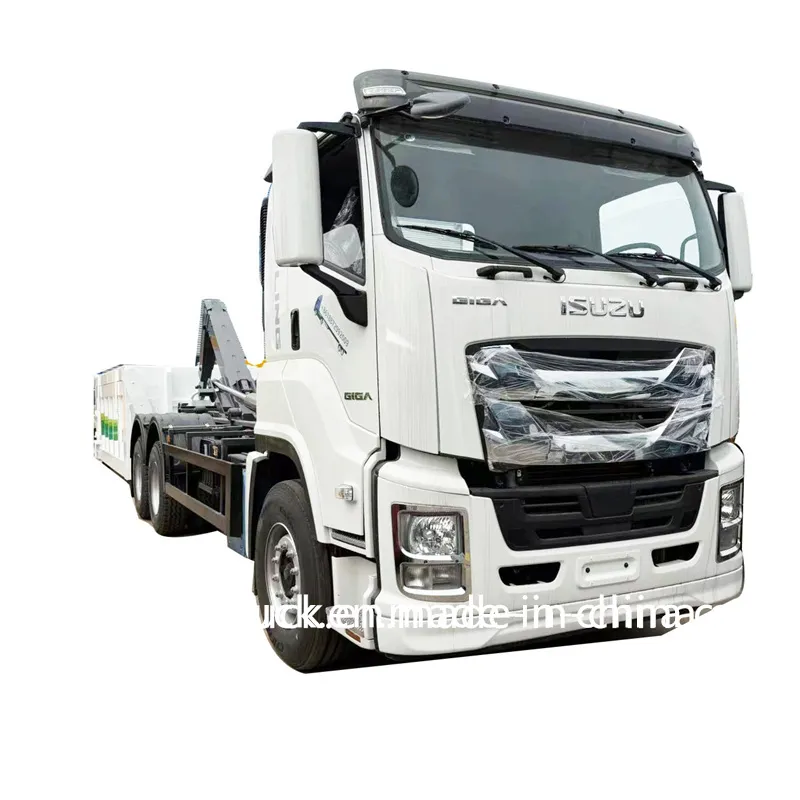
Pick a rear loader when crews collect bags and mixed bins door to door, a side loader when every household sets out the same wheeled bin and you want one-person operation, and a hook lift when waste builds up in large containers at fixed sites. Compaction, crew size and the container system separate the three far more than body volume does.
How Each Truck Loads and Carries Waste
Rear loader
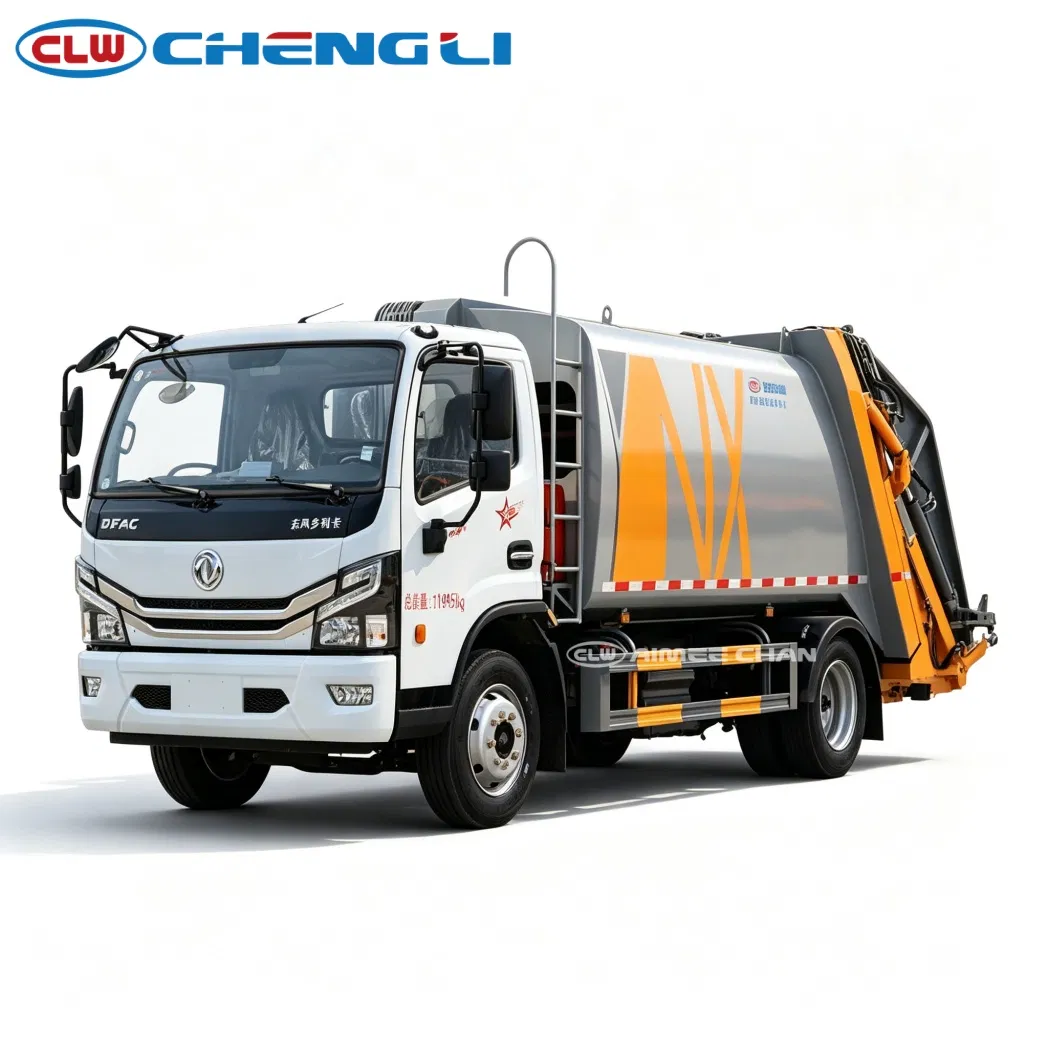
Crews tip bags or bins into a hopper at the tail, and a packer plate pushes the waste forward and compresses it. Because loading happens by hand or with a rear bin lifter, a rear loader accepts almost anything that fits the hopper: loose bags, 120 L and 240 L wheeled bins, 660 L communal bins and the odd bulky item. Our 9 m³ Dongfeng Dolica rear loader runs a 15–30 s loading cycle and discharges in 25 s or less.
Side loader
A side loader also compacts, but it collects from the side. On automated versions an arm behind the cab grabs a wheeled bin, lifts it over the body and sets it back down while the driver stays in the cab. That only works when bins are the same type, placed at the curb on the arm side and spaced so the arm can reach them. We do not currently list side loaders.
Hook lift
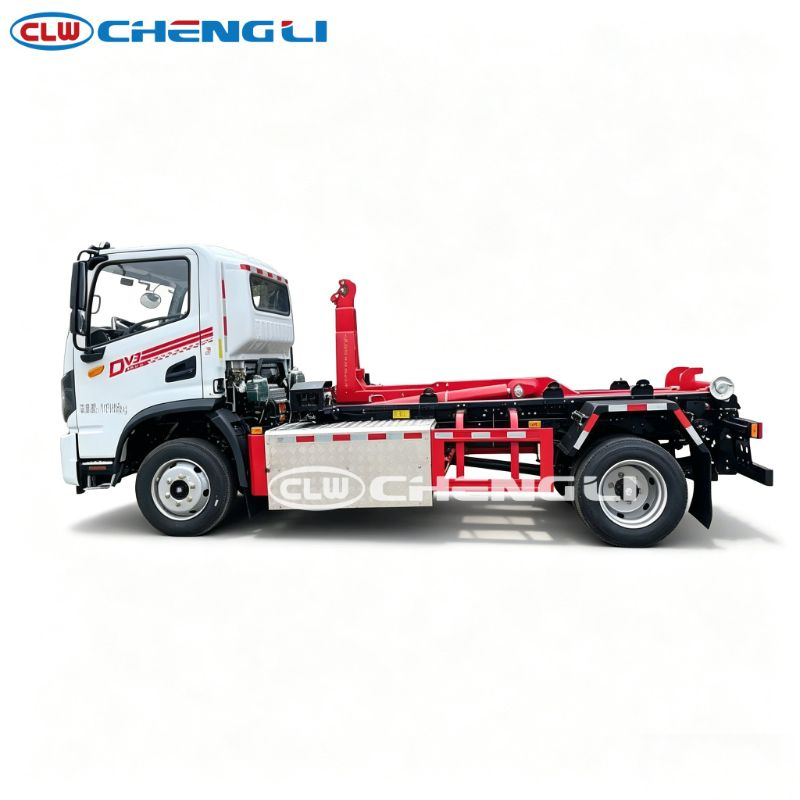
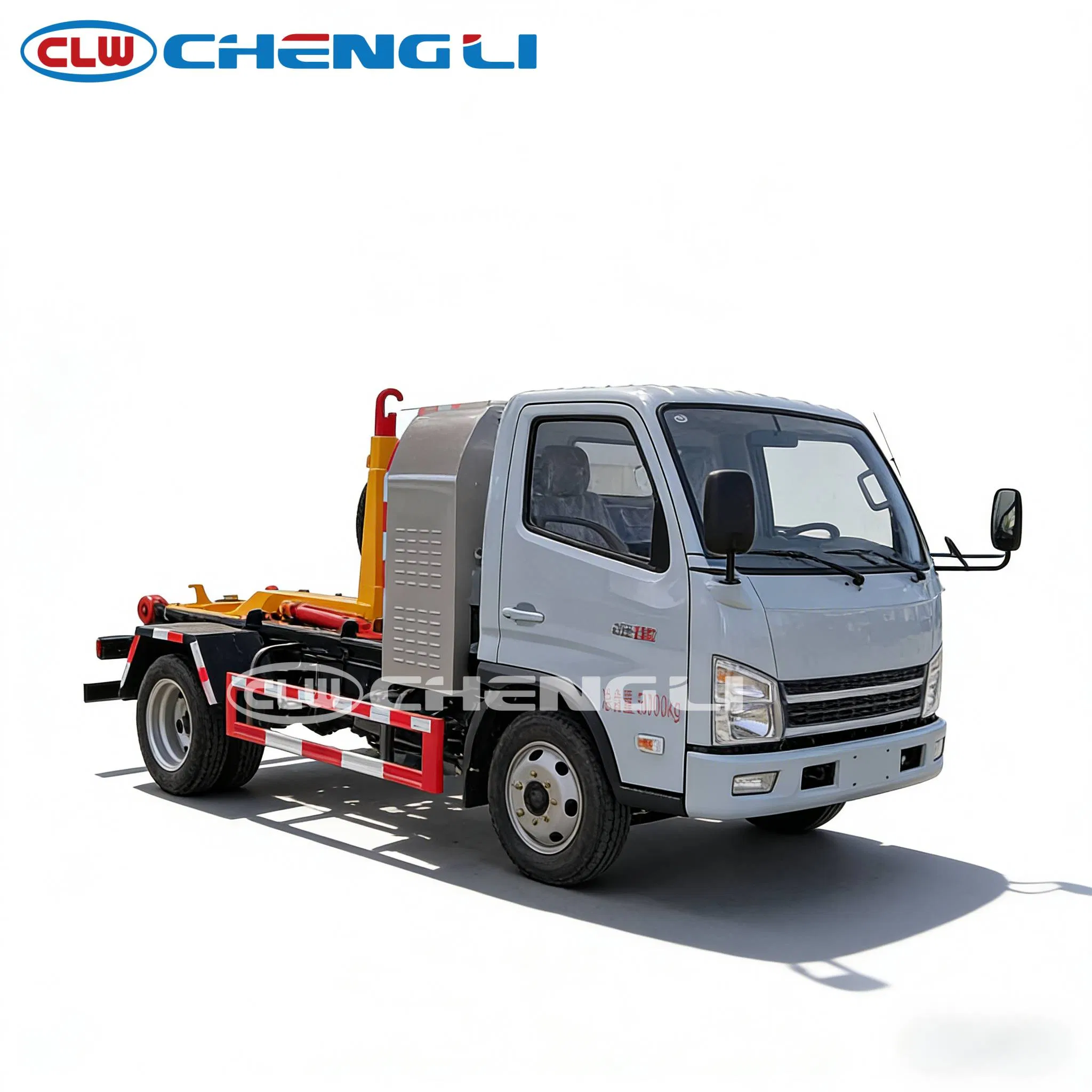
A hook lift does not collect from the street at all. A hydraulic arm pulls a full container onto the frame, the truck hauls it to the disposal point, tips it and returns it or swaps it for an empty one. Nothing is compacted on the truck unless the container itself is fed by a stationary compactor at the site. Our Isuzu 6x4 hook lift truck handles 25 m³ containers and completes a lifting cycle in about 50 seconds.
Rear Loader vs Side Loader vs Hook Lift: Side-by-Side
| Rear loader | Side loader | Hook lift | |
|---|---|---|---|
| How waste is loaded | By hand or rear bin lifter into a hopper | Automated or semi-automated side arm | Whole container pulled on by hook arm |
| Compaction on the truck | Yes | Yes | No |
| Usual crew | Driver plus one or two loaders | Driver only (automated) | Driver only |
| Accepts | Bags, mixed bins, bulky items | One standard wheeled bin type | Large containers left on site |
| Cycle figure in our range | 15–30 s per loading cycle | Not offered | About 50 s per container lift |
| Size in our range | 9–22 m³ bodies | Not offered | 2.22–25 m³ containers |
| Rated payload in our range | 5,135–10,090 kg | Not offered | 1,665–5,865 kg on light chassis, including container |
| Best fit | Dense residential streets, mixed set-out | Suburbs with uniform carts | Markets, building sites, transfer stations |
Rear loader figures cover our 9 m³ Dongfeng Dolica to the 22 m³ Dongfeng Vasol T5; hook lift figures span our compact Foton electric unit, the CLH5120 electric truck and the 25 m³ Isuzu 6x4.
Crew Size, Cycle Time and Route Density
Labor is usually the biggest running cost difference. A rear loader needs people at the back of the truck, which costs wages but gives flexibility: loaders can pick up bags beside a bin, clear spilled waste and handle households that never got a standard cart. On narrow streets with cars parked along the curb, that flexibility is often the only way to collect at all.
An automated side loader trades flexibility for a smaller crew. With one person per truck and no one stepping down at each stop, it suits long suburban routes where bins stand in a neat line. The catch is the bin program: every household needs a compatible cart, and poorly placed bins mean the driver gets out anyway.
Hook lifts work on a different rhythm. Instead of hundreds of stops per shift, the truck makes a handful of container swaps, each taking minutes rather than seconds. One driver and one truck can serve many containers, so the number of containers, not the number of trucks, sets capacity. Many cities combine all three, with compactors on residential routes and hook lift containers at transfer points; our municipal sanitation overview shows how they fit alongside sweepers and sprinklers.
Payload: Why a 25 t Hook Arm Is Not 25 t of Waste
Hook lift trucks are often quoted by hook arm rating, and that number is easy to misread. Our Isuzu 6x4 has a 25 t hook arm on a 25,000 kg GVW chassis with an 11,500 kg curb weight. Gross vehicle weight minus curb weight leaves 13,500 kg for the crew, the container and the waste together. The container's own weight comes off first, so the legal waste load is lower still.
The lighter trucks show the same rule. The CLH5120 electric hook lift is rated at 5,800 or 5,865 kg depending on battery, and that figure includes the 8–12 m³ container. The compact Foton electric unit carries 1,665 kg including its 2.22–3.34 m³ bin.
Compaction changes the comparison again. The 22 m³ Vasol T5 rear loader sits on the same 25,000 kg GVW as the Isuzu hook lift but carries a rated 10,090 kg, about 460 kg per cubic meter of body. Assume loose household waste at 150 kg/m³: a 25 m³ open container holds roughly 3,750 kg, while the compactor, packing at close to 3:1, can approach its full payload in a smaller body. For light household waste, a compactor carries more per trip. For heavy material the hook lift wins, but watch the limit: soil and broken concrete can exceed 1,000 kg/m³, so a full 25 m³ container of rubble would be far over legal weight. Fill heavy containers partly, or use smaller ones.
Which Truck Fits Your Collection System
- Old town centers and dense housing: a 9 m³ rear loader. At 7,720 mm long and 2,320 mm wide, it fits streets where larger trucks cannot turn.
- Suburbs with one standard cart per house: an automated side loader, provided the bin program is already in place or funded alongside the trucks.
- Mixed residential routes with long haul to the landfill: a 6x4 rear loader such as the 22 m³ Vasol T5, which cuts trips without exceeding axle limits on household waste.
- Markets, hospitals, factories and building sites: hook lift containers left on site and swapped when full.
- Transfer stations feeding a distant landfill: a 6x4 hook lift shuttling large containers loaded by a stationary compactor.
- Narrow lanes with small, frequent pickups: a compact electric hook lift such as the 4,950 mm long Foton unit with 2.22–3.34 m³ bins.
What to Confirm Before Ordering
- Set-out method: bags, wheeled bins (give sizes such as 120 L, 240 L or 660 L) or site containers.
- Bin or container interface: lifter type for bins; for hook lifts, hook height, container length and drawings of containers you already own.
- Waste density: weighbridge records or a description of the waste, so the body or container is sized by weight as well as volume.
- Legal GVW and axle loads: and, for hook lifts, the empty weight of each container.
- Crew plan: how many people ride each truck and any rules on staff working at the rear.
- Street and site access: maximum length, width and height; our garbage trucks run from 4,950 mm to 10,050 mm long.
- Discharge point: transfer station hopper, tipping floor or landfill face, and the space available for tipping or push-out.
- Power source: the diesel emission level your market requires, or depot charging for electric trucks.
FAQ
Is a side loader faster than a rear loader?
Per stop, an automated side loader is usually quicker because nobody leaves the cab, and it keeps a steady pace on long, uniform routes. On streets with parked cars, scattered bins or bags beside the carts, a rear loader crew often finishes sooner because loaders deal with each stop directly instead of the driver repositioning the arm or stepping out.
Can one hook lift truck replace several compactors?
Only for waste that is already collected in large containers. A hook lift moves containers between a site and a disposal point; it cannot collect household bins along a street. Where waste is concentrated, for example at a market or transfer station, one hook lift truck with enough containers can do work that would otherwise need several compactor trips.
Can a rear loader handle wheeled bins without manual lifting?
Yes. A hydraulic bin lifter at the hopper raises and tips the bin, so the crew only wheels it into place. Our 14 m³ Dongfeng rear loader takes 120 L, 240 L and 660 L bins. Send photos or drawings of your bins so the lifter is matched to their rim or trunnion bar.
Do hook lift containers compact the waste?
Standard open or closed containers do not. Sites that need more weight per container use a stationary compactor that packs waste into a sealed hook lift container, which the truck then collects. Without it, light waste fills a container by volume long before it reaches the truck's payload limit.
Are electric versions available for each type?
For rear loaders and hook lifts, yes. Our 16 m³ electric compactor carries a 210 kWh battery with a rated 280 km range, and the CLH5120 hook lift offers 138 or 155 kWh battery options. We do not currently list side loaders in electric or diesel form. Check the longest route and depot charging time before choosing electric.
Start from how waste is set out, then match the truck: rear loaders for mixed door-to-door collection, side loaders for uniform carts and small crews, hook lifts for containers at fixed sites. Then size the body or container by weight as well as volume. Browse our garbage truck range, or tell us your bin types, waste weights and route conditions and our engineers will propose the collection system and chassis to match.