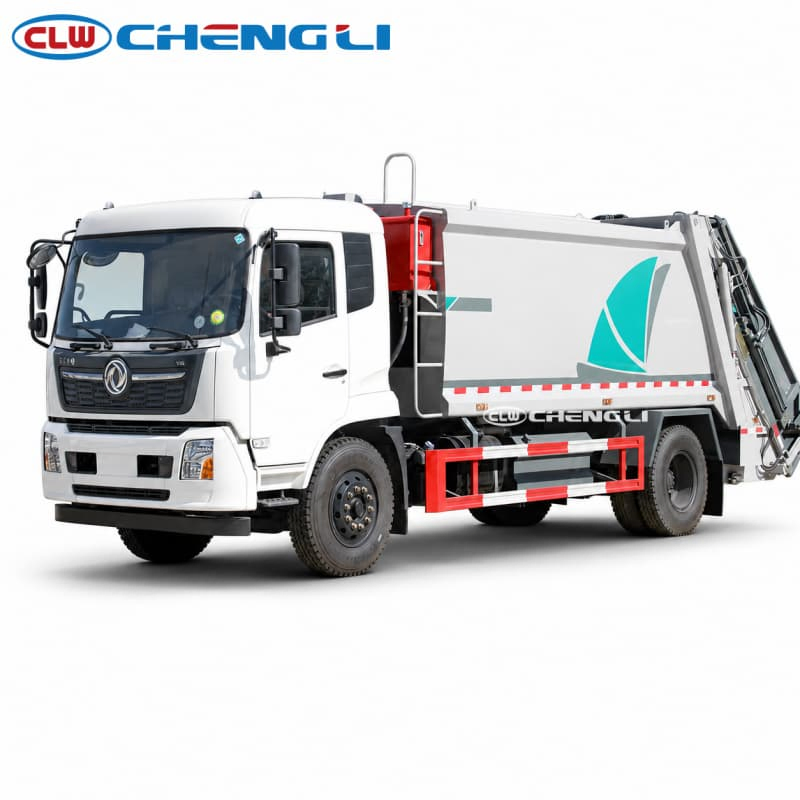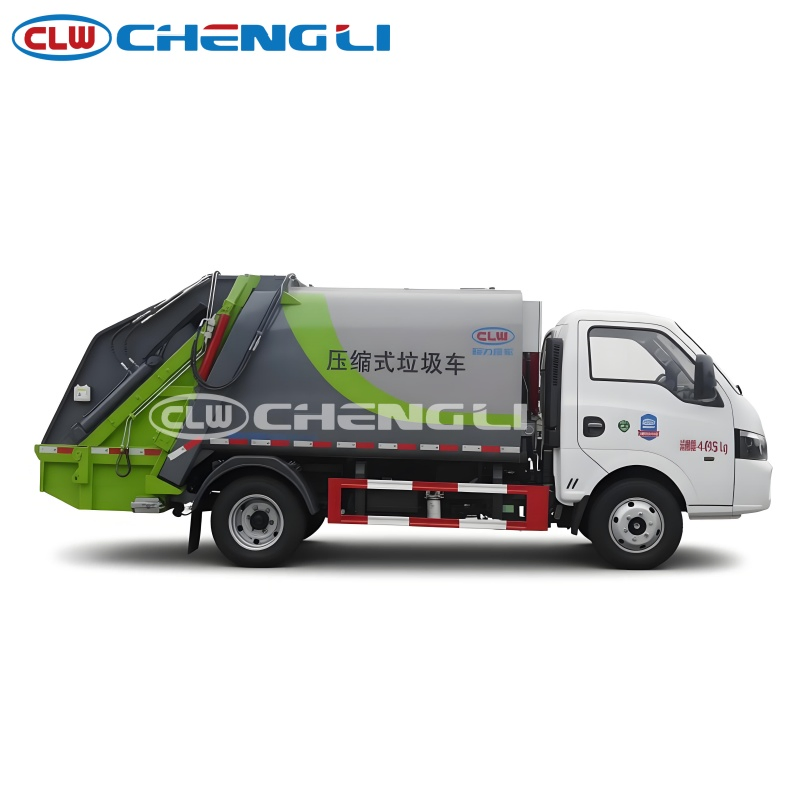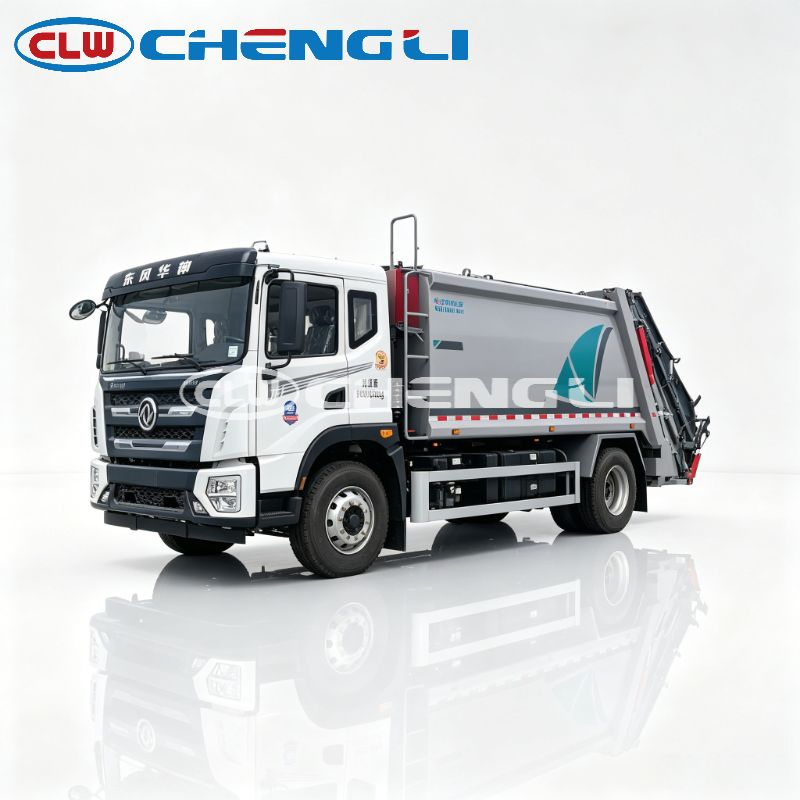
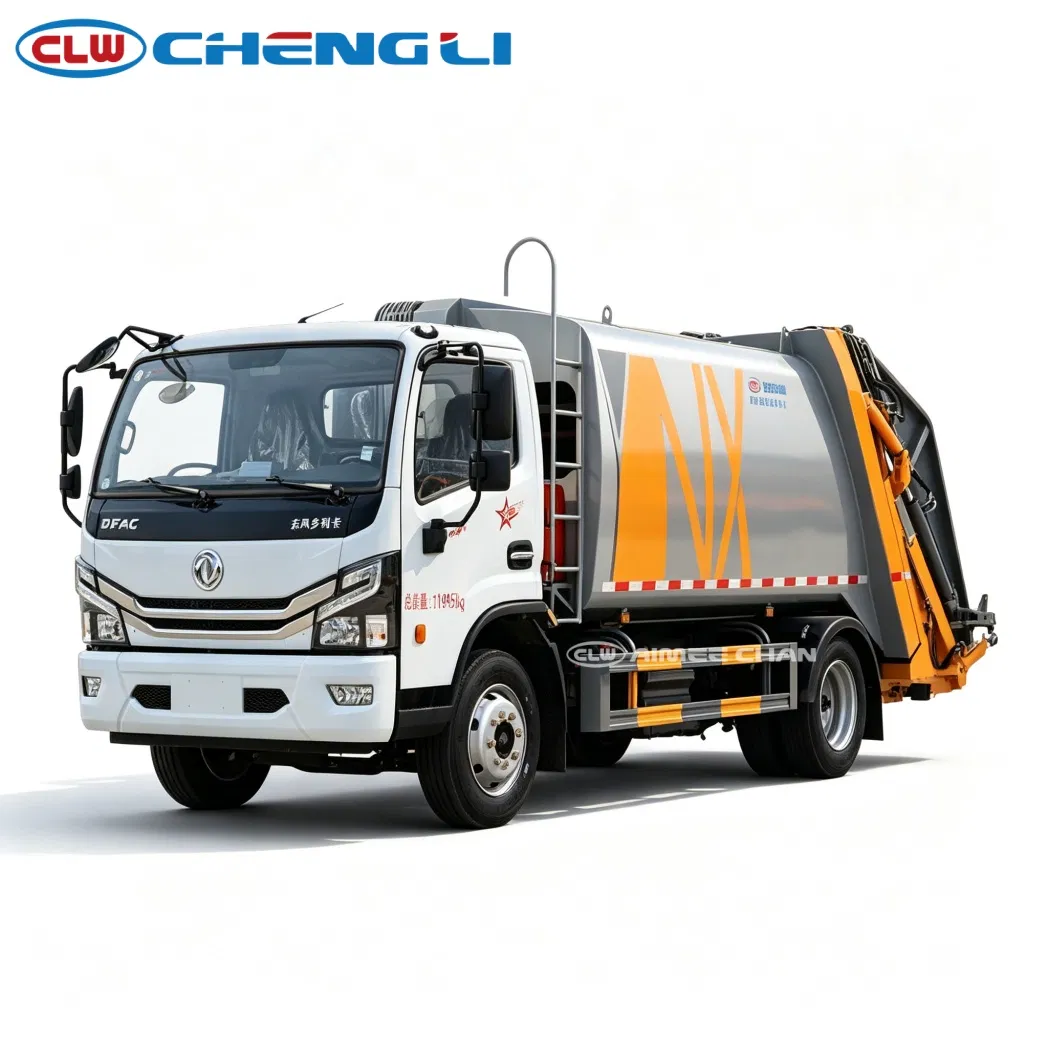
Garbage compactor trucks are sized by body volume, and the trucks we build run from 9 m³ on a 12 t 4x2 chassis to 22 m³ on a 25 t 6x4 chassis. Between those sit the 14 m³ and 16 m³ bodies on 4x2 chassis that city fleets usually consider. The right size is the one whose rated payload, not just its volume, matches the weight of your waste.
How Compactor Truck Size Is Measured
The number in the name, such as 14 m³, is the internal volume of the refuse body: the sealed box between the front bulkhead and the tailgate. It does not include the hopper at the rear, and it does not tell you how many tonnes the truck may carry. Three other figures complete the picture:
- Gross vehicle weight (GVW): the maximum legal weight of the loaded truck, set by the chassis and axles.
- Rated payload: what is left after the curb weight of the chassis, body, hydraulics and crew is subtracted from GVW.
- Compaction ratio: how far the packer plate squeezes loose waste. Our 14 m³ CLW compactor is rated at 1:2.8 to 1:3.2, so roughly three cubic meters of loose waste go into each cubic meter of body.
Volume tells you how much waste fits. Payload tells you how much you are allowed to carry. A sizing decision that looks at only one of them usually goes wrong on the first wet-season route.
Garbage Compactor Truck Sizes by Chassis Class
The table sets our current rear loader compactors side by side. Each row is a real configuration, not a theoretical range.
| Body volume | Chassis and drive | GVW | Rated payload | Overall length | Typical route |
|---|---|---|---|---|---|
| 9 m³ | Dongfeng Dolica, 4x2 diesel | 11,995 kg | 5,135 kg | 7,720 mm | Residential streets, small towns |
| 14 m³ | Dongfeng or CLW, 4x2 diesel | 18,000 kg | Confirmed per build | 9,600–9,745 mm | Standard city collection |
| 16 m³ | Dongfeng, 4x2 battery electric | 12,500 kg | 5,805 kg | 8,950 mm | Night work, low-emission zones |
| 22 m³ | Dongfeng Vasol T5, 6x4 diesel | 25,000 kg | 10,090 kg | 10,050 mm | Long routes, high-volume districts |
Two patterns stand out. First, volume and GVW do not rise together: the 16 m³ electric truck has more body than the 14 m³ diesel trucks but a much lower GVW, because the chassis class is different. Second, the step from 4x2 to 6x4 is what makes 22 m³ workable; the third axle lets the Vasol T5 carry almost twice the rated payload of the 9 m³ truck.
We do not currently list compactors below 9 m³. For very narrow lanes and small daily volumes, a sealed 5 m³ food-waste body on a light Dongfeng D6 chassis or a small hook-lift truck may fit better than a compactor.
Why Payload, Not Volume, Usually Limits the Load
Dividing rated payload by body volume gives the average waste density each truck can carry when full without going overweight:
| Truck | Payload ÷ volume | Allowable density when full |
|---|---|---|
| 9 m³ Dongfeng Dolica 4x2 | 5,135 kg ÷ 9 m³ | About 570 kg/m³ |
| 16 m³ Dongfeng electric 4x2 | 5,805 kg ÷ 16 m³ | About 360 kg/m³ |
| 22 m³ Dongfeng Vasol T5 6x4 | 10,090 kg ÷ 22 m³ | About 460 kg/m³ |
Now compare that with your waste. Dry, packaging-heavy waste ends up at a lower density than wet household waste rich in food scraps. As a worked example, if loose waste weighs 150 kg/m³ and the packer achieves 3:1, the compacted load is about 450 kg/m³. The 9 m³ and 22 m³ trucks can be filled completely at that density. The 16 m³ electric truck would reach its payload limit at roughly 13 m³, leaving part of the body empty.
If your waste is wetter, say 200 kg/m³ loose, the same 3:1 ratio gives 600 kg/m³, and even the 9 m³ truck reaches its payload before the body is full. This is why we ask for a description of the waste stream, or weighbridge data, before recommending a size. A bigger body does not help when the axles, not the box, are the limit.
Matching Body Size to Streets and Route Length
Overall length and width decide where the truck can work. Our 9 m³ rear loader is 7,720 mm long and 2,320 mm wide, which keeps it maneuverable in older neighborhoods and on market streets. The 14 m³ trucks grow to 9,600–9,745 mm long and 2,550 mm wide, and the 22 m³ 6x4 reaches 10,050 mm. Wheelbase follows the same trend: 4,700 mm on the Dongfeng 14 m³ and 5,800 mm on the CLW 14 m³, which affects turning circle as much as overall length does.
Route length pulls the other way. Each trip to the transfer station or landfill is unproductive time. On a short urban loop close to a transfer point, a 9 m³ truck making more trips can keep pace with a 14 m³ truck. When the disposal site is far away, the larger body earns its keep by cutting trips, provided the waste density stays within its payload.
Electric compactors add a third variable. The 16 m³ Dongfeng electric truck carries a 210 kWh battery with a stated 280 km range, which should be checked against your longest route plus the energy used by the hydraulics at each stop. Our municipal sanitation vehicle overview shows how compactors fit alongside sweepers, sprinklers and food-waste trucks in one fleet.
Bin Lifters, Cycle Times and Discharge
Body size should match the bins on the street. Our Dongfeng 14 m³ compactor has a lifter for 120 L, 240 L and 660 L bins, a loading cycle of 15–30 seconds and discharge in under 25 seconds. On dense routes with hundreds of stops, those times matter more than a few extra cubic meters: seconds saved per lift add up over a shift.
Larger bodies need more hydraulic work to compact and eject, so check that the PTO and pump are sized for the body rather than carried over from a smaller model. Hopper size matters too: a small hopper on a large body slows loading when crews tip several bins at once.
How to Specify Compactor Size Before Ordering
- Estimate the weight of waste per trip, not just the volume, using weighbridge records if you have them.
- State whether the waste is mostly dry packaging or wet household and food waste.
- Give the maximum truck length, width and height that your streets, depot and transfer station allow.
- Confirm the legal axle loads and GVW limit in your country so the chassis can be matched.
- List the bin sizes in service, for example 120 L, 240 L or 660 L, so the lifter is matched to them.
- Give the round-trip distance to the disposal site and the number of trips planned per shift.
- For electric trucks, state the longest daily route and the charging time available at the depot.
- Specify left- or right-hand drive and the emission level your market requires.
FAQ
What is a typical garbage truck size for city collection?
For general municipal collection, 14 m³ on a 4x2 chassis sits in the middle of our range, with two models at 18,000 kg GVW. It balances body volume, a single rear axle and an overall length under 10 m. Smaller towns often choose 9 m³, while districts with long haul distances move to 6x4 trucks with 20 m³ or more.
How many tonnes of garbage does a 14 m³ compactor carry?
It depends on waste density and the approved payload of the final truck. At a compacted density of 450 kg/m³, a full 14 m³ body holds about 6.3 t of waste. Our 14 m³ trucks are built on 18,000 kg GVW chassis, and the exact rated payload is confirmed for each build once the chassis, engine and body are fixed.
Is a 6x4 compactor always better than a 4x2?
No. A 6x4 adds payload, as the 22 m³ Vasol T5 shows with 10,090 kg rated payload, but it costs more to run, needs more room to turn and wears more tires. If your waste is light or your routes are short and tight, a 4x2 truck making extra trips is often the better choice.
What does a 1:3 compaction ratio mean?
It means the packer reduces loose waste to about one third of its original volume. Our CLW 14 m³ compactor is rated at 1:2.8 to 1:3.2. Actual results vary with the waste stream: cardboard and plastic film compress well, while wet organic waste is already dense and compresses less.
Can a compactor body be fitted to a different chassis?
Yes, within limits. The body must suit the chassis wheelbase, frame length and GVW. A 14 m³ body can sit on several 18 t class 4x2 chassis, but moving it to a lighter chassis cuts payload sharply. Tell us your preferred chassis brand and we will confirm which body sizes it can carry legally.
Start with the weight of waste per trip, then pick the smallest body and chassis that carry it legally and still fit your streets. Many fleets end up with a mix: compact 9 m³ trucks for tight districts and 14 m³ or 22 m³ trucks where routes are longer. Browse all our garbage compactor and collection trucks, or compare the 9 m³ Dongfeng Dolica rear loader with the 22 m³ Vasol T5 6x4. Then send us your waste volumes, bin sizes and street limits and our team will propose a body size and chassis.