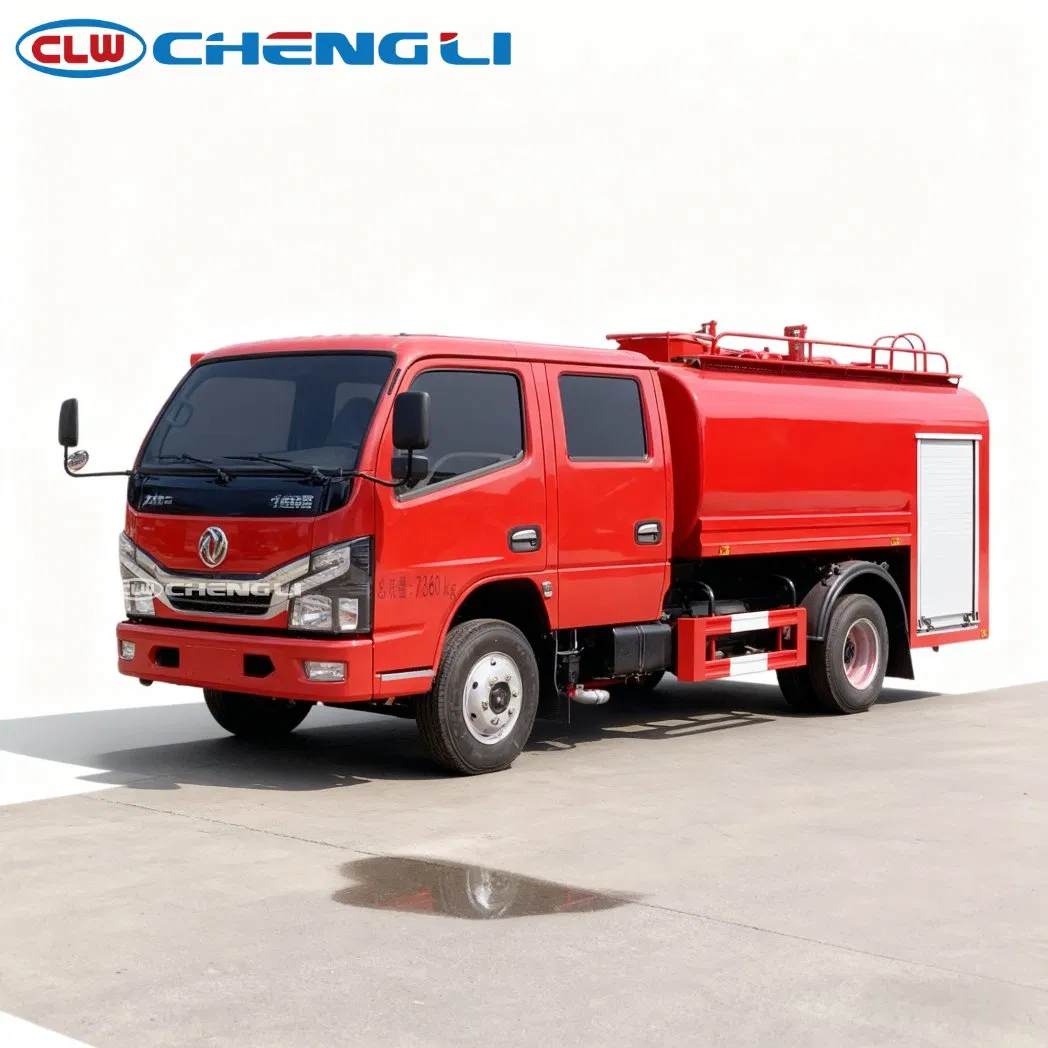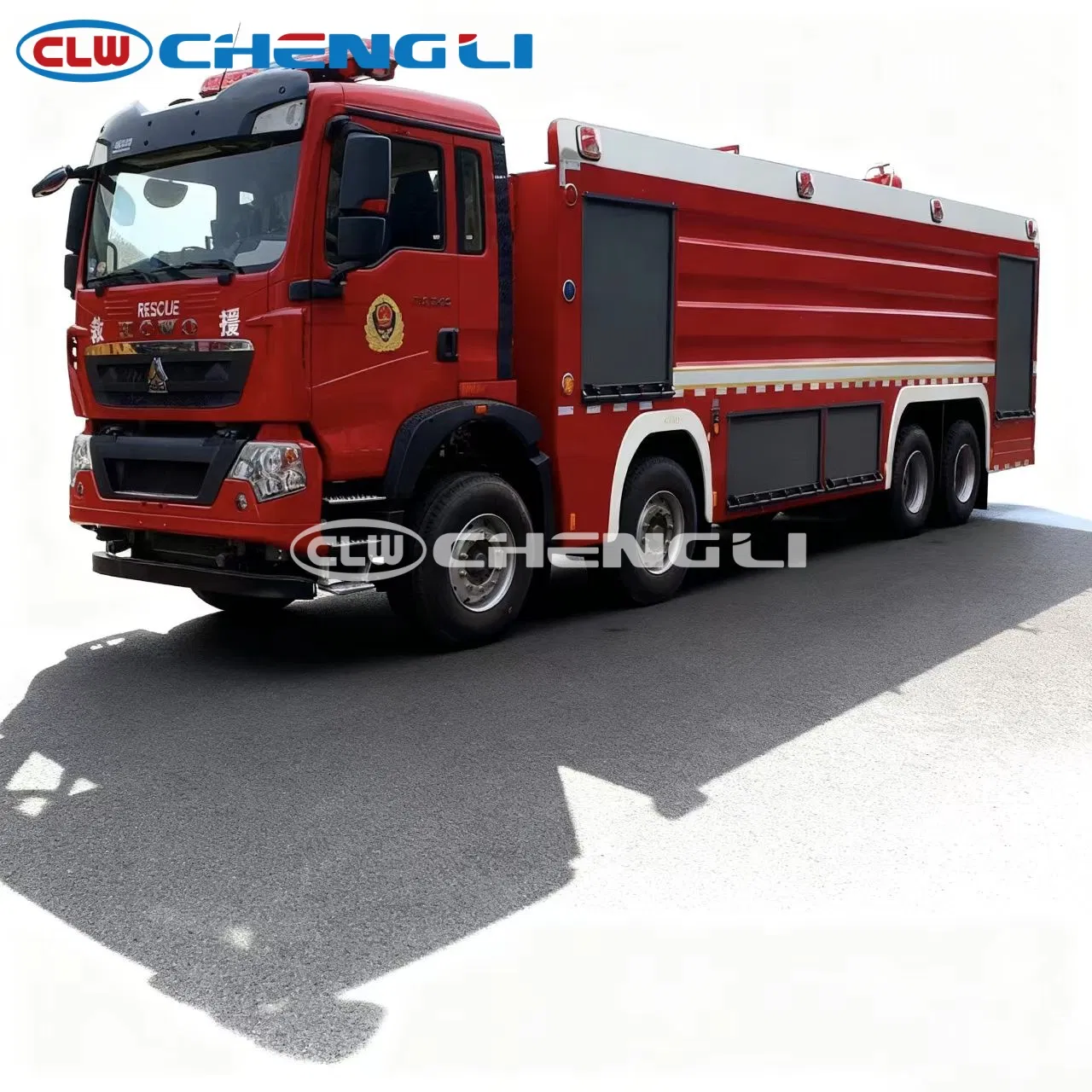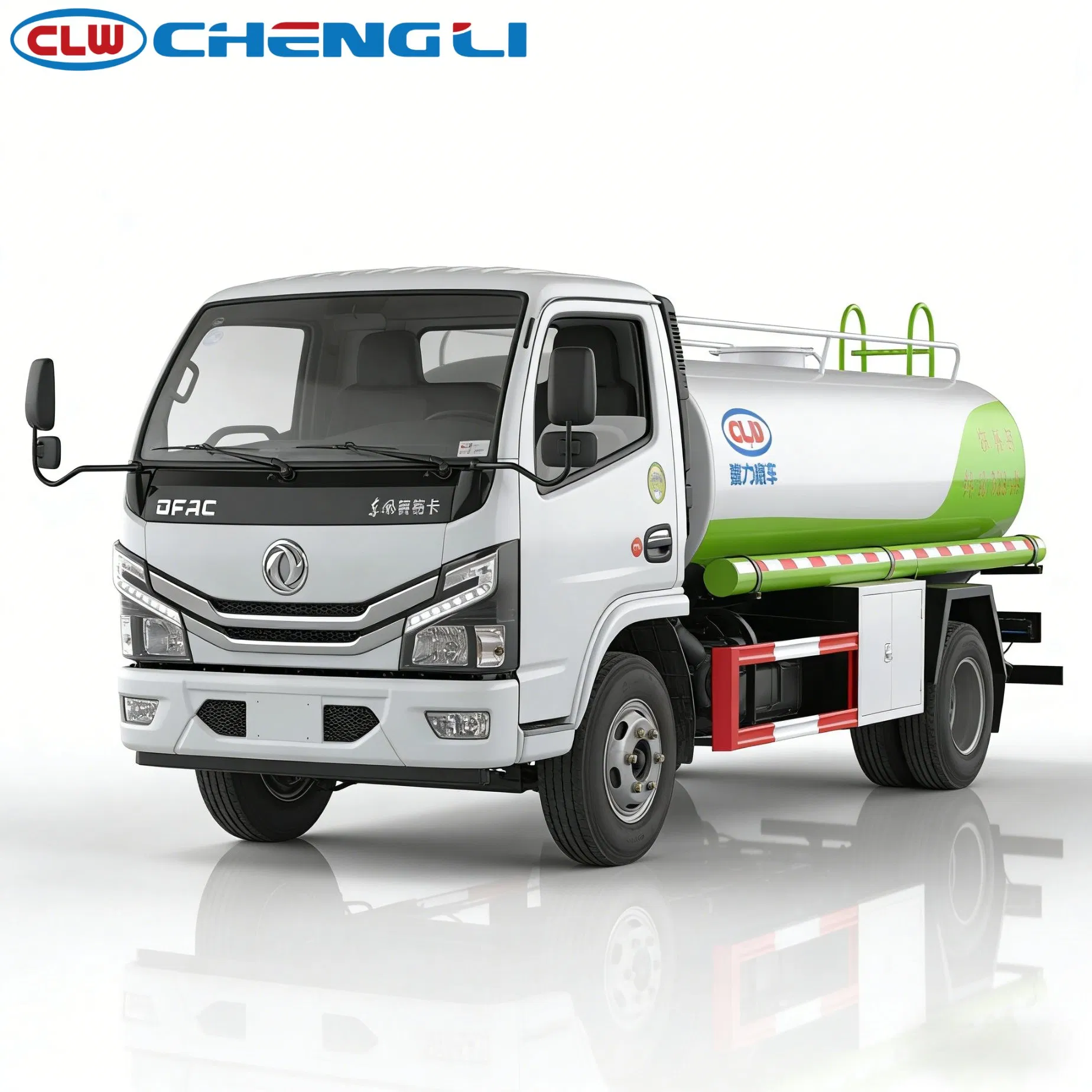
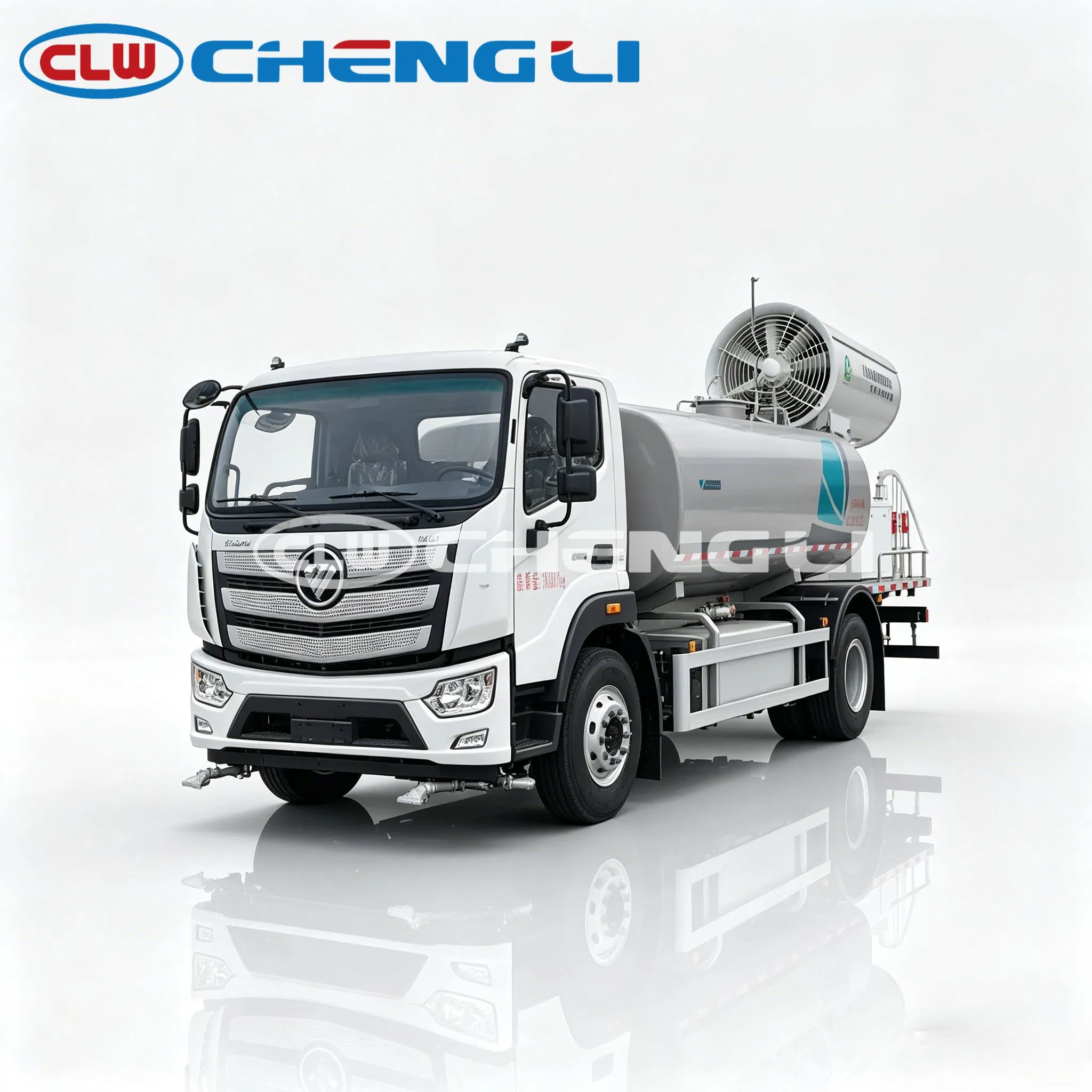
Our water trucks carry from 3,360 L on a light 4x2 chassis to 25,000 L on an 8x4 water tender, and the ceiling is set by legal payload, not tank size. One liter of water weighs about 1 kg, so a tanker can only travel full if its rated payload covers the tank. In our range, 4x2 trucks reach 13,000 L and our published 6x4 potable-water tanker has a 20,000 L nominal tank.
Water tanker capacity at a glance
The table converts each truck into US gallons (1 US gal = 3.785 L) and full water mass (about 1 kg per liter), next to its gross vehicle weight (GVW) and rated payload.
| Truck | Tank | US gal (approx.) | Drive | Water mass when full | GVW | Rated payload |
|---|---|---|---|---|---|---|
| Dongfeng fire sprinkler | 3,360 L | 890 | 4x2 | 3,360 kg | 7,360 kg | 3,270 kg |
| Dongfeng fire and sprinkler | 7,000 L | 1,850 | 4x2 | 7,000 kg | 11,995 kg | 6,670 kg |
| Dongfeng fire sprinkler | 9,290 L | 2,450 | 4x2 | 9,290 kg | 16,200 kg | 9,155 kg |
| Foton electric dust suppression | 13,000 L | 3,430 | 4x2 | 13,000 kg | 18,000 kg | Confirm at quotation |
| Dongfeng potable-water tanker | 20,000 L nominal | 5,280 | 6x4 | 20,000 kg if full | 25,000 kg | Confirm completed-vehicle payload |
| HOWO water tank fire truck | 25,000 L | 6,600 | 8x4 | 25,000 kg | 42,450 kg | 24,800 kg |
Two patterns stand out. Capacity climbs with axle count, and several nominal tank volumes need a separate payload check before a brim-full road load is assumed. The gap is small, 90 kg on the 3,360 L truck and 330 kg on the 7,000 L truck, but it decides how full the tank can travel.
Why legal payload, not tank volume, sets the limit
A tank is sized by geometry; a truck is licensed by weight. Rated payload is gross vehicle weight minus curb weight and the seated crew allowance. Because water weighs about 1 kg per liter, the maximum legal fill in liters is roughly equal to the rated payload in kilograms, less anything else the truck carries, such as hoses and tools.
Take our 7,000 L Dongfeng 4x2. Gross vehicle weight is 11,995 kg, curb weight is 5,130 kg and rated payload is 6,670 kg. A brim-full tank holds about 7,000 kg of water, so the legal fill is at most about 6,670 L, and less if equipment rides on the truck. The shell volume is a maximum; payload is the working limit.
Axle ratings add a second limit. On a three-axle tanker, the tank position and wheelbase must keep each axle group within its approved rating. Local road and bridge limits can also be lower than the chassis rating; check them for every route.
Water tanker sizes by chassis class
Small tankers under 5,000 L
The 3,360 L Dongfeng Dolika is the smallest truck in this range: 4x2, 7,360 kg GVW, 6,200 mm long and 1,980 mm wide, so it fits lanes and yards a full-size tanker cannot enter. One tank feeds both a fire pump and sprinkler equipment. The trade-off is refill frequency on long routes. Our compact fire trucks and electric road washers carry smaller tanks, but they are built around pumps or washing gear.
Medium tankers from 7,000 to 13,000 L
In our range, medium tankers are two-axle 4x2 trucks with GVW between about 12,000 kg and 18,000 kg. Our 7,000 L and 9,290 L Dongfeng trucks run 3,800 mm and 3,950 mm wheelbases, and the 9,290 L truck is 2,500 mm wide and 7,750 mm long. This class suits municipal road watering and construction dust control because it balances trip length against turning space.
The 13,000 L Foton electric dust suppression truck takes the 4x2 class to its top end within an 18,000 kg GVW, with a 200 kWh battery and up to 340 km per charge. Batteries add mass, so confirm rated payload for the final build before assuming a full tank is legal.
Large 6x4 and 8x4 tankers
Every tank above 13,000 L in this selection sits on three or four axles. The Dongfeng 6x4 potable-water tanker has a 20,000 L nominal stainless-steel tank on a 25,000 kg GVW chassis. Confirm the completed vehicle's curb mass, crew and permitted payload before deciding the travelling water fill.
The four-axle HOWO 8x4 25,000 L water tender is our largest: 42,450 kg GVW, 24,800 kg load capacity and 11,990 mm overall length. It suits shuttle supply at ports, airports and industrial sites. Before choosing it, confirm that your roads, bridges and gates accept a 42,450 kg vehicle and that your refill point can deliver 25,000 L quickly.
Tank material and baffles
Where we specify tank material, it is steel: plate with anti-corrosion treatment on the 7,000 L Dongfeng, and carbon steel with a stainless option on the Foton electric truck. Treated carbon steel suits reclaimed or untreated water for dust control and washing. For drinking water, choose stainless steel with a food-grade internal finish and confirm the requirement with your health authority.
Baffles matter as much as material. In a partly filled tank, water surges forward under braking and sideways in corners, shifting load between axles. Baffles divide the tank into connected cells so the water moves in smaller volumes. Because payload often keeps the tank short of full, surge is a daily condition. Ask for the baffle layout and manhole positions on the tank drawing.
Water tanker vs water sprinkler truck
A water tanker, or bowser, moves water from a filling point to a delivery point such as a site storage tank, a village or a fire scene; its key figures are tank volume, pump output and discharge fittings. A sprinkler truck adds distribution equipment for work on the move. Our dedicated 6x4 potable-water tanker is configured for delivery, while the Foton electric sprinkler pairs a front cannon with a 35 m jet and a rear fog cannon reaching 15 m.
Some fleets need both roles. Our Dongfeng fire sprinkler trucks combine spray equipment with a fire pump and monitor, and the monitor on the 7,000 L truck reaches at least 60 m. For planning a mixed fleet, see our municipal sanitation solutions.
How to specify a water tanker
- Working volume: the water you need per trip, checked against rated payload rather than tank shell size.
- Road limits: the legal gross and axle limits on your routes, including bridges and site access.
- Drive type: 4x2 for most paved city work; 6x4 or 8x4 when the volume needs more axles.
- Water quality: treated carbon steel for non-potable water; stainless steel and a food-grade finish for drinking water.
- Discharge equipment: pump type and flow, hose reel, spray bars, water cannon or fire monitor.
- Refill method: hydrant inlet size (the Foton truck uses 65 mm), self-priming pump or top filling.
- Crew and cab: seat count, since each extra occupant reduces rated payload and legal water.
- Market details: emission level, left- or right-hand drive and your country's lighting and marking rules.
FAQ
What is a normal water tanker capacity?
There is no single normal size; capacity follows axle count. In our range, two-axle 4x2 trucks carry 3,360 L to 13,000 L, the three-axle 6x4 potable-water tanker has a 20,000 L nominal tank and the four-axle 8x4 tender carries 25,000 L. For city streets, the 7,000 L to 9,290 L trucks strike a practical balance between trip length, turning space and refill time.
How many gallons does a big water tanker hold?
Our largest, the HOWO 8x4, holds 25,000 L, or about 6,600 US gallons. The 6x4 potable-water tanker has a 20,000 L nominal tank, roughly 5,280 US gallons, and the 13,000 L Foton holds about 3,430 US gallons. To convert any tank yourself, divide liters by 3.785. Remember that the gallon figure describes the tank shell; the legal load is still set by rated payload.
How much does a full water tanker weigh?
Add the curb weight, the crew and about 1 kg for every liter of water. Our 9,290 L Dongfeng weighs 6,850 kg empty; a brim-full tank brings it to 16,140 kg before the crew, only 60 kg under its 16,200 kg GVW. The 25,000 L HOWO reaches 42,200 kg before the crew against a 42,450 kg rating. That is why the working fill stays within rated payload.
Is lorry water tank capacity measured differently?
No. Lorry is the British and Commonwealth word for truck, so the capacity figures are the same. Tanks are also often quoted in cubic meters: 1 m³ equals 1,000 L, so a 20 m³ tank holds about 20,000 L. Where a purchase specification uses imperial gallons, divide liters by 4.546, not 3.785; our 25,000 L tank is about 5,500 imperial gallons.
Start from the water you need per trip, check it against rated payload and your road limits, then choose the chassis that carries it legally. Compare current builds in our water sprinkler truck range, then send your working volume, route limits, water quality and destination market through our contact page, and our engineers will propose a tank and chassis configuration.