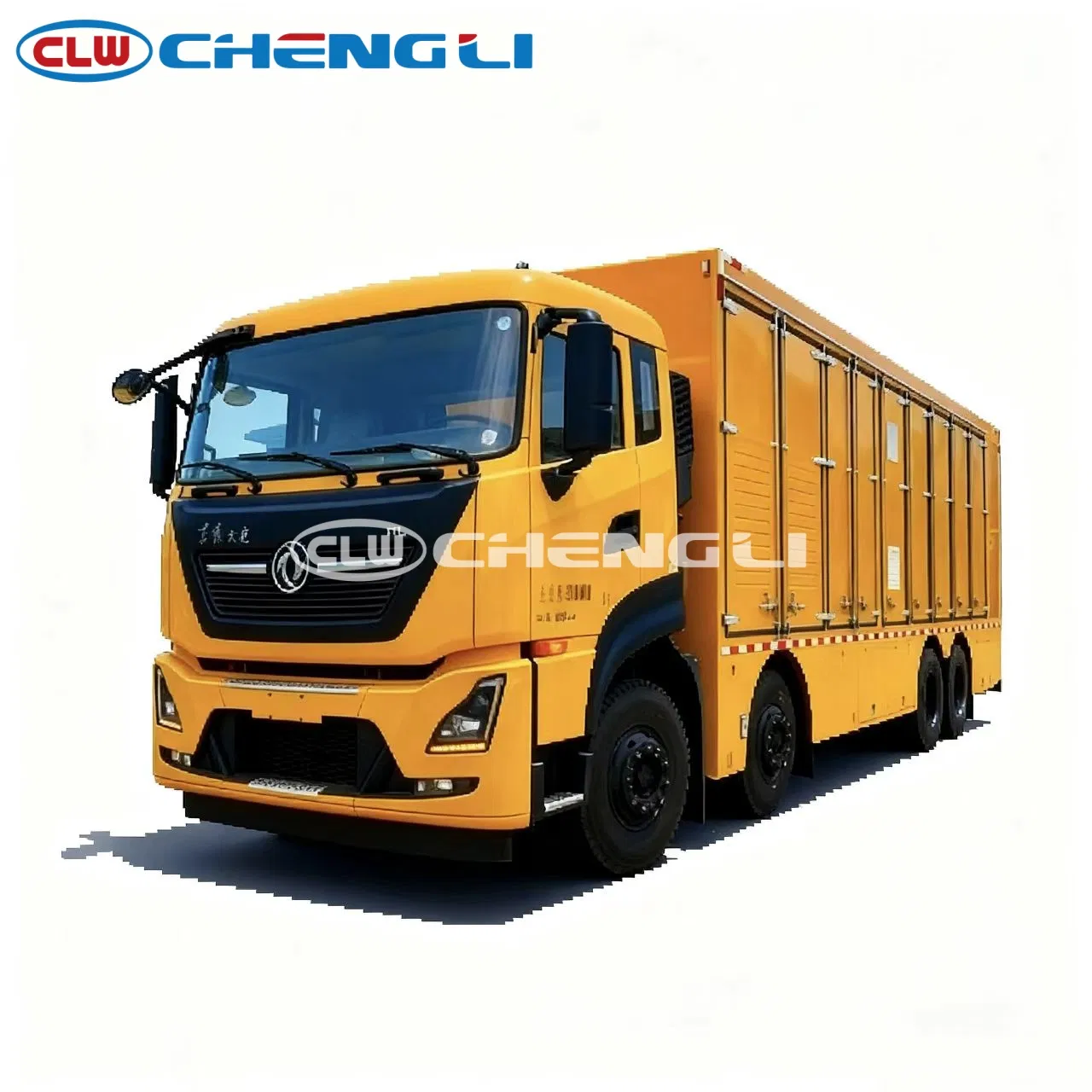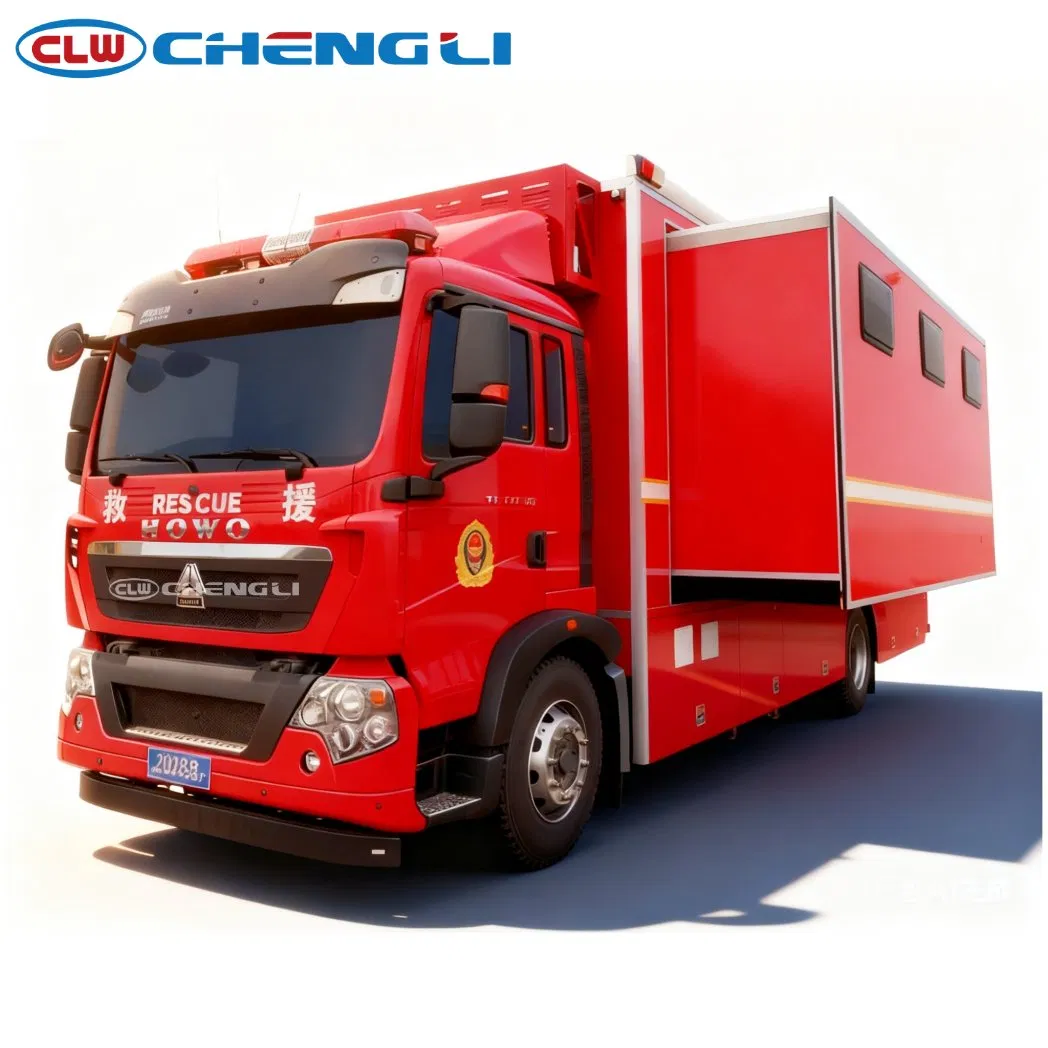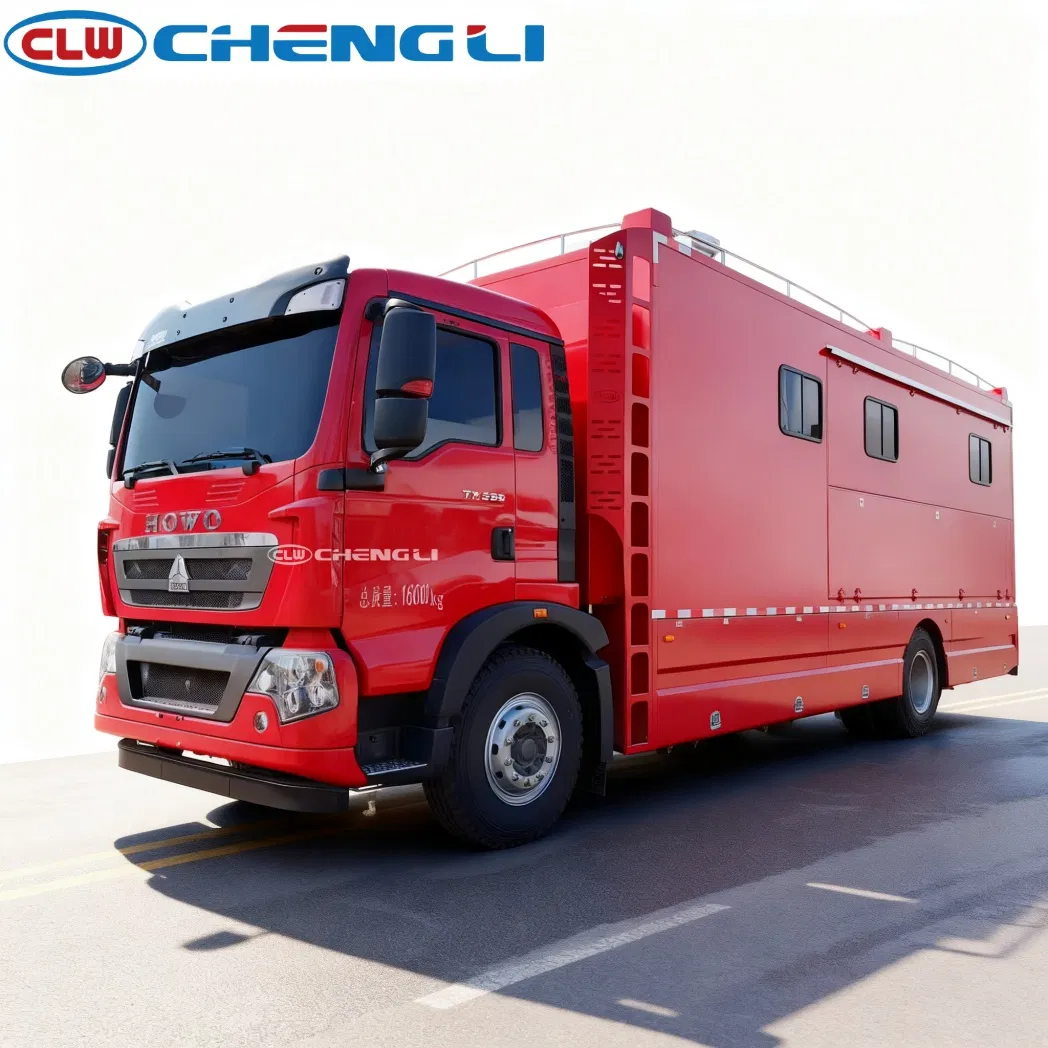
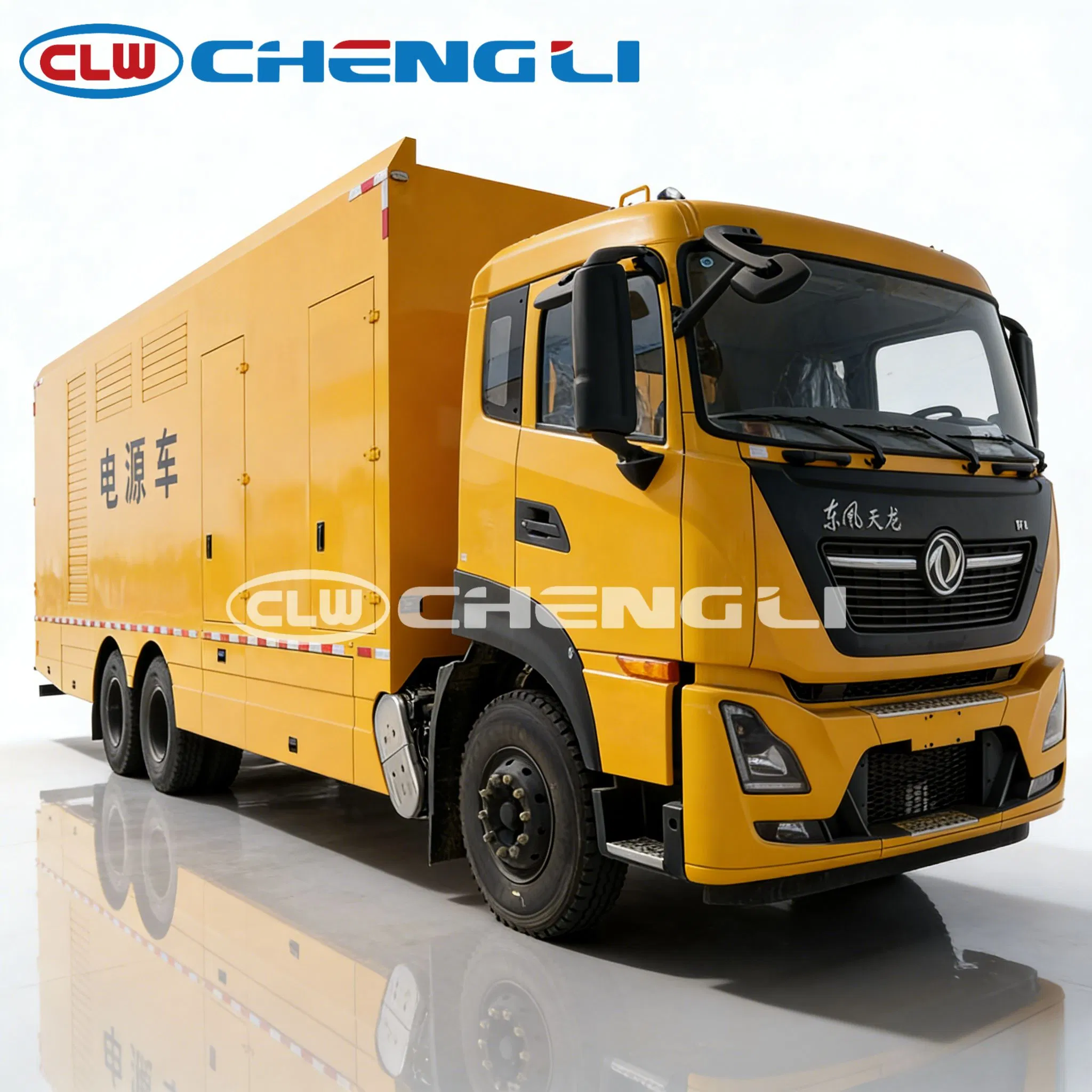
Emergency support vehicles keep a response running once the first rescue work is done. They fall into four jobs: command trucks that coordinate and communicate, power trucks that replace the grid, shelter trucks that house crews, and supply trucks that feed, wash and treat people on site. Our range runs from a five-seat command SUV to a 2,000 kW power truck and a 24-person accommodation truck.
Four jobs emergency support vehicles do
Each job has one figure that decides the size of the vehicle. Start there, then choose the chassis.
| Job | What the vehicle provides | Deciding figure | Our range |
|---|---|---|---|
| Command and communication | Network links, sensors, a working space for the command team | Access to the scene; hours of continuous operation | SUV, 4x4 pickup and 4x4 light trucks, 3,055–6,000 kg GVW |
| Mobile power | Generator output, distribution and cabling | Rated output and full-load runtime | 400 kW 4x2, 800 kW 6x4, 2,000 kW 8x4, plus silent and van-based sets |
| Shelter | Beds, toilet, water, air conditioning | People housed per truck | 8-person and 24-person HOWO trucks; Sitrak accommodation truck |
| Supply and services | Meals, laundry, medical care | People served per day | Kitchen for about 300 people per service, 6-machine laundry, dental clinic van |
Command and communication vehicles
A command vehicle has to reach the scene early and stay connected when public networks fail. Speed and access matter more than floor space. Our Dongfeng M-Hero 4x4 emergency command vehicle provides a 4G/5G dual-mode network terminal and gas-detection equipment on an off-road chassis. Check communications coverage and the final equipment list for the deployment area.
Off-road access calls for four-wheel drive. The 4x4 pickup drone command vehicle weighs 3,055 kg gross, with 31° and 26° approach and departure angles, a roof drone platform and a vehicle-mounted communication station. The Dongfeng M-Hero 4x4 at 5,630 kg and the Dongfeng 4x4 6 t add a 4G/5G dual-mode network terminal, a multi-gas detector and an oxygen concentration sensor; the 6 t truck also carries a generator, energy-storage battery, drainage system and lighting in a 5,800 mm body. Choose the smallest vehicle that carries your team and equipment, since a command post parked close to the incident is worth more than a larger one parked far away.
Mobile power trucks from 400 kW to 2,000 kW
Power trucks carry a generator set in a sealed, sound-insulated body with its own controls, cabling and leveling legs. Our range steps up by chassis:
- 400 kW on a Dongfeng 4x2: 9,000 × 2,500 × 3,800 mm, 400 V or 380 V output, eight hours at full load and noise of no more than 75 dB at 1 m.
- 800 kW on a Dongfeng Tianlong 6x4: 380 V / 220 V at 50 Hz, eight hours at full load, four 5 t hydraulic legs, remote monitoring and 600 mm wading depth, with body heights of 3,800 mm or 3,980 mm.
- 2,000 kW on a Dongfeng 8x4: generator sets, a power transformer and cooling equipment on a 31,000 kg GVW chassis, 11,990 mm long.
The two heights of the Dongfeng Tianlong 800 kW power truck exist for a reason: the 3,800 mm version clears more height-limited bridges and gates, while the 3,980 mm version gives more room inside the body. For hospitals, homes and night work, the Dongfeng Tianjin silent generator truck keeps its set in a soundproofed body, with output specified to the load. Smaller Iveco vans carry a generator and equipment cabinet for crews that need tools and power rather than grid-scale supply.
Sizing a power truck: kW, kVA, runtime and fuel
Start from the load, not the generator. Add up the connected equipment, such as hospital circuits, pumps, lighting towers and communications, and allow for motor starting current. Generators are often quoted in kVA: at the common 0.8 power factor, kW equals kVA × 0.8, so an 800 kW set corresponds to about 1,000 kVA.
Runtime then sets fuel logistics. Our 400 kW and 800 kW trucks are rated for eight hours at full load. A diesel generator at full load typically uses roughly 0.25 L per kWh, so 800 kW for eight hours (6,400 kWh) needs in the order of 1,600 L of diesel. Plan refueling before the response begins, and check the output voltage, frequency and connectors against the equipment you will supply: our trucks deliver 50 Hz, with 380 V / 220 V or 400 V options.
Shelter and accommodation trucks
Crews on multi-day deployments lose time traveling to hotels or setting up tents. A shelter truck gives them beds, a toilet, water and air conditioning next to the work. The HOWO 8-person shelter truck houses a small team in a 10,770 mm body on an 18,000 kg chassis. The HOWO 24-person mobile accommodation truck houses a full unit on a 7,100 mm wheelbase, with a side section that extends on site for extra floor space. The Sitrak accommodation truck adds fold-out beds and a bathroom for crew rest between shifts.
Plan the parking spot as carefully as the truck. These bodies stand close to 4 m high and run long wheelbases, so check access routes, and arrange water, wastewater and power connections for multi-day stays.
Kitchen, laundry and clinic trucks
Supply trucks turn a response site into a working camp. The HOWO emergency food service truck carries stoves, counters, refrigerators, ventilation and a water supply in one body, sized to cook for about 300 people per service. The HOWO mobile laundry truck carries six washing machines, a rinsing machine and a 10 kg dry-cleaning unit with drying, ironing and folding tables, so uniforms and bedding stay on site. The JMC mobile dental clinic brings a treatment unit and diagnostic instruments to villages, schools and relief camps in a van just under 6 m long.
Each of these needs utilities on arrival: water in, wastewater out and electrical supply, which is where a power truck and a water tanker fit into the same fleet. Our fire and emergency services solutions show the wider fleet, and our rescue truck equipment guide covers lighting, drainage and tool trucks.
How to specify an emergency support vehicle
- Job and scale: the number of people to command, house, feed or treat, and for how many days.
- Power demand: connected load in kW, voltage, frequency, connectors and required runtime.
- Communications: networks, radio bands and satellite service used in your country.
- Access: road surfaces, bridge heights and gates on the routes to likely sites, and whether 4x4 is needed.
- Site utilities: water, wastewater and power arrangements for shelter, kitchen and laundry trucks.
- Interior layout: beds, work stations, storage and equipment positions, agreed on a drawing before the body is built.
- Market details: emission level from Euro 2 to Euro 6, left- or right-hand drive and warning-light and livery rules.
FAQ
What is an emergency support vehicle?
It is a vehicle that supports responders rather than fighting a fire or freeing a casualty directly. Command vehicles, mobile power trucks, shelter and accommodation trucks, field kitchens, laundry trucks and mobile clinics all fall in this group. They matter most in long responses such as floods, earthquakes and large outages, when crews and victims need power, food and rest on site.
How big should a mobile generator truck be?
Size it to the load you must carry, with a margin for motor starting current. A field hospital, pumping station or relief camp needs a very different set from a lighting tower and tools. Our power trucks cover 400 kW, 800 kW and 2,000 kW, plus smaller silent and van-based sets with output specified to order. Send us your load list and we will match the set.
Is a mobile command vehicle better on a truck or an SUV?
It depends on the team and the terrain. An SUV or pickup reaches the scene fastest and parks anywhere but carries a small team and light equipment. A 4x4 light truck adds sensors, power and storage while staying compact. Larger box-bodied command trucks, which we do not currently list, give more working space but need better roads. Many agencies run a fast unit and a larger one together.
How many people can a mobile kitchen truck feed?
Our HOWO emergency food service truck is sized for about 300 people per service, which covers a mid-sized relief camp or large work crew. Daily output depends on how many services you run, your menu, and how quickly supplies, water and fuel reach the truck. For larger camps, plan more than one kitchen or pair the truck with field catering.
Build an emergency support fleet around the jobs your responses actually need: command first, then power, shelter and supply sized to the number of people and days involved. Compare current builds in our emergency support vehicle range, then send your response scenarios, crew sizes and destination market through our contact page, and our engineers will propose a configuration for each vehicle.