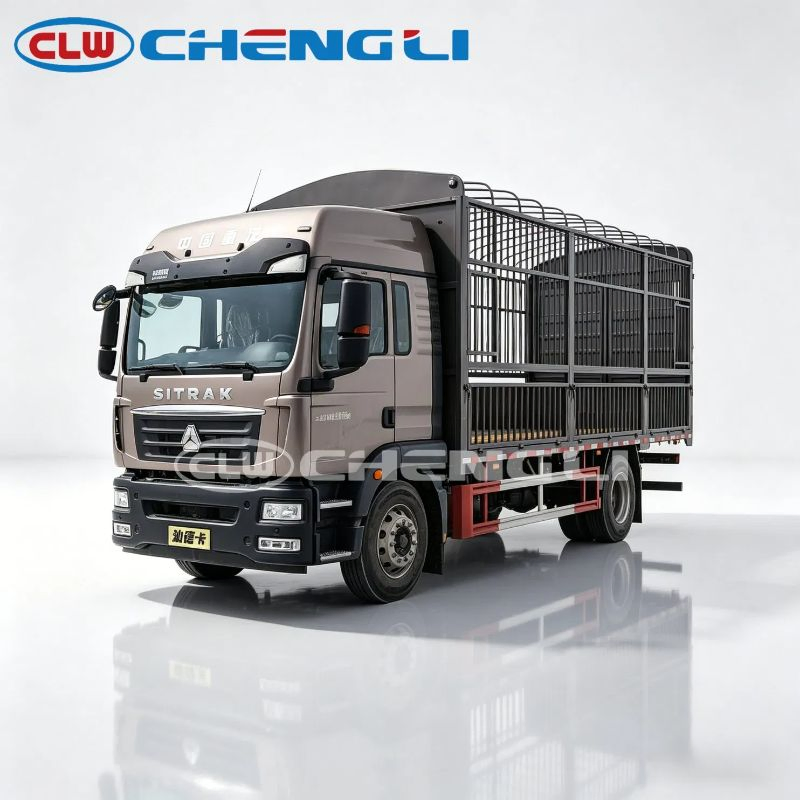
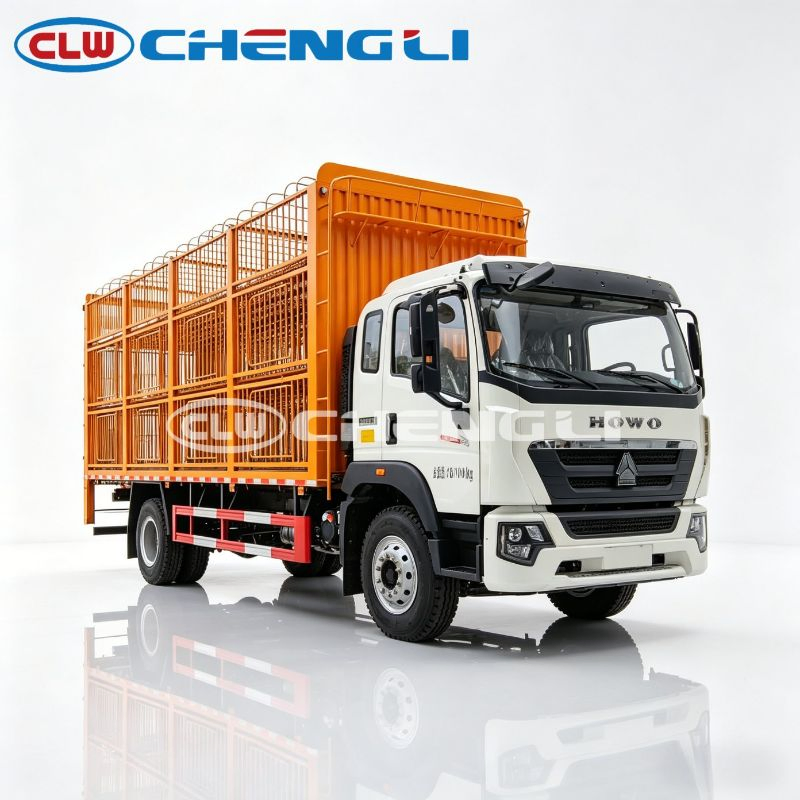
Deck count follows the animal. Cattle need one deck with full standing height, while sheep, goats, young pigs and crated poultry travel on two or three decks. Every layout also needs cross-ventilation, non-slip floors and partitions that stop the load surging. Our two 18,000 kg 4x2 livestock trucks cover both ends: a three-deck body for small stock and a 2,750 mm-high pen body for larger animals.
How livestock truck bodies differ by species
The body is built around the tallest animal it will carry and the way animals will get on and off at the farm. The table sets out the usual starting point for each species; your local transport rules decide the final space allowance and journey limits.
| Species | Usual deck layout | Loading | Main risk to design out |
|---|---|---|---|
| Cattle | Single deck with full standing height | Ramp or loading dock, wide rear doors | Load surge under braking; bruising on sharp edges |
| Sheep and goats | Two or three decks | Ramp, dock or lift to upper decks | Heat build-up on the upper and middle decks |
| Pigs | One to three decks, depending on size | Gentle ramp or hydraulic tail lift | Heat stress, since pigs cannot sweat |
| Poultry | Crates or modules on multiple levels | Crate handling, often by forklift | Airflow through the center of the stack |
Our two livestock trucks compared
Both trucks sit on 18,000 kg GVW two-axle chassis with 6,500 kg front and 11,500 kg rear axle ratings, and both stand just under 4 m tall. The body is where they differ.
| Item | HOWO 4x2 three-deck | Sitrak 4x2 pen body |
|---|---|---|
| Body size (L × W × H) | 6,200 × 2,450 × 2,520 mm inside | 6,750 × 2,500 × 2,750 mm |
| Decks | 3, with adjustable partitions | Pen-style enclosure |
| Rated payload | 9,805 kg | 10,570 kg |
| Engine | 162 kW (220 hp) | 228 kW (310 hp) |
| Wheelbase | 5,200 mm | 5,000 mm |
| Loading | Rear tailgate; hydraulic tail lift optional | Ramp or dock, side gates and rear doors |
| Ventilation | Side, roof and adjustable vents | Adjustable vents and open pen panels |
| Suspension | Leaf spring | Leaf spring; air suspension optional |
The extra 90 hp on the Sitrak 310 hp livestock truck matters on hilly routes, where holding speed on climbs shortens the time animals spend on board.
Deck layout, floor area and payload
A livestock load is limited by two numbers: floor area and payload. On the HOWO three-deck livestock truck, each deck measures 6,200 × 2,450 mm, or about 15.2 m², so three decks give about 45.6 m² of floor. The 2,520 mm internal height divided by three leaves about 840 mm per deck before floor thickness, which suits sheep, goats, young pigs and crated birds. Check the clear height against your largest animals before choosing three decks for finished pigs.
Payload works the other way. If your finished pigs average 110 kg, the 9,805 kg payload allows about 89 animals by weight; your space allowance per animal may set a lower number. Spread over 45.6 m², the rated payload averages about 215 kg per square meter of deck. The Sitrak's 6,750 × 2,500 mm floor gives about 16.9 m² and 10,570 kg of payload, roughly 625 kg per square meter, which is why a single tall pen suits heavy animals.
Live loads move. Animals shift under braking and cornering, and three loaded decks raise the center of gravity. Adjustable partitions split each deck into smaller pens so animals brace against each other rather than surging, and they let you separate animals by size.
Ventilation: keeping animals cool on the move and at stops
Most livestock bodies rely on passive ventilation: air enters through side slots and vents as the truck moves and leaves through the roof and rear. That works at road speed and stops working when the truck stands still, so plan loading, fuel stops and waiting time around shade and short dwell times. Heat stress risk is highest on the middle and upper decks and in humid weather.
The HOWO body offers side, roof and adjustable vents, and the Sitrak uses adjustable vents with open pen panels. Adjustable openings matter in cold climates too: closing the front openings in winter limits wind chill on animals at the front of the load. Temperature monitoring and a watering system are options on the HOWO three-deck truck and are worth specifying for long routes or hot regions.
Loading: ramps, docks and hydraulic tail lifts
How animals board decides the rear of the body. Farms with loading chutes or docks can use the Sitrak's ramp-or-dock loading and its side gates. Where there is no dock, or animals must reach an upper deck, a hydraulic tail lift saves time and handling; it is an option on the HOWO three-deck truck, whose rear tailgate weighs 550 kg. Keep ramps gentle and cleated, and light the inside of the body, since animals move more willingly toward light than into a dark opening; lighting is another option on the HOWO body.
Floors, partitions and cleaning
The floor takes urine, manure and wash water on every trip. The HOWO body uses an anti-slip floor with galvanized punched plates that drain liquid and resist corrosion, and both trucks use bolted Q235 steel side guards, so a damaged panel can be unbolted and replaced. Clean and disinfect after every load: remove bedding and manure, wash from the top deck down, disinfect, then let the body dry before the next farm. A truck that moves between farms without cleaning is a well-known route for disease spread. Our agriculture and livestock solutions cover the wider farm fleet, and our bulk feed truck guide explains the feed side of the same routes.
What to confirm before ordering a livestock truck
- Species and weights: the animals you carry, their average and maximum weight, and whether species or sizes are mixed.
- Head count per trip: checked against both floor area and payload, using your local space allowance.
- Deck layout: single deck or multi-deck, and the clear height each deck needs.
- Farm loading: ramp, dock or hydraulic tail lift, and the door positions your chutes require.
- Climate: hot, humid or cold routes, and whether you need temperature monitoring, watering and adjustable vents.
- Ride and power: leaf or air suspension, and 220 hp or 310 hp for the grades on your routes.
- Route limits: the height limit on your roads, since both trucks stand close to 4,000 mm.
FAQ
How many cattle can a livestock truck carry?
Floor space usually sets the number before payload does. Our Sitrak pen body has about 16.9 m² of floor and a 10,570 kg payload. By weight alone that is about 21 head at 500 kg each, but most space allowances for cattle of that size would permit fewer. Apply the allowance your transport rules require, then check the weight.
What is the difference between a livestock truck and a cattle trailer?
A livestock truck has the body mounted on its own chassis, so it is shorter and easier to turn in farm lanes and yards. A semi-trailer cattle carrier is pulled by a tractor head and carries far more animals per trip on highway routes. We do not currently list livestock semi-trailers; our range is rigid 4x2 livestock trucks.
Can one livestock truck carry different species?
Yes, if the body is laid out for it. Adjustable partitions separate animals by species and size, and a multi-deck body can put smaller animals on the upper decks. The limits are clear height, since each deck must suit the tallest animal on it, and your local rules, which may restrict mixing species or animals of different sizes.
Is a livestock lorry the same as a livestock truck?
Yes. Lorry is the British and Commonwealth word for truck, so a livestock lorry, cattle lorry or stock truck describes the same vehicle. The specification points are identical: deck layout, ventilation, loading method and payload. Height and weight limits differ by country, so quote your market when you ask for a configuration.
Start from the animals: their size decides the deck layout, their number decides floor area and payload, and your climate and farm loading decide ventilation and the rear of the body. Compare both builds in our livestock truck range, then send the species, head count, route and destination market through our contact page so our engineers can propose a body layout.