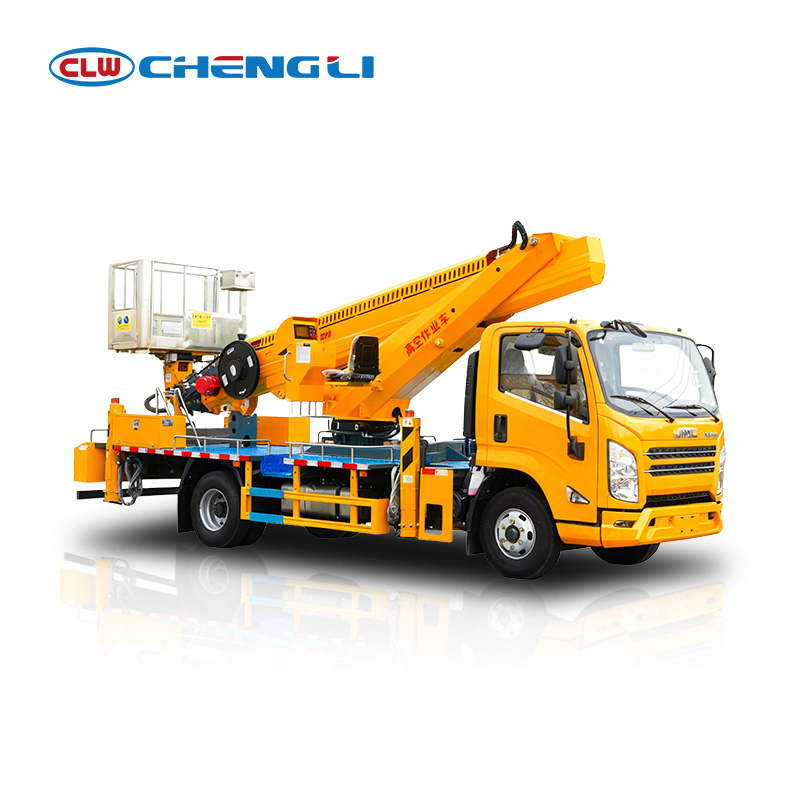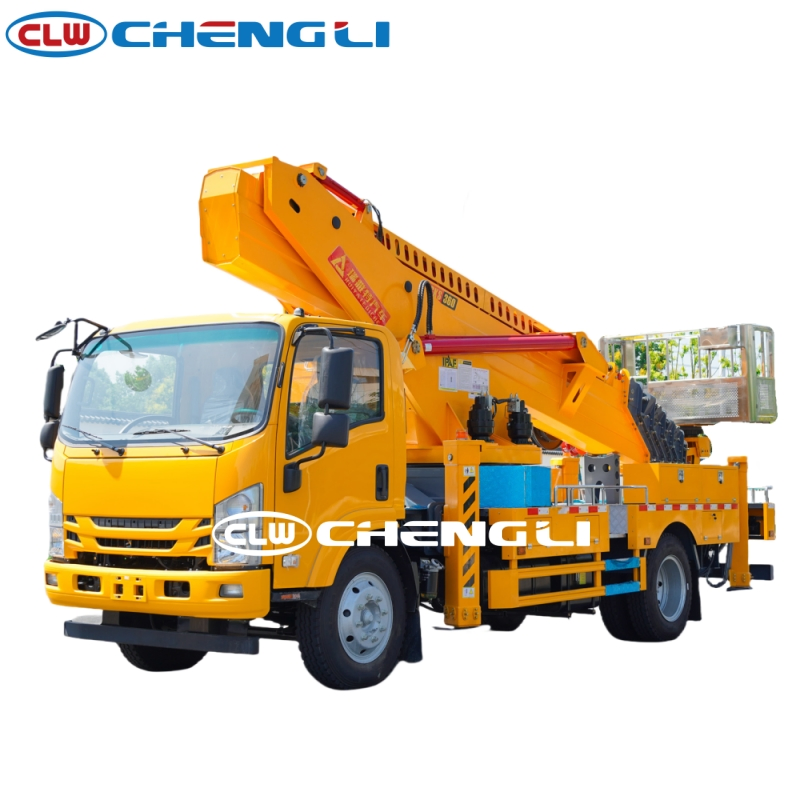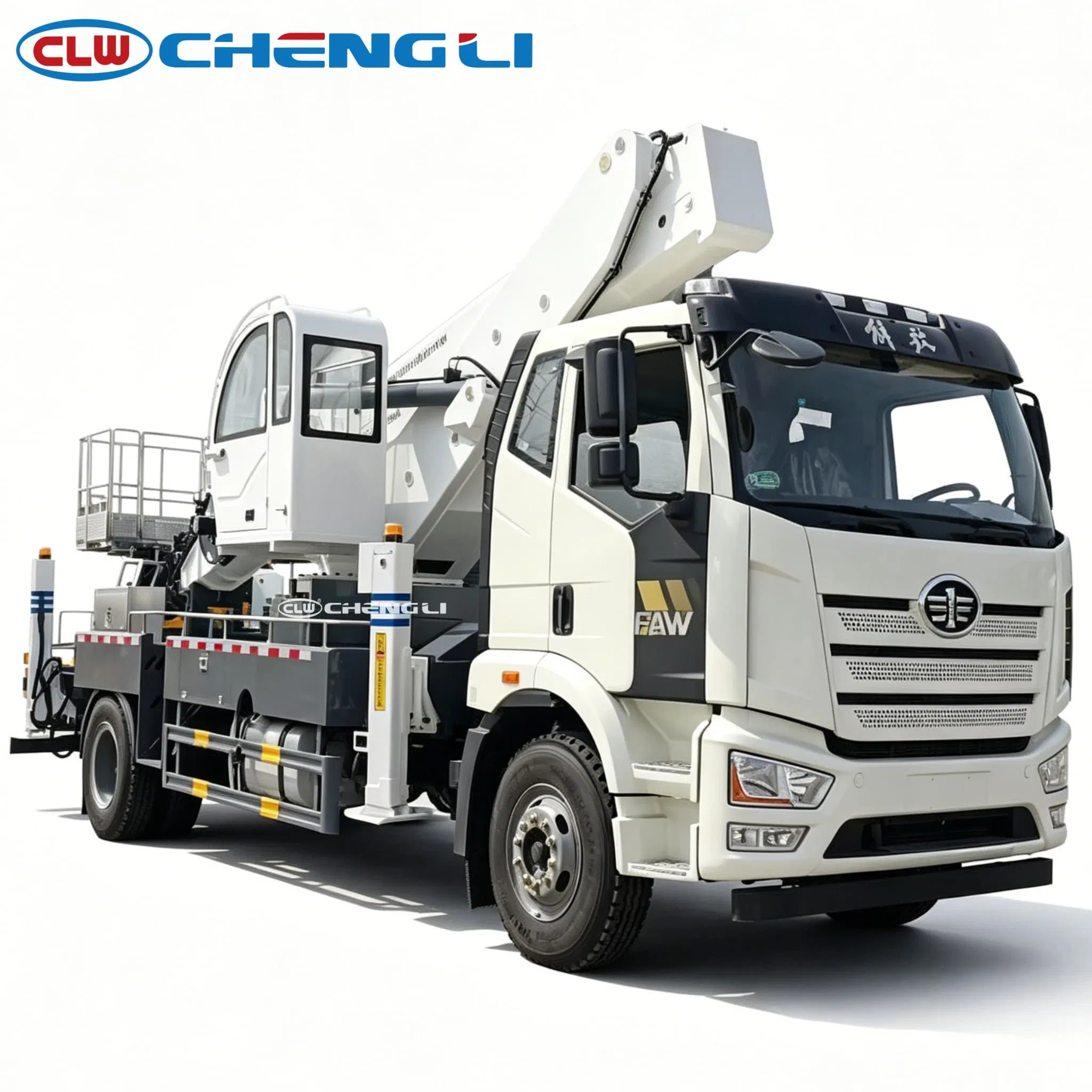
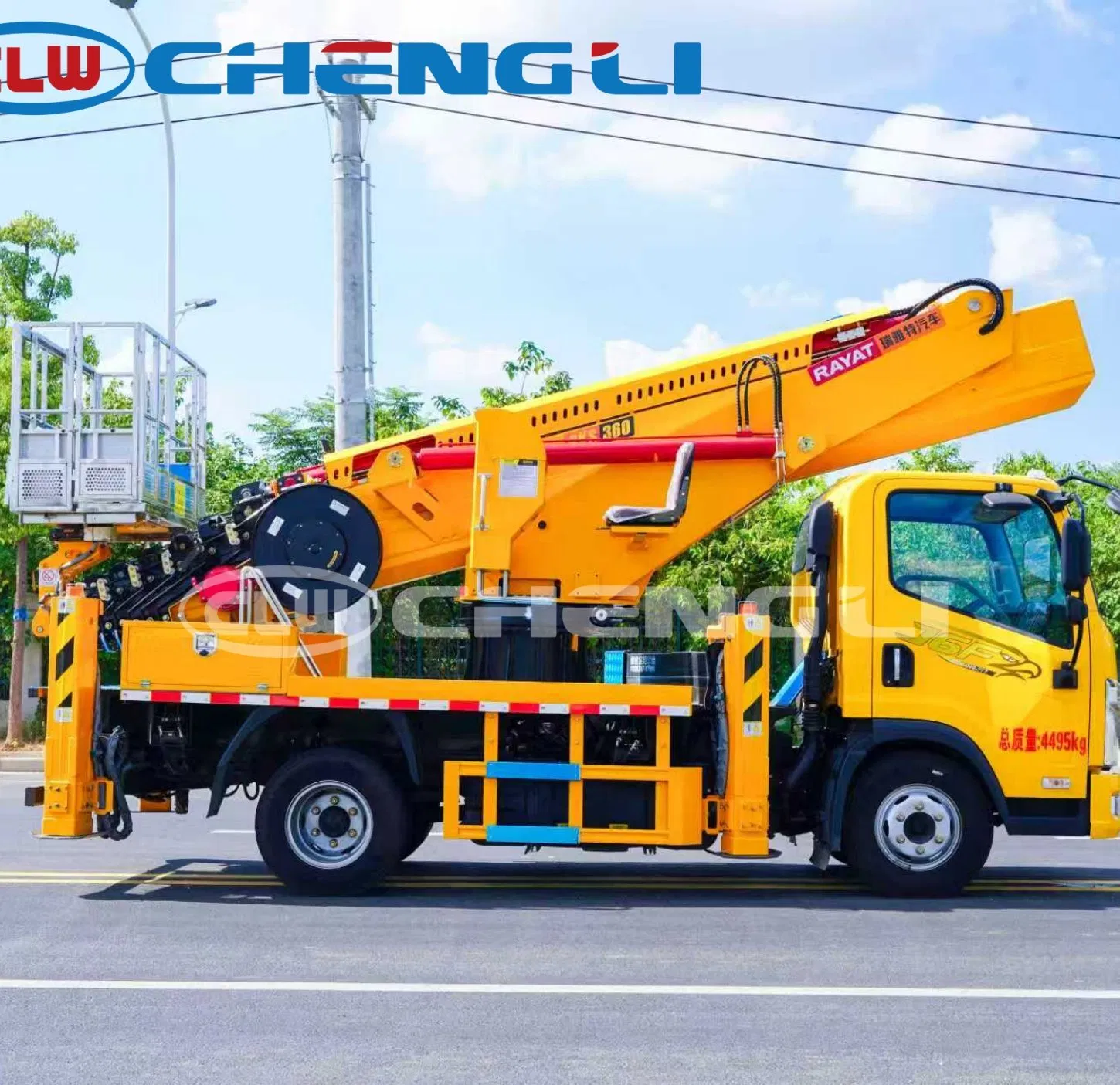
Size a utility bucket truck by the job, not by the tallest number in the catalog. A light 4x2 with 14–24 m of working height covers most street-light, sign and low-rise facade work; 28–36 m trucks suit distribution lines, telecom equipment and mid-rise buildings; 45–65 m machines are for bridges, high-mast lighting and industrial plants. Outreach at the working height matters as much as height itself.
Which Aerial Truck Fits Which Job
The table pairs common utility and municipal jobs with the truck classes we build. Height figures are maximum working heights; outreach is the horizontal reach of the basket from the turntable.
| Job | Our truck class | Examples in our range | What to check first |
|---|---|---|---|
| Street lights, traffic signs, signals | 14–24 m on 4,495 kg GVW 4x2 | 14 m with 10 m range; 23 m and 24 m with 11 m range | Outreach over the sidewalk; 4,200/4,000 mm stabilizer span |
| Distribution lines and telecom equipment | 28–36 m on 4x2 | 28 m with 14 m radius; 36 m with 18 m range | Insulation requirements; outreach at pole-top height |
| Facades, windows and building signs | 17.5–36 m | 17.5 m telescopic; 36 m straight boom | Basket size; outreach at full height; parking distance from the wall |
| Bridges, high-mast lighting, industrial plants | 45–65 m on 18,000–25,000 kg chassis | 45 m with 20 m radius; 65 m on 6x4 | Stabilizer spans of 8,200–9,200 mm; road closure |
| Crew-based maintenance | Double-cab 4x2 | 2+3 and 3+3 seating | Boom height and basket rating for the exact build |
| Maintenance with materials | 18 m with tipper body | 280 kg basket, 10.6–11.6 m radius | Whether the boom may work with a load in the body |
Street-Light and Sign Maintenance: Light 4x2 Trucks
Street-light crews stop dozens of times a shift, so the truck has to be short, quick to set up and easy to park. Our light aerial trucks are built on 4,495 kg GVW chassis about 6,000 mm long and 2,050 mm wide, which fit narrow streets and most parking bays.
Look past height to the reach curve. Our Chengli 14 m aerial platform reaches 10 m sideways, but only at about 6 m of working height; at the full 14 m, outreach drops to 2.8 m. That suits a lamp head on a bracket over the curb, not one set back behind a wide sidewalk. Our JMC 23 m platform keeps 5 m of outreach at full height and reaches 11 m at its widest, for lights set back from the curb or poles behind a ditch.
Plan the footprint too. Front and rear stabilizer spans of 4,200 mm and 4,000 mm are more than a typical 3.5 m traffic lane, so the setup takes a lane and a bit of shoulder or sidewalk. Night lamp replacement in residential streets is where our Chengli electric 4x2 aerial truck, with a lithium iron phosphate battery and 100 kW or 110 kW drive options, helps by keeping engine noise and exhaust out of bedrooms.
Power Lines and Telecom: Reach, Rotation and Insulation
Line work puts the basket over or beside conductors, often with the truck parked on the road shoulder and the pole in a field. Outreach at pole-top height decides whether the truck can do the job from the road. Our Isuzu 28 m platform reaches its 14 m maximum radius at 17 m of working height; our Dongfeng 36 m platform reaches 18 m sideways and still works at 15 m height at that reach. The Dongfeng slews 360° continuously, so the crew can work both sides of the pole without moving the truck.
The term lineman bucket truck usually implies an insulated boom rated for work near energized lines, and insulation is a specification, not a feature to assume. Our 18 m truck carries an FRP basket with a PE lining, but a non-conductive basket is not the same as a dielectrically rated boom. In the US, vehicle-mounted aerial devices are covered by ANSI A92.2; other markets set their own rules. If crews will work near live conductors, specify the insulation rating and test your utility requires and confirm it in writing at quotation.
Facades, Windows and Building Signs
Facade work needs a basket that climbs close to the wall and stays steady there. A straight telescopic boom does this well. Our Isuzu 36 m straight-boom aerial platform uses a four-section synchronous telescopic boom on a 9,495 kg GVW chassis, with a 1,400 × 700 × 1,000 mm basket and a minimum operating height of 0.68 m for work near the ground.
The catch is outreach at the top: at 36 m that truck reaches 5 m from its turntable. To work the top floors, it has to park close to the building, so check that the sidewalk, trees and canopies allow it. For two- and three-story buildings, our JMC 17.5 m platform on a 4,495 kg chassis keeps the job simple, with 9 m of maximum range and a 1,200 × 710 mm basket.
Bridges, High-Mast Lighting and Industrial Plants
At 45 m and above, the truck becomes a planned lift rather than a quick stop. Our FAW J6P 4x2 45 m aerial platform reaches 45 m height or 20 m radius, but not both at once: at full radius the working height is 5 m, and at full height the radius is 5 m. Read the reach chart for the point you actually need, such as a bridge bearing under the deck edge or a floodlight ring on a mast.
Setup space is the other constraint. The FAW 45 m truck needs stabilizer spans of 8,200 mm and 8,900 mm, and our FAW 6x4 65 m platform spreads its outriggers to 8,500 mm at the front and 9,200 mm at the rear. That is two to three traffic lanes, so these jobs need a road closure plan and ground bearing checks. The FAW 45 m truck also stands 4,060 mm tall in travel position, which matters for low bridges and plant gates.
Crew Cabs, Tipper Bodies and Electric Chassis
Some fleets need the truck to carry the crew as well as the basket. Our Dongfeng double-cab aerial truck seats 3+3 on an 8,070 mm long chassis with Yuchai 170 hp or 220 hp engines, and a Chengli double-cab version seats 2+3. Confirm the boom height and basket rating of the exact build before you plan jobs around it.
Other crews carry parts and debris. Our 18 m aerial truck with a tipper body pairs a 280 kg basket with a working radius of 11.6 m at 100 kg or 10.6 m at 280 kg, and hauls poles, cable or cuttings in the body. For inner-city routes with low-emission rules, the electric 4x2 option gives street-light crews zero tailpipe emissions. For the basics of boom types, basket ratings and chassis stability, see our aerial work platform truck buying guide.
What to Confirm Before Ordering
- The highest and furthest work point on your typical job, measured as height plus horizontal distance from where the truck can park.
- The reach chart at that point, not only maximum height and maximum outreach.
- Basket rated load and size for the crew and tools you send up.
- Stabilizer spans against lane width, sidewalk space and ground conditions at typical sites.
- Insulation rating and test requirements if crews work near energized lines.
- Cab seating, storage and any tipper or cargo body the crew needs.
- Diesel or electric chassis, and charging access at the depot for electric trucks.
- Travel height and length for low bridges, tunnels, depots and plant gates.
FAQ
What is a utility bucket truck?
It is a truck with a boom and a personnel basket used to reach overhead equipment such as street lights, power and telecom lines, signs and building fronts. The term is common in North America; elsewhere the same vehicle is called an aerial work platform truck or bucket lift truck. Utility versions often add crew seating, tool storage and, for line work, an insulated boom.
Is a lineman bucket truck always insulated?
No. Lineman is a job description, not a rating. Some line trucks have insulated booms for work near energized conductors; others are used only on de-energized lines or for telecom and lighting. If your crews work near live conductors, write the required insulation class and test standard into the order and ask for test documents with delivery.
Can one bucket lift truck handle street lights and power lines?
Often, if the reach covers both. A 23–28 m truck with 11–14 m of outreach handles most street lights and many distribution poles from the road. It cannot replace an insulated truck for live-line work, and on narrow streets it takes more space than a 14 m truck. Fleets with both jobs usually run a mix of sizes.
Are electric bucket trucks practical for city work?
For city routes that return to a depot each night, yes. Street-light and sign crews drive short distances between many stops, and a quiet, zero-emission chassis suits night work in residential areas. Check battery range with the boom's power draw included, charging time at the depot and service support for the high-voltage system.
Pick the truck for the work point, then check the footprint, the crew and the chassis. Browse all our aerial work platform trucks and send us your typical job heights, outreach and street widths; our engineers will propose a height class, boom type and chassis for your utility, road or municipal fleet.