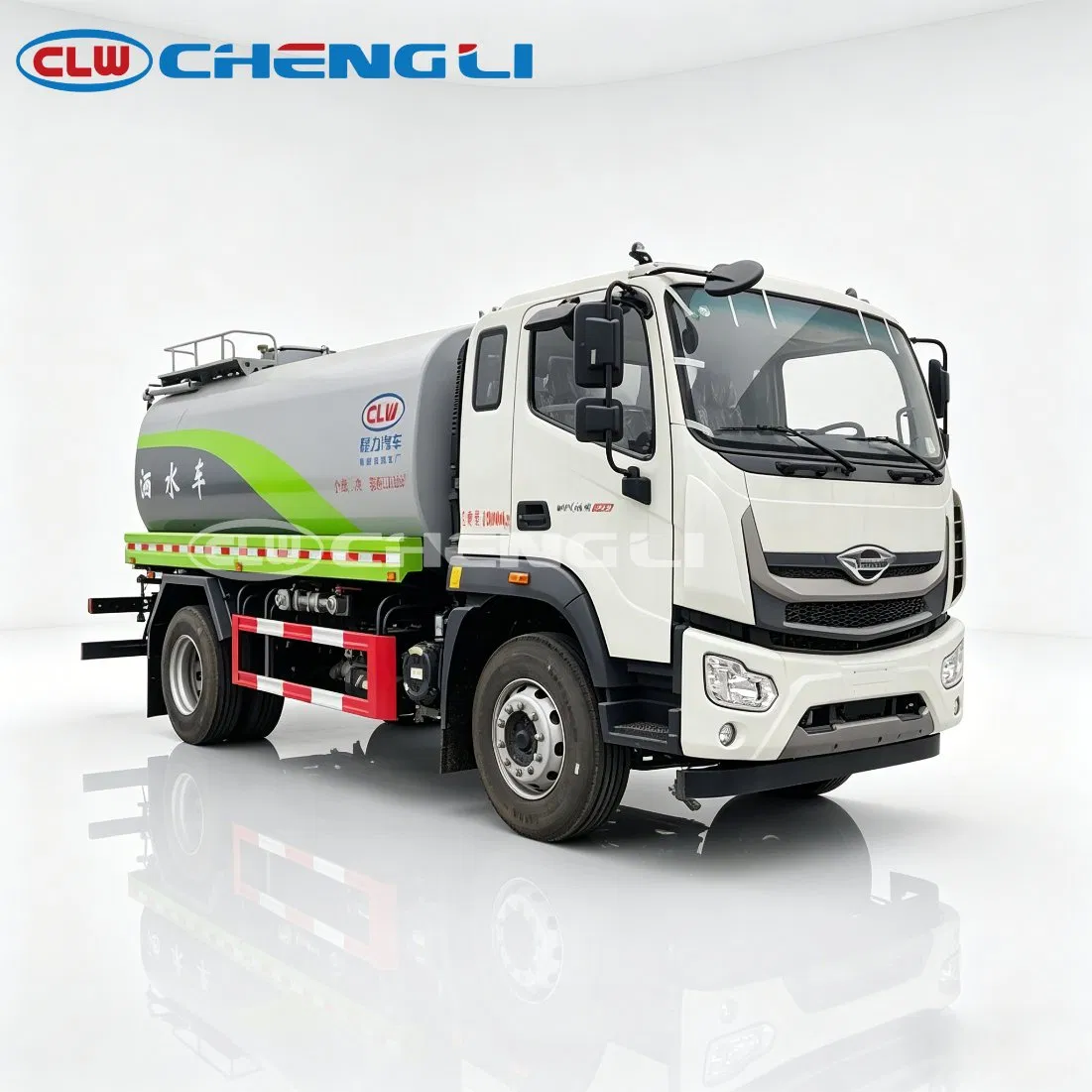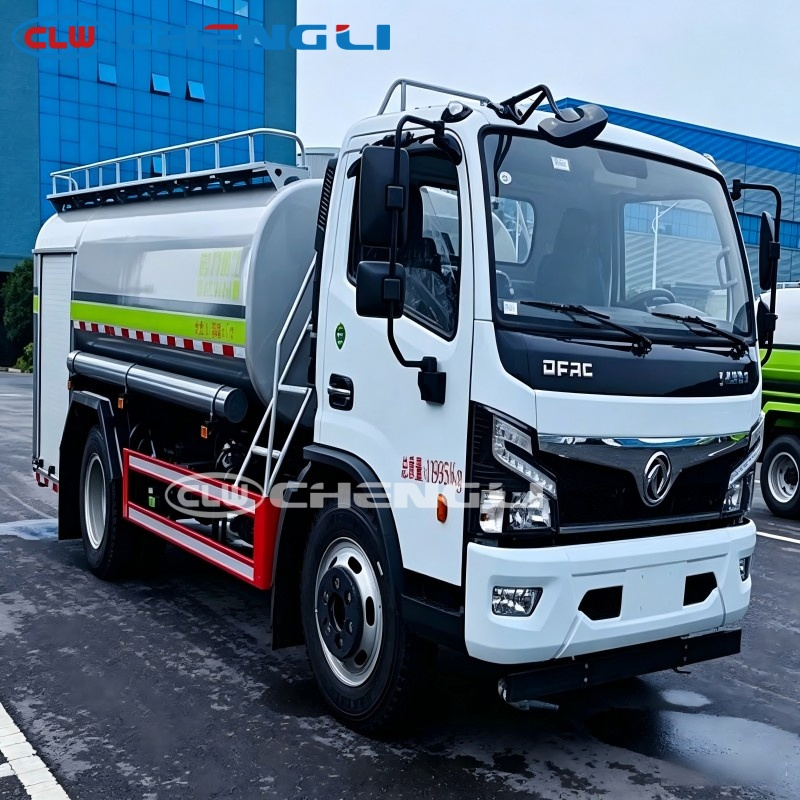
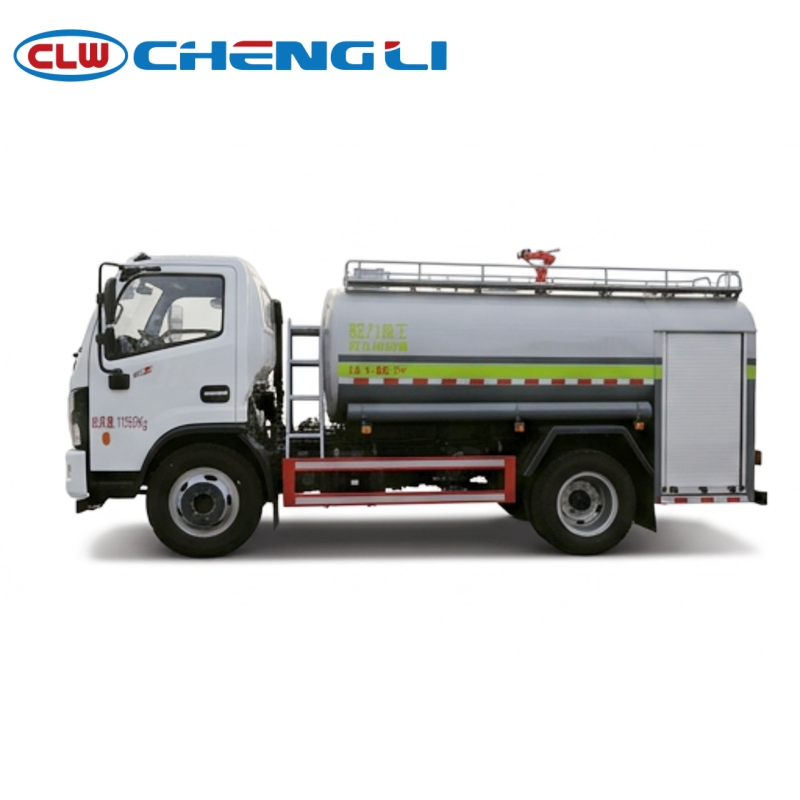
On a haul road a sprinkler truck lays water to hold dust down, on a city street it flushes the gutter line, and along a median it waters the planting. The choosing rule is simple: pick the spray outlets for the job first, then size the tank to the payload the chassis can legally carry, not to the biggest number on the tank plate.
What Each Spray Outlet Does
A water sprinkler truck is a tank on a chassis with a PTO-driven or electric pump and several outlets, each aimed at a different job. Most municipal builds carry at least three of the four below; site trucks often drop the front flush bar and put the budget into rear coverage and a cannon.
| Outlet | Where it sprays | Main use | What to check |
|---|---|---|---|
| Front flushing | Low, angled nozzles ahead of the front bumper | Driving grit and litter toward the curb; washing the gutter line | Nozzle angle, pressure, separate left and right control from the cab |
| Rear sprinkling | Wide spray bar behind the rear axle | Dust suppression and road damping across a full lane | Spray width, even coverage, drip-free shutoff |
| Side spraying | Nozzles on one or both sides of the tank | Wetting shoulders, curbs, green belts and medians | Reach, nozzle adjustment, clearance to parked cars |
| Water cannon | Roof or rear-platform monitor, often 360° rotation | Throwing water onto stockpiles, trees, facades or small fires; mist for airborne dust | Jet and mist range, rotation, cab or manual control |
Throw distance is the easiest number to misread. The cannon on our Foton 4x2 13 m³ electric dust suppression truck throws a direct jet up to 35 m (about 115 ft), but its mist setting reaches up to 15 m (about 49 ft). Neither figure is a spray width for road damping, which depends on the rear and side nozzles.
Dust Suppression on Construction Sites, Quarries and Mine Haul Roads
Haul roads dry out quickly, so the truck runs loop after loop and every trip back to the fill point is dead time. That pushes site buyers toward bigger tanks and three-axle chassis.
Typical site configuration
For road watering, our Foton 4x2 sprinkler has an 11.1 m³ effective tank, front flushing, rear spraying and a water cannon. Its 18,000 kg GVW and 6,675 kg curb weight make the final permitted water fill a separate weight check. Match spray outlets, road conditions and operating load to the route.
What changes on a mine or quarry
Site water is often drawn from ponds or settling basins, so specify a suction strainer and a pump that tolerates some fine solids. Ask for extra corrosion protection inside the tank if the water is hard or saline. Rear nozzles should be easy to clear, because a blocked nozzle leaves a dry stripe. Overwatering is a risk too: a slick ramp is dangerous for loaded dump trucks, so the driver needs cab control to cut flow on grades.
For dust drifting over the fence of an urban construction site, a mist cannon does more than a spray bar. An electric truck such as the Foton, with a 200 kWh battery and up to 340 km of range per charge, also avoids adding diesel exhaust at the site boundary.
Road Washing and Municipal Street Work
Municipal sprinkler trucks spend most of their shift on paved streets, where the job is washing rather than damping. Front flushing does the heavy work: angled jets ahead of the front axle drive sand, leaves and litter toward the curb and into the gutter line, where a sweeper or the drainage system takes over.
City work favors a different chassis balance. Two-axle trucks turn tighter in old streets and park more easily at hydrants. The Foton 4x2 carries 13,000 L (about 3,434 US gal) on an 18,000 kg gross vehicle weight chassis, refills through a 65 mm hydrant inlet and has zero tailpipe emissions, which matters on night routes through residential areas. That Foton configuration fits the washing and sweeping mix many municipal sanitation fleets run.
Specify front nozzle pressure and independent left and right flush control from the cab; a truck that flushes both sides at once wastes water on one-way streets.
Green-Belt and Park Irrigation
Irrigation of medians and roadside trees is often underestimated at ordering. Side nozzles wet the planted strip as the truck drives past, but trees and raised planters need a cannon or a hose reel. A cannon with graded settings helps: the Foton's cannon rotates 360° and switches between direct jet, heavy rain, moderate rain, light rain and drizzle, so the operator can soak a tree pit without washing soil off a young planting.
Irrigation water is often reclaimed or untreated. If that is your supply, choose a stainless steel tank (an option on the Foton, whose standard tank is carbon steel) or a proper internal coating, and put a filter ahead of the pump. A rear working platform gives the operator a safe place to aim the cannon during slow, stop-start irrigation runs.
Dual-Duty Fire and Sprinkler Trucks
Towns and industrial parks without a dedicated pumper often buy one truck that waters roads on normal days and answers small fires when needed. These fire sprinkler trucks add a fire pump and a monitor to the sprinkler body. Our Dongfeng 4x2 9,290 L fire sprinkler truck pairs a fire pump and monitor with a cab-controlled spray system on a 16,200 kg gross vehicle weight chassis. Our Dongfeng 4x2 model with a nominal 7,000 L tank carries a CB10/30 pump and a PS8/30 monitor rated for at least 60 m (about 197 ft) of reach.
The pump and monitor add weight and maintenance. If fire cover is the main reason to buy, a dedicated fire truck is the better tool; if watering is the main duty, the dual-duty build earns its keep.
Tank Size, Payload and Legal Fill
Water weighs about 1 kg per liter, so a full tank in liters is roughly the payload it uses in kilograms. On sprinkler trucks the two numbers are often almost identical, and sometimes the tank is slightly larger.
| Truck | Tank | Water mass, full tank | Rated payload | GVW | Main use |
|---|---|---|---|---|---|
| Dongfeng 4x2 fire and sprinkler | about 7,000 L nominal (1,849 US gal) | about 7,000 kg | 6,670 kg | 11,995 kg | Watering plus first response |
| Dongfeng 4x2 fire sprinkler | 9,290 L (about 2,454 US gal) | about 9,290 kg | 9,155 kg | 16,200 kg | Main roads, quarries, fire standby |
| Foton 4x2 electric | 13,000 L (about 3,434 US gal) | about 13,000 kg | Confirm on build sheet | 18,000 kg | Urban routes, site perimeter |
| Foton 4x2 diesel | 11.1 m³ effective (about 2,930 US gal) | about 11,100 kg | Confirm final road load | 18,000 kg | Municipal watering and dust control |
Compare the third and fourth columns. On the nominal 7,000 L truck a full tank is about 330 kg over the rated payload before anyone climbs in; on the 9,290 L truck the gap is about 135 kg; the Foton 11.1 m³ vessel also needs a completed-vehicle payload check before a full road load is assumed. An overloaded truck wears axles and tires and fails roadside weigh checks. Ask for the approved fill level on the final weight plate. Our water tanker truck capacity guide covers chassis-by-chassis tank sizing in more detail.
What to Confirm Before Ordering a Sprinkler Truck
- The duties by share of the shift: haul road damping, street washing, irrigation or fire standby, since this sets which outlets you need.
- Tank volume against the approved payload and the legal fill level on the final weight plate, with the crew count included.
- Drive and axle layout for your ground: 4x2 for paved city routes, 6x4 for unpaved haul roads and heavy full-tank loads.
- Pump drive (PTO or electric), and whether the pump must self-prime from ponds, rivers or open tanks as well as fill from hydrants.
- Outlet set and controls: front flush bar, rear spray bar, side nozzles, cannon type and range, and which functions the driver switches from the cab.
- Tank material and lining for your water: corrosion-treated carbon steel, or stainless steel for reclaimed or saline water.
- Refill interface, for example a 65 mm hydrant inlet, and the coupling type your hydrants use.
- For electric trucks, battery capacity, charging arrangement and range on your actual route with the pump running.
FAQ
Is a water bowser the same as a water sprinkler truck?
Not quite. Water bowser is the British and Commonwealth term for a mobile water tank, which may be a towed trailer or a truck, used mainly to carry and supply water. A sprinkler truck is built to discharge water while driving, with front, rear and side nozzles and often a cannon. Many buyers use a sprinkler truck as a bowser, but a plain bowser cannot wash or damp a road.
What is the difference between a road washing truck and a road sweeper?
A road washing truck uses water pressure alone to move dirt toward the curb or drain. A sweeper uses brushes and suction to lift debris into a hopper, and a washing sweeper adds a spray system on top. Washing covers more street per shift on lightly soiled roads; sweeping is needed where sand, leaves or litter would otherwise be pushed straight into drains. Many cities run both in sequence.
How does a dust suppression truck differ from a standard sprinkler?
A dust suppression truck adds a fog or mist cannon that breaks water into fine droplets. The droplets hang in the air and catch airborne dust around demolition, crushing and stockpile work, where a spray bar only wets the ground. Mist uses far less water per minute than a jet, so the same tank lasts longer. Specify a mist cannon when dust drifts off site, and a spray bar when traffic lifts it from the road.
When is a water cannon truck worth the extra equipment?
A cannon earns its place when the target is off the road: tree crowns, stockpiles, building facades, crusher feed points or a small fire. It lets one operator cover a spot from a distance without walking out with a hose. On a route that is only lane damping, a cannon adds weight and maintenance with little return. Wind cuts cannon range sharply, so check reach under your own site conditions before relying on the rated maximum.
How many sprinkler trucks does a site or city need?
Work it out from water demand, not road length alone. Estimate the water each kilometer needs per pass, multiply by the passes per day, and divide by the usable tank volume to get the number of trips. Then add refill time and travel to the fill point. If one truck cannot finish the loops inside a shift, add a truck or move the fill point closer; a closer standpipe often saves more time than a bigger tank.
Choose the outlets for the work, the chassis for the ground and the tank for the legal payload, in that order. Browse our water sprinkler trucks, then send us your route, water source and main duties and our team will propose a tank size, drive layout and spray configuration for your market.