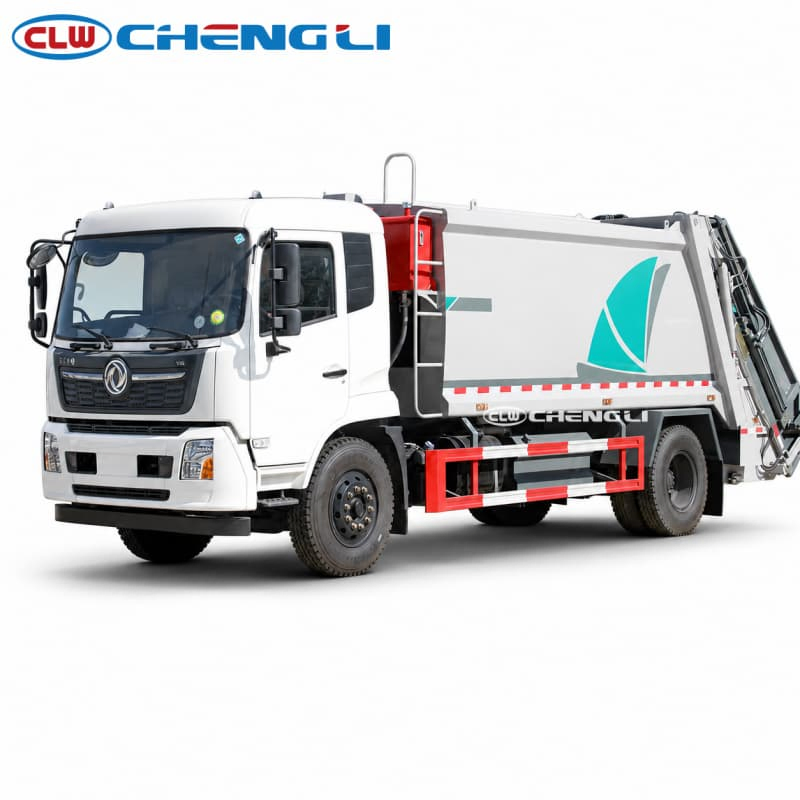
Six body types handle nearly all municipal waste collection: rear-loading compactors, side loaders, hook lift trucks, skip loaders, sealed kitchen waste trucks and small self-dumping trucks. The right choice depends on how waste is presented for pickup (bags, wheeled bins, large containers or skips), how dense it is, and how far the truck travels to the disposal site.
Rear-loading compactor garbage trucks
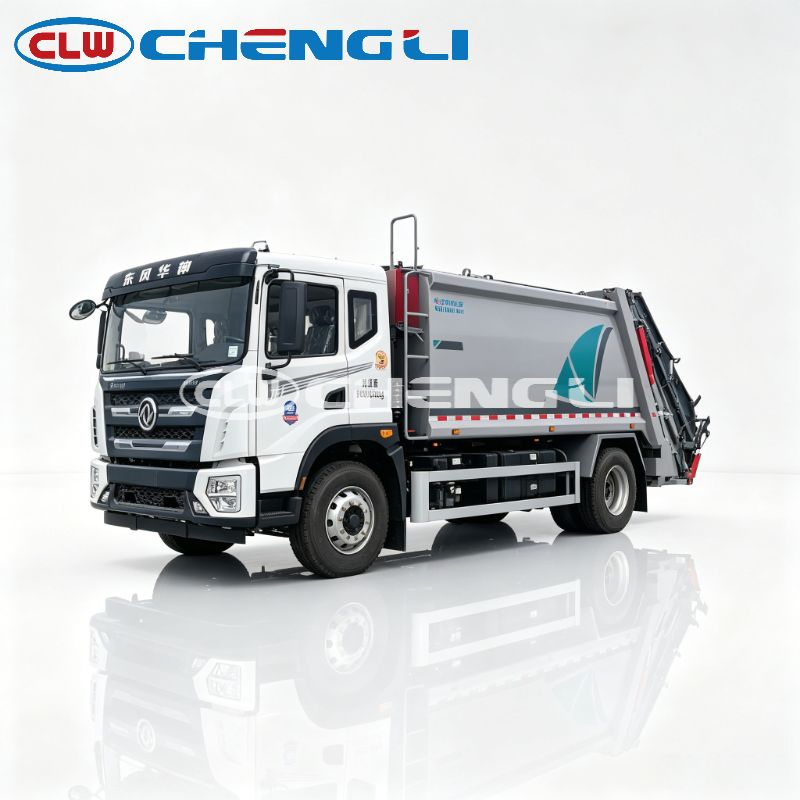
The rear loader is the standard municipal garbage truck. Crews tip bags or wheeled bins into a hopper at the tail, and a hydraulic packer plate sweeps the load forward into the body and compresses it against an ejector panel. Our 14 m³ Dongfeng rear loader runs a 15–30 s loading cycle and discharges in less than 25 s.
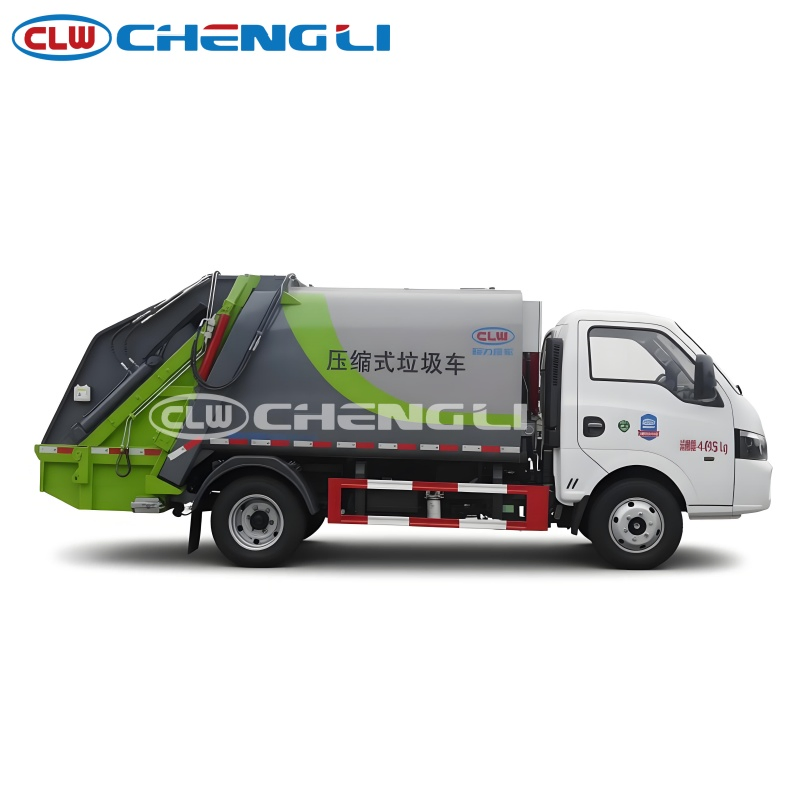
Compaction is what separates a compactor from a simple tipping body. With a compression ratio of 1:2.8 to 1:3.2, as on our CLW 4x2 compactor, a 14 m³ body holds the equivalent of roughly 39–45 m³ of loose waste. An open body of the same size would need about three trips for the same waste.
Garbage truck sizes and payload
Our compactor bodies currently run from 14 m³ to 16 m³ on 4x2 chassis, with gross vehicle weights of 12,500–18,000 kg. The 14 m³ Dongfeng rear loader is rated for about 10 t, roughly 150 full 240 L bins, which works out to about 710 kg per m³ of body. The 16 m³ electric compactor carries 5,805 kg, or about 360 kg per m³. Light, bulky household waste fills the electric body by volume first; wet or mixed waste can reach its weight limit before the body is full.
Diesel or electric compactors
Our battery-electric Dongfeng compactor pairs a 16 m³ body with a 210 kWh LFP battery, a 200 kW motor and a rated range of 280 km, with charging in about 1.5 hours. Short, stop-heavy urban routes suit electric drive, and a quiet truck makes night collection in city centers easier. The trade-off is payload: 5,805 kg on a 12,500 kg GVW chassis, against about 10 t on the 18,000 kg diesel rear loader. Diesel remains the simpler choice for long rural routes or depots without charging.
Side loaders and bin-lifter trucks
A side loader picks up bins from the curb with an arm mounted behind the cab. On automated units the driver works the arm from the cab, so one person can run the route. It only works when every household uses standardized wheeled bins, set out on the side the arm reaches. Front loaders, which lift large commercial containers over the cab, are common in North America. We do not currently list either type.
A middle ground is a rear loader or small tipper fitted with a hydraulic bin lifter. The lifter grips the bin's rim or trunnion bar, raises it and tips it into the hopper, so crews stop lifting waste by hand. The 14 m³ Dongfeng rear loader takes 120 L, 240 L and 660 L bins, while our food waste truck handles 120 L and 240 L kitchen bins. Confirm the bin standard in your city before ordering, because a lifter made for one rim or trunnion pattern will not grip another.
Hook lift, roll-off and skip loader trucks
These trucks do not compact waste on the route. They carry a container that stays at the site, fills up, and is then swapped for an empty one. One truck can serve many containers, which suits markets, construction sites, factories and transfer stations. Hook lift, roll-off and skip loader trucks are not in our current range.
Hook lift and roll-off trucks
A hook lift truck uses a hydraulic arm with a hook that engages a bar on the front of the container, pulls it onto the truck frame and tips it at the disposal site. Roll-off trucks, common in North America, do a similar job. Hook height and container length must match the truck; mixing container standards is a common and expensive mistake.
Skip loaders
A skip loader lifts a smaller skip with two hydraulic arms and chains, sets it on the deck and tips it at the disposal site. Skips are simple containers that suit tight urban sites, but they hold less and are open-topped, so light waste needs a net or cover in transit.
Kitchen and food waste trucks
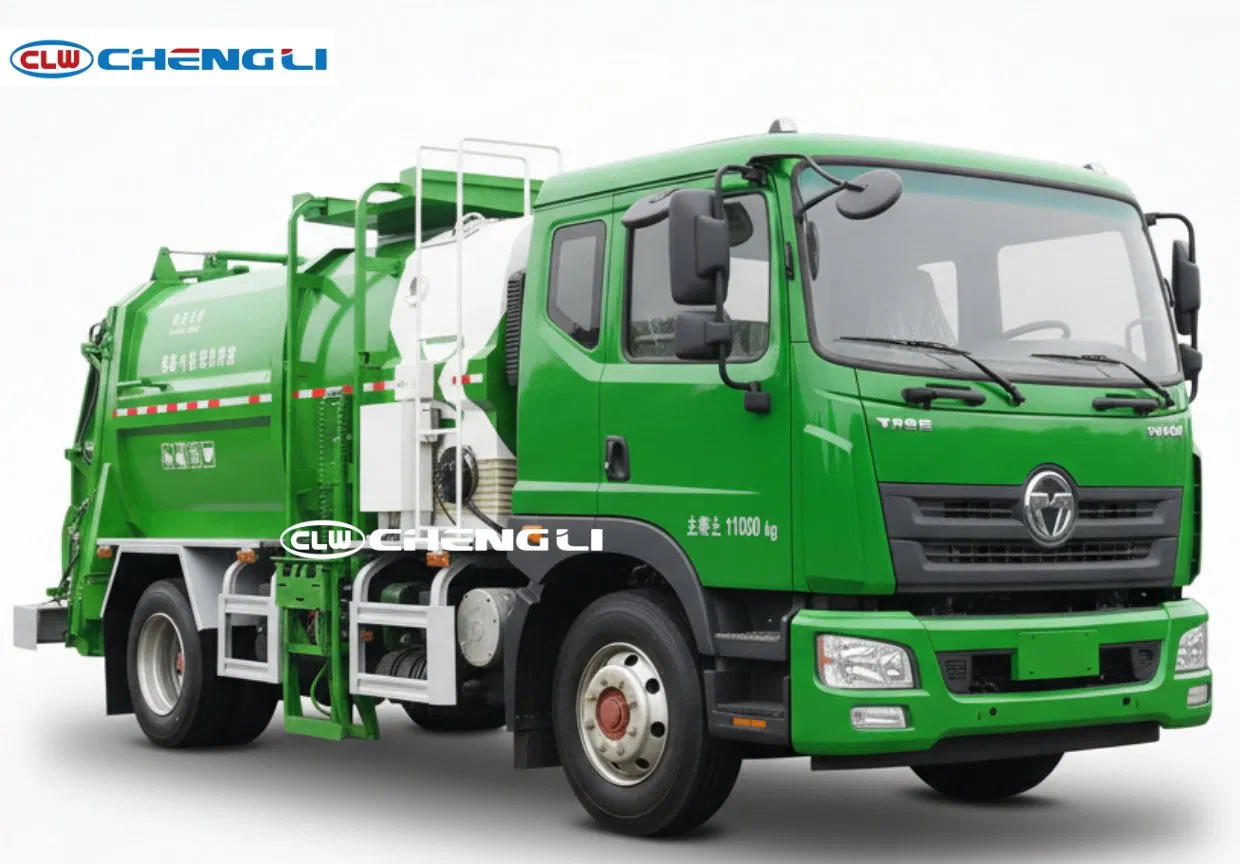
Food waste is wet, heavy and prone to leaking. An ordinary compactor tailgate is not designed to hold large volumes of liquid. A kitchen waste truck uses a sealed tank-style body, a sealed rear door and a dedicated wastewater tank.
Our 10 m³ Dongfeng 6x2 food waste truck shows the typical layout: a lifter for 120 L and 240 L kitchen bins, a 700 L wastewater tank, a 450 L clean water tank feeding a high-pressure wash system, a hydraulically locked rear door and push-out discharge in 25 s or less. The body is built from low-alloy steel, 4 mm on the sides and 5 mm on the bottom.
Size these trucks by weight. Food waste can approach the density of water, about 1 kg per liter, so a full 10 m³ body could weigh close to 10 t. This truck's rated payload is 7,855–8,300 kg depending on version, which is why food waste bodies are usually smaller than household compactor bodies.
Self-dumping and bucket-lift small trucks
For narrow lanes, villages, markets and hillside settlements, a full-size compactor is often the wrong tool. Small garbage trucks on light chassis use an open or covered tipping body that dumps at a transfer point. Some add a hydraulic lifter that raises bins or a dedicated bucket over the body side, so one driver can collect without a crew. We do not currently list this type.
The compromise is simple: without compaction, the truck makes more trips for the same waste, but it reaches streets where a 2,550 mm wide, 9,600 mm long compactor cannot turn.
Choosing between garbage truck types by collection model
Start from how residents and businesses set out their waste, not from the truck. The table below matches common collection models to the garbage truck types that suit them.
| Collection model | Suitable truck type | Check first | In our current range |
|---|---|---|---|
| Bags and 120–240 L bins, door to door | Rear-loading compactor | Lifter type, payload vs waste density | 14 m³ and 16 m³ compactors |
| 660 L communal bins | Rear loader with heavy-duty lifter | Lifter rating and bin interface | 14 m³ Dongfeng rear loader |
| Standard wheeled bins on long suburban routes | Side loader | Bin standard, pickup side | Not currently offered |
| Restaurants, canteens and markets | Sealed kitchen waste truck | Wastewater tank, payload by weight | 10 m³ Dongfeng 6x2 |
| Construction debris, bulky waste, transfer stations | Hook lift or roll-off | Container standard, lift rating | Not currently offered |
| Many small sites with frequent swaps | Skip loader | Skip size, deck length | Not currently offered |
| Narrow lanes, villages, feeder routes | Self-dumping or bucket-lift small truck | Vehicle width, turning space | Not currently offered |
| Night collection in city centers | Electric compactor | Route length, depot charging | 16 m³ electric compactor |
A common pattern is small feeder trucks in old districts, compactors on main residential routes and hook lift containers at the transfer station. For the other vehicles a city sanitation fleet relies on, see our municipal sanitation solutions.
What to confirm before ordering a garbage truck
These eight points decide most garbage truck configurations:
- Waste type and density. Density decides whether the body fills by volume or by weight first.
- Bin standard. Bin sizes such as 120 L, 240 L or 660 L and the lifter interface. Send photos and drawings of the bins you already use.
- Legal axle loads and GVW. Local limits set the usable payload. Ask for the axle load split of the finished truck, for example 6,500/11,500 kg front/rear on our CLW 4x2 compactor.
- Street and site access. Narrow streets, low clearances and depot turning space. Our garbage trucks range from 3,200 mm to 3,500 mm high and 7,000 mm to 9,745 mm long.
- Discharge point. Landfill tip face, transfer station hopper or pit. Push-out and tipping discharge need different space behind and above the truck.
- Power and fueling. The diesel emission level your market requires, or charger power and depot space for an electric truck.
- Liquid handling. Wastewater tank size and door sealing for food or wet waste, and whether you need an onboard wash system.
- Controls and crew. Cab or rear hydraulic controls, curbside control position and how many crew members ride on each route.
FAQ
What are the common garbage truck sizes?
Garbage trucks are sized by body volume in cubic meters. Our current range covers 10 m³ to 16 m³: a 10 m³ food waste truck, two 14 m³ compactors and a 16 m³ electric compactor, on chassis from 12,500 kg to 18,000 kg GVW. Choose the size by payload and street access, not volume alone.
Is a hook lift truck the same as a roll-off truck?
They do the same job, loading, carrying and tipping large containers, but with different mechanisms. A hook lift pulls the container on with a hydraulic arm and hook, while a roll-off uses a tilting frame and a cable winch. Hook lifts are usually quicker to operate in tight spaces; roll-offs are widespread in North America and handle very long containers. The two container systems are not interchangeable, so match any new truck to the containers you already own.
Can a regular compactor collect kitchen waste?
It can handle small amounts mixed into household waste, but it is a poor choice for a dedicated food waste route. Wet waste releases liquid under compaction, and a body without a sealed door and a large wastewater tank will drip on the road. A sealed kitchen waste truck with a 700 L wastewater tank, like our 10 m³ Dongfeng unit, keeps liquid on board until the discharge point.
How far can an electric garbage truck travel on one charge?
Our 16 m³ electric compactor has a rated range of 280 km from its 210 kWh battery. Real range on a collection route depends on the number of stops, hydraulic cycles, payload, climate and terrain, since compaction and bin lifting use energy too. Many urban routes are much shorter than 280 km, but ask for an energy estimate based on your route length and stop count before replacing diesel trucks.
Do garbage trucks come in left-hand and right-hand drive?
Yes. Our 14 m³ Dongfeng rear loader is available in LHD or RHD, and it offers electric, manual and remote operation. Drive side matters more on garbage trucks than on most vehicles, because crews work at the curb all shift. Specify the drive side, curbside control position and any side-mounted equipment together, so the driver and crew step down and work away from traffic.
Pick the truck from the collection model outward: compactors for bagged and binned household waste, sealed bodies for food waste, container trucks for sites that fill skips or hook lift containers, and small self-dumping trucks for streets a compactor cannot reach. Then size it by payload and axle limits, not body volume alone. Browse our garbage truck range, or send us your waste type, bin standard and route conditions and our engineers will propose a body and chassis to match.