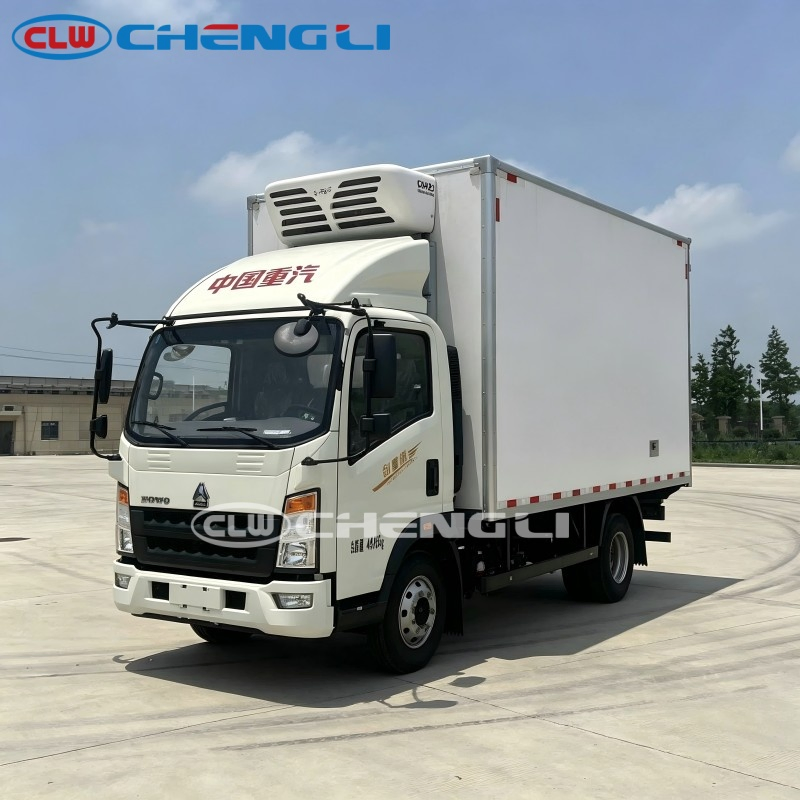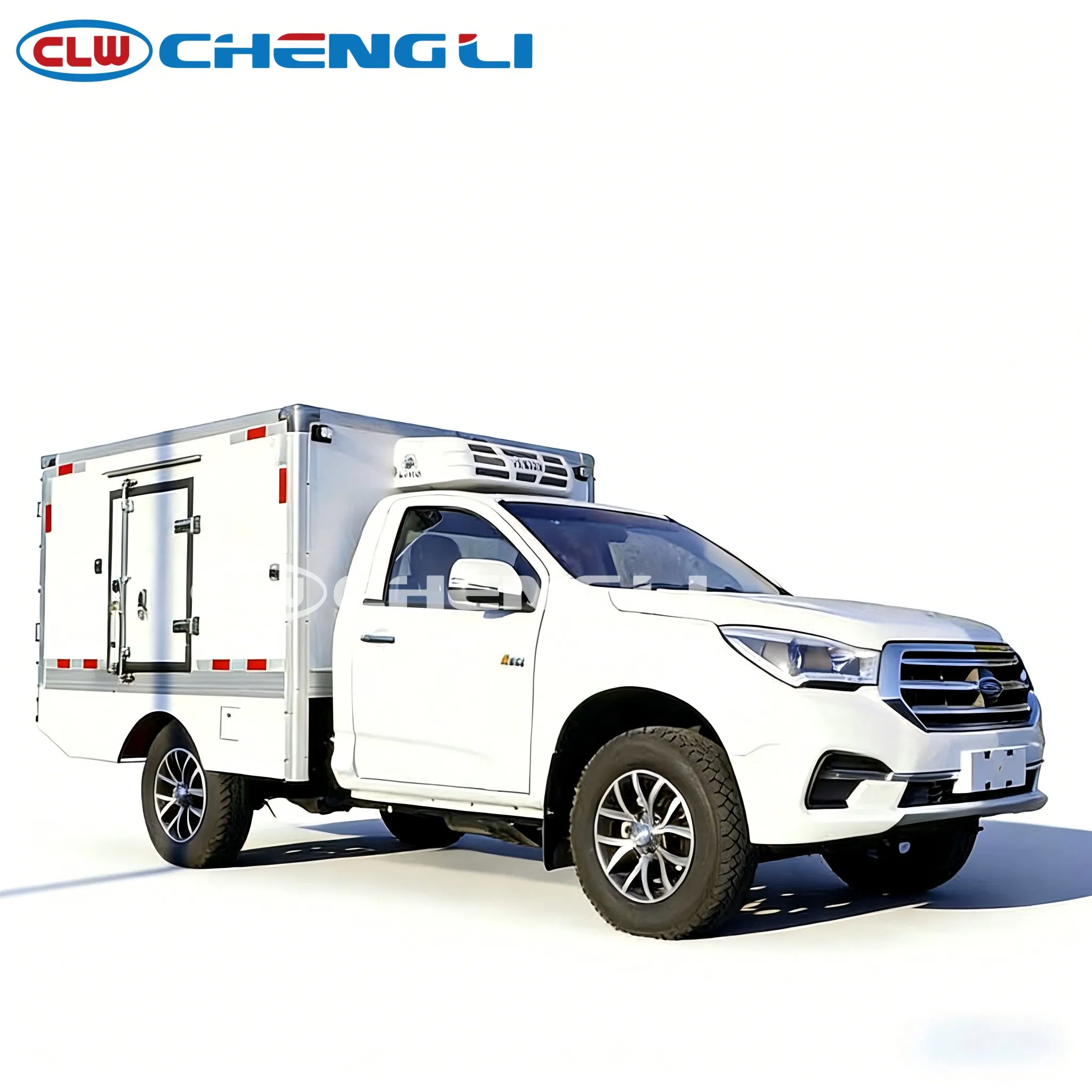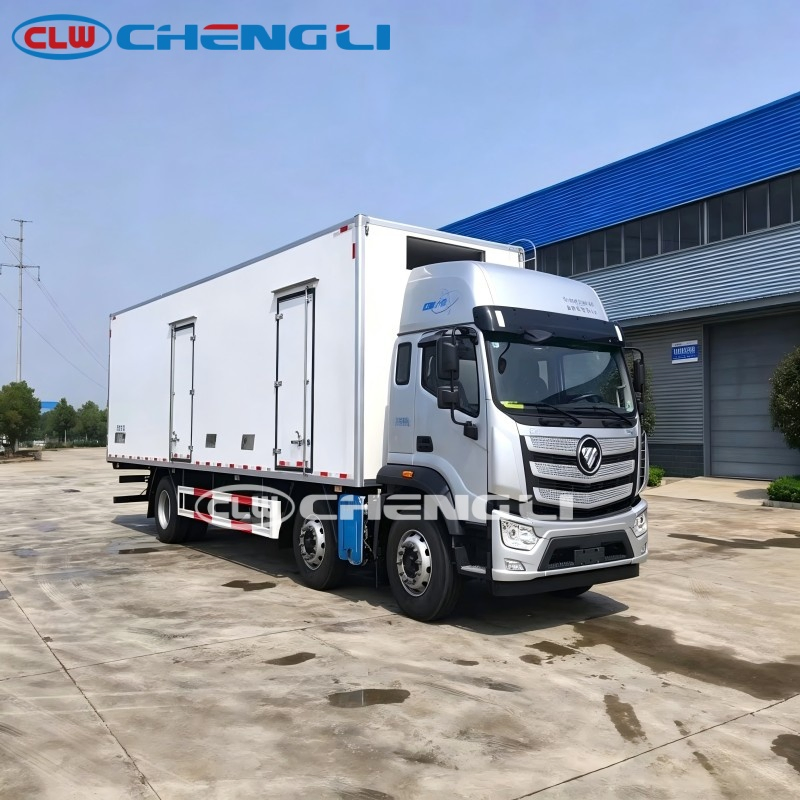
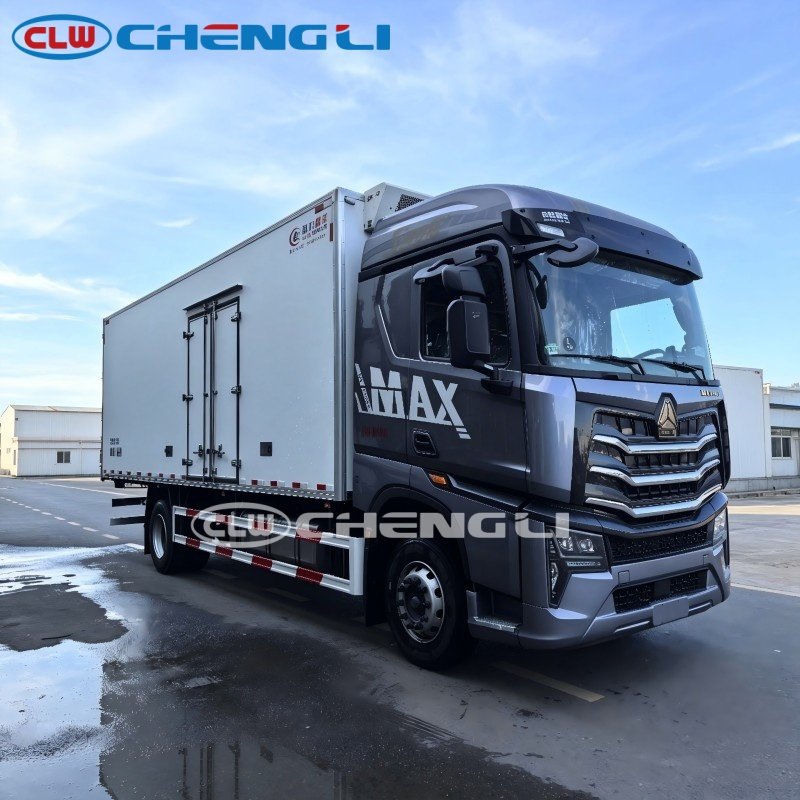
Start with the cargo temperature: chilled produce, dairy and fresh meat ride at about 0 to +5 °C, frozen goods at −18 °C or colder, and that figure sets the insulation, the refrigeration unit and the price class. Then size the box by volume and by legal payload; our reefers run from a 4.23 m³ pickup to a 60 m³ 6x2 truck.
Whatever you call it, this guide covers it: refrigerated truck in catalogues, refrigerated lorry in the UK, Kenya and Nigeria, fridge truck or fridge van in everyday speech, reefer in the trade, and freezer truck when the cargo is frozen. They are one vehicle, an insulated box with a refrigeration unit on a truck chassis, and the choices below apply to all of them.
Chilled or frozen: which temperature class do you need?
Most cold-chain loads fall into two classes. Chilled cargo such as vegetables, fruit, dairy, fresh meat and flowers is held above freezing, usually between 0 and +5 °C, and some produce is damaged if it gets colder. Frozen cargo such as meat, fish, frozen vegetables and bakery products is held at −18 °C or below.
The refrigeration unit has to reach the lower limit with a full load, the doors closed and the ambient heat of your hottest month. Our Isuzu 4x4 refrigerated pickup is rated for −18 to +5 °C. The Iveco CLW5041 8.5 m³ van uses a Xenkeli unit rated down to −15 °C; its stated rating does not cover a −18 °C frozen-food specification.
A reefer holds temperature; it does not pull warm cargo down, so pre-cool the load and the box. Door openings also cost more cooling than highway kilometers, so a multi-drop city van needs a larger unit margin than a one-drop regional truck.
Box volume, payload and the legal weight limit
Box volume tells you how many pallets or cartons fit; rated payload tells you how much they may weigh. Across our current range, box volume runs from 4.23 m³ to 60 m³, rated payload from 544 kg to 18,370 kg and gross vehicle weight (GVW) from 2,780 kg to 32,000 kg. Payload is what remains of the GVW after the curb weight, which includes the insulated body and refrigeration unit, and the crew.
Divide payload by box volume to see whether a truck fills up by space or by weight first:
- Our HOWO 4x2 18 m³ light reefer carries 1,155 kg on a 4,495 kg GVW, about 64 kg per m³ of box. It suits light, bulky loads.
- The HOWO 4x2 48 m³ refrigerated truck carries 9,990 kg on 18,000 kg GVW, about 208 kg per m³.
- The Foton 6x2 60 m³ truck carries 14,470 kg on 25,000 kg GVW, about 241 kg per m³.
Dense cargo such as boxed frozen meat or fish can reach the weight limit before the box is full. Weigh a typical loaded pallet or crate from your own operation and do the division before choosing a size.
Check internal dimensions as well as nominal volume. The 18 m³ HOWO box measures 4,000 × 2,100 × 2,100 mm inside, which works out to 17.6 m³. Width matters for pallets: the 7,800 mm box on our HOWO 48 m³ truck is 2,420 mm wide inside, enough for two 1,200 mm pallets side by side with 20 mm to spare, so loading has to be neat.
Insulation panels and thickness
An insulated body is a sandwich: fiberglass-reinforced plastic (FRP) inner and outer skins bonded to a foam core. Polyurethane (PU) foam gives low heat flow for its thickness, while extruded polystyrene (XPS) board is dense and absorbs little moisture. Several of our trucks combine the two, and the FAW 8x4 uses high-density XPS.
Thickness is the bigger lever. The Foton G7 van uses 50 mm polyurethane panels, suited to chilled city work. The Isuzu pickup has 80 mm polyurethane and the Foton Aumark 5.1 m truck has 80 mm XPS board, a better starting point for frozen cargo. Conduction through a panel is roughly inversely proportional to its thickness, so moving from 50 mm to 80 mm cuts it by about 38%. The cost is space: each extra 30 mm on the side walls takes 60 mm off internal width.
Heat also leaks through the details: the floor, the door seals and any fixings that pass through the panel. The FAW 8x4 has a 110 mm floor, the CLW5041 van uses a labyrinth door seal and stainless hinges, and the CL5042 electric truck body is built to reduce thermal bridges.
Engine-driven or independent refrigeration unit?
Two layouts cover most trucks. An engine-driven, or direct-drive, unit runs its compressor from the truck engine, usually by belt, with the condenser mounted on the roof or front wall of the box and the evaporator inside. It is lighter and simpler, which is why it is common on vans and light trucks, but cooling depends on the engine running. Electric standby, where offered, lets the box plug in at the depot.
An independent unit has its own small diesel engine, so it holds temperature with the truck switched off and during long stops. It weighs more, burns its own fuel and needs its own servicing, and it is the usual choice on medium and heavy trucks with large boxes or long routes.
On our trucks, Thermo King and Carrier units are offered on many models, and the Isuzu pickup carries a Carrier Transicold unit. The Foton G7 van and Foton Aumark can also take a CLW unit, the CLW5041 van uses Xenkeli, and the battery-electric CL5042 uses a Chengli unit. On an electric truck, confirm how the unit is powered and how much range it takes. Ask for the unit's cooling capacity at your box setpoint and your hottest ambient, not just the brand.
Pickup, light, medium and heavy reefers compared
The table groups our current refrigerated trucks by chassis class. A temperature is shown where the unit rating is fixed; on the other models the range follows the unit you specify.
| Class | Models | Box L × W × H | Box volume | Rated payload | GVW | Temperature |
|---|---|---|---|---|---|---|
| Pickup and van | Isuzu 4x4 pickup; Foton G7, Iveco CLW5041 and JAC vans | 1,870 × 1,740 × 1,300 mm to 3,360 × 1,640 × 1,550 mm | 4.23–8.5 m³ | 544–1,400 kg | 2,780–4,280 kg | −18 to +5 °C (Isuzu); down to −15 °C (Iveco CLW5041) |
| Light truck | HOWO 18 m³, CL5042 electric | 4,000–4,080 × 2,100 × 2,100 mm | About 18 m³ | 910–1,155 kg | 4,495 kg | Set by the unit specified |
| Medium 4x2 | Foton Aumark 5.1 m | 5,100 × 2,450 × 2,400 mm | About 30 m³ | 7,395 kg | 14,055 kg | Set by the unit specified |
| Heavy 4x2 | HOWO 47 m³ and 48 m³, Foton Auman 49 m³ | 7,800 × 2,420 × 2,500–2,550 mm | 47–49 m³ | 8,500–9,990 kg | 18,000 kg | Set by the unit specified |
| Heavy 6x2 | Foton 60 m³ | 9,650 × 2,450 × 2,500 mm | 60 m³ | 14,470 kg | 25,000 kg | Set by the unit specified |
| Heavy four-axle | FAW 8x4, CLH5320 | 9,100–9,400 × 2,450 × 2,500–2,550 mm (CLH5320) | About 56–59 m³ (CLH5320, by box size) | 17,370–18,370 kg | 31,000–32,000 kg | Set by the unit specified |
Pickups and vans suit city streets and small drops; the Isuzu 4x4 is the choice for rural collection on rough roads. Light 4,495 kg GVW trucks with 18 m³ boxes handle bulky urban loads. The 18,000 kg 4x2 trucks cover regional distribution. The 6x2 and four-axle trucks carry the most, but at 12,000 mm long and up to 4,000 mm high they need dock, yard and route checks. For wider fleet planning, see our cold-chain food transport page.
Multi-temperature and door options
A multi-temperature body splits the box with an insulated bulkhead, fixed or movable, and uses a unit with more than one evaporator so each compartment holds its own setpoint. One truck can then serve a supermarket or food-service route that takes both chilled and frozen goods. The trade-off is lost volume, extra weight and a stricter loading order. None of our current standard models is a multi-temperature build, so state the compartment sizes and setpoints at inquiry and we will confirm feasibility at quotation.
All our refrigerated bodies load through rear doors. The Foton Aumark, Foton Auman, FAW 8x4 and CLW CB6 add a side access door, which helps on multi-drop routes when the next order is not at the back. The Foton G7 van takes single or double rear doors, with a side door as an option. Every extra door is another seal to maintain, so add doors only where the delivery pattern needs them.
Inside the box, check airflow: several of our HOWO, JAC and Foton trucks have an aluminum-alloy ventilation slot for air circulation. A tail lift speeds up drops without a dock, but its weight comes straight off the payload, so ask for the completed-vehicle weight with the lift fitted.
How to specify a refrigerated truck
Send these points with your inquiry and the quotation can be checked line by line:
- Cargo and setpoint: product types, the box temperature you need, for example +2 °C or −18 °C, and whether one truck must run both.
- Climate: the highest outside temperature on the route and whether the truck parks in the sun.
- Route pattern: door openings per day, the longest stop with the engine off and daily distance, which decide between an engine-driven and an independent unit.
- Load: pallet or crate size, loaded weight per pallet and pallets per trip, so both volume and payload can be checked.
- Box build: internal dimensions, insulation material and thickness, floor type, door layout and any partition or tail lift.
- Chassis: GVW class, drive (4x2, 4x4, 6x2 or 8x4), diesel, gasoline or electric, emission level and left- or right-hand drive.
- Refrigeration unit: preferred brand, cooling capacity at your setpoint, electric standby and a temperature recorder if your customers ask for one.
- Standards: specify the refrigerated-transport standard your market requires and confirm it at quotation.
FAQ
What is the normal reefer truck temperature range?
Many reefer units cover both chilled and frozen setpoints. Our Isuzu pickup is rated −18 to +5 °C, spanning chilled and standard frozen setpoints; the Iveco CLW5041 is rated down to −15 °C. The rating is what the unit can reach; the actual box temperature also depends on insulation, ambient heat, door openings and whether the load was pre-cooled, so specify the setpoint you really need.
What does a 5 ton refrigerated truck mean?
The term is used two ways, so ask which one a quotation means. Some buyers mean about 5 t of cargo; others mean a truck of about 5 t gross weight. Our 4,495 kg GVW light reefers carry 910 to 1,865 kg of cargo. For around 5 t of payload you need a medium chassis such as the Foton Aumark 5.1 m, which carries 7,395 kg on a 14,055 kg GVW.
Is a freezer truck different from a refrigerated truck?
A freezer truck is a refrigerated truck built to hold −18 °C or colder. That usually means thicker insulation, well-maintained door seals and a unit sized for frozen duty at your hottest ambient temperature. A chilled-only truck with thin panels and a small unit may pull down to −18 °C on a cool day and still fail to hold it on a hot multi-drop route. Order for the coldest cargo you expect to carry.
What is a refrigerated box body made of?
Typical construction, and the one we use on models such as the Foton Aumark, FAW 8x4 and CL5042, is a sandwich panel: FRP inner and outer skins around a polyurethane or XPS foam core. The Foton Aumark body is built on a galvanized steel-tube frame. Floors vary: aluminum patterned plate on the CLW5041 van, wear-resistant patterned steel on the CL5042 electric truck and a 110 mm floor on the FAW 8x4. Choose the floor for how you load, whether by pallet truck, roll cage or hand.
Pick the temperature class first, size the box by both volume and payload, and only then choose the chassis and refrigeration unit that carry it. Compare pickups, vans and 4x2, 6x2 and 8x4 reefers in our refrigerated truck range, then send us your cargo, setpoint, pallet count and route and our engineers will propose a matching box, insulation and unit.