Road maintenance vehicles fall into four working groups: winter trucks that spread salt and clear snow, truck-mounted attenuators (TMA) that shield crews from traffic, patching trucks that repair potholes and cracks, and slurry or washing units that treat and clean the surface. Our range covers each group, from an 8 m³ salt spreader to a 70K-labeled TMA and a heated bitumen patching truck.
Road maintenance vehicle types at a glance
Each group has its own deciding figure. Getting that figure right matters more than chassis brand or engine output.
| Type | Job | Deciding figure | Our examples |
|---|---|---|---|
| Salt spreader and snow plow truck | De-icing, snow clearing | Hopper volume vs payload; spread width and rate | 8 m³ on an 18,000 kg 4x2; 12 m³ on a 25,000 kg 6x4 |
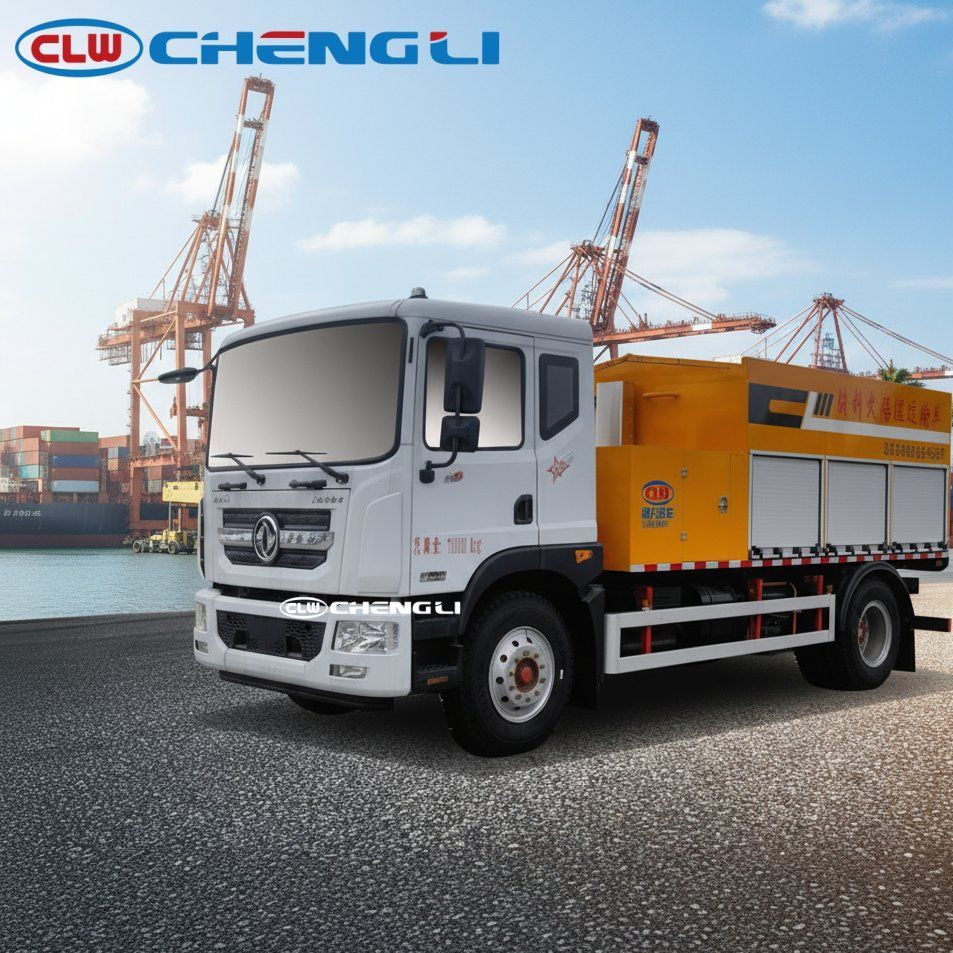
| Truck-mounted attenuator (TMA) | Protecting crews in work zones | Crash-test speed and impact masses of the complete system | JMC double-row carriers, 4,150 kg GVW, 70K label |
| Bitumen patching truck | Pothole and crack repair | Heated tank, hopper insulation and tools carried | Dongfeng D9 with a 500 L heated bitumen tank |
| Cement slurry spreader | Pavement and base treatment | Payload and spray equipment | Dongfeng 4x2 rated for 9 t |
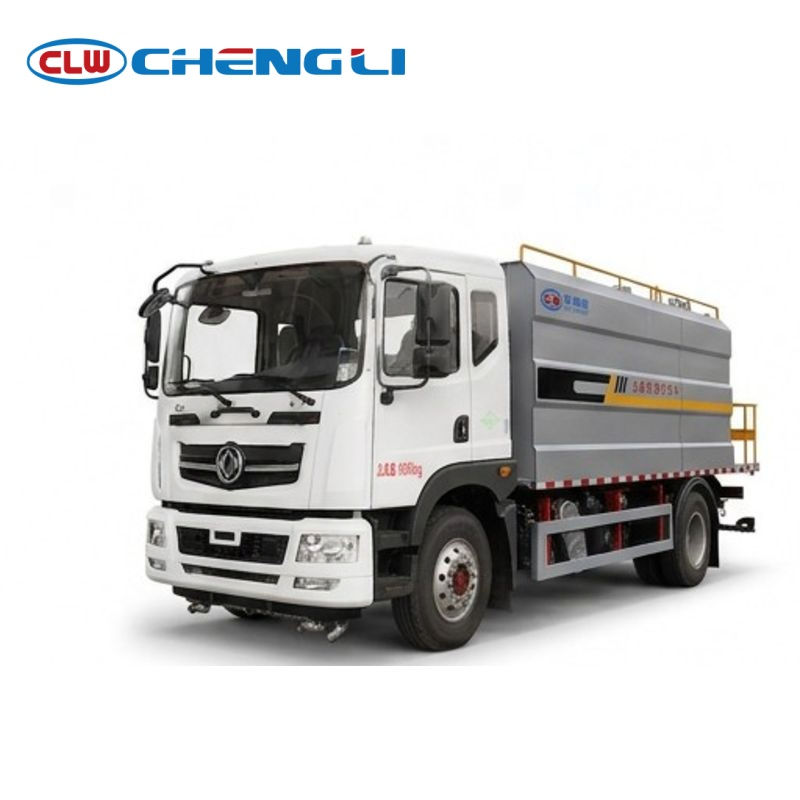
| Road washer | Washing curbs, lanes and street furniture | Vehicle width and water volume | Compact electric washers in our road sweeper range |
Winter maintenance: salt spreaders and snow plow trucks
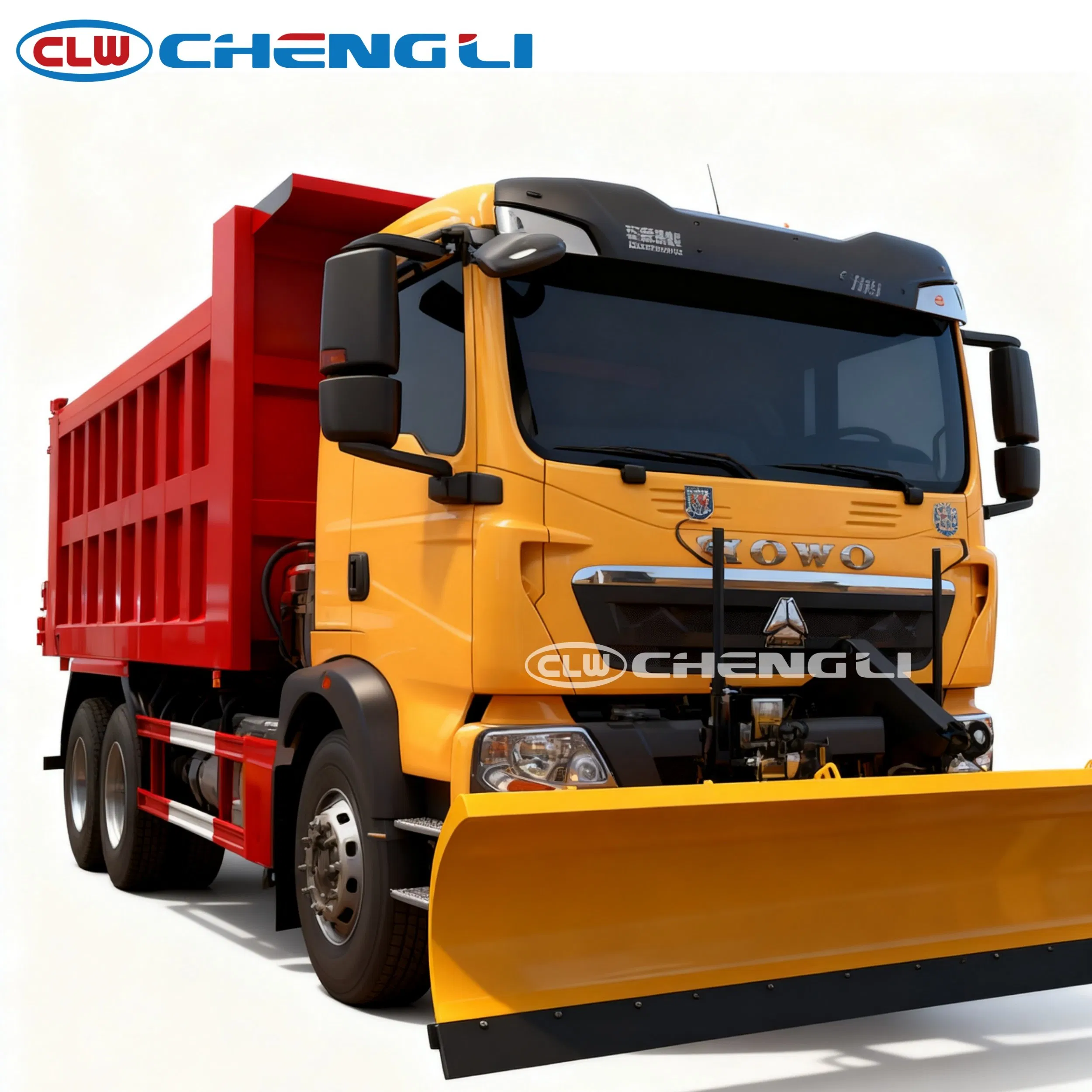
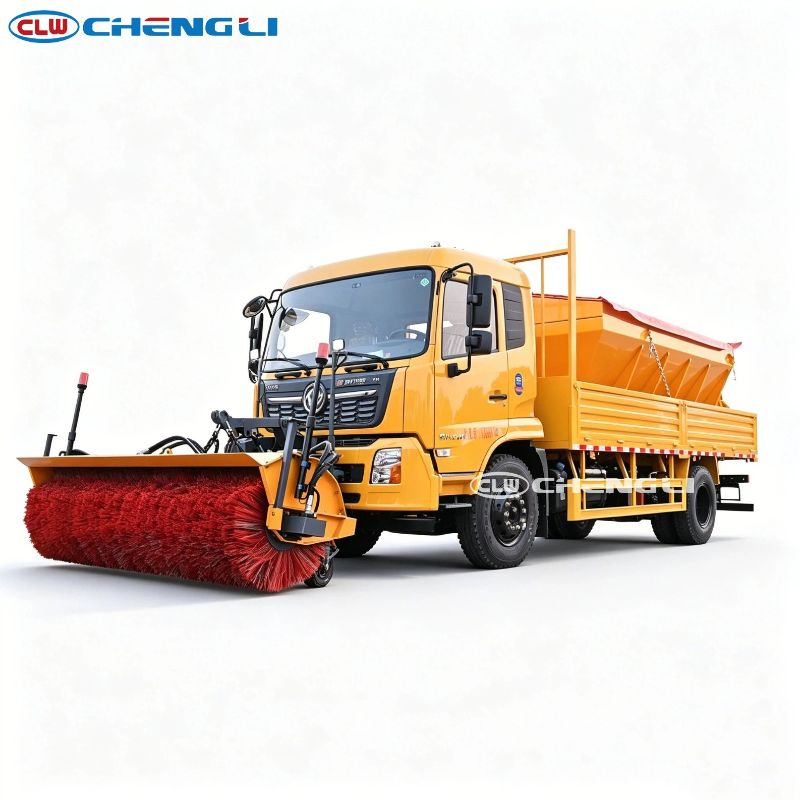
A winter truck combines a rear spreader with a front snow attachment. Our Dongfeng CL5180 8 m³ salt spreader uses a Q235 steel hopper, a scraper-chain conveyor and a 550 mm stainless-steel disc driven through a chassis power take-off. It spreads 2–14 m wide at 20–300 g/m² and works at 5–45 km/h, controlled from the cab. The HOWO 6x4 carries a 12 m³ spreader, spreads 2–15 m wide at the same working speeds and takes either a snow roller or a blade in front.
Front attachments suit different snow. A blade pushes deep or packed snow aside; a rotary brush sweeps light snow and slush off the surface. Many fleets specify the attachment by route, so confirm which one your roads need rather than ordering both by default. Both trucks come with an arrow warning light, tarpaulin cover, filter screen and rear ladder.
Hopper volume vs payload on a spreader
A spreader hopper is sized in cubic meters, but the truck is licensed in kilograms. Dry rock salt weighs about 1.2 t per cubic meter, varying with grain size and moisture, and sand or grit mixes weigh more. That turns hopper volume into a weight check:
- 8 m³ Dongfeng: 9,000 kg payload. A full hopper of salt at about 1.2 t/m³ is about 9.6 t, so the legal fill is about 7.5 m³.
- 12 m³ HOWO 6x4: 10,305 or 10,370 kg payload depending on build. A full hopper of salt is about 14.4 t, so the legal fill is about 8.6 m³.
The larger hopper still earns its place with lighter material and for gritting mixes measured by volume, but plan shift length on payload. Coverage follows from the spread rate: 9,000 kg of salt at 30 g/m² treats about 300,000 m², or roughly 43 km of road spread 7 m wide. Ask whether spreader output follows ground speed or is set by the operator, since that decides how consistent the rate stays as the truck slows at junctions.
Truck-mounted attenuators for work-zone protection
A TMA is a crash cushion on the back of a truck that parks or crawls behind a road crew. If a driver misses the warning signs, the cushion absorbs the impact and the carrier's mass stops the errant vehicle short of the workers. Our JMC 70K double-row TMA truck carries a 1,650 × 2,000 × 650 mm cushion on a 4,150 kg GVW chassis with a five-seat cab, and its impact cases cover 1,100 kg and 2,270 kg vehicles at 70 km/h, plus 2,270 kg glancing and oblique impacts.
A rating label is not a certificate. In the US, attenuators are crash-tested under the AASHTO MASH procedure, where Test Level 2 is run at 70 km/h and Test Level 3 at 100 km/h. Match the test speed to the traffic speed on the roads where the truck will work, specify the test level your road authority requires and ask for the crash test report for the exact carrier and cushion at quotation. Some authorities also set a minimum carrier weight, so check it against the 4,150 kg GVW.
Pothole and surface repair trucks
Patching work needs hot material, tools and power on one vehicle. The Dongfeng D9 bitumen road maintenance truck carries a 500 L heated bitumen tank with thermal-oil heating, a Liyalu G10 burner, an insulated high-viscosity pump and a manual spray nozzle for tack coating repairs. A V-shaped hopper with 150 mm insulation and a hydraulic auger handles material, a 7 kW gasoline generator powers the equipment and a quick coupling runs a hydraulic pickaxe. Controls sit in the cab and at the rear, and the 18,000 kg GVW chassis is rated for 7,370 kg of payload.
Wider treatments call for dedicated trucks. The Dongfeng 4x2 cement slurry spreader, rated for 9 t on an 18 t chassis, applies slurry through a lifting spray device with a railed rear platform for the operator. For resurfacing and tack coats over whole lanes, an asphalt distributor with a full-width spray bar is the right tool; our guide to asphalt distributor tank size and spray rates covers that choice.
Matching vehicles to your maintenance program
Most road authorities work in seasons. Winter spreaders and plows run hard for a few months and stand the rest of the year, while patching, slurry and washing work peaks in the dry season. A TMA is needed all year wherever crews work next to live traffic, and often in more than one place at a time. Start from your network length, the number of crews working at once and your winter severity, then size each group. Our roads and utilities solutions show how these trucks fit alongside sweepers, water trucks and construction vehicles.
What to confirm before ordering road maintenance vehicles
- Spreader material: salt, grit or a mix, its density, and the legal fill it allows on each chassis.
- Spread settings: width and rate ranges your treatment plan needs, and whether output should follow ground speed.
- Snow attachment: blade or rotary brush for each route, with the plow mounting and hydraulics to suit.
- TMA test level: the test standard, speed and impact masses your road authority requires, with the crash test report for the complete carrier and cushion.
- Patching equipment: bitumen heating, hopper insulation, generator and hydraulic tools for your repair method.
- Crew and cab: seat count for the crew each truck carries, such as the five-seat double-row TMA cab.
- Market details: emission level, left- or right-hand drive and local lighting and marking rules for work vehicles.
FAQ
What is a road maintenance vehicle?
It is any truck built to keep an existing road open and safe, rather than to build a new one. The main types are winter spreaders and plows, truck-mounted attenuators for work zones, pothole patching trucks, slurry spreaders and road washers. Road construction trucks, such as asphalt distributors, overlap with maintenance when they apply tack coats and surface treatments to existing roads.
How much salt does a salt spreader truck carry?
Payload decides it, not hopper size. Our 8 m³ spreader is rated for 9,000 kg, which is about 7.5 m³ of dry rock salt at 1.2 t/m³. The 12 m³ HOWO 6x4 is rated for 10,305–10,370 kg, about 8.6 m³ of salt. With lighter materials, more of the hopper can be used; with wet salt or grit, less.
What does 70K mean on a TMA truck?
On our JMC TMA trucks, 70K is a rating label tied to impact cases at 70 km/h with 1,100 kg and 2,270 kg vehicles. It describes the cushion's test speed class, not a certificate for your market. Ask for the crash test report behind the label and compare it with the test level your road authority requires before the truck works behind a crew.
Can one truck do winter and summer maintenance?
Partly. A spreader chassis with a front plow mount spends summer idle unless the body can be changed, and a patching truck carries heated equipment a spreader cannot. Some fleets use a TMA all year and pair it with seasonal trucks. Tell us your seasonal workload and we will suggest where one chassis can cover two jobs and where it cannot.
Choose road maintenance vehicles group by group: spreaders by material weight and spread settings, TMAs by tested speed, patching trucks by repair method. Compare current builds in our road maintenance vehicle range, then send your network, winter conditions and crew plan through our contact page, and our engineers will propose a fleet.