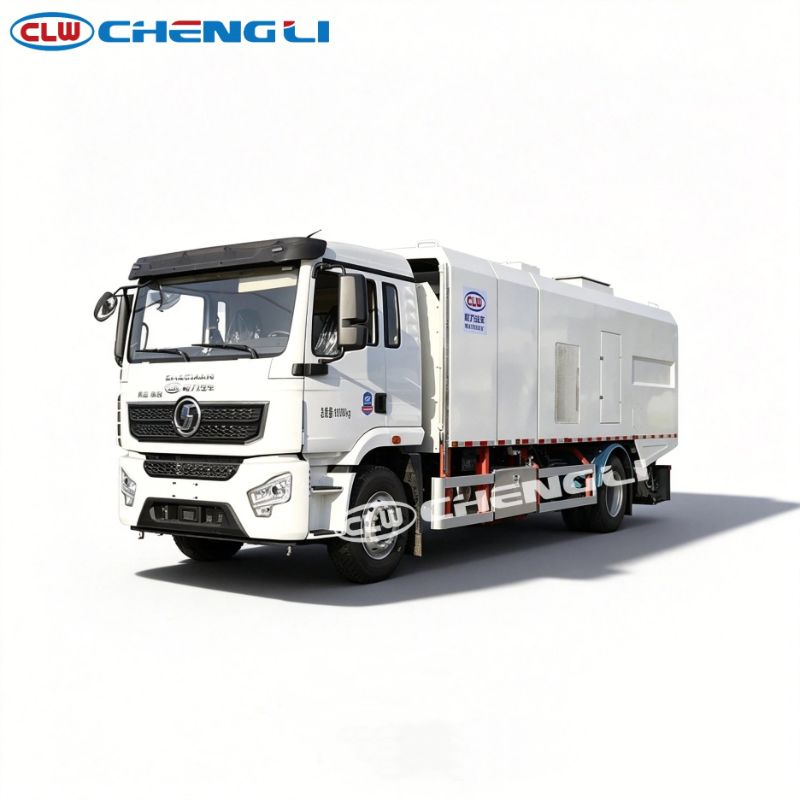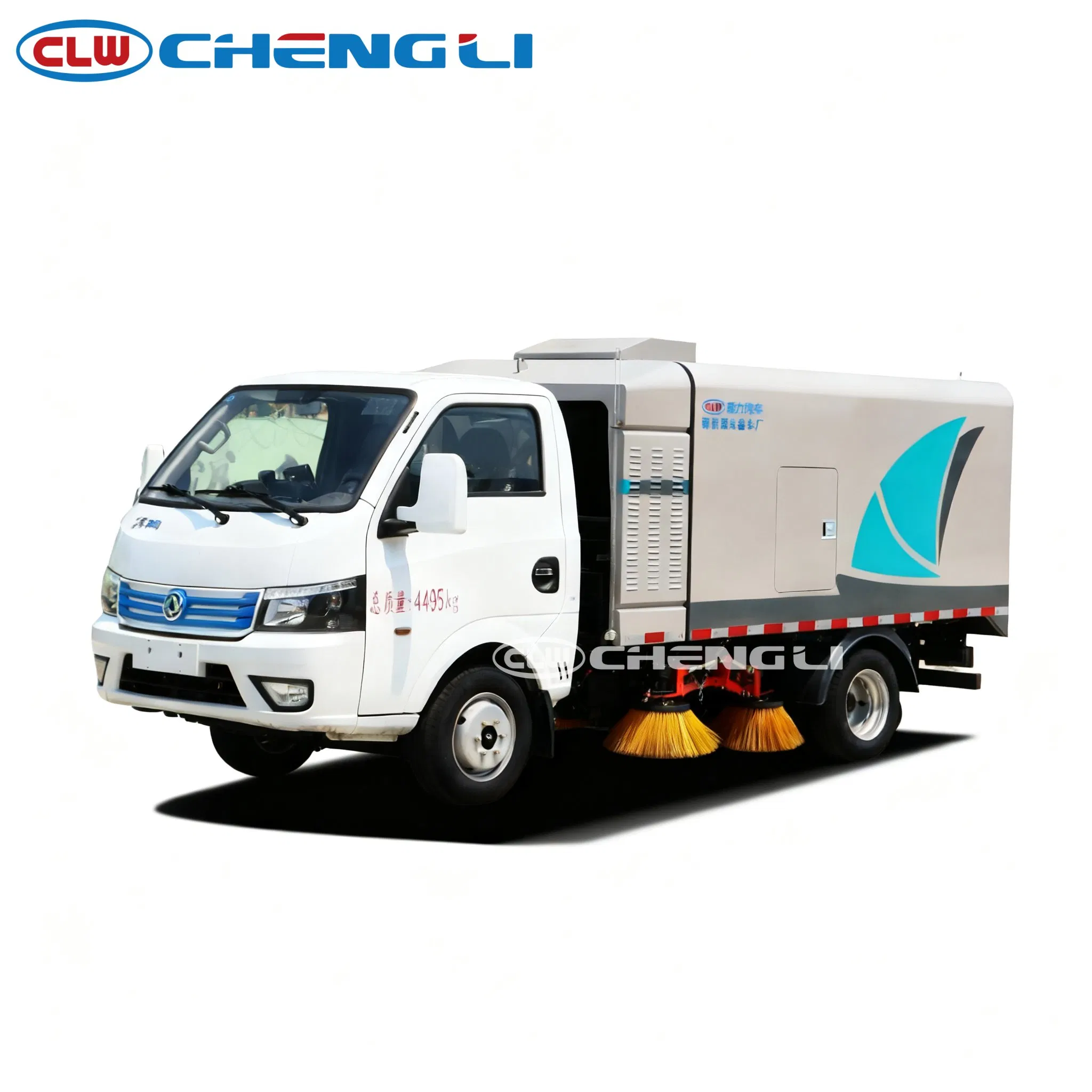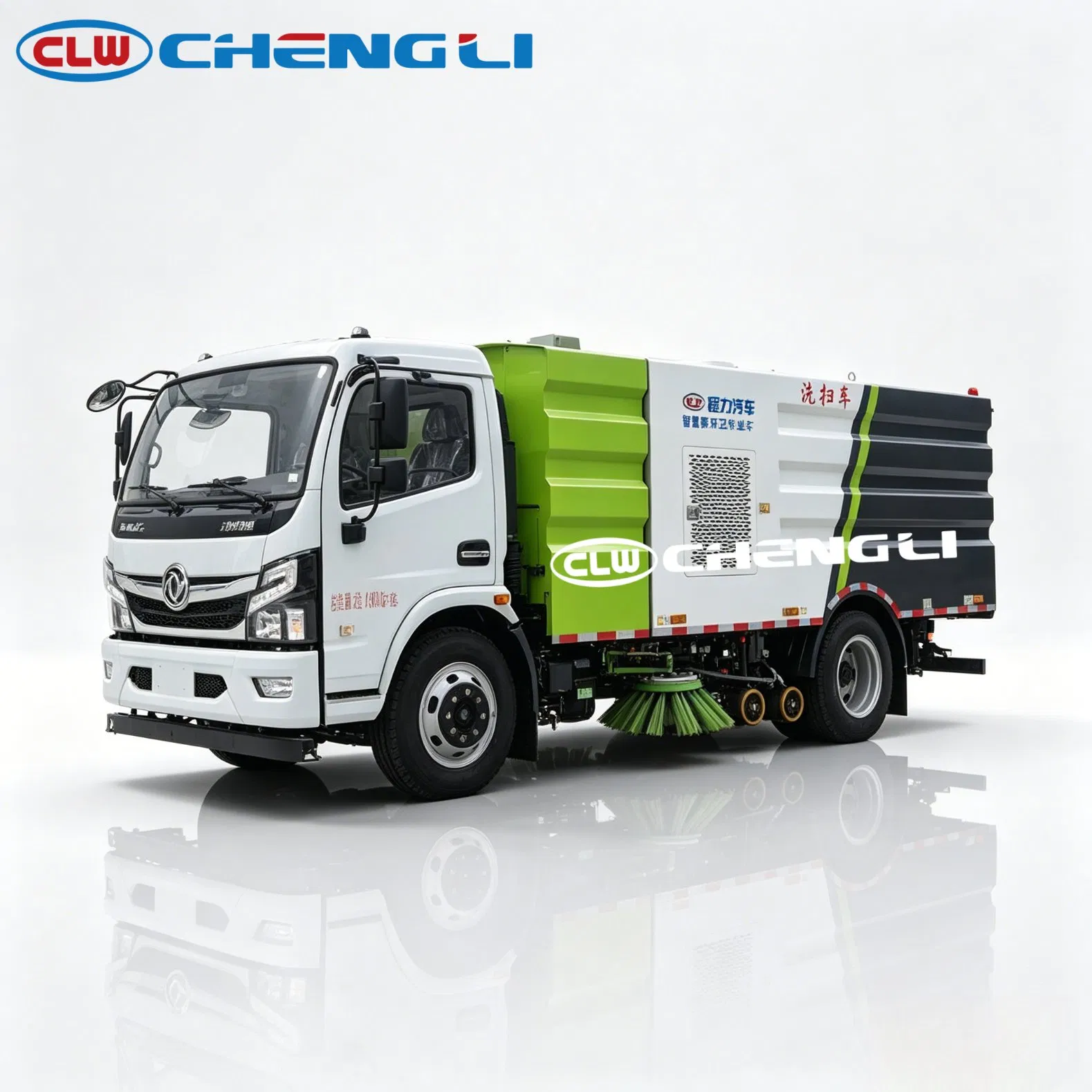
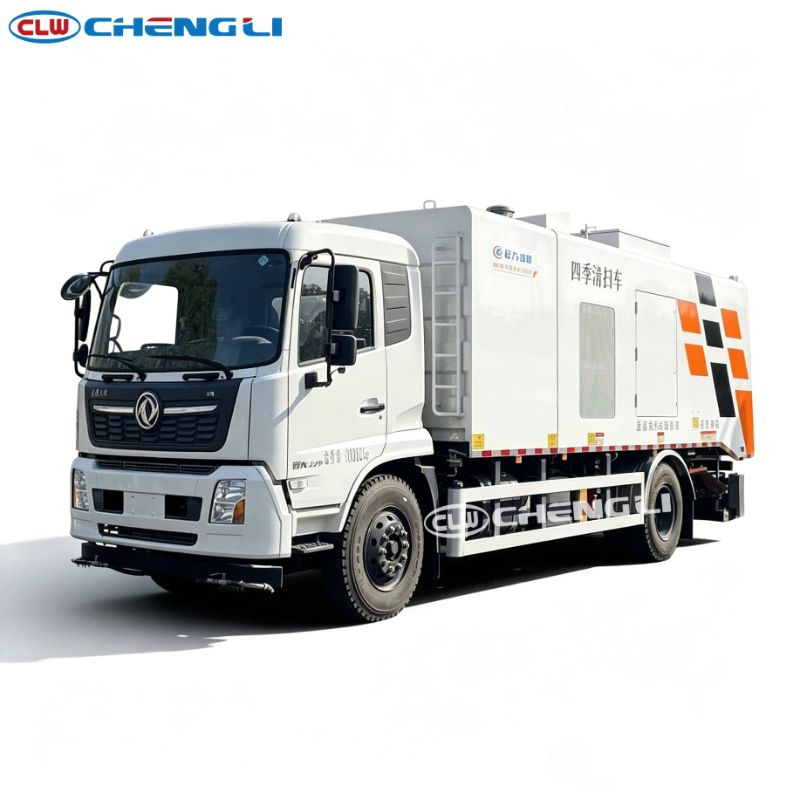
The first decision is pure sweeping or wash-and-sweep; the second is the sweeping width that fits your streets. Our road sweeper trucks run from a 1.5 m compact electric unit on a 1,950 kg chassis to 3.5 m wide machines, with debris hoppers of 4–11 m³ and water tanks of 4.2–6.5 m³ on trucks of up to 18,000 kg GVW.
Pure sweeping or wash-and-sweep: which cleaning method fits?
Every road sweeper truck lifts debris into a hopper. What changes is how much water it uses, and water decides the tank layout and the payload left for debris.
Pure (dry) sweepers
A dry sweeper uses side brushes to push debris into the path of a suction nozzle, and a fan pulls it into the hopper. Water is limited to a light dust mist or left out entirely. Our Dongfeng Huashen dry-type electric sweeper covers up to 3.2 m on a 4,495 kg GVW 4x2 chassis, and the Geely compact unit clears 1.5 m with a high-pressure centrifugal fan. Dry machines are light and simple, but they stir up fine dust unless filtration is good.
Wash-and-sweep trucks
A washing sweeper adds a high-pressure water circuit ahead of or between the brushes. The jets loosen caked mud and silt, the brushes gather it and suction picks up the slurry. The CL5180 electric washing and sweeping truck runs a PT36 plunger pump at up to 115 L/min and 10 MPa from a 4.2 m³ clean-water tank. At full flow that tank lasts about 36 minutes, so refill points belong in the route plan. Our compact Dongfeng diesel washer-sweeper does the same job in a 2,300 mm wide body.
Dry-wet vacuum sweepers
Between the two sits the vacuum sweeper built for heavy dust. The CLW5188 dry-wet road sweeper pairs an 11 m³ dust tank with a 6.5 m³ water tank and 12 filter cartridges, so it can run dry with filtered exhaust air or wet to keep dust down. Our electric road pollution sweeper follows the same idea with a 4.5 m³ hopper and a 4 m³ filter cartridge silo. These are the trucks for coal yards, ports, mines and construction access roads.
As a rule of thumb, choose dry sweeping for leaves, litter and loose grit on regularly cleaned streets, wash-and-sweep where mud, silt or oily residue sticks to the surface, and a dry-wet vacuum unit where airborne dust is the main complaint. A sweeper rarely works alone; see how it fits with collection and washing vehicles in our municipal sanitation fleet solutions and our guide to garbage truck types.
Sweeping width: matching the machine to your streets
Sweeping width is measured across the brushes at full reach, not across the vehicle body. Our range runs from 1.5 m on the Geely compact sweeper to 2.4 m on the CL5180, 3.2 m on the Dongfeng Huashen and the compact Dongfeng washer-sweeper, and 3.5 m on the two 11,995 kg GVW Dongfeng electric units.
Width sets the area you clean per hour. For example, a 3.5 m path at 10 km/h covers a theoretical 35,000 m² per hour, twice what a 1.75 m path covers at the same speed. Working speeds are 3–20 km/h on the Dongfeng electric units and 3–25 km/h on the CLW5188; real output falls with debris load, parked cars and turns.
The vehicle body matters as much as the brush reach. Overall widths run from 1,420 mm on the Geely unit and 1,700 mm on our mini 27 kW electric sweeper to 2,550 mm on the 18,000 kg trucks, and lengths from 4,050 mm to 9,400 mm; the CL5180 needs a 20 m turning diameter. Small chassis win in old town centers, markets and park paths. On arterial and ring roads, the 3.2–3.5 m machines finish in fewer passes.
Hopper and water tank volumes, and the payload behind them
Volume tells you how much space the truck has; payload tells you how much of it you can fill. Water weighs about 1,000 kg per m³, so a full 6.5 m³ tank carries about 6,500 kg (14,330 lb) before any debris is collected. Dry sand weighs roughly 1.5 t per m³, so a hopper full of road grit reaches its weight limit long before it is full, while leaves and litter fill it by volume first.
| Sweeper | Cleaning method | Power | Sweeping width | Hopper | Water tank | GVW |
|---|---|---|---|---|---|---|
| Geely compact sweeper | Dry, brush and fan suction | Electric, 15.97 kWh | 1.5 m | Confirm at quotation | Confirm at quotation | 1,950 kg |
| Dongfeng Huashen CL5040TXSBEV | Dry type | Electric, 55.7 kWh | 3.2 m | Confirm at quotation | Dry type | 4,495 kg |
| Compact Dongfeng washer-sweeper | Wash, sweep and suction | Diesel, 93–136 kW (126–184 hp) | Up to 3.2 m | Confirm at quotation | Stainless, size to confirm | 7,360 kg |
| Dongfeng electric sweeper | Wet and dry sweeping | Electric, 110 kWh | 3.5 m | 4 m³ | 5 m³ | 11,995 kg |
| Dongfeng road pollution sweeper | Suction with filter silo | Electric, 110 kWh | 3.5 m | 4.5 m³ | Confirm at quotation | 11,995 kg |
| CL5180 | Wash, sweep and suction | Electric, 264 or 315 kWh | 2.4 m | Confirm at quotation | 4.2 m³ | 18,000 kg |
| CLW5188 | Dry-wet suction, 12 filter cartridges | Diesel, 210 hp auxiliary engine | Confirm at quotation | 11 m³ | 6.5 m³ | 18,000 kg |
The compact Dongfeng washer-sweeper has a 1,430 kg rated payload on a 7,360 kg GVW, so water and debris together must stay under that figure. The electric road pollution sweeper carries 4,050 kg; its 4.5 m³ hopper filled with wet grit would exceed that on its own. Ask for the axle load split with a realistic mix of water and debris, not with every tank at nominal volume.
Electric or diesel road sweeper?
Six of our eight road sweeper trucks are battery-electric, with packs from 15.97 kWh on the Geely unit to 264 or 315 kWh on the CL5180. Quoted driving ranges are 135 km for the Geely, 220 km for the Dongfeng Huashen and 300 km for the two 110 kWh Dongfeng units. Brushes, fan and pump draw from the same battery, so range while sweeping is shorter; ask for an energy estimate for your shift length and cleaning mode.
Charging is the other planning item. The Dongfeng Huashen accepts 30 kW charging, so its 55.7 kWh pack needs a little under two hours from empty at full charger power, before losses. Larger packs need more charger power or longer depot time. Electric sweepers suit night work in city centers, pedestrian zones and semi-enclosed areas where exhaust and noise matter; the Geely unit runs at or below 88 dB.
Diesel remains the practical choice where charging is not available or shifts are long. The compact Dongfeng washer-sweeper takes power from the chassis engine through a PTO, which keeps the truck simple and light. The CLW5188 carries a separate 210 hp Cummins auxiliary engine for the fan and pump, so suction stays constant whatever the road speed or gear. The trade-off is a second engine to fuel and service. Specify the emission level your market requires and confirm it at quotation.
What drives road sweeper truck price
We quote each sweeper against a specification, so the useful question is which choices move the price.
Chassis class and GVW. A 1,950 kg micro chassis and an 18,000 kg two-axle truck differ in cab, axles, tires and body size.
Power source and battery size. On an electric sweeper the battery pack is a major cost item, and moving from 264 kWh to 315 kWh on the CL5180 adds to it. A diesel truck with an auxiliary engine costs more than one that runs its equipment from a PTO.
Cleaning system. A high-pressure plunger pump, filter cartridges, a dust silo and a rear suction nozzle each add parts beyond a basic brush-and-fan layout.
Tank and hopper materials. Stainless steel costs more than carbon steel. Our two 110 kWh Dongfeng units use 4.5 mm Q235 carbon steel for the tank body, while the compact washer-sweeper has a stainless water tank with filtration.
Spares and shipping. Spare brushes, filters and nozzles ordered with the truck add to the quotation. Vehicle size decides whether a sweeper travels in a container or as roll-on/roll-off cargo, and the destination port changes the freight cost.
What to confirm before ordering a road sweeper
- Debris and surfaces. Leaves, litter, grit, mud or construction dust, on asphalt, concrete or paving. Send photos of typical routes.
- Sweeping width and access. The width you need and the narrowest street, gate or depot entrance the truck must pass.
- Cleaning mode. Dry, wash-and-sweep or dry-wet, plus the water pressure and flow you expect from the washing circuit.
- Tank sizes and loaded weight. Hopper and water tank volumes, checked against a loaded-weight calculation with realistic debris density and your legal axle limits.
- Power and energy. The diesel emission level your market requires, or battery size, charger power and the charging time your depot allows.
- Discharge. Where the hopper empties, such as a transfer station, skip or open ground, and the tipping clearance needed; our 110 kWh Dongfeng units lift the bin to at least 45°.
- Drive side and controls. LHD or RHD, and which curbside the brushes and controls should favor.
- Starter spares. Brushes, filters, nozzles and hoses to hold in stock for the first months of work.
FAQ
What is the difference between a vacuum sweeper and a mechanical sweeper?
A vacuum sweeper lifts debris with a fan and suction nozzle, while a mechanical sweeper throws it onto a conveyor or into a hopper with a main broom. Vacuum units are better at fine dust, sand and small stones; mechanical brooms cope well with heavy, compacted material. Most of our current range uses brush-and-suction collection, so confirm the pickup method for the model you shortlist.
Is a washing sweeper the same as a water sprinkler truck?
No. A water sprinkler truck carries a large tank and sprays water for dust suppression, road washing or irrigation, but it does not collect anything. A washing sweeper uses its water to loosen dirt and then brushes and vacuums the residue into a hopper. To settle dust on an access road, a sprinkler is simpler; for litter and silt, you need a sweeper.
Can a street sweeper truck work on wet roads or in rain?
Wash-and-sweep and dry-wet machines are built to handle water, so wet roads are part of their normal work. A dry sweeper can run on damp streets, but wet dust and mud clog cartridge filters and stick inside suction hoses, which cuts airflow. If your routes are often wet, choose a model with a washing circuit and plan more frequent filter and hose cleaning.
What wears out fastest on a road sweeper truck?
Brushes wear first, followed by suction hoses, nozzles, filters and fan components exposed to abrasive grit. When suction drops, check the nozzle gap to the road, look for blocked hoses, inspect fan wear and reset brush height. Daily filter and nozzle checks after dusty work, plus periodic lubrication, keep pickup steady and protect the fan.
How often does a sweeper need to unload?
It depends on debris density, not just hopper size. A 4 m³ hopper sweeping leaves may run a full shift, while the same hopper collecting sand can reach the payload limit in a short stretch of dirty road. Plan unloading points along the route, and on wash-and-sweep trucks time them with water refills.
Choose the cleaning method from the dirt on your streets, the sweeping width from your narrowest route and the tank sizes from the payload the chassis can legally carry, then decide electric or diesel by shift length and charging access. Browse our road sweeper truck range, or tell us your street widths, debris type and shift pattern and our engineers will propose a configuration.