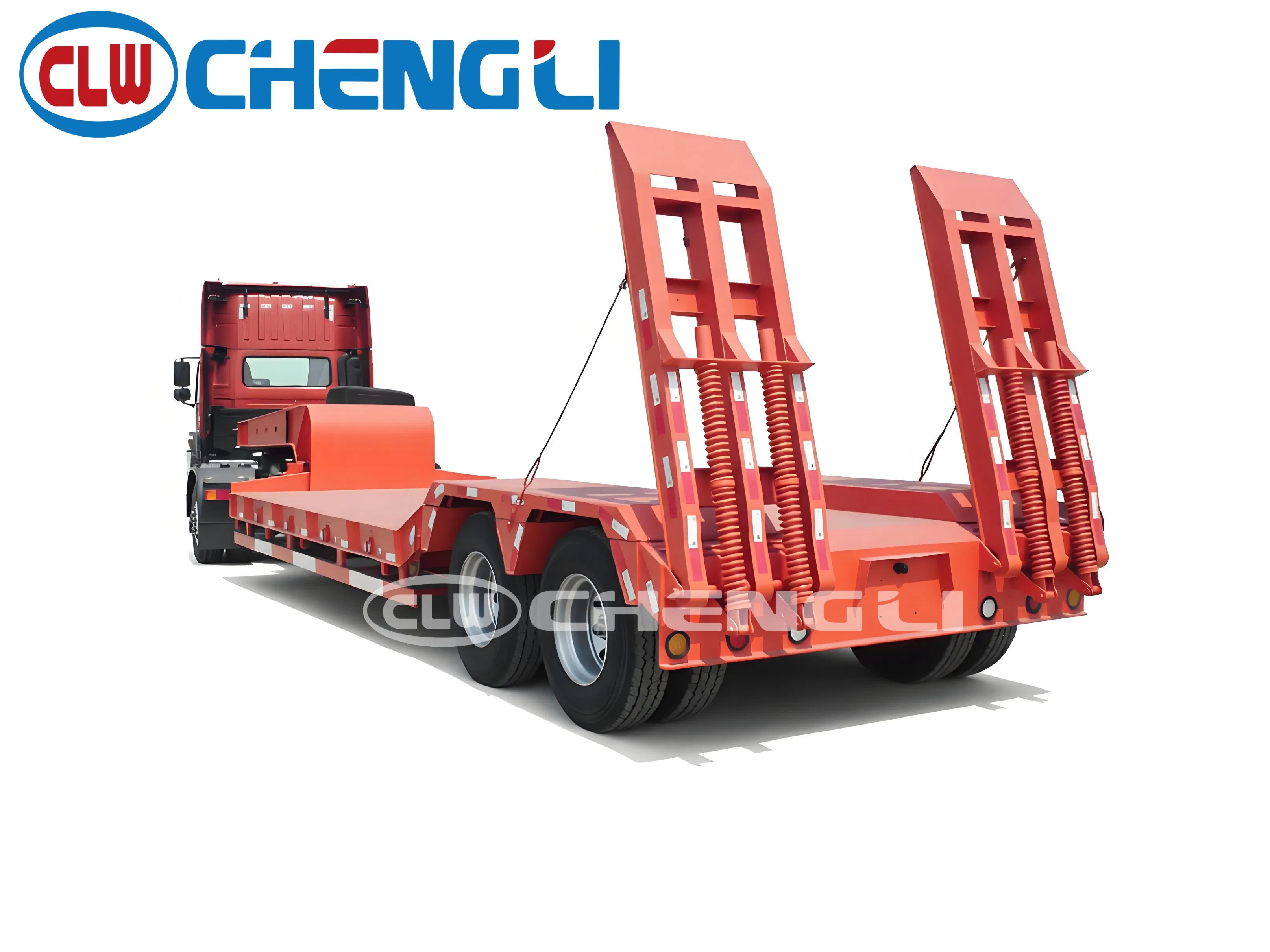
The cargo picks the trailer: loose powder needs a pneumatic tank, pellet feed needs an auger tank, containers need a skeletal chassis, machinery needs a low, wide flatbed, and mixed pallets need a stake or fence body. The main semi-trailer types are flatbed and skeletal, side wall (stake), tank and bulk, and refrigerated van. Tippers and lowbeds complete the usual list.
Semi-Trailer Types at a Glance
The table below groups the semi-trailers we build by body type. Figures are for the configurations in our current range, so treat them as reference points for comparison.
| Trailer type | Typical cargo | Axles | Capacity in our range |
|---|---|---|---|
| Flatbed platform | Machinery, steel, project cargo | 2 | 35,000 kg GVW, 3,000 mm wide deck |
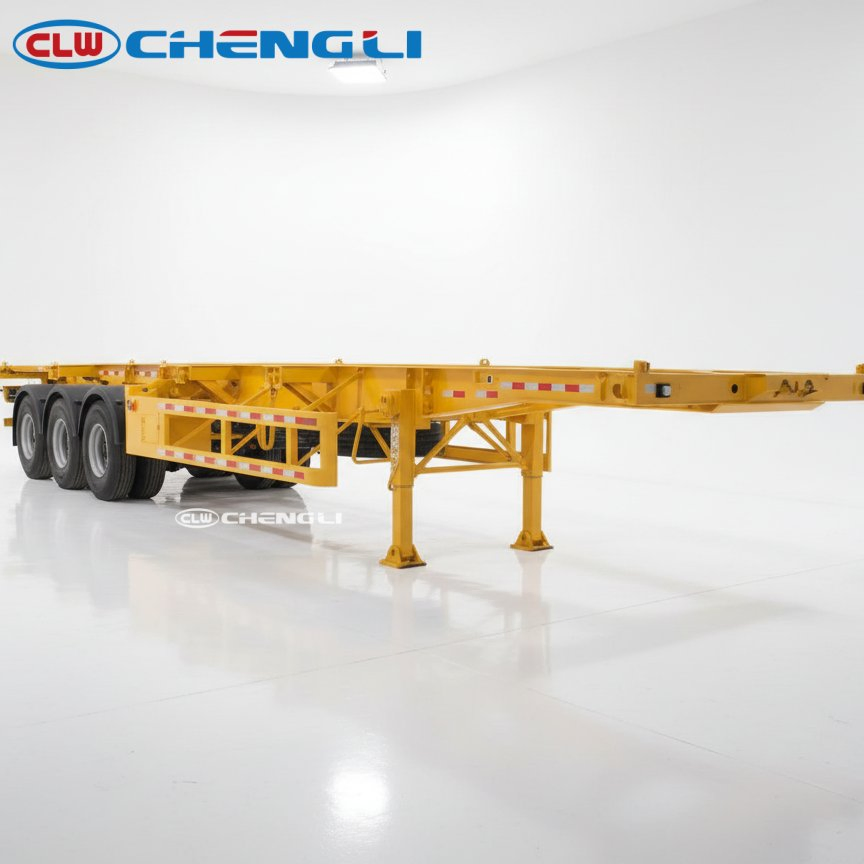
| Skeletal container chassis | 40 ft containers, tank containers | 3 | 33,100 kg payload |
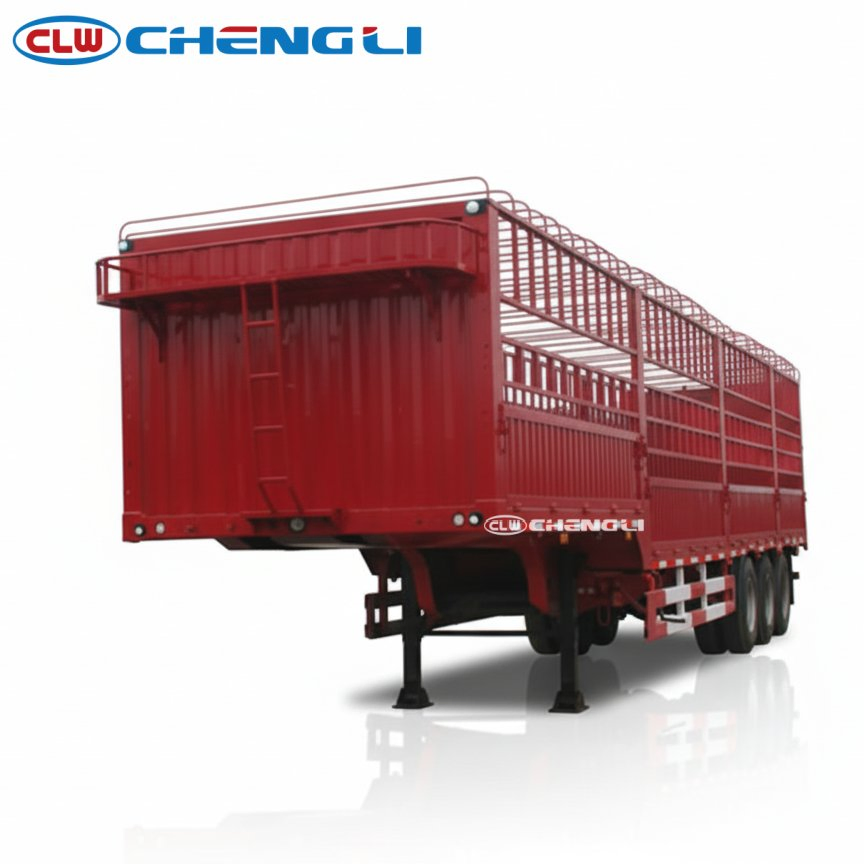
| Stake (fence) trailer | Bagged goods, crops, general cargo | 3 | 33,650 kg payload |
| Refrigerated van | Chilled and frozen food | 3 | 74–80 m³, 29,600–31,900 kg payload |
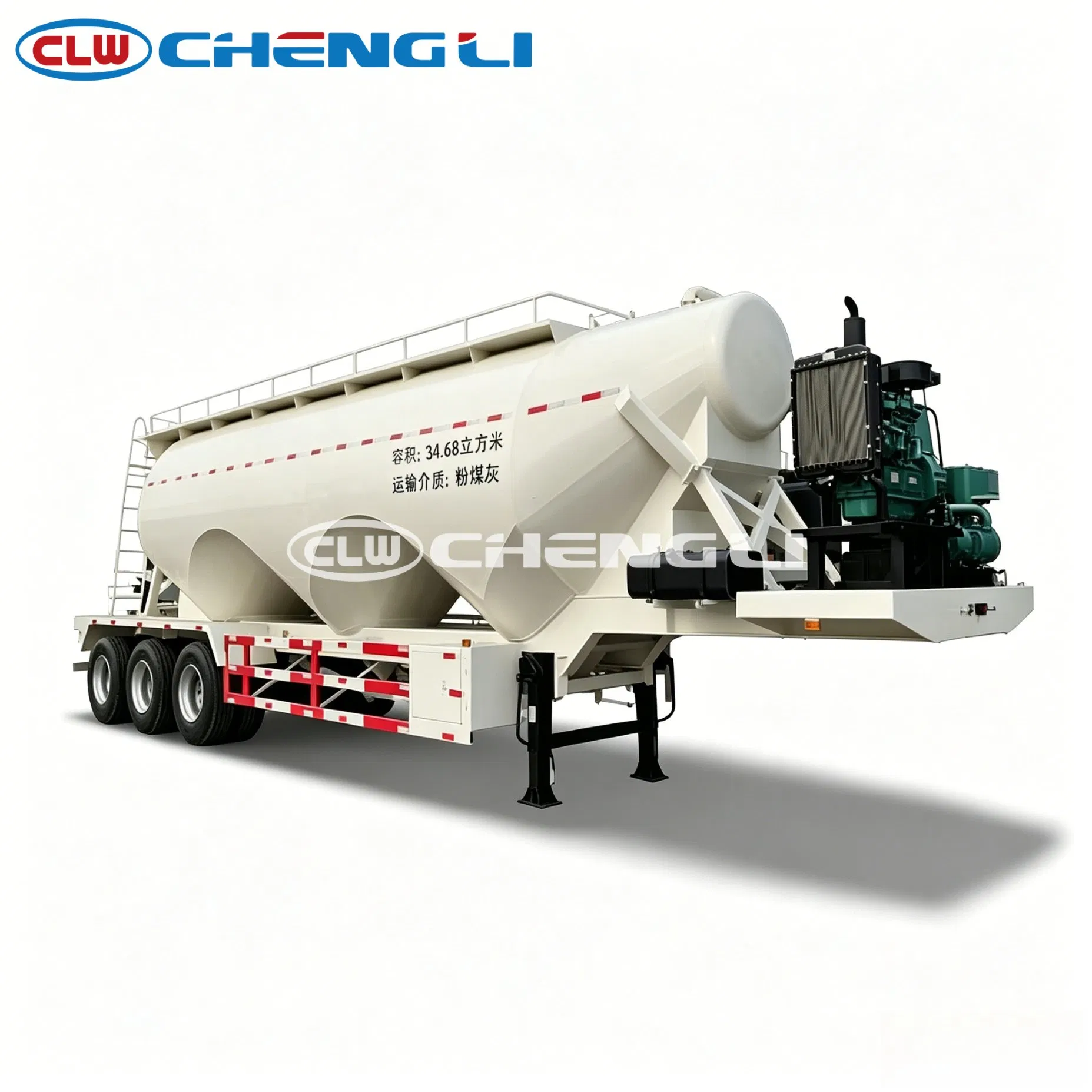
| Cement powder tank | Cement and dense powders | 3 | 35–45 m³, 46–50 t rated load |
| Flour powder tank | Flour and food powders | 3 | 40–60 m³, 25–30 t load |
| Feed tank | Pellet and bulk feed | 2 or 3 | 58–60 m³, 27,700–32,800 kg payload |
| Liquid tank | Milk, sulfuric acid | 3 | 32–32.2 m³, 28,500–32,200 kg payload |
Flatbed, Skeletal and Lowbed Trailers
Flatbed semi-trailers
A flatbed takes anything that can be craned on or driven up ramps and chained down. Our two-axle machinery flatbed has a 3,000 mm wide deck, a 1,150 mm unloaded platform height and a 35,000 kg gross vehicle weight. Read that last figure carefully: after the 6,200 kg curb weight, the cargo allowance is about 28,800 kg, not 35 t. The wide deck suits machinery, but many markets treat anything over 2,550 mm as oversize, so check permit rules on your routes.
Skeletal container chassis
A skeletal trailer keeps only the main beams, cross members and container locks, so it is lighter than a flatbed but carries containers and nothing else. Our three-axle container trailer comes either as a skeletal frame for 40 ft containers and frame-style tank containers, or with a flatbed deck for general cargo on return trips. It carries a 33,100 kg payload on a 6,500 kg curb weight. Choose skeletal for port and depot shuttles; choose the deck version when return loads are rarely containerized.
Lowbed trailers for machinery
A lowbed drops the deck between the gooseneck and the axles so tall machines such as excavators stay under height limits. We do not currently list this type. As a check, on a route with a 4,000 mm height limit, our 1,150 mm flatbed deck leaves about 2,850 mm for the machine; anything taller needs a lowbed.
Side Wall, Fence and Refrigerated Van Trailers
Stake and fence trailers
A side wall or fence trailer adds a low steel box and removable posts to a flat deck so stacked or loose cargo cannot shift off the side. Our three-axle 33.65 t stake semi-trailer is 13,000 mm long, with a 600 mm high steel bottom box holding 19 m³, rack heights of 1,800 to 2,400 mm, and sides that open in four to seven sections.
Fewer, wider opening sections give forklifts a long clear opening; six or seven narrower sections let a crew open only the part of the side needed at each drop. Dense cargo reaches the payload limit long before the top rail, so match rack height to cargo density rather than ordering the tallest option.
Refrigerated van trailers
A refrigerated van is a closed, insulated box with a refrigeration unit on the front wall. Our three-axle reefer trailers offer 74 to 80 m³ and 29,600 to 31,900 kg of payload, and the 78 m³ and 80 m³ versions are rated for −30 to +25 °C. Tell us the product temperature and the hottest ambient temperature on the route, because those two figures size the insulation and the unit.
Tank and Bulk Trailers
Tank trailers split into powder tanks that unload with compressed air and liquid or feed tanks that unload by pump, gravity or auger. Cargo density sets the right volume, which is why our tank sizes vary so much at similar payloads.
Bulk cement trailers and flour tanks
Bulk cement weighs about 1.3 to 1.5 t/m³, so a small tank reaches the weight limit quickly. Full, our 35 m³ three-cone cement tank would hold roughly 46 to 53 t, in line with its 46,000 kg payload rating; a 45 m³ version is also available. Flour is far lighter, so our 304 stainless steel flour tanks run from 40 to 60 m³ at 25 to 30 t ratings. They unload at 0.2 MPa through a 7 m hose with a design residue below 0.1%, and partitioned versions keep two products apart.
Bulk feed trailers
Feed trailers deliver pellets from the mill to farm silos, usually with augers, which are generally gentler on pellets than pneumatic transfer. Volumes in our range run from 58 to 60 m³ and payloads from 27,700 to 32,800 kg. The three-axle, four-auger version has a 9 m top auger that lifts hydraulically and swings 180° to silo inlets, with up to five separately controlled compartments for multi-drop routes. See our agriculture and livestock transport page for farm-side planning.
Liquid tanker semi-trailers
For liquids we build two very different tanks. The 32.2 m³ milk tanker uses 304 food-grade stainless steel, a mirror-polished interior and polyurethane foam insulation, with up to four compartments. The 32 m³ sulfuric acid tanker uses lined carbon steel, pressure relief and reinforced manholes. Confirm tank material against your cargo's safety data sheet. We do not currently list fuel tank semi-trailers.
Tipper trailers
Tipper semi-trailers lift the whole body with a front hydraulic cylinder to dump sand, gravel or ore. We do not currently list this type.
Axle Count, Suspension and Kingpin Choices
Gross weight is shared between the trailer axles and the tractor's fifth wheel. On our two-axle flatbed, 18,000 kg sits on the axles and 17,000 kg on the fifth wheel. On our three-axle reefers, the axle group carries 24,000 kg of a 40,000 kg gross weight, leaving about 16,000 kg on the kingpin. Two axles save curb weight and tires; three become necessary as gross weight approaches 40 t, which is why nearly all of our range is three-axle.
Leaf springs are standard on almost every trailer we build: simple, easy to repair on the roadside and tolerant of rough roads. Air suspension, fitted to our 59.3 m³ feed semi-trailer and available on the acid tanker, rides softer and is kinder to cargo and tank structure, but it needs clean compressed air and careful maintenance. Choose leaf springs for unpaved routes and remote workshops, air for long highway runs with sensitive loads.
The kingpin must match the tractor's fifth wheel jaw. The two common sizes are 2 in (50.8 mm, often called 50#) and 3.5 in (88.9 mm, often called 90#). Most of our trailers use the 90# kingpin; the 35 m³ cement tanker can take either. Also check kingpin setback, which sets swing clearance to the cab, and coupling height, so the trailer rides level.
Matching a Tractor Head to the Trailer
Buy the tractor and trailer as a pair and check four things: towing rating, fifth wheel size, drive configuration and fifth wheel load. Our tractor heads show how the choice shifts with the work.
On paved highways and maintained site roads, our 6x4 diesel tractor with a 340 hp engine and a 30 to 40 t towing rating suits the 40,000 kg gross trailers above. For mine access and unpaved routes, our 6x6 tractor with a 460 hp engine and a 50 t towing rating keeps traction when the road turns to mud. Both use a 90 mm fifth wheel that pairs with the 90# kingpin. For short, repeatable runs such as port container shuttles, our 6x4 electric tractors handle roughly 37.6 to 38.7 t of trailer, with rated ranges of 295 km and 300 km.
Heavy bulk trailers need a second look. Our 35 m³ cement tanker has a 53,250 kg gross weight, above the 50 t towing rating of even the 6x6, so match its loaded weight to your tractor and road limits. And a 40,000 kg three-axle trailer puts about 16 t on the tractor's rear bogie, so check the tractor's rear axle rating.
What to Confirm Before Ordering
Most mismatches trace back to one of these points, so settle them before the specification is frozen.
- Cargo and density: product, bulk density or unit weight, and whether loads are mixed.
- Route limits: gross combination weight, axle loads, width, height and length in every country you cross.
- Payload in writing: curb weight and rated payload, plus a check that a full body at your cargo density stays within it.
- Axles and suspension: two or three axles, leaf springs or air, and tire size.
- Coupling: kingpin size (50# or 90#), kingpin setback and coupling height, checked against the tractor you will use.
- Loading and unloading: ramps or crane for flatbeds, opening sections for stake bodies, pneumatic or auger discharge and hose length for tanks.
- Materials and compartments: carbon steel, wear-resistant steel or 304 stainless steel, lining for chemicals, and the number of compartments.
- Braking and lighting: ABS type, air connections and the lighting and electrical standard of your market, confirmed at quotation.
FAQ
How long is a typical semi-trailer?
Length depends on body type. Our semi-trailers run from 9,000 mm overall for the two-axle feed trailer to 13,610 mm for an 80 m³ refrigerated van. Stake and flatbed trailers sit at 12,000 to 13,000 mm, and container chassis are sized to the container, with our 40 ft chassis at 12,400 mm. Maximum legal length varies by country, so confirm the limit for the complete combination, not just the trailer.
How much does an empty semi-trailer weigh?
Curb weight depends mostly on body type. In our range, open trailers are lightest: 6,200 kg for the two-axle flatbed, 6,350 kg for the stake trailer and 6,500 kg for the container chassis. Cement tanks weigh 7,250 to 8,200 kg, stainless flour tanks 9,500 to 10,500 kg and the 59.3 m³ feed trailer 11,300 to 11,750 kg. Every extra kilogram of trailer is a kilogram less of payload.
How much cargo can a three-axle semi-trailer carry?
At a 40,000 kg gross weight, our three-axle trailers carry 28,250 to 33,650 kg: the 59.3 m³ feed trailer sits at the low end, the stake trailer at the high end, and body weight explains the gap. Some bulk tankers carry higher ratings, such as the 35 m³ cement tanker at 46,000 kg, but whether you can use that rating depends on the axle and gross weight limits in your country.
Can one tanker semi-trailer carry both flour and feed?
It can if the tank is built for food-grade cargo and cleaned between loads. Our stainless multi-cone powder tanks are designed for flour, feed, grain and plastic pellets, with partitioned compartments, large manholes and smooth internal surfaces, and a washout system can be added. Carbon steel feed tanks are not a good choice for flour. Plan the cleaning routine and product sequence before you mix cargoes on one trailer.
Start with the cargo, then work outward: density and handling method pick the body, route limits pick the axles and gross weight, and the tractor you already run decides the kingpin and fifth wheel load. Browse our full range of semi-trailers to compare configurations, then send us your cargo, route limits and tractor model and our engineers will propose a trailer to match.