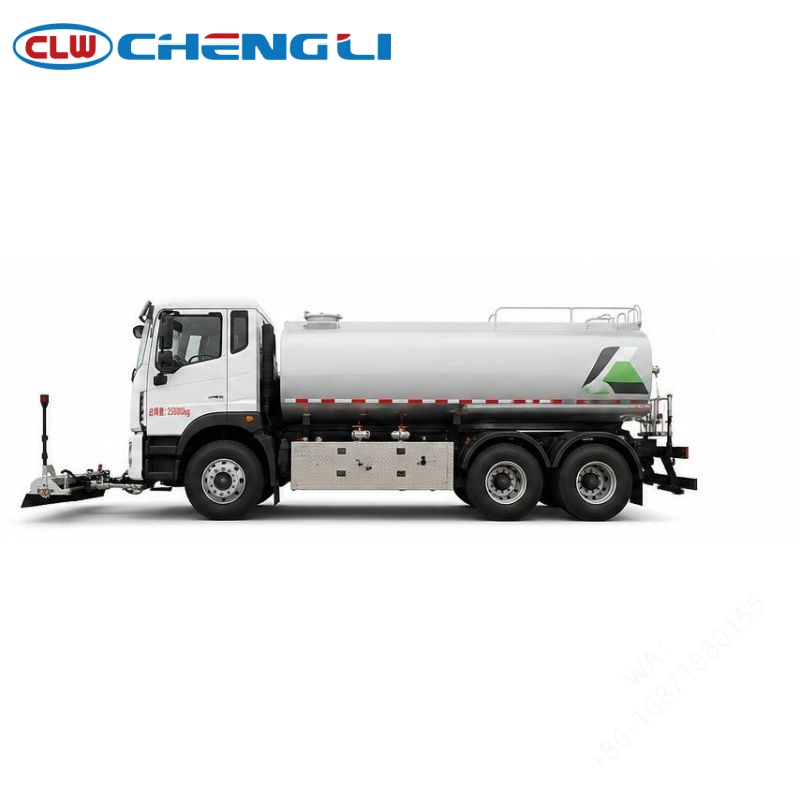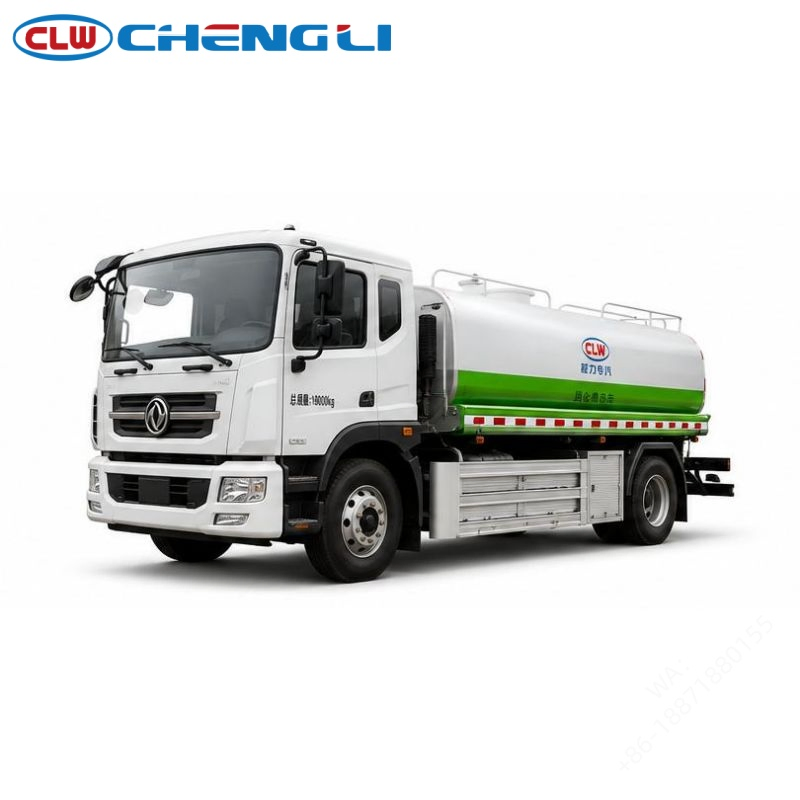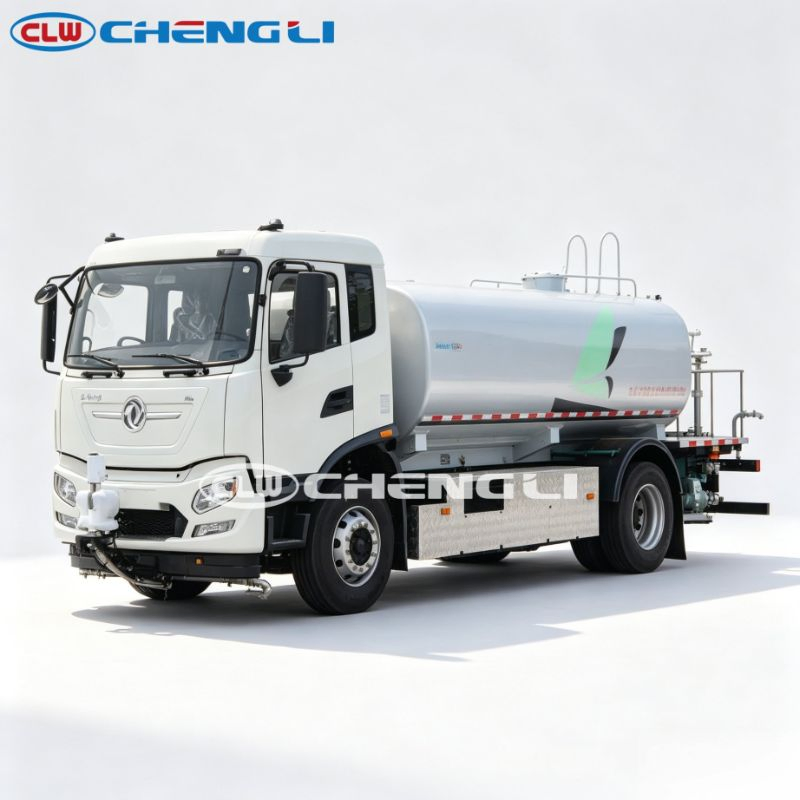
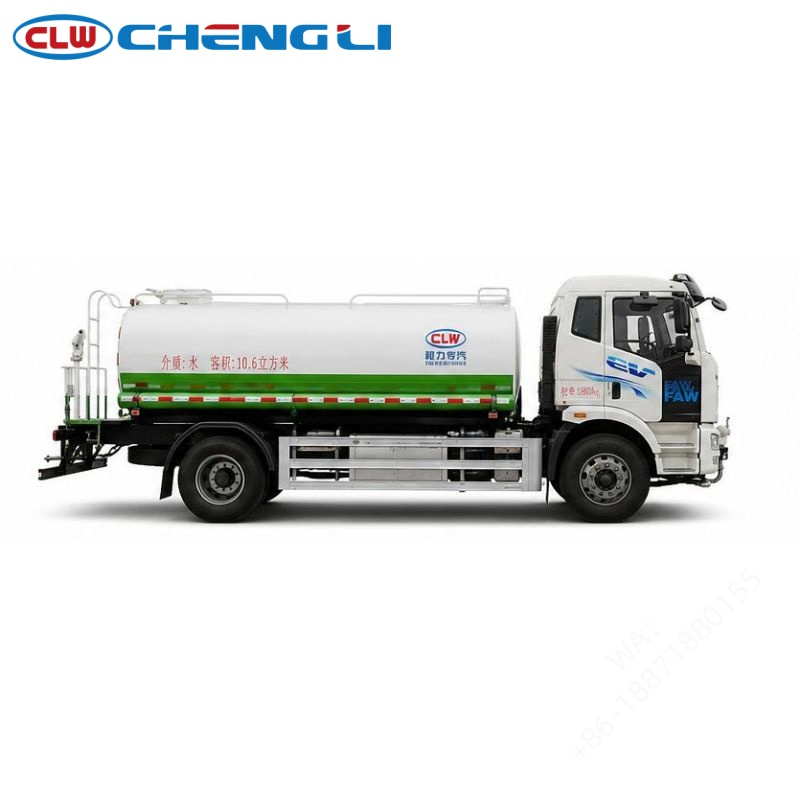
Pick electric for fixed urban routes that end at a charger every shift, and diesel for sites without grid power, long rural runs and the most water per trip. The trade-off is weight: on our 18,000 kg 4x2 chassis the battery sprinklers weigh 8,760–9,420 kg empty, against 6,675–7,705 kg for diesel, so they carry roughly 1.6–2.7 m³ less water.
Electric vs Diesel Sprinkler Trucks at a Glance
An electric water sprinkler truck carries the same spray equipment as a diesel one: front flushing, side spraying, rear sprinkling and a rear water cannon, with spray widths above 16 m on our full-size builds. The differences sit under the tank: power source, empty weight and pump drive.
| Item | Electric sprinklers | Diesel sprinklers |
|---|---|---|
| 4x2 tank sizes in our range | 3.75–13 m³ | 2.01–15 m³ |
| 6x4 tank sizes | 14.22 m³ effective | 14–14.14 m³ |
| Curb weight at 18,000 kg GVW (4x2) | 8,760–9,420 kg | 6,675–7,705 kg |
| Drive power | Motor ratings 80–180 kW, peaks up to 260 kW | 95–300 hp on 4x2; 229–433 hp on 6x4 |
| Transmission | Direct-drive automatic | Mostly manual with PTO; one automatic 4x2 |
| Quoted driving range | 265 km (166 kWh) to 340 km (200 kWh) | Limited by fuel tank; refuel anywhere |
| Tailpipe emissions | Zero | Euro VI / China VI builds available |
Curb Weight and Payload: Where the Battery Costs You Water
Water weighs about 1 kg per liter, so on a truck limited by gross vehicle weight (GVW) every kilogram of battery comes out of the tank. The table compares our 4x2 sprinklers built to the same 18,000 kg GVW. The fourth column is GVW minus curb weight before crew; the rated payload on the weight plate is a little lower once seats are counted.
| Truck | Power | Curb weight | GVW minus curb | Tank |
|---|---|---|---|---|
| Foton 4x2 | Diesel | 6,675 kg | 11,325 kg | 11.1 m³ effective |
| SAIC Hongyan 4x2 | Diesel | 7,000 kg | 11,000 kg | 15 m³ vessel |
| Dongfeng 4x2 | Diesel | 5,130 kg | Confirm final road load | 7 m³ physical tank |
| FAW 4x2 | Electric | 8,760 kg | 9,240 kg | 9.0 m³ effective |
| Dongfeng 4x2 | Electric | 8,945 kg | 9,055 kg | 8.86 m³ effective |
| Dongfeng 4x2 | Electric | 9,420 kg | 8,580 kg | 8.385 m³ effective |
The listed diesel examples range from a 7 m³ physical tank on a lighter Dongfeng chassis to an 11.1 m³ effective tank on an 18 t Foton chassis. The electric examples have 8.385–9.0 m³ effective tanks. Compare each completed vehicle's weight and allowable water load before attributing a capacity difference to battery mass. Crew counts too: our FAW 4x2 9.0 m³ electric sprinkler is rated for 9,110 kg with two occupants and 9,045 kg with three, so each extra seat takes 65 kg of water off the legal load.
Read tank figures with care. The 15 m³ vessel on the SAIC Hongyan diesel is larger than its 11,000 kg margin, so its legal fill is nearer 11 m³ less crew. The same applies to our Dongfeng 13 m³ electric sprinkler, whose tank is a 13 m³ physical vessel: the vessel tells you what fits, the weight plate tells you what you may carry.
On three axles the gap nearly closes
At 25,000 kg GVW our Dongfeng Huashen 6x4 electric sprinkler weighs 11,290 kg empty, inside the 10,725–11,500 kg span of our diesel 6x4s. That leaves 13,710 kg for water and crew against 13,500–14,275 kg on the diesels, so all of them fill a 14 m³ class tank close to full. The 14.22 m³ tank on the electric truck still slightly exceeds its margin, so confirm the approved water load. If you want electric and maximum water per trip, the 6x4 is where the battery penalty stops mattering.
Range, Motor Power and Pump Work on an Electric Sprinkler
Our Dongfeng 13 m³ electric sprinkler quotes 265 km of driving range from a 166 kWh CATL lithium iron phosphate (LFP) battery; the Foton 13 m³ electric dust suppression truck quotes 340 km from 200 kWh. Those are driving figures. A sprinkler spends much of its shift crawling at spraying speed with the pump running, and on a battery chassis the pump draws on the same energy, so range on a spraying route is lower than the quoted number.
Size it from the route: depot-to-route distance, route length times passes, and trips to the fill point, plus pump hours. If the total sits well inside the quoted range, with margin for air conditioning, hills and battery aging, one overnight charge covers the shift. If not, you need a larger battery, a midday top-up or a diesel truck.
Power is rarely the limit. Our 4x2 electric sprinklers use motors rated from 80 kW to 180 kW, with peak outputs up to 260 kW, through a direct-drive automatic transmission with regenerative braking. That suits stop-start city work: no clutch to slip at every hydrant stop, smooth creeping at spraying speed and some energy recovered at each stop. Our diesel 4x2s run 95–300 hp engines, most with a manual gearbox and a PTO driving the pump, as on our Dongfeng 4x2 7 m³ diesel sprinkler.
Which Routes Suit Electric and Which Suit Diesel
Electric makes the most sense where the truck returns to the same depot every night and works close to people. Night and early-morning washing in residential districts, city centers, parks and low-emission zones all favor it, since the truck runs quietly and adds no exhaust at street level. Construction sites inside a city are another fit: the Foton 13 m³ electric truck throws a mist up to 15 m to catch dust at the site boundary without adding diesel fumes. For the full range of spray duties by site type, see our guide to sprinkler truck uses.
Diesel stays the better tool when charging is the weak link: mine and quarry haul roads with no grid connection and more than one shift a day, or rural routes with long distances between refills. Where the job is the most water per trip on two axles, the lighter diesel chassis wins, and in many export markets diesel and chassis parts are easier to find than high-power chargers.
Purchase Price, Running Cost and Service
An electric sprinkler usually costs more to buy and less to run per kilometer. Payback depends on your electricity and diesel prices, annual kilometers and how long you keep the truck. Budget for the depot charger and grid connection too.
An electric drivetrain has no engine oil, filters or clutch to service, and regenerative braking eases brake wear. In exchange, the battery is the most expensive single part, so ask about expected cycle life and who services the high-voltage system in your country. Diesel keeps the advantage of familiar service in most municipal workshops. Tank, pump and nozzle upkeep is the same for both.
What to Confirm Before Ordering
- Daily duty: kilometers to and on the route, passes per shift, pump hours and the distance to the fill point, so range can be checked against real work.
- Approved water load on the final weight plate with your crew count, not only the tank or vessel volume.
- Depot charging: available grid power, the charging connector standard used in your market and the charging time you can accept overnight.
- Battery chemistry, energy in kWh and supplier; our range uses LFP packs from CATL, EVE Power, CALB or FinDreams.
- Ambient temperature range on your routes, so battery heating or cooling can be specified.
- For diesel trucks, the emission level your registration rules require and the gearbox and PTO arrangement for the pump.
- Outlet set and controls: front flush, side spray, rear sprinkling, cannon or mist cannon, and which functions the driver controls from the cab.
FAQ
Does an electric sprinkler truck have enough power for hills with a full tank?
Yes, on normal road grades. Electric motors deliver full torque from standstill, and our Dongfeng 13 m³ electric sprinkler is rated at 1,200 Nm continuous and 2,800 Nm peak. Long, steep climbs drain the battery faster, so include them in the range estimate. On unpaved or wet grades traction is the real limit, which is a matter of axle layout, not drivetrain.
How long does an electric sprinkler truck take to charge?
As a rough guide, divide battery energy by charger power and add time for the slower final part of the charge. A 166 kWh pack on a 60 kW charger needs around three hours or a little more; on a smaller charger it becomes an overnight job. Tell us your depot supply and we will match the charging setup to your shift pattern.
What does effective tank capacity mean on a sprinkler truck?
It is the usable water volume, which is smaller than the total shell volume. Our Dongfeng 8.385 m³ electric sprinkler has a total tank volume of 8.60 m³, for example. Neither figure is the legal load: that comes from the weight plate, so compare effective volume with rated payload before you count on a full tank.
Is an electric dust suppression truck different from an electric sprinkler?
The chassis and tank are similar; the difference is the cannon. A dust suppression truck carries a mist or fog cannon that throws fine droplets to catch airborne dust, while a standard sprinkler relies on nozzles that wet the road. Our Foton 13 m³ electric truck combines both, with a 360° cannon that throws a jet to 35 m and mist to 15 m.
Can one fleet run both electric and diesel sprinklers?
Yes. A practical split is electric trucks on inner-city and night routes that return to the depot charger, with diesel trucks on outer districts, highways and construction support. The spray equipment and operator training are largely the same, so drivers can move between them with little retraining on the watering side.
Choose the drivetrain by the route and the charging you can provide, then size the tank to the weight plate rather than the vessel. Compare builds across our water sprinkler trucks, many of which serve municipal sanitation fleets, and send us your daily route length, depot power supply and duties; our team will propose an electric or diesel configuration with the approved water load for your market.