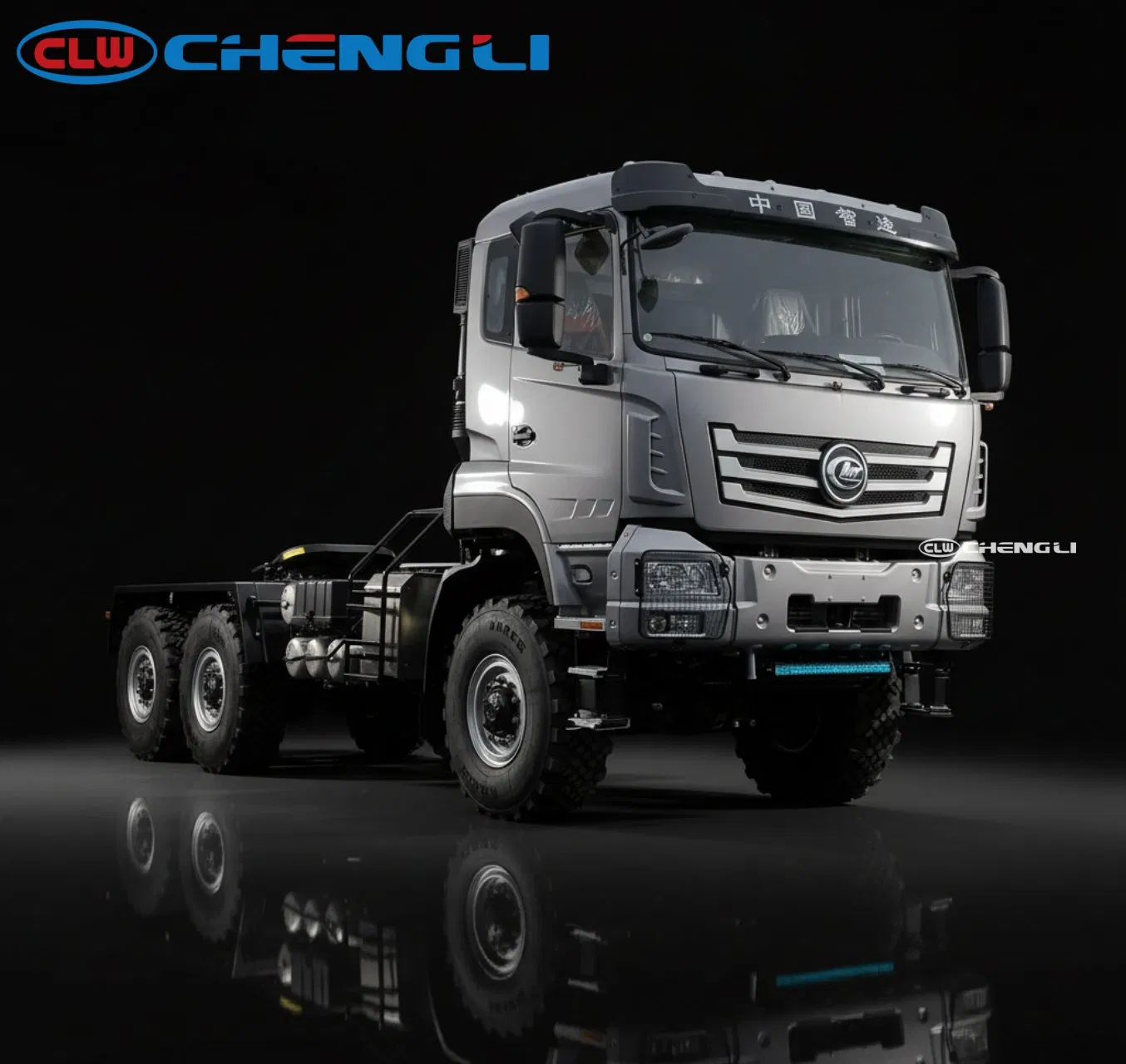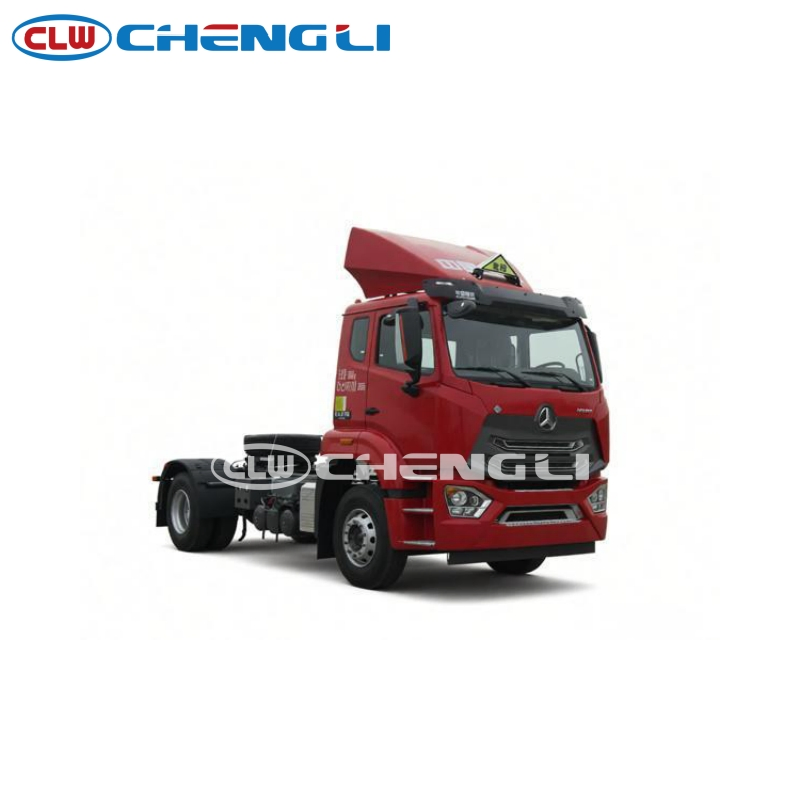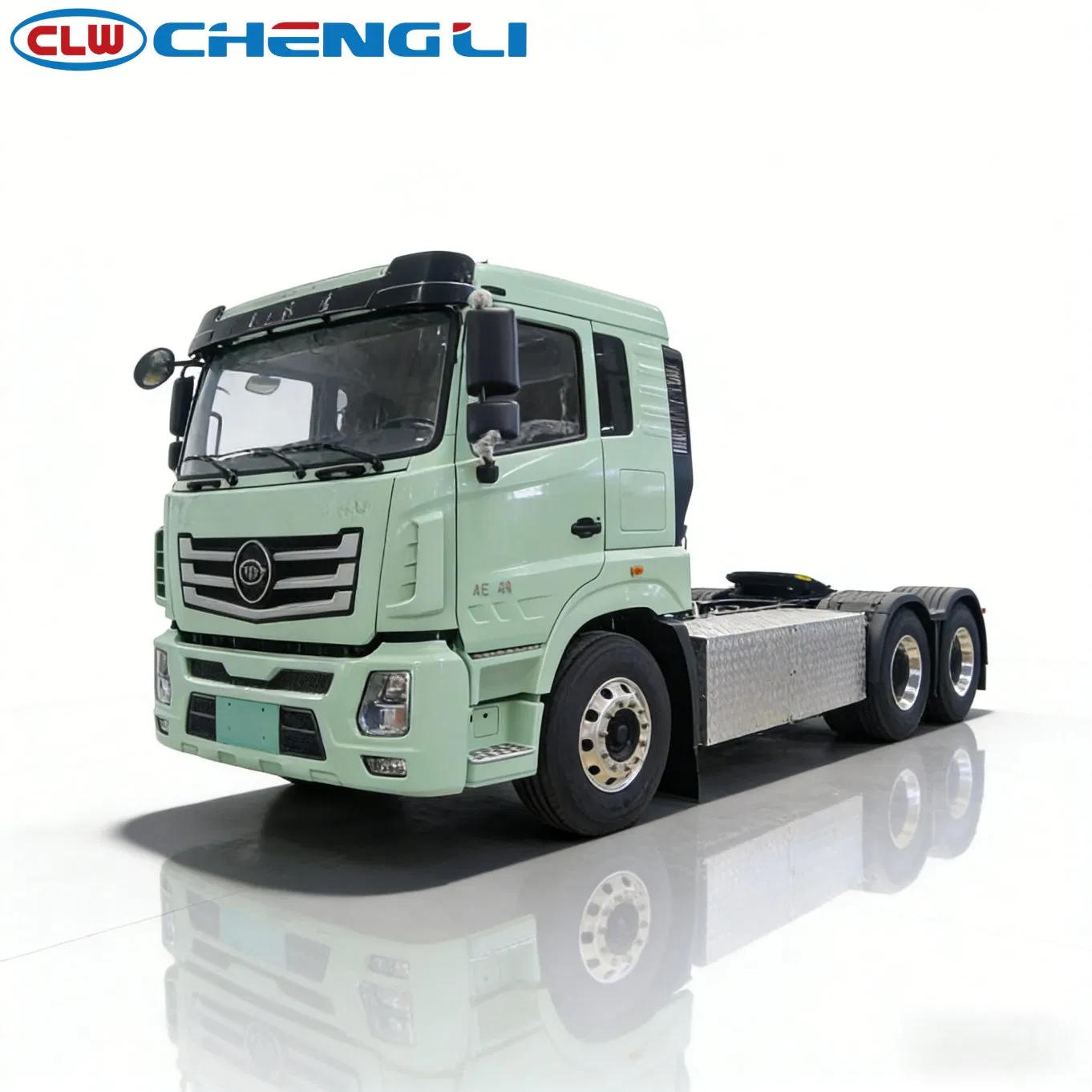
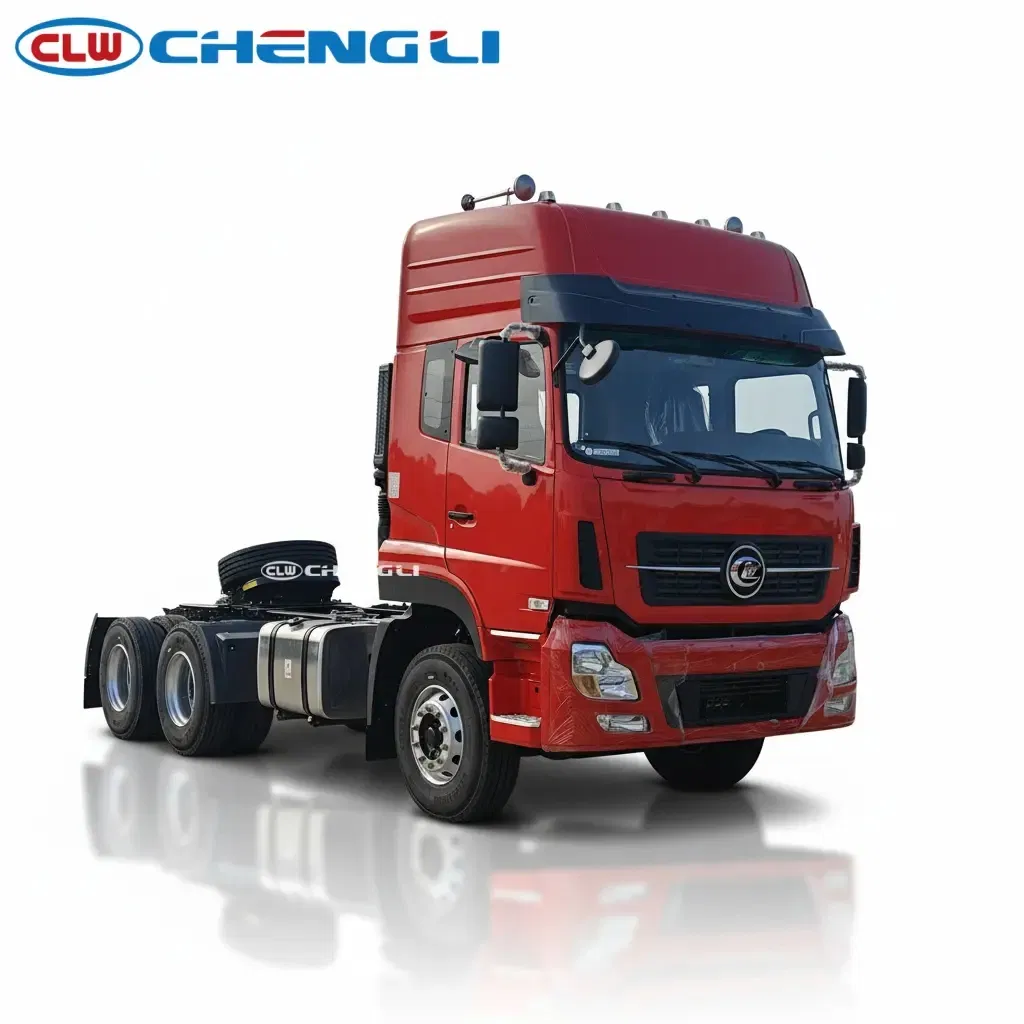
A 4x2 tractor head has one driven rear axle and suits lighter trailers on paved highways. A 6x4 has two driven rear axles, so it carries a heavier fifth-wheel load and keeps traction on grades, wet ramps and broken roads. Our diesel 6x4 is rated for 30–40 t of towed load and our 6x6 off-road tractor for 50 t. For construction, mining and bulk haulage, start from 6x4.
What 4x2, 6x4 and 6x6 mean on a tractor head
The first number counts wheel positions and the second counts the driven ones. A 4x2 tractor has two axles with only the rear one driven. A 6x4 has three axles: a steer axle and a tandem of two driven rear axles. A 6x6 drives all three, including the front axle. The fifth wheel sits over the rear axle group, so the number of rear axles decides how much trailer weight the tractor frame can take, and the number of driven axles decides how much of that weight turns into grip.
Grip matters more on a tractor than on a rigid truck, because it pulls several times its own weight and its only traction comes from the load on its driven wheels. A single driven axle is fine on a dry highway and marginal on a wet ramp out of a quarry.
4x2 vs 6x4 vs 6x6 tractor heads at a glance
The 6x4 and 6x6 columns use our current tractors. We do not currently list a 4x2 tractor head, so that column describes the layout in general terms.
| Item | 4x2 | 6x4 | 6x6 |
|---|---|---|---|
| Driven axles | 1 | 2 (rear tandem) | 3 (all axles) |
| Typical tire set | 6 road tires | 10 road tires (295/80R22.5 on our electric 6x4) | 6 single 425/85R21 off-road tires plus a spare |
| Axle ratings on our models | – | 7,000 kg front, 18,000 kg rear tandem (electric 6x4) | 6.5 t front, 16 t per rear axle |
| Power on our models | – | 340 hp Cummins diesel; 510 kW and 840 kW peak electric | 460 hp (340 kW) Weichai diesel |
| Rated towing on our models | – | 30–40 t diesel; 38,700 kg electric port tractor | 50,000 kg |
| Best suited to | Paved linehaul with moderate trailer weights | Construction, mining roads, bulk and heavy freight | Loose surfaces, unmade access roads, remote sites |
| Main trade-off | Least traction and kingpin capacity | More tires and tare weight than a 4x2 | Heaviest driveline and highest tire and maintenance cost |
When a 4x2 tractor is enough, and when it is not
A 4x2 earns its place on long paved routes with box, curtain-side or refrigerated trailers that rarely run at maximum weight. With one drive axle and four fewer tires than a 6x4, it saves tare weight, fuel and tire spend.
The limits show up under heavy loads. One driven axle caps the kingpin load the tractor can accept, and a loaded combination on a wet grade can spin its drive wheels before the engine runs out of power. Axle count also affects legality: in many markets the permitted gross combination weight rises with the number of axles, so a 6x4 with a three-axle trailer (six axles) is often allowed more than a 4x2 with the same trailer (five axles). Check your national limits before comparing trucks.
Choose a 6x4 for lowbeds, tippers, bulk and fuel tankers, or any route with site roads and steep climbs. Our guide to semi-trailer types and how to choose them covers the trailer side of the match.
Matching horsepower to gross combination weight
Gross combination weight (GCW) is the tractor, the trailer and the cargo together. Dividing engine power by GCW gives a quick check of how a combination will hold speed on grades. Using the curb weights and towing ratings of our tractors:
- CLW 6x4 diesel: 340 hp, 15,000 kg curb weight and 30–40 t towed, so 45–55 t combined and about 6.2–7.6 hp per tonne.
- CLW 6x6 off-road: 460 hp, 15,000 kg curb weight and 50 t towed, so about 65 t combined and 7.1 hp per tonne.
- Dongfeng 6x4 electric: 510 kW with 10,300–11,300 kg curb and 37,570–38,570 kg trailer weight options, about 48,870 kg combined and 10.4 kW per tonne.
- CLW 6x4 electric port tractor: 840 kW peak for a 49,000 kg combination (10,300 kg tractor plus 38,700 kg towed), about 17 kW per tonne at peak.
A higher ratio holds speed on long climbs; a lower one is acceptable on flat roads. Electric figures are peak ratings, so compare them with care against diesel power. Our 340 hp CLW 6x4 tractor head uses a FAST 12-speed gearbox and comes with an 89 or 120 km/h top-speed option. The top speed is usually set by the rear-axle ratio, and the 89 km/h setting trades speed for pulling force on grades, which suits loaded site work.
Fifth wheel, kingpin and wheelbase
Trailer kingpins come in two common sizes: 2-inch (50.8 mm) on most standard road trailers and 3.5-inch (88.9 mm) on heavy-duty trailers such as lowbeds. Our CLW diesel tractors carry a 90 mm fifth-wheel coupler, the class that takes a 3.5-inch kingpin. If your fleet runs 2-inch trailers, say so at quotation so the fifth wheel is specified to match. Coupling height is the second check: the trailer's front must sit level on the fifth wheel plate when coupled.
Wheelbase sets maneuverability and trailer clearance. The CLW 6x4 diesel uses a short 3,200 + 1,300 mm wheelbase and is 6,810 mm long, which helps in tight yards and leaves more of the legal combination length for the trailer. The CLW 6x6 50 t off-road tractor runs a longer 3,900 + 1,450 mm wheelbase for its larger tires and off-road duty. Always confirm swing clearance between the cab back and the trailer nose in tight turns.
Electric tractor heads for ports and short regional routes
Electric tractors fit repeatable routes that end at a charger every day. The CLW 6x4 38.7 t electric port tractor carries a 400.61 kWh battery, two 420 kW axle motors with 62,000 N·m combined peak torque, a 300 km rated range and energy use of about 1 kWh/km. It adds an electric hydraulic power station for trailer lifting, AEBS, IEBS and ESC, plus reserved space for a range extender.
The Dongfeng 6x4 electric tractor pairs a 510 kW motor with a 295 km cruising range. Plan daily distance on the rated range, not on battery size divided by consumption: 400 kWh at 1 kWh/km suggests 400 km, but 300 km is the planning figure, and load, climbs and cold weather shorten it further. For open-road haulage and remote mines, a diesel 6x4 remains the practical choice; see our construction and mining solutions for matched fleets.
How to specify a tractor head before ordering
- Trailer list: type, axle count, loaded weight, kingpin size (2-inch or 3.5-inch) and coupling height for every trailer the tractor will pull.
- Weight limits: the legal gross combination weight and axle limits on your routes, including bridges and site gates.
- Road conditions: paved, gravel, mud or sand, and the steepest grade the loaded combination must climb.
- Drive type: 6x4 for heavy and mixed work, 6x6 where loose surfaces need all-axle traction.
- Engine and emission level: power for your combination weight and an emission level from Euro 2 to Euro 6 that matches the diesel quality in your market.
- Top speed and gearing: the 89 or 120 km/h option, chosen by route type rather than habit.
- Trailer services: power take-off for tipping or bulk-discharge trailers (optional on the 6x6), or hydraulic power for port trailers.
- Cab and steering: left- or right-hand drive, and two or three seats.
FAQ
How much can a 6x4 tractor head pull?
It depends on the tractor rating and your road rules. Our diesel CLW 6x4 is rated for 30–40 t of towed load, and the CLW electric port tractor for 38,700 kg within a 49,000 kg combination. The 6x6 off-road tractor is rated for 50 t. The legal figure on public roads is set by your country's combination weight and axle limits, which can be lower than the tractor rating.
Does a 6x4 tractor cost more to run than a 4x2?
Usually yes, per kilometer. A 6x4 carries four more tires, a second driven axle with its own differential and oil, and more tare weight, which raises fuel use on light loads. The extra cost pays back when loads are heavy or roads are poor, because the 6x4 keeps traction, carries more kingpin weight and often qualifies for a higher legal combination weight.
Can any tractor head pull any semi-trailer?
No. The kingpin size must match the fifth wheel, the trailer must couple at the right height, and the air brake and electrical connections, including any trailer ABS connector, must be compatible. Tipping and bulk-discharge trailers may also need hydraulic or compressed-air supply from a tractor power take-off. Send your trailer drawings with the inquiry so these points are checked before production.
Is a tractor head the same as a prime mover?
Yes. Tractor head, tractor unit, semi truck and prime mover all describe a truck with a fifth wheel instead of a cargo body, built to pull semi-trailers. Prime mover is the usual term in Australia and parts of Asia and Africa, while semi truck is common in North America. The specification points above apply whatever the name.
Do mining sites need a 6x6 tractor?
Only where the surface is loose or unmade. On maintained haul roads a 6x4 is usually enough and costs less to run. Our 6x6 earns its extra driveline on soft access roads, sand and steep unsealed ramps: it drives the front axle, runs 425/85R21 off-road tires and uses an off-road braking system, with an optional power take-off for trailer equipment.
Pick the drive type from your roads and your heaviest loaded trailer, then match power, gearing and the fifth wheel to that combination. A 6x4 covers most heavy work; a 6x6 is for loose ground; electric tractors suit short, repeatable routes with depot charging. Compare current models in our tractor head range, then send your trailer list, route conditions and destination market through our contact page, and our engineers will propose a tractor configuration.