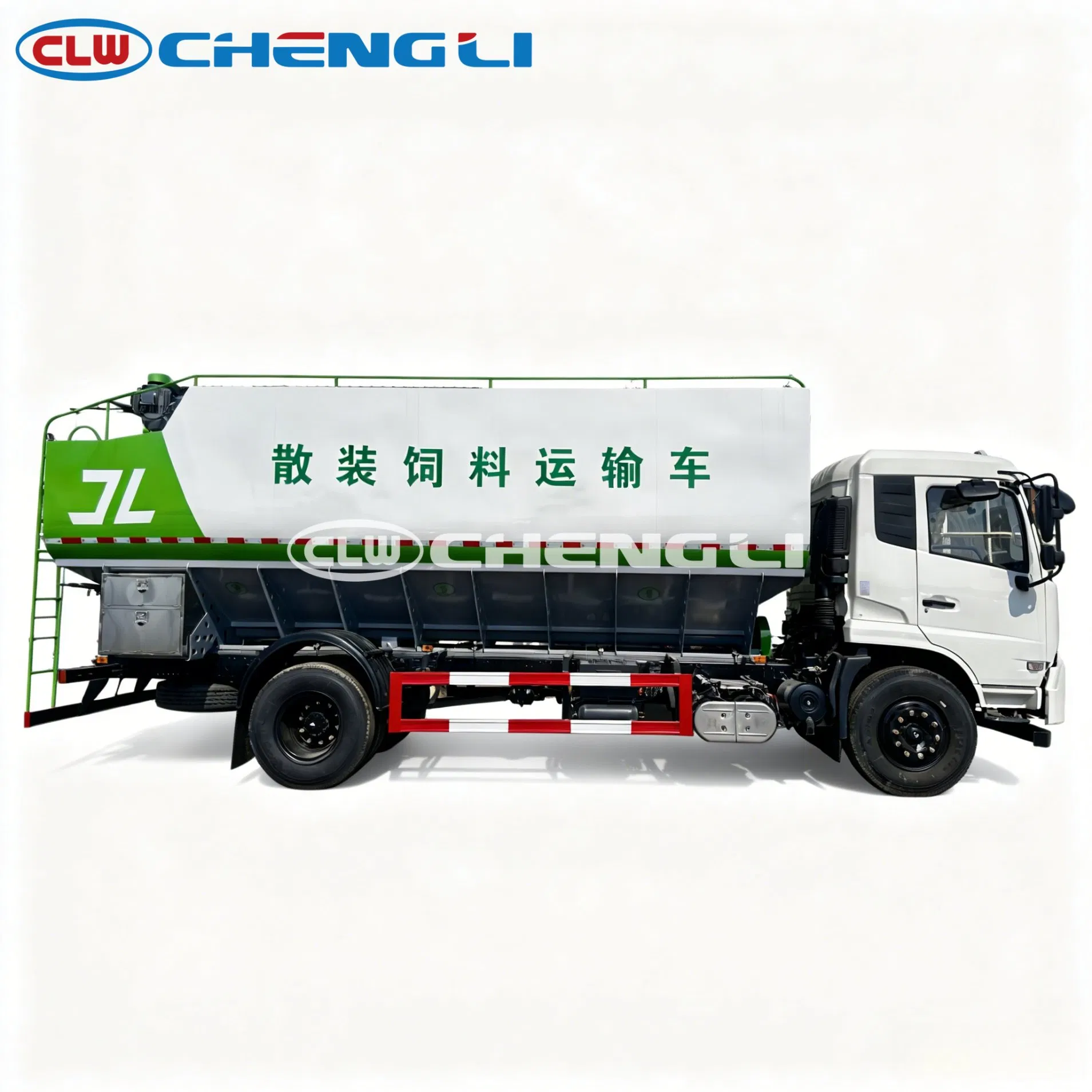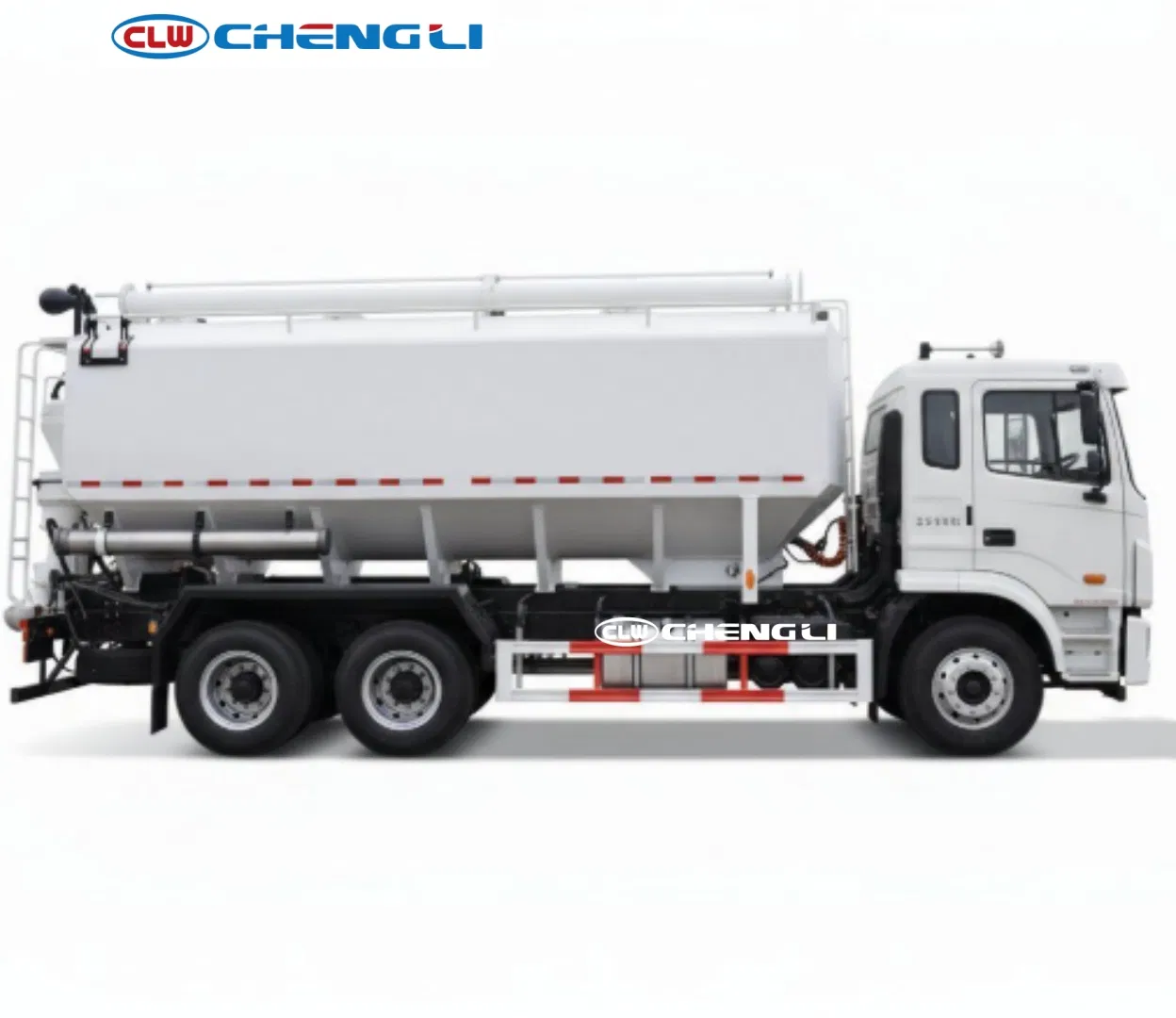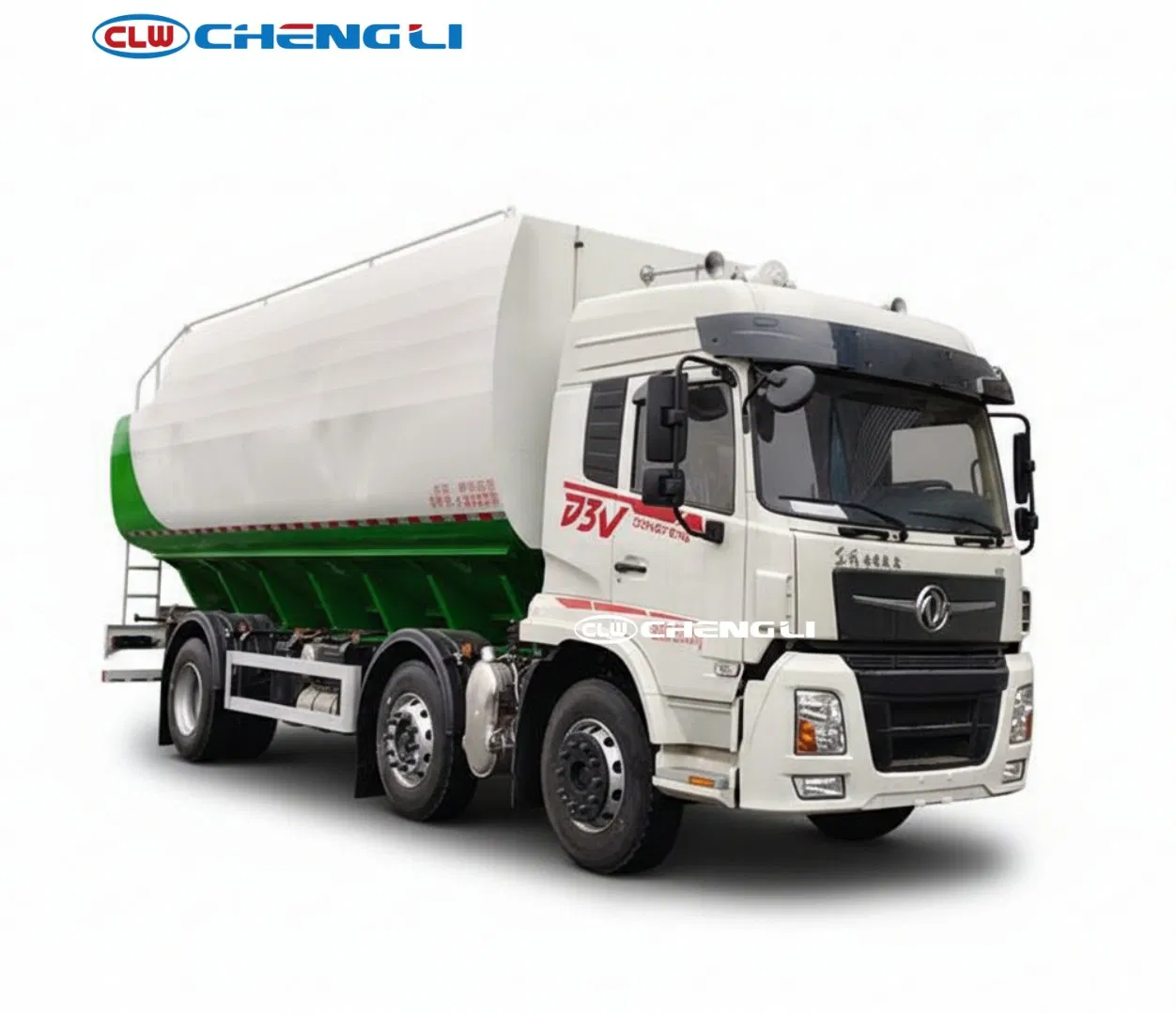
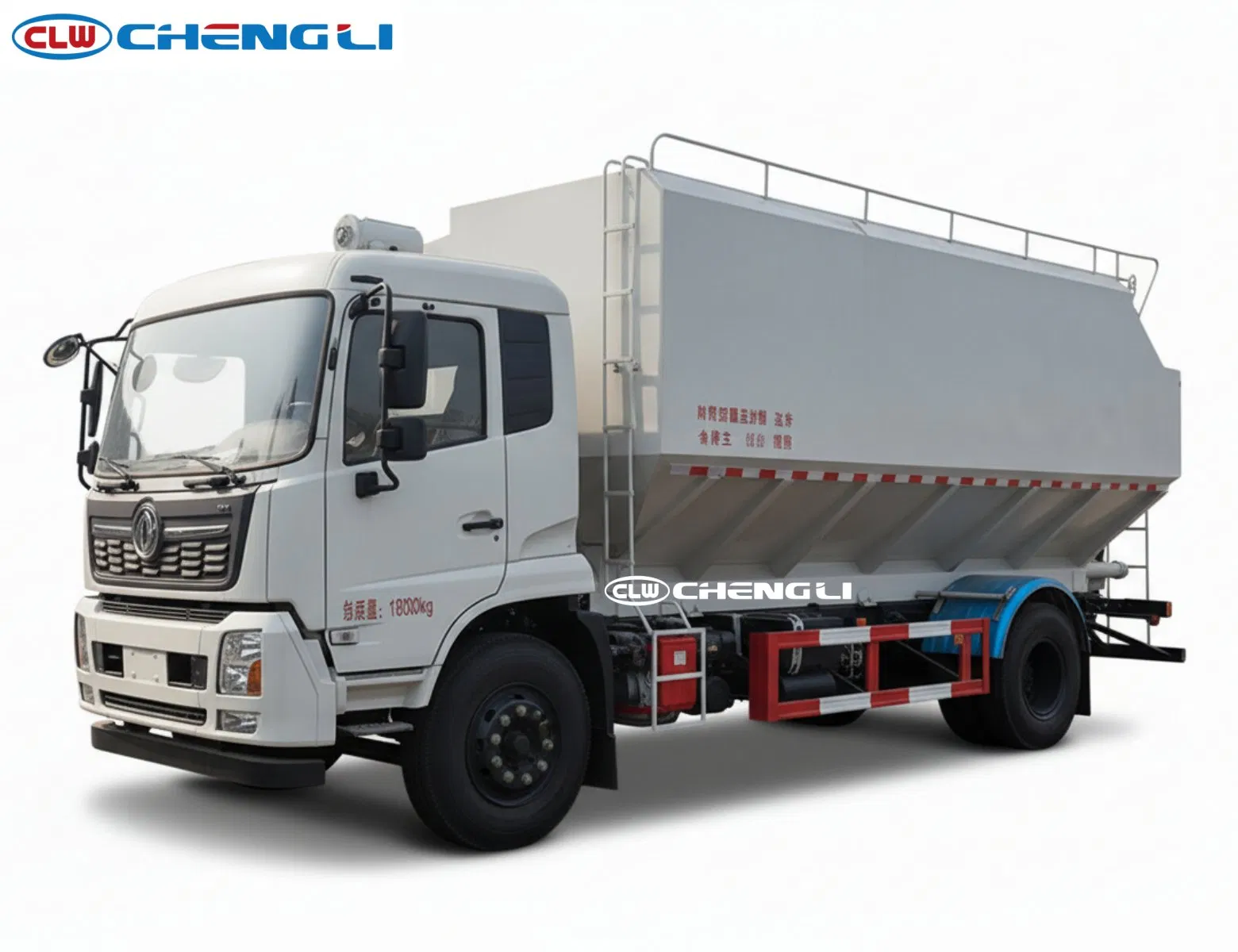
Our bulk feed trucks run 8,250–9,000 mm long on 4x2 chassis, 9,000–10,980 mm on three axles and 10,500–12,000 mm on 8x4s, and almost every three- and four-axle build stands 3,850–4,000 mm tall. Length and wheelbase decide which farm bends you can take, height decides which gates and sheds you clear, and approach and departure angles decide the ramps.
Bulk Feed Truck Dimensions at a Glance
Dimensions follow the chassis class, which in turn follows gross vehicle weight (GVW). The ranges below cover the rigid feed trucks we build; individual models vary with wheelbase and tank options.
| Chassis class | GVW | Overall length | Overall height | Width | Tank body (L × H) |
|---|---|---|---|---|---|
| 4x2, 2 axles | 18,000 kg | 8,250–9,000 mm | 3,600–3,800 mm | 2,430–2,550 mm | 6,000–6,190 × 1,625–2,350 mm |
| 6x2 and 6x4, 3 axles | 24,900–25,000 kg | 9,000–10,980 mm | 3,850–3,995 mm | 2,550 mm | 6,500–7,100 × 2,300–2,650 mm |
| 8x4, 4 axles | 31,000 kg | 10,500–12,000 mm | 3,900–4,000 mm | 2,500–2,550 mm | 8,050–9,150 × 1,800–2,745 mm |
Two patterns stand out. Width barely changes, because 2,500–2,550 mm is already the practical road limit in most markets. Height rises from the 4x2 to the three-axle class and then flattens just under 4 m, so the 8x4 gains volume through a longer tank, not a taller one.
Overall Height: Why Most Builds Stop Just Under 4 m
A 4.0 m overall height limit is common on public roads in many countries, and most of our three- and four-axle feed trucks are drawn to fit under it at 3,950–3,998 mm. The Dongfeng 8x4 30 m³ truck sits exactly at 4,000 mm, so check it against your local limit before you order.
Farms are often tighter than the road. Old shed doors, covered loading bays, pipe bridges and overhead power lines at silo yards can sit well below 4 m. The 4x2 class is the easy answer for such sites: our Dongfeng 18.91 m³ 4x2 feed truck stands 3,670 mm tall with a tank body only 1,625 mm high.
Tank height also changes how a truck feels on the road. On a 9,000 mm tank body, our 35.5 m³ Dongfeng 8x4 uses a 1,800 mm tall tank and stands 3,900 mm overall, while our 40 m³ Dongfeng 8x4 uses a 2,350 mm tank and reaches 3,995 mm. The lower tank keeps the center of gravity down on cambered farm roads, at the cost of 4.5 m³ of volume.
Length, Wheelbase and Turning on Farm Tracks
Wheelbase controls the turning circle more than overall length does. Our 4x2 trucks use 4,500–5,000 mm wheelbases; three-axle trucks combine a front wheelbase with a rear tandem, for example 4,600 + 1,300 mm on our JAC 30 m³ 6x4 feed truck; and 8x4 trucks add a second steered front axle, as in 1,900 + 4,160 + 1,350 mm on our FAW Jiefang 36.5 m³ 8x4.
Several models come in more than one length for the same tank. Our Dongfeng 26.89 m³ truck is offered at 9,480, 10,080 or 10,980 mm, with the middle wheelbase section growing from 3,500 to 5,000 mm. The short version turns tighter in a farmyard; the long version spreads load over a longer frame. If your drivers already struggle to position a truck beside a silo, choose the shortest wheelbase that still meets your axle-load rules.
Rear overhang and tail swing
Overhang is the part of the body behind the last axle. On our Dongfeng 31.01 m³ 6x2 truck it ranges from 2,055 mm to 2,565 mm depending on length. A long overhang swings wide when the truck turns sharply, which matters beside silo legs, feed bins and parked equipment.
Approach and Departure Angles at Farm Entrances
Approach angle is the steepest ramp the front bumper can meet without touching; departure angle is the same at the rear. They decide whether a truck clears a ditch crossing, a weighbridge ramp, a loading dock or the dip where a farm track meets a paved road.
| Truck | Approach | Departure | Overall length |
|---|---|---|---|
| Dongfeng 17.44 m³ 4x2 | 17° | 8–9° | 9,000 mm |
| Dongfeng 26.89 m³ three-axle | 18° | 17° | 9,480–10,980 mm |
| JAC 30 m³ 6x4 | 18° | 15° | 9,500 mm |
| FAW Jiefang 36.5 m³ 8x4 | 21° | 10° | 11,200 mm |
| Dongfeng 40 m³ 8x4 | 19° | 15° | 12,000 mm |
| FAW Jiefang 55 m³ 8x4 | 15° | 7–8° | 12,000 mm |
Departure is usually the weaker figure, and it drops as the body reaches further behind the rear axle; overall length alone does not decide it, since two of these 12,000 mm trucks differ by 7–8°. The largest tank in our range, on the FAW Jiefang 55 m³ 8x4 feed truck, has the lowest departure angle at 7–8°, with rear overhang options of 2,350–3,350 mm. That is fine on paved mill routes; on farms with steep entrances, a 40 m³ truck with a 15° departure angle is the safer choice.
Unloading Geometry and Unloading Speed
Dimensions also shape the unloading side of the job. On several of our auger trucks the upper auger swings through 180°, so the driver can reach silo inlets without repositioning the whole truck; confirm the auger reach and discharge height against your tallest inlet.
Unloading rate sets how long the truck stands at each farm. Our CL5312ZSL6SS 32.8 m³ truck unloads at 500–550 kg/min, so a 15 t load takes about 27–30 minutes. Many of our auger trucks are rated for residue below 0.1%, which is no more than 15 kg left from a 15 t load, and some add vibration assistance to clear the tank floor. Auger drive can be electric or hydraulic on many models; most of our electric-auger builds come without an on-board diesel generator, so confirm how the auger motors will be powered on your build.
For the choice between auger and pneumatic discharge, and how compartments work on multi-drop routes, see our bulk feed truck guide.
What to Measure Before Ordering
- Lowest overhead obstacle on the route and at each farm: gates, shed doors, pipe bridges and power lines near silos.
- Road height, width and length limits in your market, and whether your permits allow a 12,000 mm rigid truck.
- Tightest bend and turning space at the silo yard, to choose the wheelbase and rear overhang.
- Steepest ramp or ditch crossing at farm entrances and weighbridges, compared with the truck's departure angle.
- Height and side of the tallest silo inlet, and how close the truck can park to it.
- Unloading time you can accept per farm, which sets the discharge system and auger size.
- Axle-load limits on farm roads and bridges, which may favor a lighter 4x2 over a heavier 8x4.
FAQ
How tall is a bulk feed truck?
Our feed trucks stand 3,600–3,800 mm tall on 4x2 chassis and 3,850–4,000 mm on three- and four-axle chassis. Most of the larger ones are built at 3,950–3,998 mm to stay under the 4.0 m road limit common in many countries. Measure your lowest gate or shed door before choosing a class.
How long is an 8x4 feed truck?
Our 8x4 feed trucks measure 10,500–12,000 mm overall. The shorter builds, such as our 10,500 mm Dongfeng Tianlong truck, uses a 1,995 + 3,200 + 1,350 mm wheelbase and is rated for 18,795 kg; the 12,000 mm builds carry the longest tanks, up to about 9,150 mm. Check that your route and farm yards take a 12 m rigid truck before ordering the largest size.
Does a bigger tank make a feed truck harder to handle?
It can. On the same 8x4 chassis, a longer tank body usually means a longer rear overhang and a lower departure angle, and a taller tank raises the center of gravity. Our 55 m³ truck has a 7–8° departure angle against 15° on our 40 m³ truck, so the extra volume costs ground clearance at the rear.
Can a feed truck be built lower than standard?
Yes, within limits. A lower, longer tank keeps overall height down, as on our 35.5 m³ 8x4 with a 1,800 mm tank and 3,900 mm overall height. Volume drops unless the tank grows in length, and length is limited by the chassis. Tell us your height limit and we will propose a tank section and chassis that fit.
Measure the farm before you size the tank: height, bends and ramps rule out options faster than volume does. Compare the builds across our bulk feed trucks, then send us your route limits, silo inlet heights and daily tonnage, and our engineers will match a chassis class and tank shape to your feed and livestock operation.