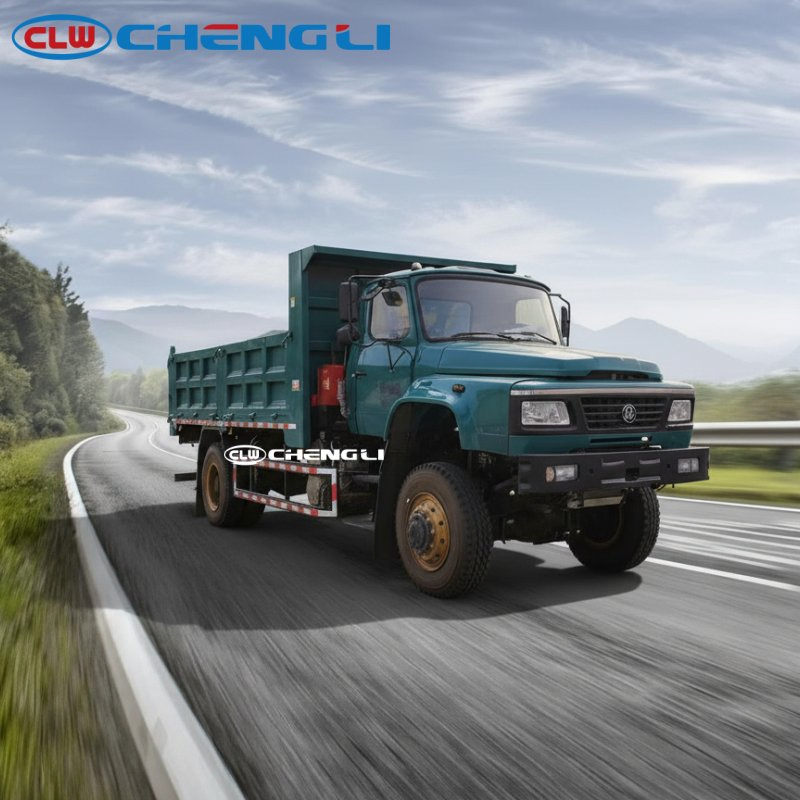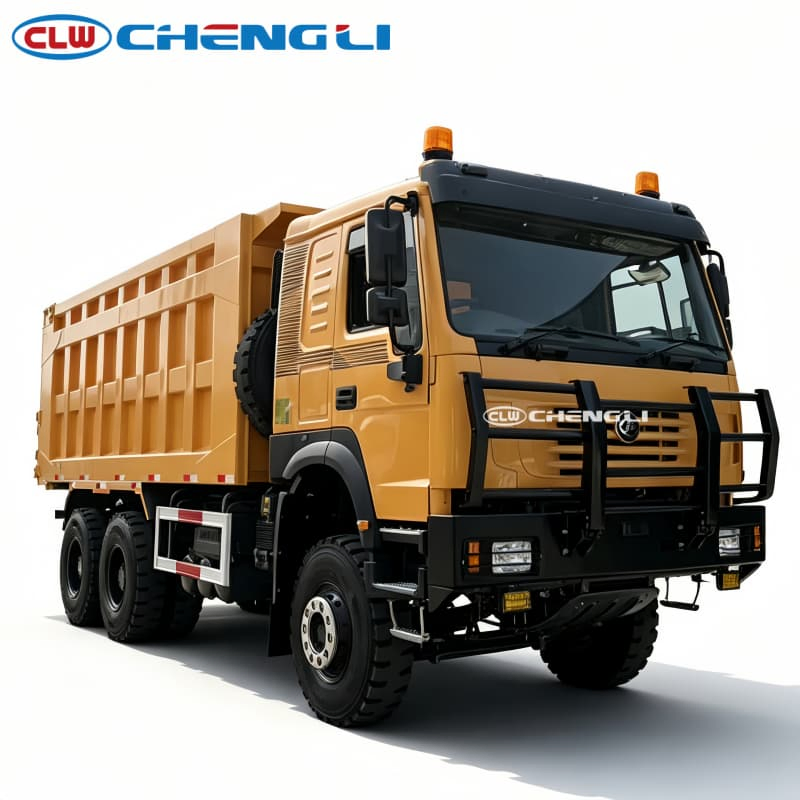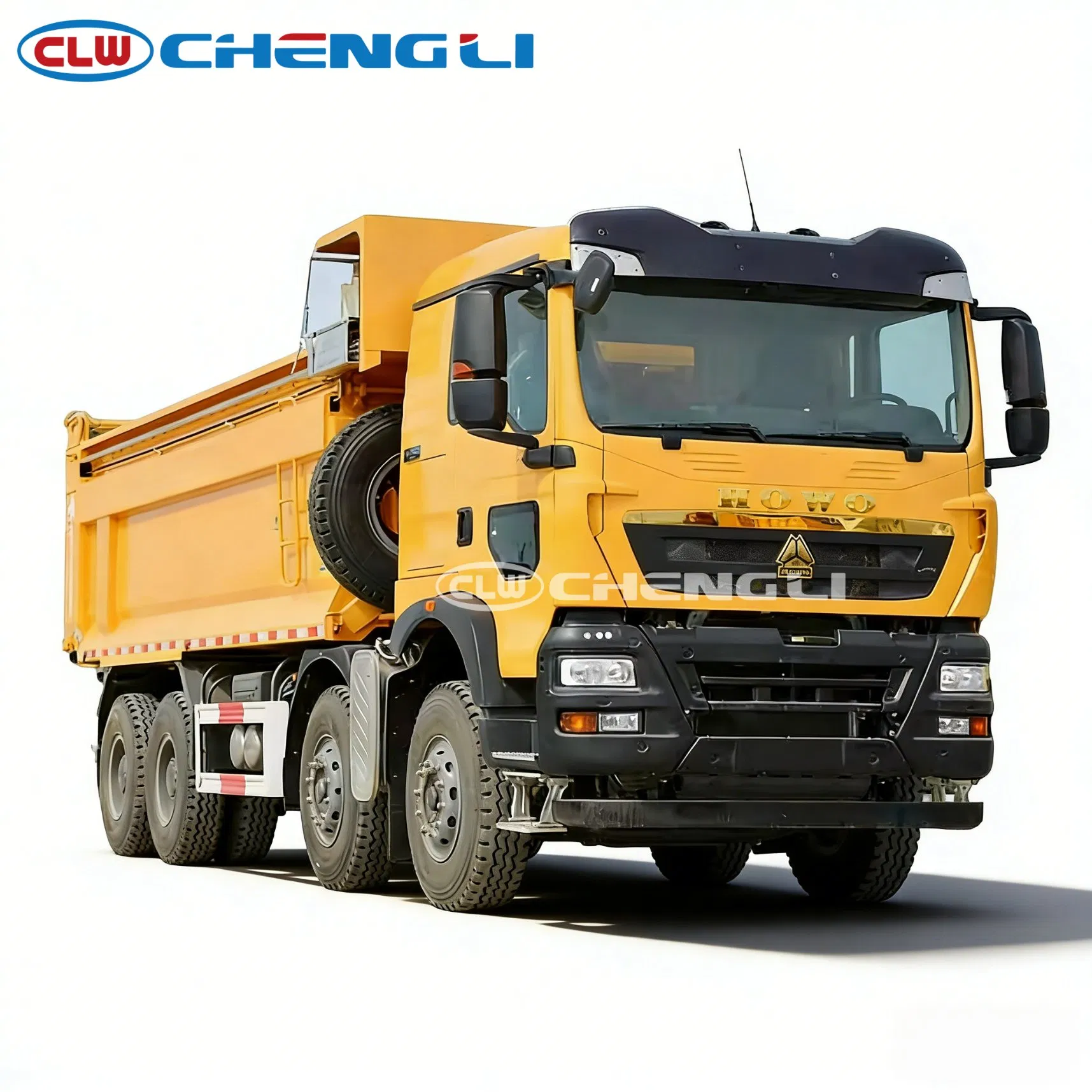
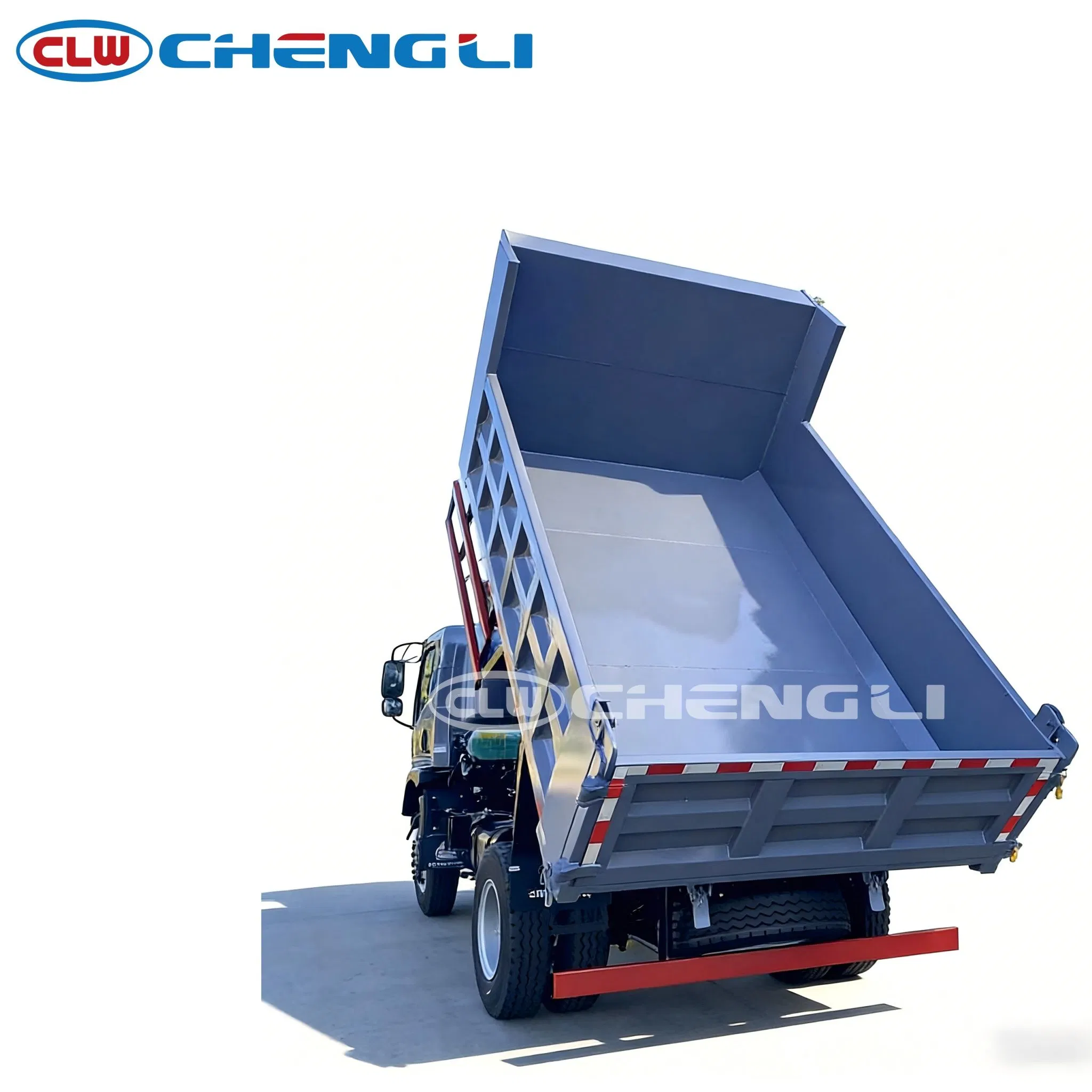
Multiply body volume by the material's bulk density and compare the result with the chassis's rated payload: that single calculation decides how much a dump truck can legally carry. Cubic meters describe the body, tonnes describe the load, and whichever limit you reach first sets the real capacity. With dense loads such as wet sand or crushed stone, weight usually runs out before the body is full.
Cubic meters or tonnes: which number limits a dump truck?
A dump truck has two capacities. Body volume, in m³, is fixed by the internal length, width and side height of the tipping body. Payload, in tonnes, is what the chassis may carry once the curb weight of the finished truck, crew and fuel is subtracted from its gross vehicle weight (GVW). Sellers often quote whichever number sounds larger, so ask for both.
Bulk density links them: the mass of one cubic meter of loose material as it sits in the body. It rises sharply with moisture. The figures below are approximate planning values; weigh a test load of your own material before you fix a body size.
| Material | Approx. loose bulk density (t/m³) | Example: tonnes in a 10 m³ body | Example: m³ that make up 10 t |
|---|---|---|---|
| Dry sand | about 1.5–1.7 | 15–17 t | 5.9–6.7 m³ |
| Wet sand | about 1.8–2.0 | 18–20 t | 5.0–5.6 m³ |
| Gravel | about 1.5–1.8 | 15–18 t | 5.6–6.7 m³ |
| Crushed stone | about 1.4–1.7 | 14–17 t | 5.9–7.1 m³ |
| Loose dry soil | about 1.2–1.5 | 12–15 t | 6.7–8.3 m³ |
| Wet soil or clay | about 1.6–2.0 | 16–20 t | 5.0–6.3 m³ |
The same body can be underloaded with dry topsoil and overloaded with wet sand. Excavated soil also swells when dug, often by roughly 20–30 percent for ordinary earth, so plan truck numbers on loose volume rather than in-ground volume. The same volume-versus-weight logic governs concrete mixer drum volume and rated load.
How to work out what your chassis can legally carry
Start from the chassis ratings, not from the body. Three limits apply at once: the manufacturer's GVW, the rated load of each axle, and the legal gross and axle limits on your roads. The lowest controls. Subtract the curb weight of the complete truck (chassis, subframe, body, tipping hydraulics, spare wheel, full fuel tank) and the crew, and what remains is legal payload.
Our own chassis show how axle ratings add up. The two-axle Dongfeng chassis under our cement slurry spray truck is rated at 6,500 kg on the front axle and 11,500 kg on the rear, for an 18 t GVW. Most of the 8x4 chassis in our concrete mixer truck range carry 6,500 kg on each of two front axles and 18,000 kg on the rear tandem, for 31,000 kg GVW. Those are chassis ratings; what public roads allow depends on local law, which varies by country and road class, so confirm gross and per-axle limits with your transport authority.
A worked example with assumed figures: take a 4x2 chassis rated at 18,000 kg GVW and suppose the finished dump truck weighs 8,000 kg with crew and fuel. Legal payload is then about 10,000 kg. At about 1.6 t/m³ for gravel, that is roughly 6.3 m³, so a 10 m³ body would be only about two-thirds full. With loose dry soil at about 1.2 t/m³, the same 10 t fills about 8.3 m³.
Distribution matters as much as the total. A dump body concentrates weight over the rear axle or tandem, so a payload can be legal overall while the rear axle is overloaded, especially with a long rear overhang. Ask the body builder for an axle-load calculation of the loaded truck.
4x2, 6x4 and 8x4 dump trucks: what the extra axles change
The drive code gives total wheel positions times driven wheel positions. A 4x2 has two axles with the rear one driven; a 6x4 has three axles with both rear axles driven; an 8x4 has four axles, two steering at the front and two driven at the rear. More axles spread the load over more tires and, in most jurisdictions, raise the permissible gross weight, which is why body volume normally grows with axle count. They also add curb weight, maintenance and turning space.
| Configuration | Axles / driven axles | Where the load goes | Typical role | Trade-off |
|---|---|---|---|---|
| 4x2 | 2 / 1 | One steer axle; a single drive axle carries most of the load | Short urban and site runs, lighter materials | Lowest curb weight, tightest turning; payload capped by one rear axle |
| 6x4 | 3 / 2 | One steer axle; rear tandem shares the load | General construction and quarry haulage | Better traction on soft ground; the front axle can become the limit |
| 8x4 | 4 / 2 | Twin steer axles; rear tandem | Heavy aggregate and earthmoving on good haul roads | Usually the highest permitted gross of the rigid options; widest turning circle |
Dump trucks rarely work alone on a road project: they feed pavers and work alongside road construction trucks such as asphalt distributors and slurry sprayers, so match the haul fleet to the paving rate. For each configuration the question is the same: after the body and tipping gear are fitted, how many tonnes are left under your local limits?
U-shaped vs box-shaped dump bodies
Box-shaped (rectangular) body
A flat floor and vertical sides give the most volume for a given outer length and width, and the volume is easy to check against a delivery ticket. Flat plates are simple to repair or reline. The weak point is the corners: wet clay and sticky soil hang up in the floor-to-side joints, so part of the load rides back to site. Box bodies suit sand, gravel and blocky rock.
U-shaped (tub) body
A curved floor and sides without sharp corners let material slide out more completely, reducing carryback of sticky loads. The curved shell is stiff for its weight, so the same strength can come with thinner plate and lower curb weight, and the load sits lower and more centrally while tipping. Against that, a U-body holds less than a box of the same outside dimensions and is harder to repair in the field.
Whatever the shape, specify floor and side plate thickness, the steel grade (abrasion-resistant plate for rock), the tailgate type and the hoist: a front-mounted telescopic cylinder or an underbody lift. A heaped load also exceeds the struck (level) volume, so ask which one a quoted m³ refers to.
What to confirm before ordering a dump truck
- Main materials, their approximate bulk density and whether they are usually loaded wet.
- Internal body dimensions, and whether the quoted m³ is struck or heaped.
- Chassis GVW, the rating of each axle and the curb weight of the completed truck with body.
- Gross and per-axle legal limits on your routes, confirmed with your local authority.
- An axle-load calculation for the fully loaded truck from the body builder.
- Body shape, plate thickness, steel grade, tailgate and hoist type.
- Duty cycle: road versus site share, haul distance and gradients, which decide drive configuration and power.
- The vehicle and emission standard your market requires for registration, confirmed at quotation.
Planning a mixed site fleet? See our construction and mining industry page.
FAQ
What is the capacity of a HOWO dump truck?
HOWO is a Sinotruk chassis brand built in 4x2, 6x4 and 8x4 forms, so there is no single HOWO dump truck capacity. It depends on the drive configuration, the body fitted and the market version of the chassis. Ask for GVW, axle ratings and completed curb weight for the exact model, then apply the bulk-density calculation above.
How much can a 6x4 dump truck carry?
A 6x4 carries more than a 4x2 because its rear tandem shares the load across two axles. The exact figure is the chassis GVW minus the completed truck's curb weight, capped by the legal tandem and gross limits where it runs. Those limits vary widely between countries, so a payload legal in one market can be an overload in the next.
Is a tipper truck the same as a dump truck?
Yes. Tipper is the usual term in British English and many export markets, while dump truck is common in the US. Both mean a rigid truck with a hydraulically raised body. Off-road haulers used in mines are also called dump trucks, but they are not road-registered and are sized by different rules.
What happens if a dump truck is regularly overloaded?
Overloading shortens the life of springs, axles, tires, brakes and the frame, and lengthens stopping distances. A heavier body raised on soft or uneven ground is also more likely to roll sideways. On public roads it can bring fines, impoundment and liability after an accident. Size the body so that your densest regular load stays within rated payload.
How many cubic meters are in a 20-tonne load?
Divide the load by the bulk density. At about 1.6 t/m³ for gravel, 20 t is about 12.5 m³; at about 1.9 t/m³ for wet sand it is only about 10.5 m³; for loose dry soil at about 1.3 t/m³ it is roughly 15 m³. Weighbridge tickets for your own material give the only accurate conversion.
The right dump truck is the one whose body, filled with your densest regular material, lands just under the legal payload on your roads. Work out density, legal limits and completed curb weight first, then choose drive configuration and body shape. To discuss a dump truck configuration for your project, send the body volume you need, the main material and your chassis preference through our contact form, and our engineers will check the numbers against your axle limits.