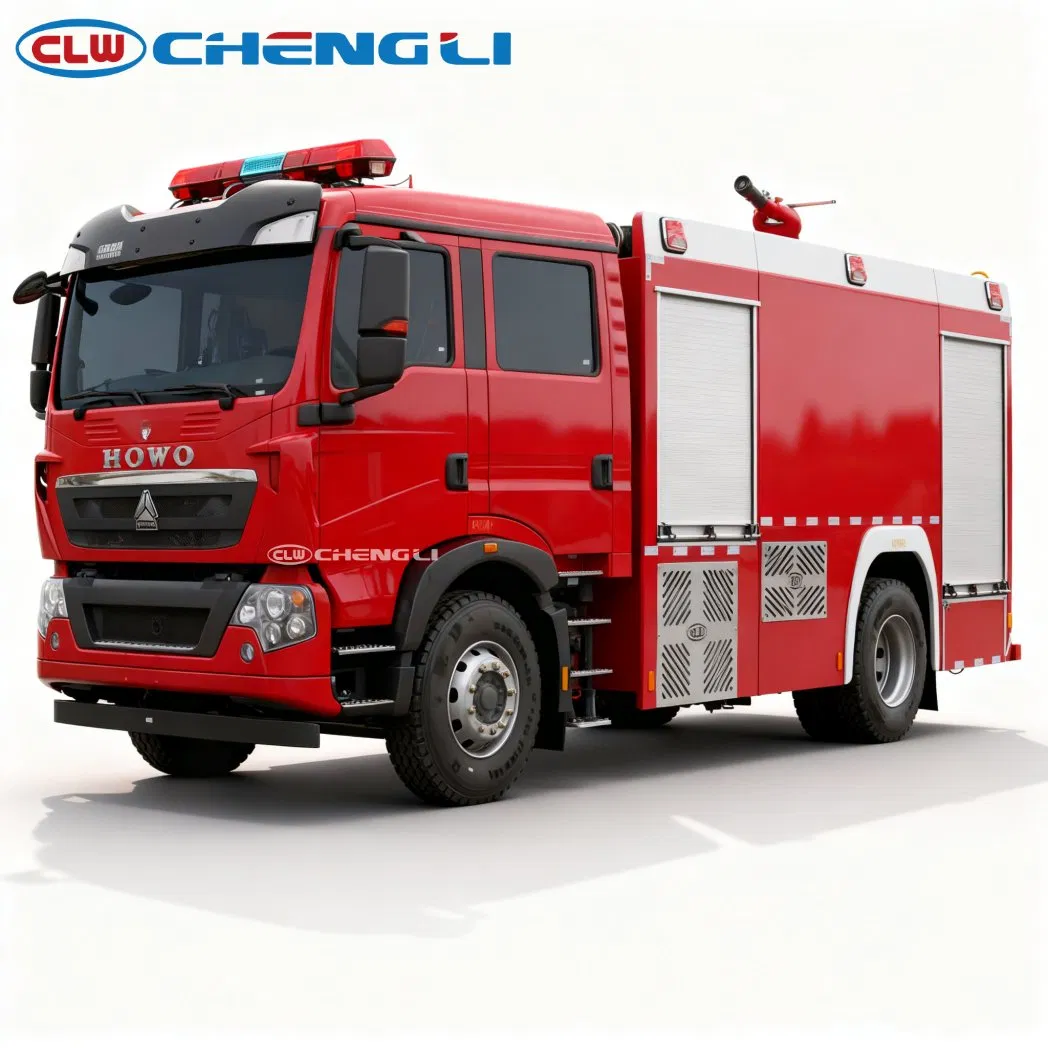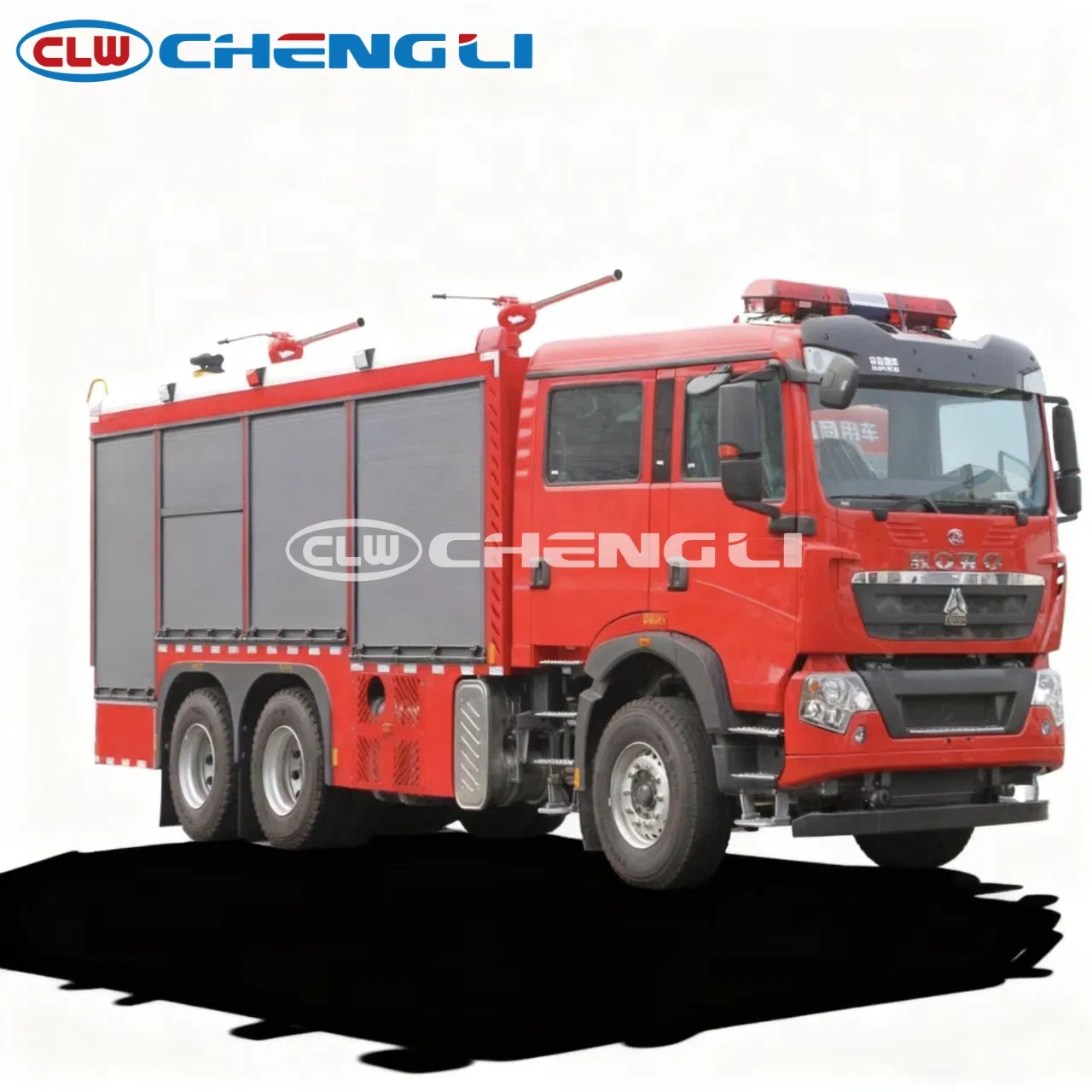
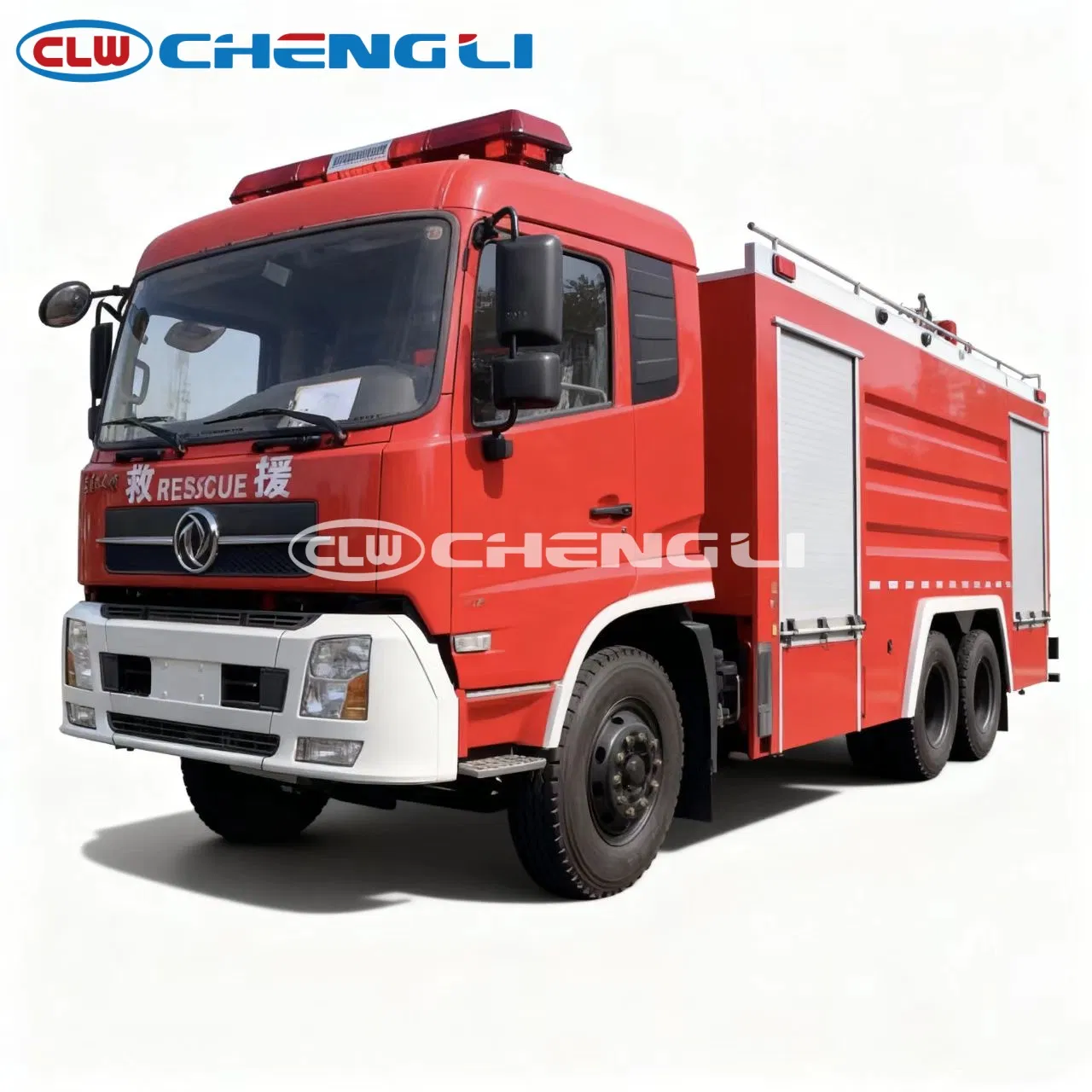
Most fire trucks fall into five groups, defined by the extinguishing agent they carry and the job they do at the scene: water tenders and pumpers, foam trucks, dry powder trucks, combined-agent trucks, and rescue or support trucks. Within each group, tank size and chassis, from a light 4x2 to a four-axle 8x4, decide how much agent a crew brings to the fire.
How fire trucks are classified
Fire trucks are sorted in three ways: by agent (water, foam, dry powder or a mix), by mission (attack, water supply, rescue, hose laying or equipment transport) and by chassis, which sets gross vehicle weight (GVW), crew cab size and off-road ability. The table uses tank ranges from the fire trucks we currently list.
| Type | Main agent | Tank range on our listed trucks | Typical use |
|---|---|---|---|
| Water tender or pumper | Water | 850–25,000 L (about 225–6,600 US gal) | Class A fires; water supply |
| Foam truck | Water plus foam concentrate | 3,000–21,000 L water; 1,000–5,500 L foam | Class B flammable liquids, plus Class A fires |
| Dry powder truck | Dry chemical powder | 4,000–6,000 kg powder | Flammable liquid and gas fires; live electrical equipment |
| Combined-agent truck | Water, foam and dry powder | 2,600 L water, 2,000 L foam, 2.0 m³ powder | Mixed or unknown risks at industrial sites |
| Rescue or support truck | Crane, winch, lighting or hose | 1,500 m of hose on the hose layer | Collisions, lifting, night work, long hose lays |
Aerial ladder and platform trucks, used for high-rise rescue, are a separate family; we do not currently list this type.
Water tenders and pumpers
A pumper carries water, a fire pump and a monitor for direct attack. A water tender, or tanker, puts more payload into the tank and shuttles water where hydrants are far apart. Many trucks do both; the difference is mostly tank size.
Our water-only trucks start at 850 L (about 225 US gal) on a light Dongfeng 4x2 with a 4,050 kg GVW. Mid-size units carry 2,000–4,000 L on Isuzu, JMC, Foton and Dongfeng chassis. At the top end, a HOWO 8x4 carries a single 25,000 L (about 6,600 US gal) tank at 42,450 kg GVW for shuttle duty.
Water weighs about 1 kg per liter, so one of our Dongfeng 4x2 fire and sprinkler trucks, with a nominal 7,000 L tank and a 6,670 kg rated payload, has to limit its fill for road travel. Compare tank volume with rated payload, not GVW.
Pump output sets how long the tank lasts: our HOWO 8x4 pairs 20,900 L of water with a 100 L/s pump at 1.0 MPa, about 3.5 minutes at full flow.
Foam fire trucks: when water is not enough
Water does little against burning fuel, solvents or oil: it sinks below lighter liquids and can spread the burning layer. Foam blankets the surface, cutting off oxygen and vapor, which is why foam trucks are the default for fuel depots, chemical plants and industrial parks.
A foam truck carries two separate tanks, water and foam concentrate, and a proportioning system mixes concentrate into the water stream at a set ratio. Across our listed foam trucks, water tanks run from 3,000 L to 21,000 L (about 790 to 5,550 US gal) and foam tanks from 1,000 L to 5,500 L (about 264 to 1,450 US gal).
Read the two figures separately: 7,800 L of total tank volume can mean 5,850 L of water and 1,950 L of foam. Water drives hose time for a municipal brigade; foam decides how large a spill fire a refinery crew can cover. Our HOWO 4x2 foam truck with 6,000 L of water and 2,059 L of foam is a typical mid-size choice.
Dry powder and combined-agent trucks
Dry powder trucks carry a dry chemical agent in pressurized vessels and discharge it through a monitor and hose lines using compressed gas. Powder interrupts the combustion reaction, which makes it effective on burning liquids, gas fires and fires near live electrical equipment. It does not cool hot surfaces, so re-ignition is a risk unless water or foam follows.
We list two HOWO 6x4 powder trucks: a 4 t dry powder fire truck at 17,650 kg GVW and a 6 t version with twin 3,000 L powder vessels at 24,450 kg GVW. The agent weighs only 4,000–6,000 kg, but curb weights of 13,200 kg and 18,000 kg cover the chassis, pressure vessels, gas supply and discharge equipment. Plan axle loads around the complete vehicle, not the agent figure.
Combined-agent trucks carry water, foam and powder so the first crew can match the agent to an unknown risk. Our HOWO 4x2 combined truck carries 2,600 L of water, 2,000 L of foam and 2.0 m³ of powder with a 60 L/s pump. The trade-off is volume: at about the same 19,000 kg GVW, our 4x2 foam truck carries 6,000 L of water.
Rescue and emergency support trucks
Not every fire truck carries an agent. Rescue fire trucks bring tools, lifting gear and lighting to road collisions and industrial accidents. Our CLH5140 rescue truck with a rear crane combines a crane, winch, reel and scene lighting on a two-axle chassis at 13,800 kg GVW, and we also list a HOWO 6x4 rescue truck in the 14 t class.
A 4x4 hose-laying truck carries 1,500 m of hose and lays it at 5–8 km/h along forest tracks. A HOWO 6x4 hook-lift chassis swaps modules, such as a fire module with a 4,000 L water tank, so one chassis can serve several roles. For the wider range we supply to this sector, see our fire and emergency services page.
Choosing by chassis size: 4x2 vs 6x4
Chassis choice follows tank size, road limits and terrain. Most of our fire trucks are 4x2, covering 850 L to 9,290 L of water and 4,050 kg to 19,550 kg GVW. Above about 10,000 L, trucks move to three or four axles to keep axle loads within limits.
| Drive | Water tanks on our listed trucks | GVW range | Where it fits |
|---|---|---|---|
| 4x2 | 850–9,290 L | 4,050–19,550 kg | Towns, industrial parks, paved roads |
| 4x4 | 1,200–4,400 L | 3,600–17,460 kg | Forest tracks, rural and unpaved access |
| 6x4 | Up to 12,000 L; 4–6 t powder | 14,000–31,800 kg | Heavy city and industrial response |
| 8x4 | 12,600–25,000 L | 37,300–42,450 kg | Airports, ports, refineries, water shuttle |
A 4x2 is lighter and cheaper to run, so most municipal buyers start there. Move to 4x4 when the truck must leave paved roads; approach angles on our 4x4 models range from 23° to 42°. Choose 6x4 or 8x4 when the risk needs more agent than a two-axle chassis can carry.
How to specify a fire truck
Confirm these points before requesting a quotation:
- Agent and volumes: water, foam and powder capacities stated separately, never as one combined figure.
- Rated payload: full tanks plus crew and equipment must stay within the rated payload and axle ratings.
- Pump and monitor: model, flow in L/s, pressure in MPa and monitor reach, written on the build sheet.
- Foam system: concentrate type, proportioning ratio and foam tank material, usually stainless steel.
- Chassis and drive: 4x2, 4x4, 6x4 or 8x4, wheelbase, engine option and left- or right-hand drive.
- Crew cab: two, three, five or six seats, depending on how many firefighters ride to the call.
- Emissions and standards: the emission level and any fire-apparatus standard your market requires, confirmed at quotation.
FAQ
Which types of fire engines does a small town need?
Most small towns start with one or two 4x2 water pumpers of 2,000–4,000 L, which fit narrow streets and carry enough for a first attack. Fuel stations or workshops justify a small foam truck next. Rescue, powder and heavy tankers are often shared regionally.
Can a foam fire truck also fight ordinary fires with water?
Yes. The water sits in its own tank, and with the foam system off the pump delivers plain water, so the truck works as a normal pumper on Class A fires. Concentrate is drawn only when the crew opens the proportioner, keeping the foam reserve for liquid-fuel incidents.
When should I choose a dry powder fire truck over foam?
Choose powder when the main risks are gas fires, pressurized fuel leaks or fires near energized electrical equipment, where foam and water are less effective or unsafe. For large spill fires, foam is usually better because it seals the surface. Many chemical sites run both, with powder for fast knockdown and foam or water to prevent re-ignition.
What equipment does a rescue fire truck carry?
A rescue fire truck carries tools rather than a large agent tank: hydraulic cutters and spreaders, lifting equipment, a winch, generators and scene lighting. Heavier units add a vehicle-mounted crane for lifting wreckage. Specify the crane capacity and reach, winch pull and lighting output in writing, because these ratings decide which incidents the truck can handle.
Start with the risk, then pick the agent, and let tank volume and rated payload choose the chassis. A town brigade may need only a 4x2 pumper, while a refinery may need foam, powder and a heavy 8x4 tanker. Browse our fire truck range, then tell our engineers your main risks, tank sizes, chassis preference and destination market, and we will propose a configuration.