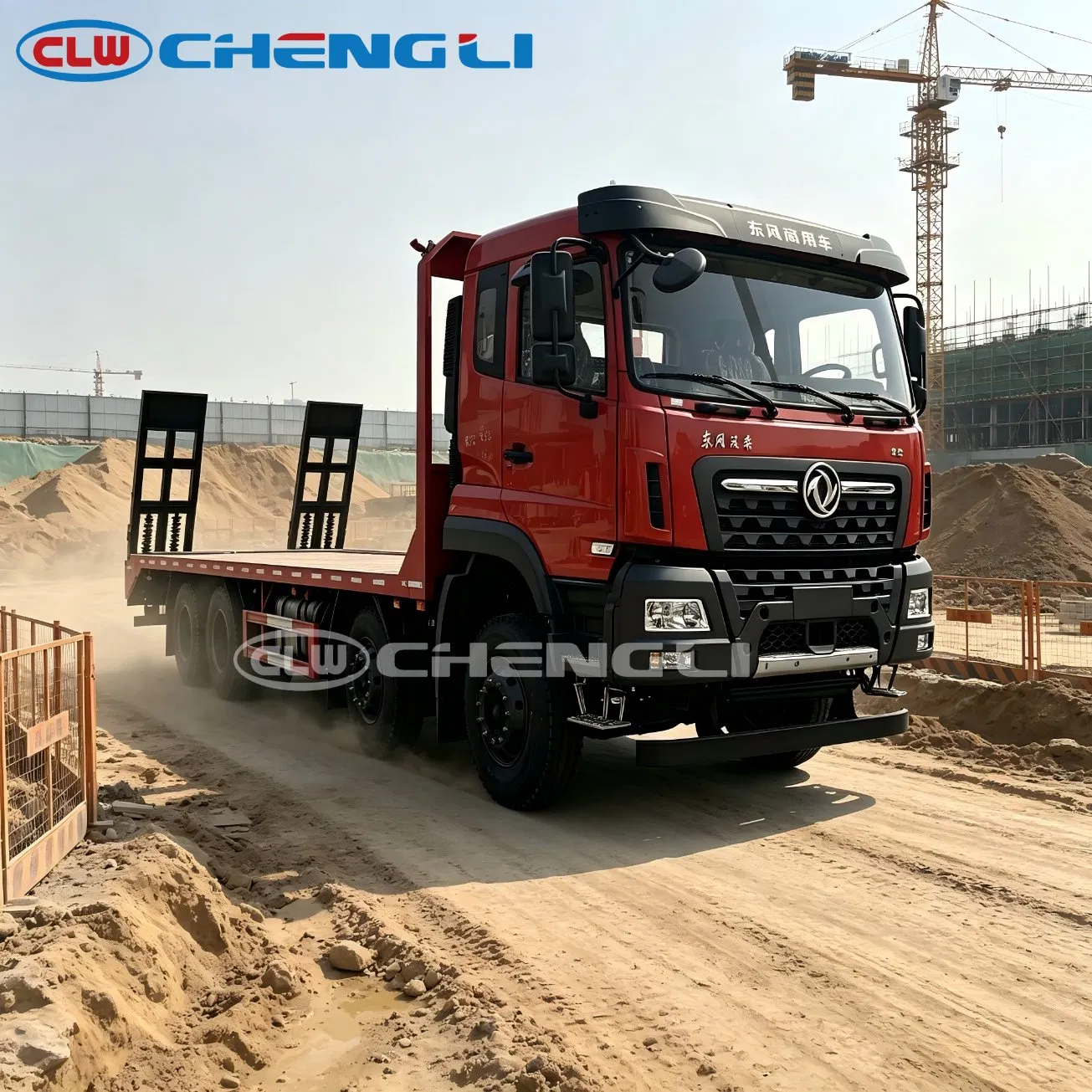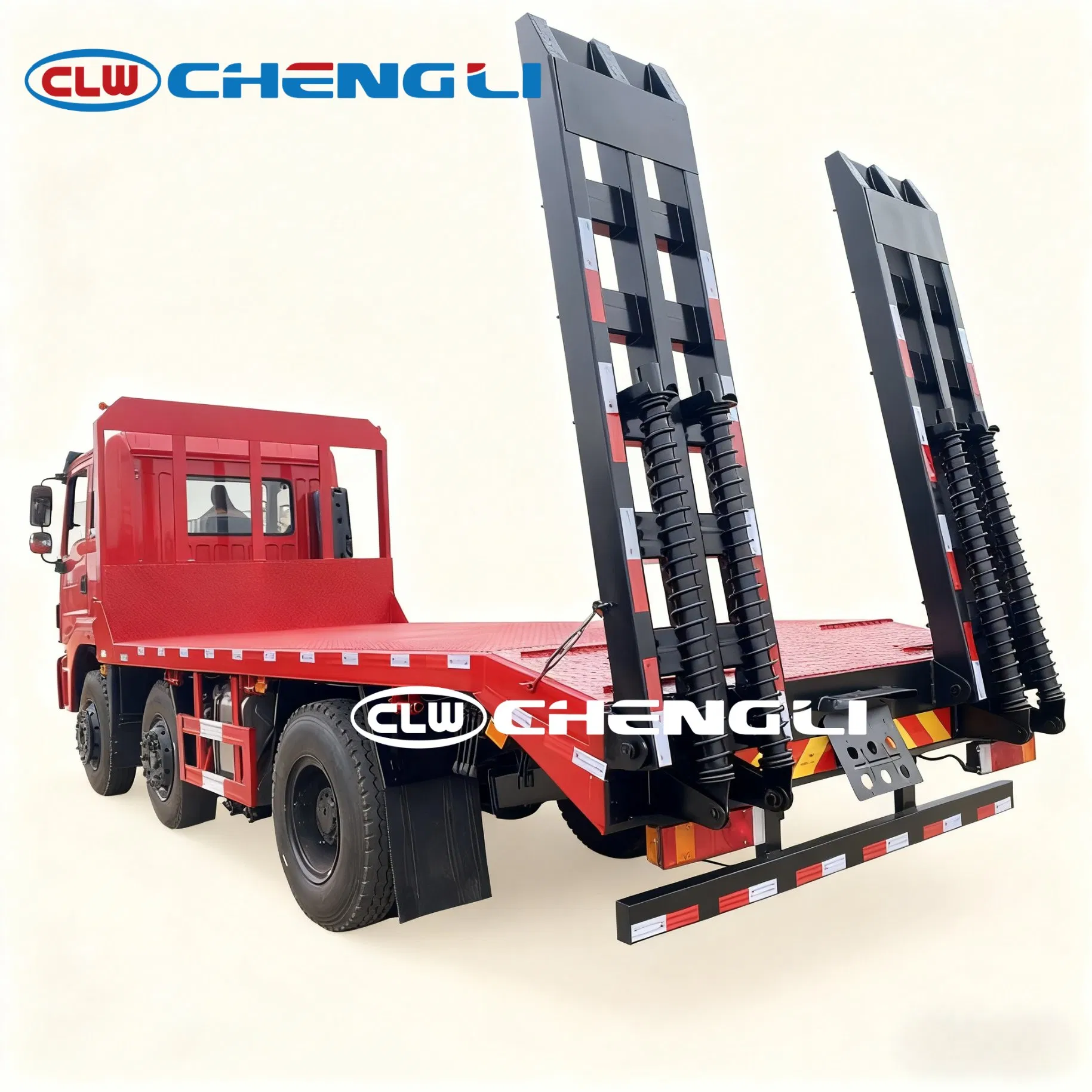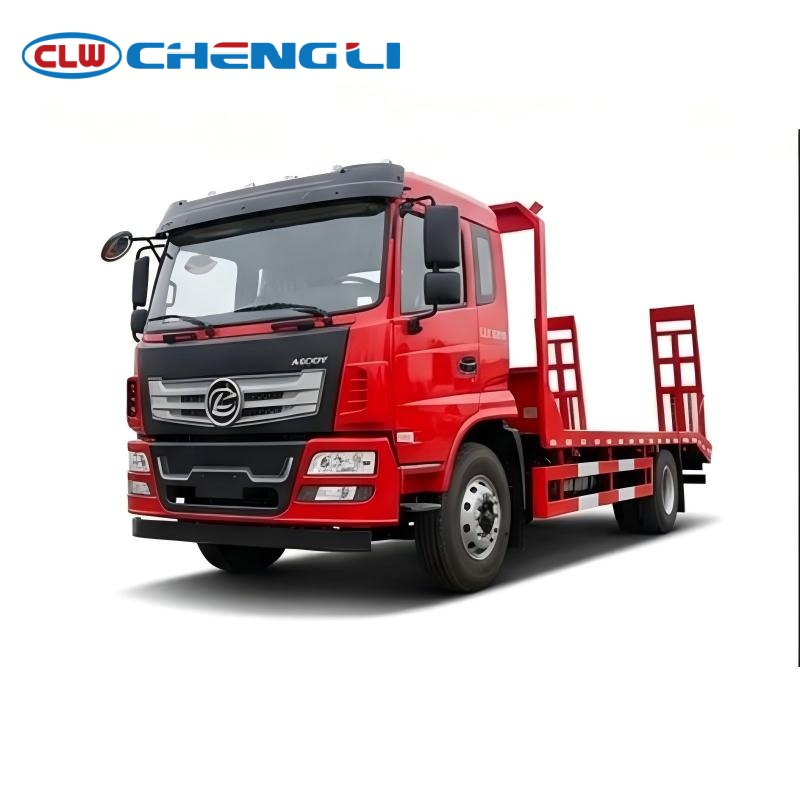
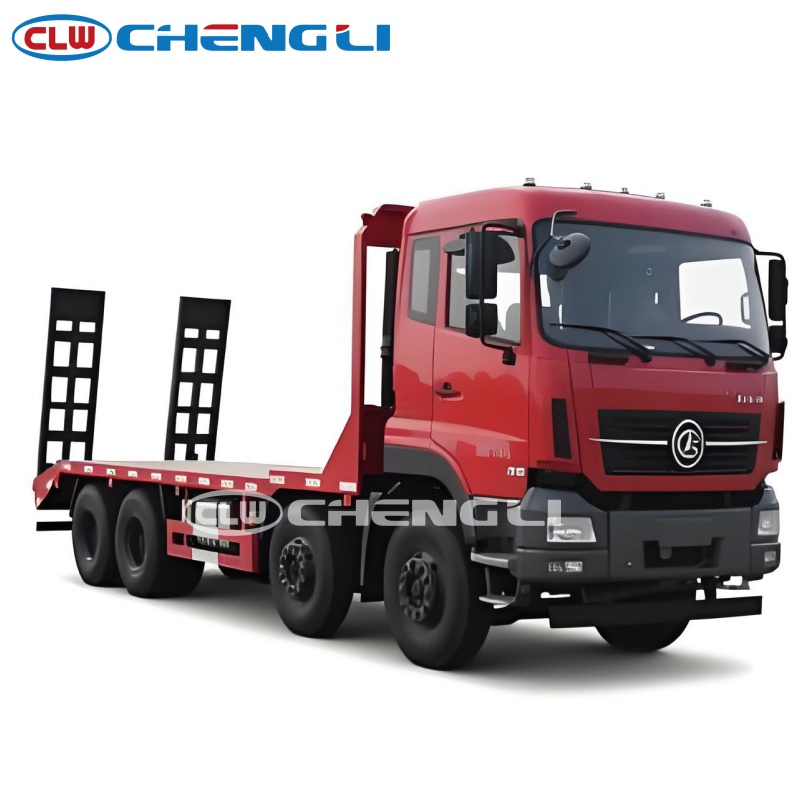
Payload on a machinery flatbed climbs with axle count. Our two-axle 4x2 flatbeds carry 9,395–11,320 kg, the three-axle 6x2 carries up to 15,325 kg and the four-axle 8x4 trucks carry 16,795–20,670 kg. Within each class, curb weight decides the rest: a lighter engine and deck leave more for the machine. Beyond about 20 t, the load belongs on a semi-trailer.
Flatbed truck payload by axle configuration
The table lists our current machinery flatbeds by gross vehicle weight (GVW), rated payload, length and engine power. Rated payload is GVW minus curb weight and the crew allowance, so two trucks with the same GVW can differ by several tonnes.
| Truck | Drive | GVW | Rated payload | Overall length | Engine |
|---|---|---|---|---|---|
| FAW flatbed | 4x2 | 16,000 kg | 9,460 / 9,395 kg | 8,600 mm | 193 hp |
| HOWO flatbed | 4x2 | 18,000 kg | 9,600 kg | 9,000 mm | 240 hp |
| CLW excavator flatbed | 4x2 | 18,000 kg | 11,320 kg | 9,000 mm | 229 hp |
| Dongfeng Jincheng flatbed | 6x2 | 25,000 kg | 15,325 / 14,385 kg | 10,995 mm | 244–270 hp |
| Dongfeng excavator flatbed | 8x4 | 31,000 kg | 16,795 kg | 10,250 mm | 400 hp |
| CLW flatbed | 8x4 | 31,000 kg | 17,370 / 17,305 kg | 12,000 mm | 400 hp |
| FAW machinery flatbed | 8x4 | 31,000 kg | 18,410 kg | 10,020 mm | 350 hp |
| CLW flatbed | 8x4 | 31,000 kg | 19,800 kg | 12,000 mm | 240 hp |
| CLW flatbed | 8x4 | 31,000 kg | 20,670 kg | 12,000 mm | 330 hp |
Why trucks with the same GVW carry different payloads
All five 8x4 trucks share a 31,000 kg GVW, yet payload runs from 16,795 kg to 20,670 kg, a spread of 3,875 kg. The difference is curb weight: engine size, frame, deck structure, ramps and fuel tank all count against the load. The CLW 8x4 with a 400 hp engine weighs 13,500 kg empty and carries 17,370 kg; the CLW 8x4 with a 240 hp engine weighs 11,200 kg and carries 19,800 kg.
That makes engine choice a payload decision. The 400 hp trucks hold speed better on long grades with a full machine on board, while the lighter builds carry more on flatter routes. Heavier options such as dual hydraulic ramps, larger fuel tanks, toolboxes and heavy-duty tie-downs each take a little more from the payload, so ask for the rated payload of the exact build you are ordering, not the model family.
Matching the truck to the machine you move
Start from the operating weight of the heaviest machine, including bucket or attachments, then add a margin for mud, fuel and tools carried with it. Common machine classes line up with our truck classes roughly like this:
- Mini and small excavators, skid steers, rollers and forklifts: a 4x2 flatbed with 9,395–11,320 kg payload, such as our CLW 4x2 11,320 kg excavator flatbed.
- Machines in the 12–15 t range: the 6x2 with up to 15,325 kg, or an 8x4 where roads are rough.
- Machines up to about 20 t: the 8x4 range, topped by our CLW 8x4 20,670 kg flatbed truck.
- Machines over 20 t: a lowbed semi-trailer and tractor head. A 20 t class excavator typically weighs 20 t or more in working trim, which leaves no margin even on our largest 20,670 kg rigid flatbed.
Weight is only half the match. Check the machine's width against the 2,500–2,550 mm deck, and its height on the deck against the height limit on your roads.
6x2 vs 8x4 flatbed trucks
Our Dongfeng Jincheng 6x2 uses twin steering front axles rated 5.5 t each and one driven rear axle rated 10 t or 13 t. It gives much more payload than a 4x2 on less weight and fuel than an 8x4, and its platform can be ordered from 6,000 to 9,000 mm long with 500 mm side beams, aluminum ramps and heavy-duty rotating tie-downs. The limit is traction: with one driven axle, it belongs on paved roads and firm yards.
An 8x4 drives both rear axles, rated together at 18,000 kg on our trucks, with two 6,500 kg steer axles in front. It keeps grip on site roads and wet ramps and carries the heaviest machines, at the cost of fuel. Our 8x4 trucks use 31.36–37.31 L/100 km, against 29.9 L/100 km for the FAW 4x2. Choose the Dongfeng 6x2 flatbed for paved regional work and an 8x4 for construction sites and mining roads; our construction and mining solutions show how the two fit a mixed fleet.
Deck, ramps and tie-downs
Deck construction differs by build. The Dongfeng and FAW 8x4 excavator carriers use 8 mm checkered steel plate on 120 × 120 × 6 mm square tubes over a 300 mm double-layer main beam, while the HOWO 4x2 and the CLW 19,800 kg 8x4 use patterned steel on 100 × 100 mm square tubes over a 280 mm double-layer frame. Tracked machines are hard on decks, so heavier plate pays back on steel-tracked excavators.
Ramps are rated separately from the deck. Options range from double-action ladders on the 8x4 excavator carriers to single or dual hydraulic ramps on those two trucks and light or heavy aluminum ramps on the 6x2. The loading angle equals deck height divided by ramp length, so longer ramps help low machines. Rear geometry matters too: departure angles run from 9° to 32° across our 8x4 trucks, and a long rear overhang with ramps can ground on steep site exits.
Secure every machine with chains or binders at rated tie-down points, bucket lowered to the deck, and park brake and track locks set. Place the machine so each axle group stays within its rating; on an 8x4, that means 6,500 kg per front axle and 18,000 kg for the rear tandem.
What to confirm before ordering a flatbed truck
- Heaviest machine: operating weight with attachments, length, width, height and track or tire type.
- Rated payload of the exact build: engine, ramps, fuel tank and tie-downs included.
- Deck length and width: 6,000–9,000 mm platform options on the 6x2; 2,500 or 2,550 mm width.
- Ramps: type, rated load and length, checked against your lowest machine.
- Axle loads: where the machine sits on the deck and the legal axle limits on your routes.
- Roads and sites: paved routes suit 4x2 or 6x2; site roads and steep exits suit 8x4.
- Market details: emission level, left- or right-hand drive and your country's height and length limits.
FAQ
How much weight can a flatbed truck carry?
It depends on axle count and build. Our two-axle 4x2 flatbeds are rated for 9,395–11,320 kg, the three-axle 6x2 for up to 15,325 kg and the four-axle 8x4 trucks for 16,795–20,670 kg. The rated payload is the legal figure for the chassis, but your national axle and gross weight limits can be lower, so check both.
What are typical flatbed truck dimensions?
Our 4x2 flatbeds are 8,600–9,000 mm long, the 6x2 is 10,995 mm and the 8x4 trucks are 10,020–12,000 mm long. Width is 2,500 or 2,550 mm. Platform length on the 6x2 can be ordered from 6,000 to 9,000 mm; on the HOWO 4x2, the bed including ramps measures 6.5 m.
Can a 4x2 flatbed carry an excavator?
Yes, a small one. Our CLW 4x2 is rated for 11,320 kg, which covers mini and small excavators with their attachments. Check the ramp rating, deck length and the rear axle load, since a heavy machine parked too far back can overload the single rear axle even when the total is within payload. Machines above that weight need a 6x2 or 8x4.
Is a flatbed truck the same as a flatbed tow truck?
No. A machinery flatbed has a fixed deck and loads over ramps, and is rated for heavy equipment. A flatbed tow truck, or rollback, has a tilting or sliding deck and a winch for recovering vehicles. Our guide to tow truck types covers rollbacks and wreckers.
Pick the axle configuration from your heaviest machine and your roads, then confirm the rated payload, ramps and axle loads of the exact build. Compare current models in our flatbed truck range, then send machine weights and dimensions, route conditions and destination market through our contact page, and our engineers will propose a flatbed configuration.