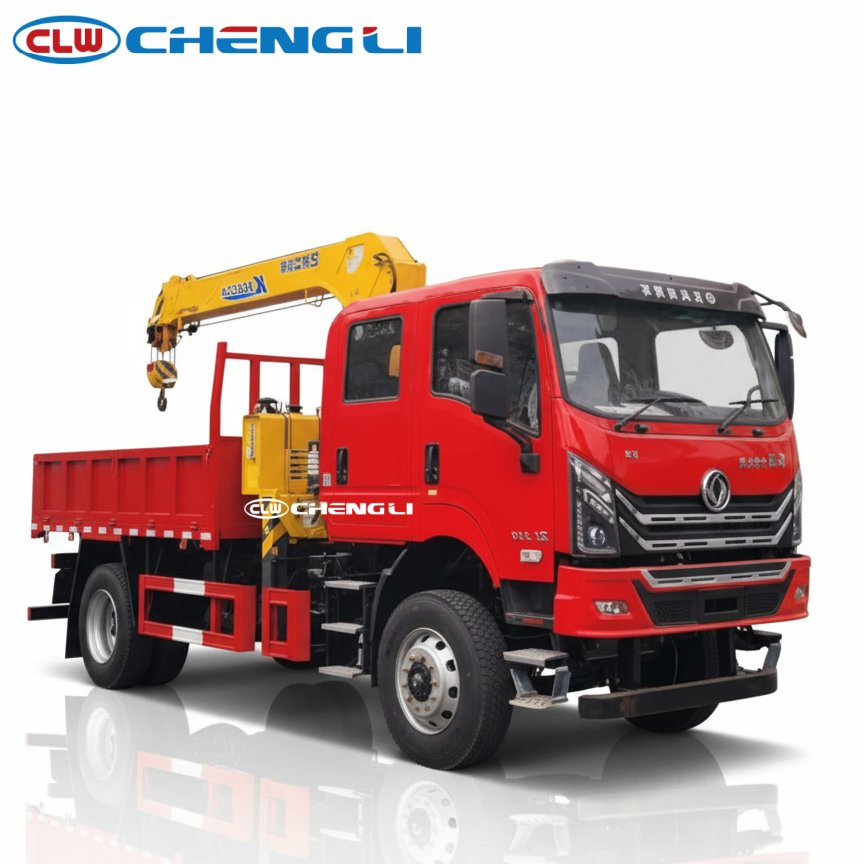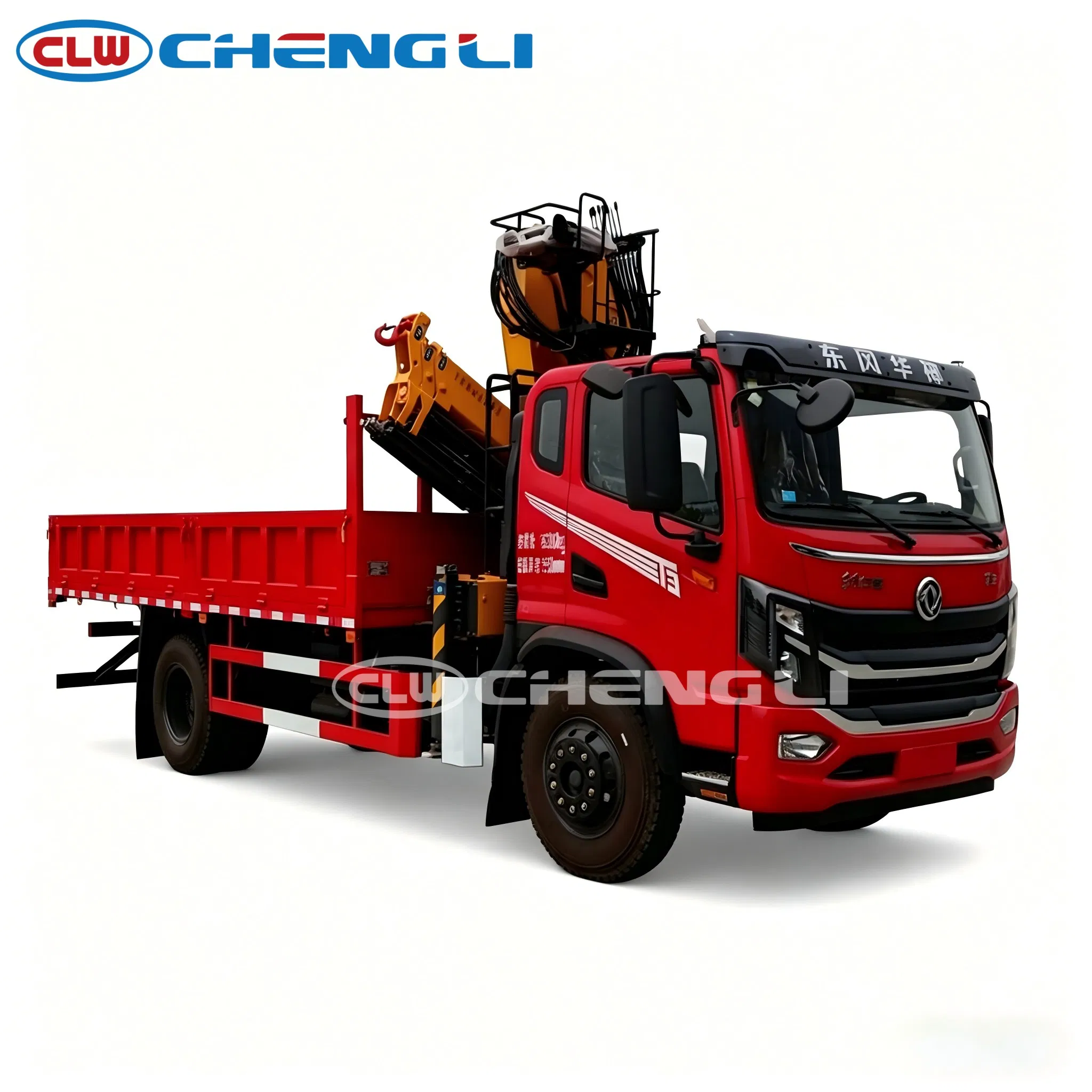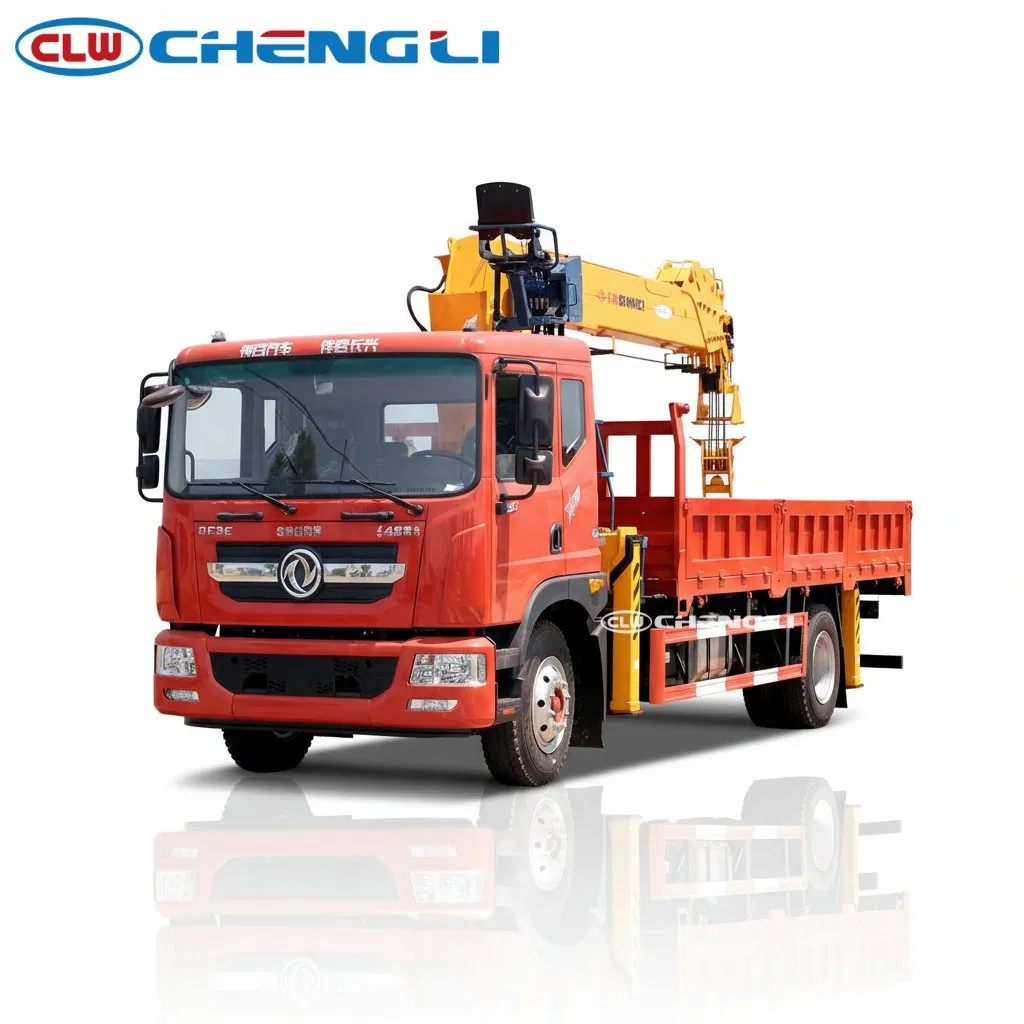
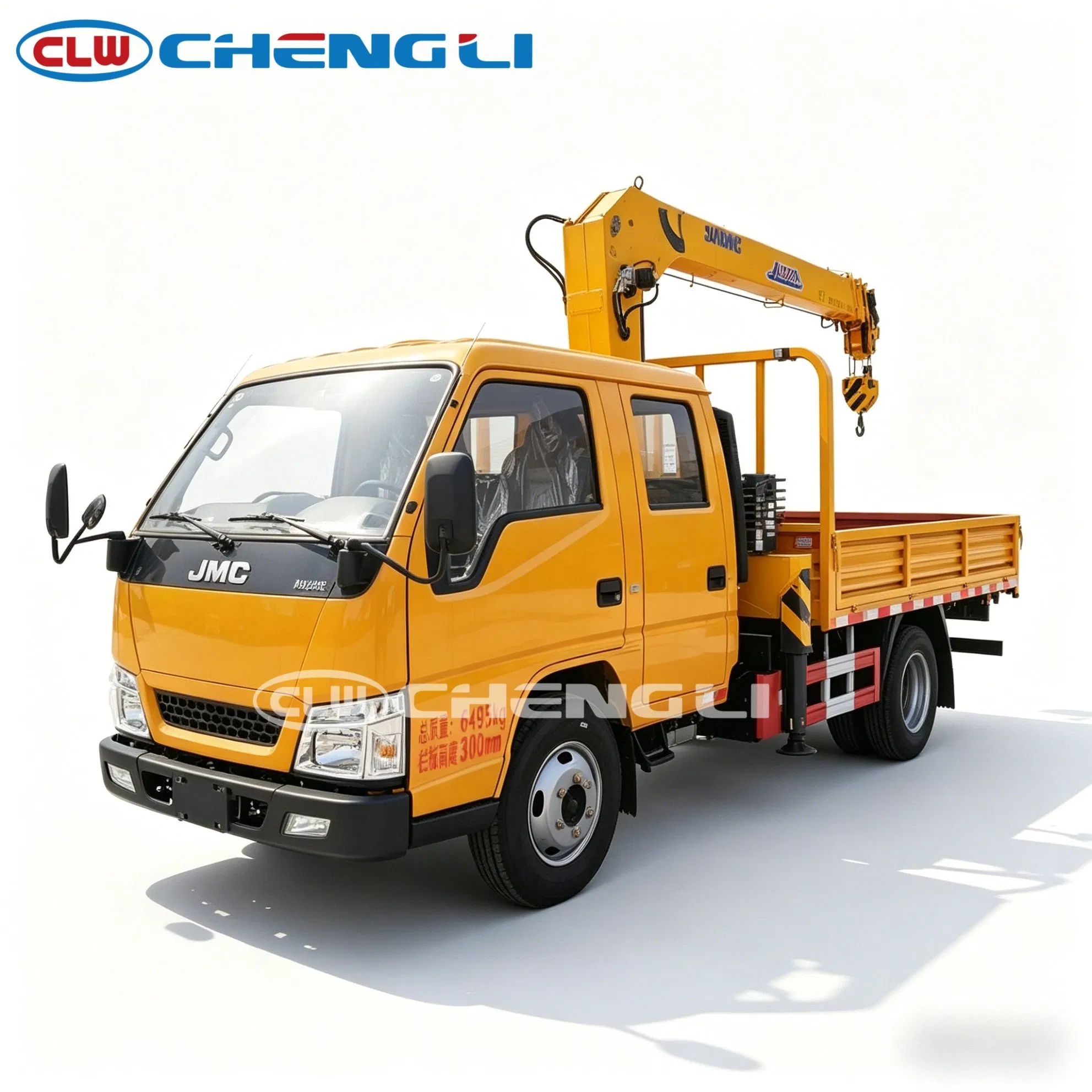
A crane sold as 5 t lifts 5 t only at its shortest radius, with the outriggers fully extended and the truck set level. Move the hook farther out and the permitted load drops roughly in inverse proportion to distance. To read capacity correctly, find the radius of your real lift on the load chart, then read the figure for that boom length, slewing zone and outrigger setting.
Rated capacity vs capacity at working radius
The headline number on a truck-mounted crane, whether 3 t, 5 t or 8 t, is its maximum rated load at one point on the chart: boom retracted and hook close to the slewing column, often about 2 m (6.6 ft) out. Real lifts happen at 4 m to 10 m, off the far side of the deck, over a trench or onto a roof.
Working radius is the horizontal distance from the slewing center to the center of the hanging load. It is not boom length: a steeply raised boom can be long and still work at a short radius. When two suppliers both quote a 5 ton crane truck, compare what each one lifts at the radius your jobs need.
Load moment: the number that limits the lift
Load moment is load multiplied by radius, in tonne-meters (t·m): the overturning and bending effect that crane and chassis must resist. Knuckle boom cranes are often sold by moment rating, such as 10 t·m or 12 t·m, which already builds reach into the number.
The arithmetic below is an example for an idealized crane with a constant 10 t·m net moment (about 72,300 lb·ft). It is not the chart of any vehicle we build. Divide the moment by the radius to get the allowable load:
| Working radius | Allowable load (example, 10 t·m) | Share of headline rating |
|---|---|---|
| 2 m (6.6 ft) | 5.0 t (about 11,020 lb) | 100% |
| 3 m (9.8 ft) | 3.3 t (about 7,350 lb) | 67% |
| 4 m (13.1 ft) | 2.5 t (about 5,510 lb) | 50% |
| 5 m (16.4 ft) | 2.0 t (about 4,410 lb) | 40% |
| 8 m (26.2 ft) | 1.25 t (about 2,760 lb) | 25% |
Real charts sit below this curve at long radius, because the boom's own weight also uses part of the moment. At very short radius, structural strength or hydraulic pressure limits the lift instead, so the chart flattens at the top. Use the division as a plausibility check, then rely on the manufacturer's chart.
How to read a truck-mounted crane load chart
- Measure the radius of your heaviest routine lift from the slewing center, not from the truck body.
- Identify the boom configuration: extensions out, and any jib or manual extension.
- Read the capacity at that radius. Between two columns, use the figure for the longer radius.
- Check the outrigger condition the column assumes: fully extended, partly extended or on tires.
- Check the slewing zone. Capacity over the rear or sides often differs from capacity over the cab.
- Deduct the hook block, slings, spreader beam and any grab or fork. The chart shows gross load at the hook.
If a chart does not state radius, outrigger condition and deductions, it is a sales sheet, not a load chart.
Outriggers, chassis and stability
A crane cannot lift more than the truck under it can hold down. Outriggers move the tipping line outward; on half-extended legs the safe moment shrinks, and on tires little remains. Charts also assume firm, level ground: a truck a few degrees out of level loses capacity quickly as the load swings outward.
Ground pressure is often underestimated. As an example, a 10 t outrigger reaction on a 0.3 × 0.3 m pad (0.09 m²) puts about 111 t/m² into the ground; a 1 × 1 m mat cuts that to 10 t/m². Ask for the maximum outrigger reaction and carry mats sized for your sites.
The crane also consumes the chassis, as our crane-equipped recovery trucks show. The Dongfeng 4x2 8 t crane wrecker has an 18,000 kg GVW and a 14,500 kg curb weight, leaving 3,500 kg for crew, tools and deck load. The SHACMAN version carries the same 8 t crane rating on a 6x2 chassis, which spreads axle load but does not change what the boom may lift. The CLH5140 rescue fire truck with a rear crane has a 13,800 kg GVW against a 13,150 kg curb weight. These are recovery and rescue vehicles rather than crane trucks, but the lesson holds: crane weight and mounting position decide front-axle load and remaining payload, so confirm both on the finished vehicle.
Their ratings also show why nameplates mislead. The Dongfeng 8 t recovery wrecker has a 4,780 kg lifting boom, and the Dongfeng 10 t rollback pairs a 10 t deck with an 8,000 kg crane. Each is a separate limit, and none says what the boom holds at 5 m. Compare these layouts among our crane-equipped tow and recovery trucks and emergency rescue vehicles with winches and cranes, or see our overview of tow truck types for recovery work.
Straight telescopic boom vs knuckle boom
A straight (telescopic) boom extends in box sections and lifts with a wire-rope winch and hook. A knuckle boom (articulating) crane folds in two or more arms, extends hydraulically and usually lifts from a hook on the boom tip.
| Point | Straight telescopic boom | Knuckle boom |
|---|---|---|
| How it lifts | Winch rope and hook; hook height set by rope length | Hook on the boom tip; winch optional |
| Stowed position | Boom rests along the deck | Folds compactly behind the cab |
| Load placement | Load hangs on rope and can swing; good for vertical lifts to height | Rigid tip places loads precisely over walls and into openings |
| Rating usually quoted as | Maximum tonnes at minimum radius | Load moment in t·m |
| Maintenance points | Fewer joints and cylinders | More pins, hoses and cylinders to inspect |
| Typical fit | Poles, pipe, steel and general handling | Building-material delivery, grabs and work around obstacles |
A straight boom gives more hook height and simpler maintenance; a knuckle boom saves deck length and places loads with more control, which suits block and pallet deliveries on construction and mining sites.
What to confirm before ordering
- The heaviest routine load, and the radius and hook height at which you lift it.
- The full load chart for the exact boom, extension and jib configuration.
- Outrigger span, charts for full, partial and on-tire setups, and the maximum outrigger reaction.
- The slewing diagram: full, reduced and blocked zones, especially over the cab.
- GVW, curb weight with the crane fitted, remaining payload and front-axle load.
- Controls and protection: lever or radio remote control and the load moment limiting system.
- Winch line pull and rope length, or maximum tip height for a knuckle boom.
- The crane standard and road rules your market requires; specify them and confirm them at quotation.
FAQ
What can a 3 ton lorry crane lift at full reach?
Much less than 3 t. For example, if a 3 t lorry crane reaches its maximum at 2 m, its moment is about 6 t·m, so at 6 m the idealized figure is 1 t, and the real chart will be lower once boom weight is counted. Many small cranes lift only a few hundred kilograms at full extension.
Do the hook, slings and grab count against capacity?
Yes. A load chart gives gross capacity at the hook, so everything hanging from the boom tip or rope counts: hook block, slings, shackles, spreader beams, pallet forks and grabs. A grab alone can weigh several hundred kilograms, a large share of the capacity at long radius. Subtract full rigging weight before comparing with the load.
Can a truck-mounted crane lift over the front of the cab?
Often only at reduced capacity, and on some models not at all. The front is usually the least stable direction because the tipping line is closer and the front axle carries less weight. If your job needs lifts ahead of the truck, specify a front stabilizer leg and confirm the chart for that zone.
What factors affect truck mounted crane price?
The main factors are load moment and reach, boom type and number of extensions, remote control, the overload protection system, winch and attachments, and the chassis needed to carry the crane legally. Extra outriggers, destination emission rules, cab choice and shipping method also move the figure. We quote a configuration, not a headline tonnage.
How does wind affect lifting capacity?
Load charts assume limited wind, and the manufacturer states a maximum wind speed for operation. Wind pushes on the boom and, more importantly, on large-surface loads such as panels, formwork or roofing sheets, adding side load and swing the chart does not include. On exposed sites, keep the radius short and stop lifting above the stated limit.
Choose a crane truck by the load you lift at the radius you work, then size the chassis around the crane's weight and outrigger reactions. Check our truck-mounted crane category, then send your heaviest lift, working radius and site conditions through our contact page and our team will propose a crane and chassis combination.