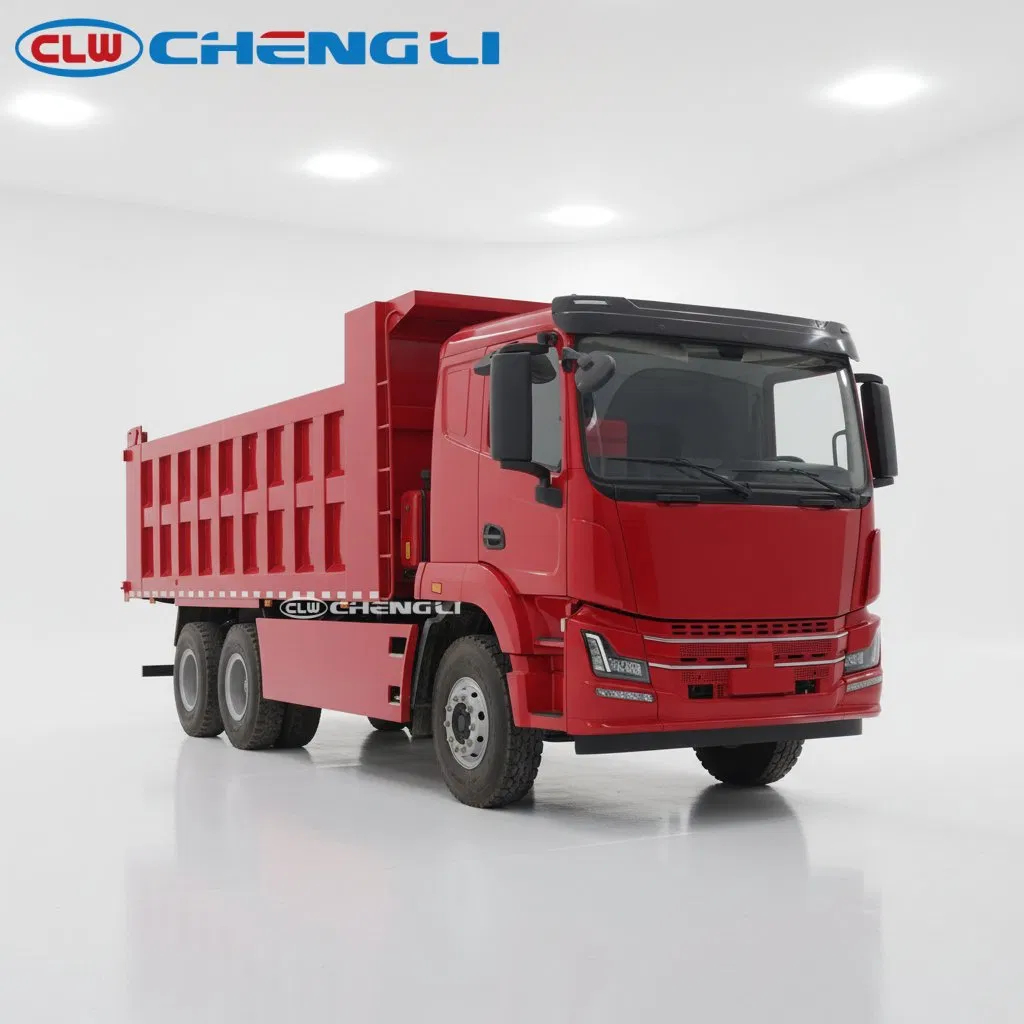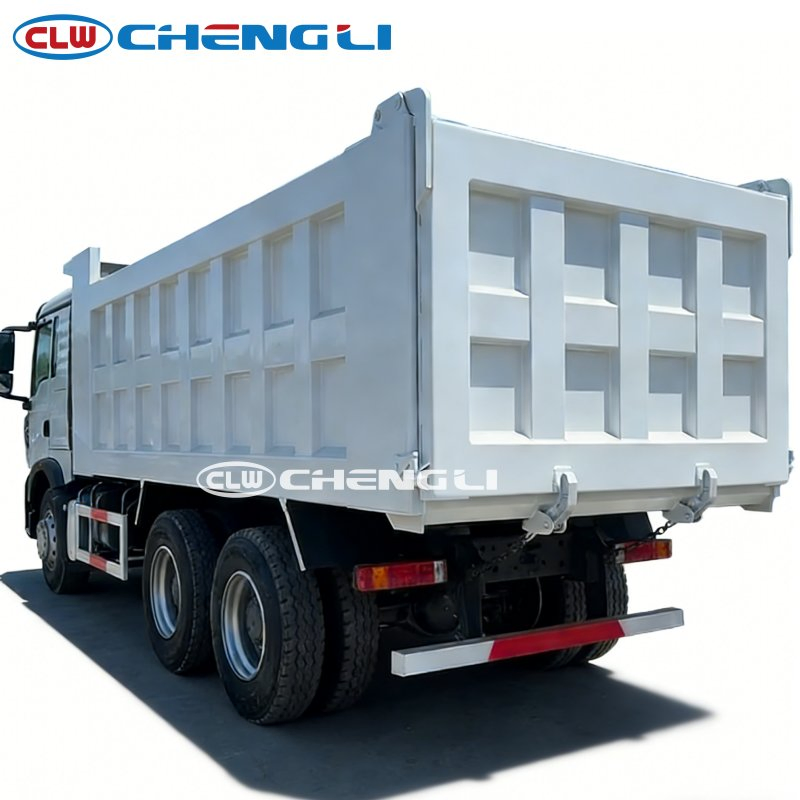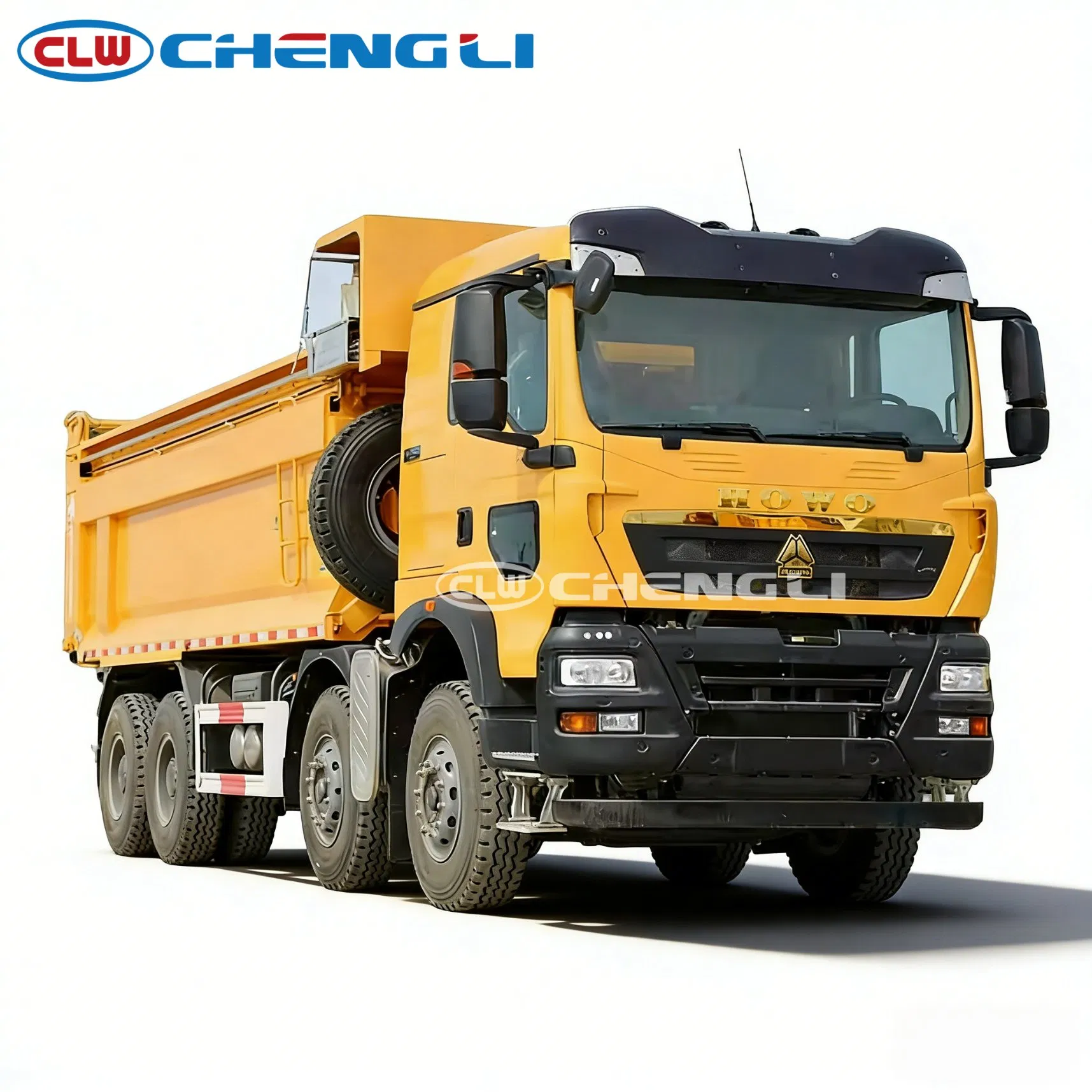
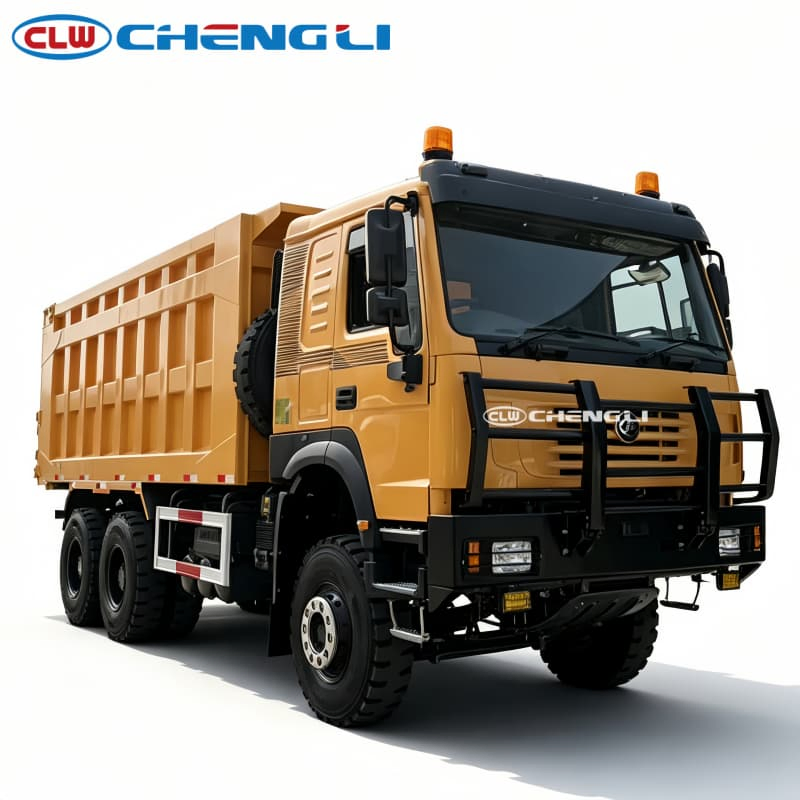
A mining dump truck is built for short, rough haul cycles in which an excavator loads the body many times a shift and heavy loads are routine; a highway tipper is built for longer runs at road speed within registered axle limits. Both are usually 6x4. The difference lies in the weight rating, body plate, frame and springs, tires and gearing.
Duty cycle: why the same 6x4 is built two ways
Duty cycle is the pattern of loading, travel and tipping that a truck repeats every working day. In an open pit or quarry the cycle is short: load at the face, climb a haul ramp in a low gear, tip at the crusher or waste dump, and return empty. The truck repeats this many times per shift, often around the clock, on unpaved roads covered in loose stone and standing water.
A highway tipper works the other way round. It completes fewer loads a day, but each run covers long distances on paved roads at 80–90 km/h, past weighbridges that check axle loads. Fuel use, braking at speed and staying within the registered weight matter more than resistance to impact.
Those two patterns stress different parts of the truck. Mining work punishes the body floor, the frame, the springs and the tires. Highway work loads the driveline at sustained speed and is limited by law rather than by steel.
Payload and GVW: two ratings on the same axle layout
Our own range shows the split. The HOWO 6x4 dump truck is rated at 39,500 kg GVW with a 26,805 kg payload, and the HOWO 7 6x4 mining dump truck is rated for 30–40 t loads in a reinforced 20 m³ body. Yet our CLW 6x2 and CLW 6x4 rear dump trucks, also three-axle trucks, are rated at 25,000 kg GVW, with payloads of 16,070 kg and 15,320 kg.
The higher figures are mechanical ratings for site and mining duty: what the axles, springs and frame are built to carry. The lower figures sit closer to what many road authorities allow a three-axle rigid truck to gross on public roads. Check the gross and axle limits where the truck will be registered before you choose. A truck plated at 25,000 kg that leaves the quarry with 35 t on board is overloaded, however strong its frame is.
Body volume tells the same story. Loose blasted rock and wet sand weigh roughly 1.6–1.9 t per m³, so a 20 m³ mining body filled level holds about 32–38 t, which matches the 30–40 t rating of the HOWO 7. Our 6x2 dump truck has a larger 21.6 m³ body but a payload of only 16,070 kg: filled level with sand it would carry more than twice its rating. That body is sized for light, bulky loads such as coal, not for rock. Our guide to dump truck capacity in cubic meters and tonnes works through the calculation step by step.
Body, frame and suspension built for loading impact
At a quarry face, an excavator drops several tonnes of rock into the body with each pass. The floor and the frame absorb that impact on every load of every shift, so mining specifications start there.
Body plate and shape
The HOWO 7 mining truck uses a high-strength steel body with a reinforced floor and sides, and the plate thickness can be set to suit the material. For comparison, a light town tipper such as our HOWO mini dump truck uses 3 mm side plate and 4 mm floor plate in Q235 carbon steel. That is fine for sand and blocks but wears through quickly under blasted rock. Rock bodies often add a sloped floor and leave out the tailgate so large stones slide out without jamming.
Frame and suspension
Our heavier tippers use straight-through triple-layer frames, and the mining truck adds reinforced multi-leaf springs. Leaf springs remain the norm on rough-duty tippers because they tolerate overload, mud and poor maintenance better than air suspension. Where a truck spends nearly all its life on paved roads, rear air suspension protects the road surface and the driver, and some markets permit higher axle loads with it.
Tipping hoist
Short, heavy rock bodies normally use a front-mounted cylinder behind the cab, as on our HOWO 7 and HOWO 6x4 models. Long bodies for lighter material, such as the 8,800 mm body on our HOWO 8x4 middle-lift dump truck, use an underbody hoist that suits the longer frame and spreads the lifting load.
Tires, brakes, engine and gearing
Tire choice follows the haul road. Many of our construction and mining tippers, including the HOWO 6x4, the HOWO 8x4 and the electric 6x4, run on 12.00R20 tires, a tube-type size widely used on site trucks because it is easy to repair in the field and comes in deep, cut-resistant treads. Highway tippers more often use tubeless 22.5-inch radials, which run cooler at sustained speed; our 6x2 dump truck uses 12R22.5 18PR. The HOWO 7 mining truck also ships on 12R22.5 18PR radials as standard, so state the tire type and ply rating you want if your haul roads are rocky.
Braking matters most on loaded descents. The HOWO 7 uses disc and drum brakes, and our CLW 4x2 and Dongfeng narrow tippers add an engine exhaust brake. On long downhill haul ramps, ask for an exhaust brake or retarder so the service brakes do not overheat.
For power, the mining truck pairs a 371 hp, 9.7 L engine, with up to 450 hp optional, with an HW19710 manual gearbox and a direct HW50 PTO for the hoist. It also carries a front bull bar and heavy-duty air intake and filtration for dusty pits. Highway tippers in the 25,000 kg class run comfortably on less: our 6x2 uses a 245 hp Yuchai engine and lists fuel use of 35.0 L/100 km. On a mine, pulling power at low speed on ramps counts for more than top speed. On the highway, gearing for 80–90 km/h and fuel use per tonne-kilometer decide the running cost.
Mining duty vs highway duty at a glance
| Feature | Mining and quarry duty | Highway tipper |
|---|---|---|
| Typical cycle | Short haul, frequent loading by excavator, unpaved ramps | Longer runs on paved roads at road speed |
| Weight rating | Mechanical rating, such as 30–40 t on our HOWO 7 6x4 | Registered GVW, such as 25,000 kg on our CLW 6x2 and 6x4 |
| Body | Reinforced floor and sides, about 20 m³ | Sized to legal payload and material density |
| Suspension | Reinforced multi-leaf springs | Leaf springs or rear air suspension |
| Tires | Deep-tread, cut-resistant; 12.00R20 common | Tubeless 22.5-inch radials common |
| Protection | Bull bar, heavy-duty air filtration | Standard bumper and filtration |
The table below places our current dump trucks against those two duties.
| Truck | GVW | Rated payload | Body | Best fit |
|---|---|---|---|---|
| HOWO 7 6x4 mining dump truck | Not stated | 30–40 t loading capacity | 20 m³ | Quarry face to crusher, open pits |
| CLW 6x4 electric dump truck | 50,000 kg | 31,305 kg | 20 m³ | Mines and large sites with a swap station |
| HOWO 6x4 dump truck | 39,500 kg | 26,805 kg | 19.3 m³ | Heavy site haulage |
| HOWO 8x4 middle-lift dump truck | 39,500 kg | 26,805 kg | 8,800 × 2,350 × 1,500 mm | Aggregate and spoil on longer routes |
| CLW 6x2 dump truck | 25,000 kg | 16,070 kg | 21.6 m³ | Paved routes, light bulk such as coal |
| CLW 4x4 off-road dump truck | 18,000 kg | 9,050 kg | 8,755 L | Soft or steep unpaved access roads |
Where electric dump trucks fit
Short, repetitive mining cycles suit battery power better than long highway runs, because the truck returns to the same points many times a shift and an electric driveline can recover energy on loaded descents. Our electric 6x4 dump truck carries a 512 kWh battery, is rated at 50,000 kg GVW with a 31,305 kg payload, and swaps its pack from underneath in about 3–5 minutes at a compatible station. It is designed mainly for mines and construction sites, and road use at that weight depends on local rules. The electric 8x4 model, rated at 31,000 kg GVW with a 15,305 kg payload and a 10 m³ body, targets city spoil haulage instead.
What to confirm before ordering
- Haul profile: one-way distance, share of unpaved road, steepest loaded grade and loads per shift.
- Material and density: rock, ore, sand, soil or coal, so the body volume matches the payload instead of exceeding it.
- Registration limits: the gross and axle limits where the truck will be plated, and whether it will use public roads at all.
- Loading equipment: excavator or wheel loader size, which sets floor and side plate thickness.
- Body shape and hoist: square, U or rock body; front or underbody cylinder; tailgate or open rear.
- Tires: size, tube-type or tubeless, and ply rating for your road surface.
- Engine and braking: engine power, exhaust brake or retarder for long descents, and the emission level your market requires.
- Dust and heat: air filtration, cooling and cab air conditioning for the site climate.
FAQ
Can a mining dump truck be registered for road use?
Often it can, provided it is plated at a weight the local authority accepts. The catch is that once plated, it may legally carry only what that plate allows on public roads, even if the frame and axles are built for far more. If the truck will split its time between a quarry and public roads, plan payload around the road limit and treat the extra strength as durability rather than capacity.
Why are mining tippers usually 6x4 rather than 8x4?
A 6x4 is shorter and turns tighter at the loading face and on haul ramps. Our HOWO 7 mining truck is 8,150 mm long, while the HOWO 8x4 middle-lift truck is 11,850 mm long. An 8x4 spreads weight over four axles, which helps on roads with strict axle limits and suits long bodies for lighter material, but the extra length is a handicap in a tight pit.
When does a quarry need a 4x4 dump truck instead of a 6x4?
When the ground, not the load, is the limit: wet-season tracks, river sand, steep unpaved access roads. Our CLW 4x4 off-road dump truck carries 9,050 kg within an 18,000 kg GVW and drives the front axle when the rear wheels sink. The trade-off is payload, so on firm, maintained haul roads a 6x4 moves more material per trip.
Is a mining dump truck the same as an off-highway haul truck?
No. Rigid mining tippers such as ours are reinforced road-truck designs that can still be shipped, registered and driven like other heavy trucks. Dedicated off-highway haul trucks and articulated dump trucks are much larger machines that stay inside the mine and are usually not road legal. We do not build them; our range covers rigid tippers from 4x2 to 8x4, including electric models.
What top speed does a mining dump truck need?
Very little of it is used. Our heavy dump trucks top out at 80–90 km/h, but loaded speeds on haul ramps are far lower. For mining work, specify gearing and engine torque for climbing loaded grades, and an exhaust brake or retarder for the descent, rather than paying for highway speed the truck will rarely reach.
Choose the build from the work rather than the axle count: a reinforced 6x4 with a rock body for short, heavily loaded quarry cycles, a 25,000 kg-class tipper for road haulage within registered limits, and a 4x4 where the ground is soft. Mine and quarry operators can see how these trucks fit wider site fleets on our construction and mining industry page and compare models across our dump truck range. Send your haul distance, material, loading equipment and destination market through our contact page, and our engineers will propose a configuration.