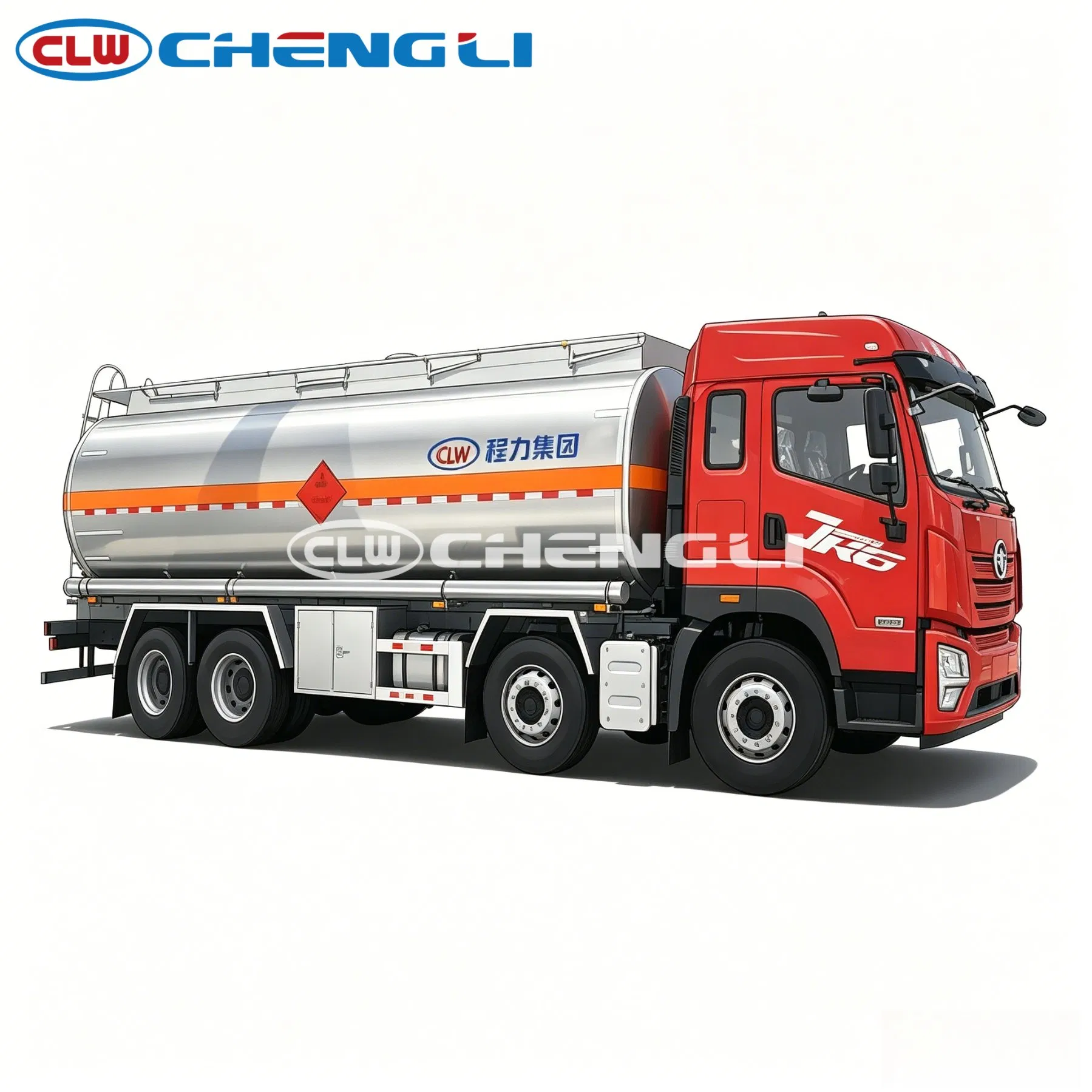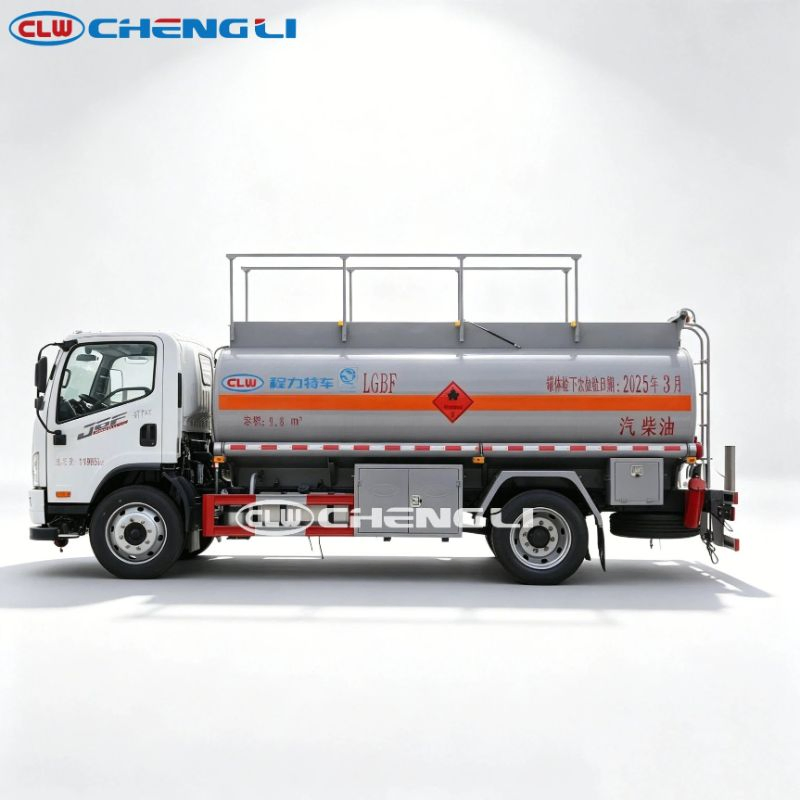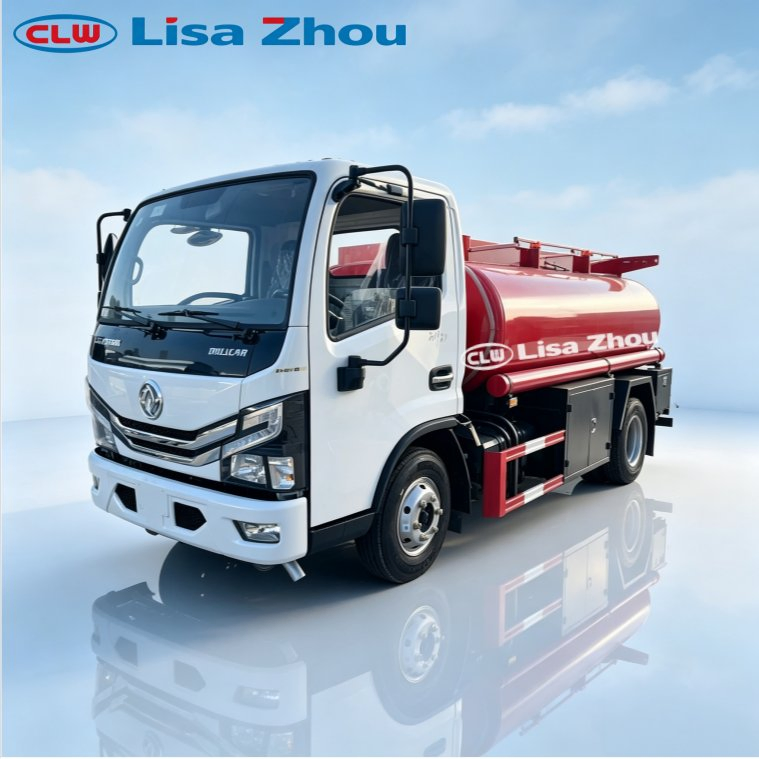
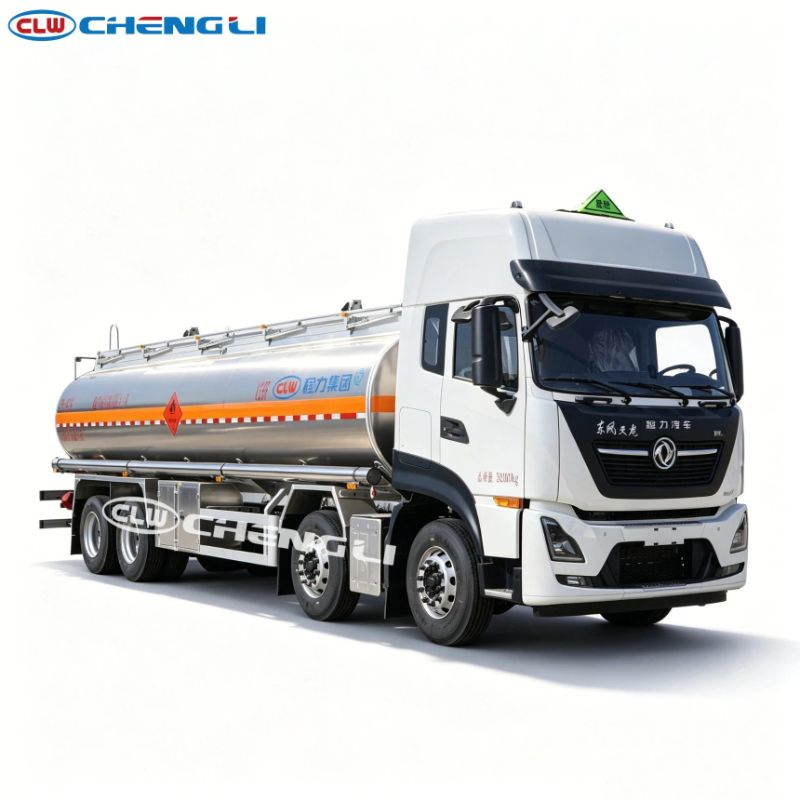
Fuel density sets the useful size of a fuel tanker: at about 0.84 kg/L, diesel puts roughly 840 kg on the chassis for every cubic meter, so rated payload, not tank volume, usually decides how much you can deliver. Our fuel tankers run from 2,630 L on a light Dongfeng 4x2 to 30.8 m³ on an FAW 8x4, in carbon steel or 5182 aluminum alloy.
Fuel bowser or fuel tanker?
The two names overlap, and which one you hear depends on the country and on the job the truck does.
- Fuel tanker, petrol tanker, road tanker: a truck that moves fuel in bulk from a terminal or depot to a filling station or a storage tank. It is loaded and emptied through large couplings and usually carries no meter of its own.
- Fuel bowser: the usual word in the UK, Australia, Kenya, South Africa and much of the rest of Africa for a truck that refuels machines where they stand. It is a small or medium tanker with a pump, a meter, a hose reel and a nozzle. Mines, farms, construction sites and generator fleets run on them.
The tank and chassis are the same; the dispensing equipment makes the difference. Our 6,000 L and 9,800 L 4x2 tankers become fuel bowsers when ordered with the optional high-flow dispenser and 15 m hose reel, and flow meter, hose reel and nozzle choices can also be specified on the 6,200 L model. If you ask for a bowser, tell us what you refuel and how many liters per fill, so the pump and meter can be sized.
On capacity: rigid petrol tankers in our range hold from 2,630 L to 30.8 m³. The road tanker capacities above that, of 40,000 L and more, belong to tanker semi-trailers pulled by a tractor head.
How much fuel can a tanker legally carry?
Tank volume is geometry. Payload is law. The two meet through density: diesel runs about 0.83–0.85 kg/L and gasoline about 0.72–0.76 kg/L, depending on blend and temperature. Multiply tank volume by density and compare the result with the rated payload. If the fuel mass is higher, the tank cannot legally be filled to the brim.
The table applies mid-range densities of 0.84 kg/L for diesel and 0.74 kg/L for gasoline to our current fuel tankers. Rated payload here is the manufacturer figure; the axle limits in your country may be lower.
| Tank (chassis) | Rated payload | Full of diesel | Full of gasoline | Diesel volume at rated payload |
|---|---|---|---|---|
| 2,630 L aluminum (Dongfeng 4x2) | 1,845 kg | 2,209 kg | 1,946 kg | about 2,190 L |
| 6,000 L carbon steel (Dongfeng 4x2) | 7,050 kg | 5,040 kg | 4,440 kg | full tank |
| 6,200 L (FAW 4x2) | 4,905 kg | 5,208 kg | 4,588 kg | about 5,840 L |
| 9,800 L carbon steel (FAW J6F 4x2) | 6,545 kg | 8,232 kg | 7,252 kg | about 7,790 L |
| 12,750 L carbon steel (Dongfeng 4x2) | 10,000 kg | 10,710 kg | 9,435 kg | about 11,900 L |
| 25,500 L aluminum (Dongfeng 8x4) | 20,220 kg | 21,420 kg | 18,870 kg | about 24,070 L |
| 30.8 m³ (FAW 8x4) | 20,665 kg | 25,872 kg | 22,792 kg | about 24,600 L |
The 12,750 L and 25,500 L tanks carry a full load of gasoline within payload, but not a full load of diesel. The 6,000 L truck has payload to spare for a dispenser and hose reel. The 30.8 m³ 8x4 holds more than its payload supports for either fuel, so plan its loads by weight.
Do not plan on 100% fill even when weight allows it. Fuel expands by about 1% for every 8–12 °C of temperature rise, so a tank needs expansion space (ullage) above the liquid. Our Dongfeng D9 shows the margin: the 13 m³ nominal tank gives about 12.6 m³ of usable volume, and the 15 m³ option about 14.5 m³.
Matching tank size to chassis and route
All our current fuel tankers sit on two-axle 4x2 or four-axle 8x4 chassis from Dongfeng and FAW. The split is practical: 4x2 trucks cover station supply, site refueling and short delivery rounds, while 8x4 trucks move bulk fuel from terminal to depot.
Light and medium 4x2 tankers
At the small end, the 2,630 L aluminum tanker has a 2,750 mm wheelbase, 4,495 kg GVW and 5,430 mm overall length, small enough for farm yards and tight urban sites. The 6,000 L and 6,200 L trucks stay under 7 m long (6,840 mm and 6,265 mm) on 3,308 mm and 3,600 mm wheelbases. The FAW J6F 9,800 L carbon steel tanker adds a 180 hp engine and a 3,900 mm wheelbase at 6,950 mm long. The 12.75–15 m³ Dongfeng trucks step up to 18,000 kg GVW and a 4,700 mm wheelbase, with a 230 hp Cummins engine on the 13–15 m³ version.
Heavy 8x4 tankers
The Dongfeng Tianlong 8x4 25.5 m³ aluminum tanker and the FAW 8x4 30.8 m³ tanker both run at 32,000 kg GVW and are 11.5–11.6 m long, with 350 hp and 349 hp engines. By weight they carry about twice the fuel of a 12,750 L 4x2 per trip (20,220 kg against 10,000 kg of payload). Before choosing one, check depot gates, turning space at stations, bridge limits and the axle loads your country allows on four-axle rigid trucks.
Compartments and multi-drop deliveries
Our standard builds are single-compartment tanks: the 6,000 L, 9,800 L, 12,750 L and 25,500 L models are all built that way, and multiple compartments can be specified on the 9,800 L and 12,750 L designs. A single compartment is lighter, simpler to clean, and fine for one product going to one customer. It is the wrong choice for:
- Two products per trip. Carrying diesel and gasoline together needs separate compartments with their own manholes, bottom valves and outlets. Many operators specify a double bulkhead with an air gap between different products so a weld leak cannot contaminate the neighboring compartment.
- Several drops per trip. A station ordering 5,000 L from a 12,750 L tank leaves the truck partly full and sloshing. Compartments sized to typical drop volumes let the driver empty one compartment completely at each stop.
- Sales by volume. Known compartment volumes, checked against a calibration chart, give a second check on the meter reading at each customer.
Plan the discharge sequence at the design stage: as compartments empty, the load shifts between axles. Baffles limit surge but let liquid pass, so they do not replace bulkheads when products must stay separate.
Carbon steel vs aluminum fuel tanks
We build fuel tanks in Q235 or Q235B carbon steel and in 5182 aluminum alloy, and the Dongfeng D9 13–15 m³ design also accepts stainless steel. Plate schedules differ with material: our 6,000 L and 9,800 L carbon steel tanks use a 4.2 mm shell and 4.5 mm heads, several models use 5 mm plate, and the 25,500 L aluminum tank uses 6.0 mm for shell, heads and baffles.
| Factor | Carbon steel | Aluminum alloy |
|---|---|---|
| Material density | about 7.85 kg/dm³ | about 2.7 kg/dm³ |
| Plate mass per m² (example) | about 39 kg at 5 mm | about 16 kg at 6 mm |
| Corrosion | needs exterior paint and draining of settled water | forms its own oxide layer, no rust |
| Repair | welded by most truck workshops | needs aluminum welding skills and filler wire |
| Material cost | lower | higher |
| Best fit | local delivery, rough sites, lowest first cost | full-load bulk runs where payload per trip pays |
Aluminum is about one third the density of steel, so even with thicker plate an aluminum shell weighs much less, and every kilogram saved can go to fuel within the same GVW. On a payload-limited tanker, as most trucks in the first table are with diesel, a lighter tank turns directly into more delivered liters; on a volume-limited one it buys little. Stainless steel is rarely needed for diesel or gasoline; consider it when the same truck will carry products where purity or corrosion matters more than weight.
Pumps, dispensers and metering
How fuel leaves the tank decides whether the truck is a delivery tanker or a mobile refueler. Our fuel tankers use three levels of equipment:
- Pump-in and pump-out oil pump. Standard on the 6,000 L (60/30 pump, 50 m³/h filling flow), 9,800 L (76/40), 25,500 L (80-60) and D9 13–15 m³ (80/60) tankers. At 50 m³/h, the 6,000 L tank fills in about 7 minutes. Compare pumps by rated flow in m³/h or L/min, not by designation.
- Bottom loading. The 12,750 L and 25,500 L builds include a bottom loading system with vapor recovery and an overfill prevention probe; the 25,500 L unit adds an anti-static cable reel and an emergency bottom valve with voice alarm. Match the coupler type to your terminal gantry before ordering.
- Dispenser package. A high-flow dispenser with a 15 m hose reel and nozzle is optional on the 6,000 L and 9,800 L trucks, and flow meter, hose reel and nozzle choices can be specified on the 6,200 L and 30.8 m³ models. This is the setup for refueling excavators, generators and fleet vehicles on site.
If you sell fuel by the meter reading, check whether your weights-and-measures authority requires a verified meter and a printed ticket, and ask for the meter accuracy class at quotation. For site work, the Dongfeng 6,000 L pump-in/pump-out tanker also carries a flame arrester and two fire extinguishers as standard.
What decides the price of a fuel tanker or bowser
Buyers in Ghana, Nigeria and Kenya often ask for "the price of a fuel tanker" before the specification is fixed. We quote each truck FOB for its exact build, so there is no single figure to give, but the order in which the specification moves the price is consistent:
- Chassis class. A 4,495 kg light truck, an 18,000 kg 4x2 and a 32,000 kg 8x4 are three separate price levels before any tank is fitted.
- Tank material. Aluminum alloy costs more than carbon steel for the same volume. It repays the difference only when the truck runs full and is limited by payload, as the weight table above shows.
- Compartments. Each extra compartment adds a bulkhead, a manhole, a bottom valve and an outlet.
- Loading and safety equipment. Bottom loading with vapor recovery and an overfill probe costs more than top loading through the manhole.
- Dispensing package. A metered dispenser, hose reel and nozzle turn a tanker into a bowser and add a clear line to the quotation.
- Emission standard and steering side. Higher emission standards add after-treatment equipment; right-hand drive must be confirmed for the exact chassis.
A price seen locally for a truck in stock already includes sea freight, import duty, clearing and the dealer's margin. Compare it with an FOB quotation only after adding those costs, and make sure both describe the same tank material and the same equipment.
What to confirm before ordering a fuel tanker
Most mistakes come from confirming volume and forgetting weight, couplers or local rules. Check each point on the final drawing. For other vehicles used in fuel distribution, see our oil, gas and chemical transport overview.
- The fuels you will carry, their density range, and whether two products travel on the same trip.
- Delivered volume per trip, calculated from rated payload and your national axle limits rather than from tank volume.
- Number, size and discharge order of compartments, with an axle-load drawing for full and part-loaded states.
- Tank material and plate thickness for shell, heads and baffles, stated on the tank drawing.
- Loading method (top or bottom), vapor recovery and overfill probe type matching your terminal.
- Pump flow rate, meter type and verification, hose length and nozzle size for your refueling points.
- Safety fittings such as the emergency bottom valve, flame arrester, grounding reel, extinguishers and warning lamps; the finished truck must comply with the dangerous-goods rules of your country, so specify the standard your market requires and confirm it at quotation.
- Chassis details: 4x2 or 8x4, emission level (Euro 2 to Euro 6 options exist on several chassis), steering side and overall dimensions against your depot access.
FAQ
What is the capacity of an oil tanker truck in gallons?
Our current range runs from 2,630 L (about 695 US gal) to 30.8 m³ (about 8,140 US gal). Mid-size 4x2 trucks carry 9,800–15,000 L, roughly 2,590–3,960 US gal. Treat any gallon figure as shell capacity: the legal load depends on the fuel density and the payload registered for your truck, and a diesel load usually stops short of the nameplate on a two-axle chassis.
What size of fuel bowser do I need for a construction site?
Add up the daily fuel use of the machines the bowser will serve and decide how often it can return to the depot. A truck that refills once a day needs a tank a little larger than one day's consumption. For most sites this points to the 6,000 L or 9,800 L 4x2 trucks, which are under 7 m long and can turn inside a yard; check the weight table above before planning on a full 9,800 L of diesel.
Is an aluminum fuel tanker worth the higher cost?
It pays when your trucks run out of payload before volume, which is typical for diesel on long, full-load terminal runs: the weight saved in the shell becomes fuel delivered on every trip for the life of the truck. An aluminum shell also stays free of rust scale. For short rounds with part loads, rough sites or regions where aluminum welding is hard to find, carbon steel is usually the more practical choice.
Why do fuel tankers have baffles?
Baffles are perforated plates across the tank that break up the wave of fuel when the driver brakes or turns, which would otherwise push the truck forward or sideways. They also stiffen the shell. Our tanks use baffles from 3.75 mm (6,000 L carbon steel) through 4.2 mm (9,800 L) to 6.0 mm (25,500 L aluminum). Ask for baffle spacing on the tank drawing, especially on long single-compartment tanks.
Can a road fuel tanker carry jet fuel?
Aviation fuel needs more than a clean tank. Into-plane refuelers use dedicated filtration, water detection, deadman controls and aviation-grade hoses and couplings, and airports set their own equipment rules; we do not currently list aircraft refuelers. A road tanker can haul jet fuel between terminals only if its tank, seals and cleaning regime are dedicated to that product and accepted by your aviation fuel supplier.
Size the tank by weight first, then choose compartments, material and dispensing to suit how the fuel will leave the truck. Browse our fuel tanker trucks from 2,630 L to 30.8 m³, then send us your fuels, delivery pattern and destination market and our engineers will propose a chassis and tank configuration with a full axle-load check.