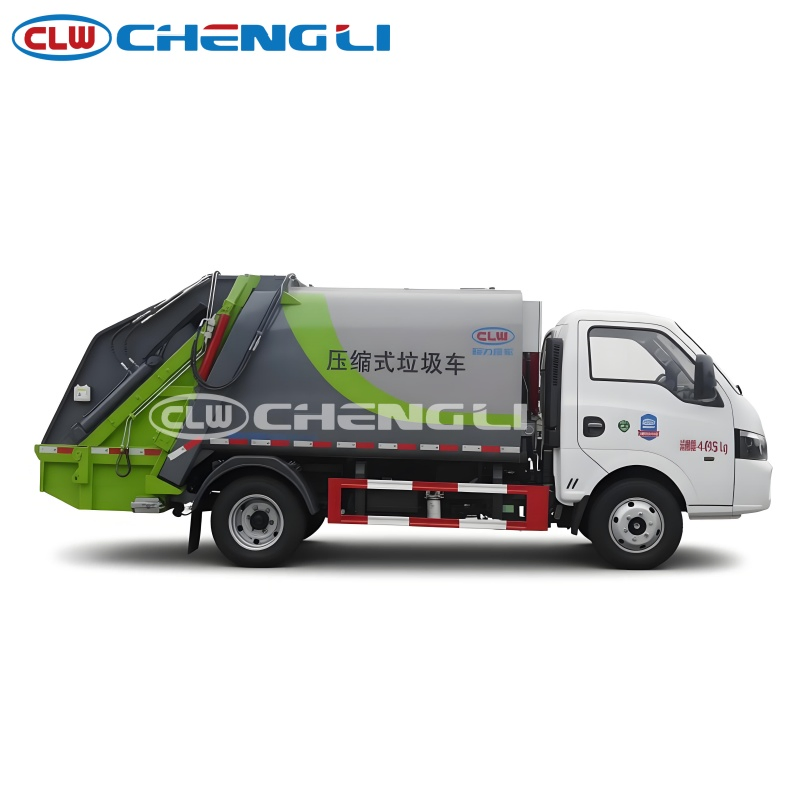
No single price fits a garbage compactor truck: the quote moves with the chassis, the body volume, the hydraulics and where the truck is shipped. Seven factors do most of the work: chassis brand and GVW, body volume, compaction ratio and hydraulic components, the loading mechanism and bin lifter, emission level, electrification, and freight to your destination port. Fix those and two quotes become comparable.
Garbage compactor truck price factors at a glance
The table maps each factor to what it changes and what to write into your inquiry, using compactors we build today. If you have not yet settled on the body style, start with our overview of garbage truck types and collection models.
| Price factor | What changes on the truck | Example from our range | What to specify |
|---|---|---|---|
| Chassis brand and GVW | Cab, engine, axles, parts network | 12,500 kg to 18,000 kg GVW | Brand, drive (4x2 or 6x2), GVW, LHD or RHD |
| Body volume | Steel weight, wheelbase, cylinder size | 10 m³ to 16 m³ | Volume, waste type, maximum length and height |
| Compaction ratio and hydraulics | Cylinders, pump, valves, body stiffness | 1:2.8 to 1:3.2 ratio; 16 MPa system pressure | Target ratio, pump and valve brand, control mode |
| Loading mechanism and bin lifter | Lifter frame, extra hydraulic circuit | 120 L, 240 L and 660 L bins | Bin sizes and number of bins per stop |
| Emission level | Engine and exhaust after-treatment | Euro 3, China VI and Euro 6 | The level your registration authority requires |
| Electrification | Battery, motor, charger, electric body drive | 210 kWh battery, up to 280 km range | Daily route length, depot charging power |
| Freight and destination port | Shipping method, port and inland costs | Shipping volume of about 58 m³ to 87 m³ | Port of discharge, Incoterm, final delivery point |
Chassis brand, drive configuration and GVW
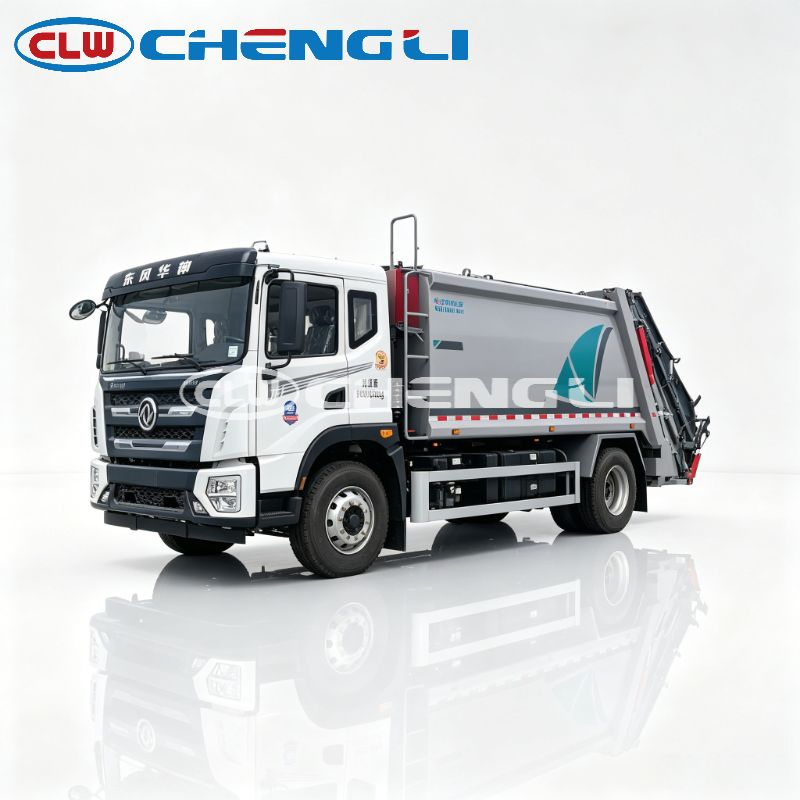
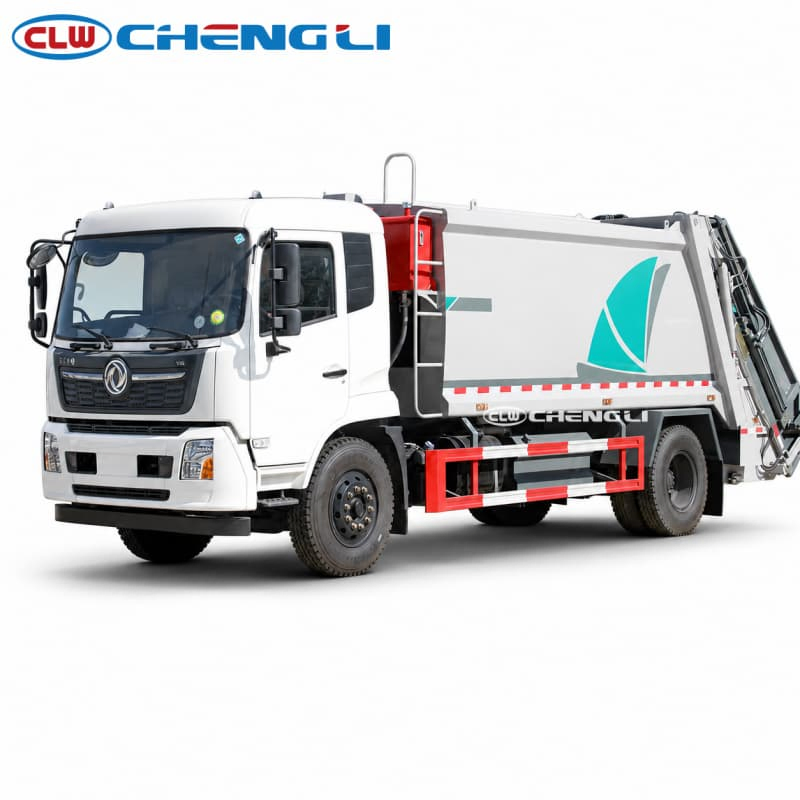
The chassis usually sets the baseline of a compactor quote, and the brand affects more than the badge. It decides the cab, the engine options and how easily you can buy filters, brake parts and injectors locally. Our Dongfeng 14 m³ rear loader, for example, can be built with a Cummins, Yuchai, Weichai or DDi engine at 169 kW; each option changes the cost and the service network behind the truck.
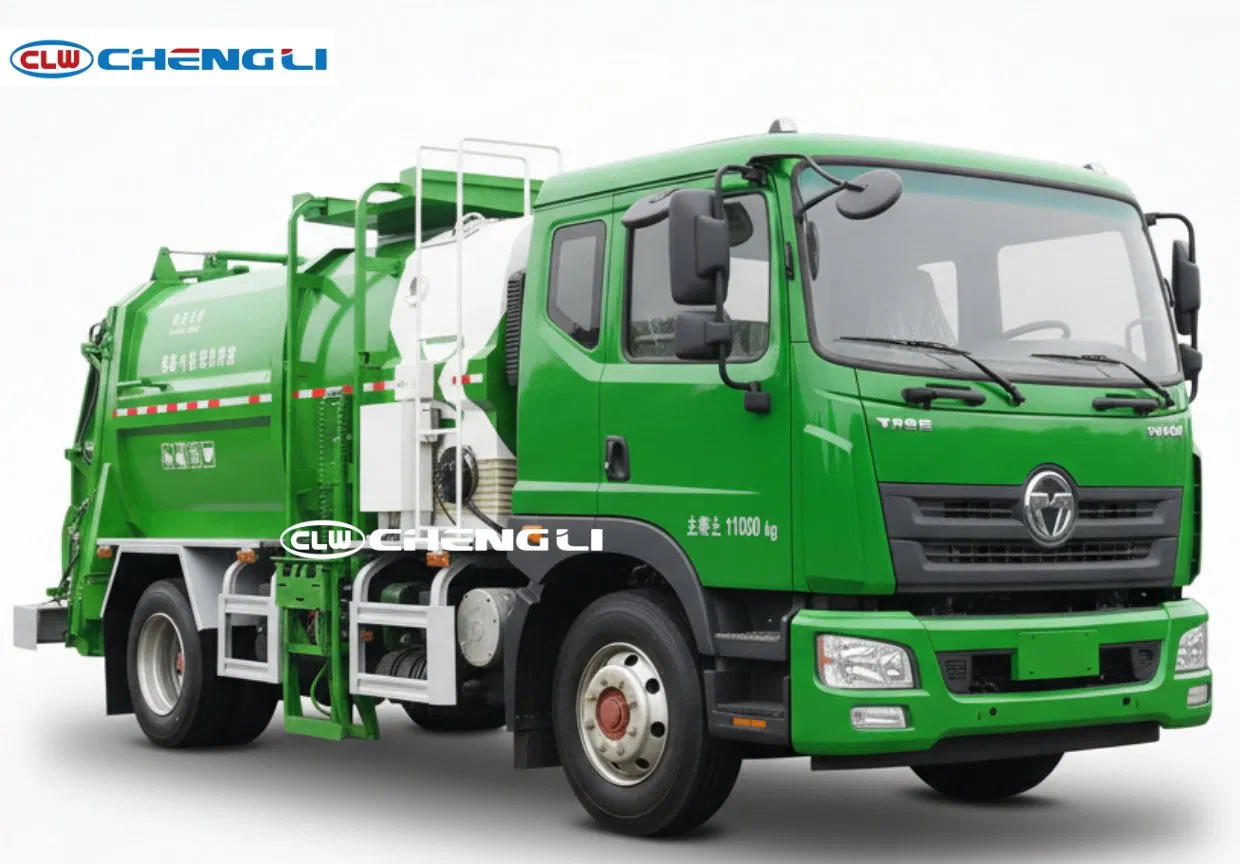
GVW and axle layout come next. Both of our 4x2 14 m³ compactors are rated at 18,000 kg GVW; the CLW version spreads that as 6,500 kg on the front axle and 11,500 kg on the rear, on a 5,800 mm wheelbase. Our 10 m³ food waste truck uses a 6x2 Dongfeng chassis at 16,200 kg GVW, with a curb weight of 8,150 kg or 7,770 kg depending on the version. A third axle adds tires, suspension and brake components, so specify it only when axle-load rules or dense waste require it. Oversizing the chassis costs money twice: once at purchase and again in fuel and tires.
Body volume, compaction ratio and hydraulics
Body volume and body steel
A larger body needs more steel, a longer wheelbase, a bigger ejector plate and longer cylinders. Our compactor bodies run from 10 m³ on the Dongfeng 6x2 food waste truck to 16 m³ on the Dongfeng electric compactor. Plate grade and thickness count as well: the food waste body uses low-alloy steel with 4 mm sides and a 5 mm floor, while the electric compactor uses Q345 manganese steel. Thicker plate adds weight and cost but resists the corrosion that wet organic waste causes. Do not pay for volume you cannot legally fill: dense kitchen waste reaches the axle limit well before a large body is full.
Compaction ratio and hydraulic components
The compaction ratio tells you how much loose waste the body can take. Our CLW 4x2 14 m³ garbage compactor works at 1:2.8 to 1:3.2, so its chamber holds the equivalent of roughly 39 m³ to 45 m³ of loose refuse (14 × 2.8 and 14 × 3.2). A higher ratio needs stronger cylinders, a stiffer body and more pump capacity.
Component brands are the second lever. On our 10 m³ food waste truck the hydraulic pump comes from Hefei Wanye, the multi-way control valve is a Yangzhou brand with an imported valve as an option, the PTO is from Jiashan and maximum system pressure is 16 MPa. An imported valve raises the quote; it is worth it where local technicians already stock that brand. Controls follow the same logic. Manual control is standard on the food waste truck with electric control as an option, the Dongfeng 14 m³ rear loader offers electric, manual or remote operation, and the electric compactor uses CAN-bus controls operable from the cab. Each step adds sensors, wiring and fault-finding skills your workshop will need.
Loading mechanism and bin lifter
A bin lifter is a separate steel frame and hydraulic circuit, so the bins you use change the price directly. The lifter on our Dongfeng 14 m³ rear loader handles 120 L, 240 L and 660 L bins with a 15 s to 30 s loading cycle. The food waste truck lifter is sized for 120 L and 240 L kitchen bins, with a lift-and-tip cycle of 25 s or less. A lifter that must grip several bin sizes is more complex than one built for a single size. Where crews load bags by hand, a plain hopper without a lifter is the simplest configuration.
Discharge and liquid handling also belong in this group. Our Dongfeng 6x2 10 m³ food waste truck uses push-out discharge in 25 s or less, a hydraulically opened and locked rear door, a 450 L clean water tank, a 700 L wastewater tank and a high-pressure cleaning system. The electric compactor carries a sewage tank at the rear. These items add cost, but they keep leachate off the street, which is the most common complaint on organic-waste routes. For how compactors fit alongside sweepers and washers in a city fleet, see our municipal sanitation vehicle solutions.
Emission level and electrification
Diesel emission level
Exhaust after-treatment grows with the emission level, and so does engine cost. Our current compactors cover three levels: Euro 3 on the Dongfeng 14 m³ rear loader, China VI on the Cummins D4.0 engine of the 6x2 food waste truck, and Euro 6 on the CLW 14 m³ compactor with its 191 kW, 4,750 mL diesel. Higher levels add particulate filters, selective catalytic reduction, a urea tank and more sensors. They also need low-sulfur diesel and a steady urea supply; in markets without both, a high-level engine becomes a maintenance problem rather than a benefit. Specify the emission level your registration authority requires and confirm it at quotation.
Battery-electric compactors
On an electric compactor, the battery replaces the engine as the dominant cost item. Our Dongfeng 4x2 electric refuse compactor carries a 210 kWh CATL lithium iron phosphate battery at 608.58 V, a 200 kW peak motor and up to 280 km of range, with a charging time of about 1.5 hours. Pack size is the main price lever: a smaller pack costs less but must still cover the route plus the energy the body hydraulics draw at every stop. Confirm whether a charger is part of the quotation; grid connection work at the depot is a local cost.
Freight, destination port and market-specific items
A complete compactor is wider than a standard container door of about 2.34 m: our trucks are 2,500 mm to 2,550 mm wide. They therefore ship roll-on/roll-off or on flat-rack containers, and freight follows the truck's shipping volume. The CLW 14 m³ compactor measures 9,745 × 2,550 × 3,500 mm, about 87 m³, while the 6x2 food waste truck measures 7,000 × 2,500 × 3,300 mm, about 58 m³. A shorter, lower truck is cheaper to ship to the same port.
The destination port matters as much as distance. A port with a regular roll-on/roll-off call is usually the simplest route; a port without one may need a flat rack or transshipment. Beyond the port, import duty, customs clearance, registration and inland transport are paid in your country and are rarely in a factory quote. Market-specific items such as local lighting, labels in your language or an extended spare parts kit also move the figure.
What to confirm before requesting a quotation
- Waste type (mixed household, commercial or wet kitchen waste), which decides body volume, plate thickness and the need for a wastewater tank.
- Bin sizes (120 L, 240 L, 660 L or hand-loaded bags) and the number of bins per stop.
- Chassis brand, drive (4x2 or 6x2), GVW, your legal axle limits and LHD or RHD.
- Required emission level and the diesel and urea quality available locally, or, for an electric compactor, daily route length and depot charging power.
- Hydraulic preferences: pump and valve brand, manual, electric or remote control.
- Maximum overall length, width and height for depots, narrow lanes and transfer stations.
- Port of discharge, preferred Incoterm and whether you need delivery to an inland depot.
- Spare parts scope and the language of manuals and control labels.
FAQ
Why can two compactor truck prices differ for the same body volume?
Body volume is only one line of the specification. One quote may include a heavier chassis, an imported control valve, a lifter for 660 L containers and a Euro 6 engine, while the other covers a basic hopper, manual controls and a lower emission level. Ask each supplier for the chassis model, GVW, hydraulic component brands, lifter type and Incoterm, then compare line by line rather than by the headline volume.
Does a higher compaction ratio justify a higher garbage truck cost?
Only when your waste is loose and light. Household waste with packaging and bulky items compresses well, so a higher ratio cuts trips to the landfill and pays back in fuel and crew hours. Wet kitchen waste is already dense and reaches the legal axle load before the body is full, so extra compaction adds cost without adding tonnes per trip. Match the ratio to a weighed sample of your own waste stream.
Is an electric compactor worth the higher purchase cost?
It depends on daily distance, charging access and local energy costs, not on the truck alone. Electric compactors suit dense urban routes with many stops, night collection where noise matters and depots that can install chargers. On long rural routes with distant disposal sites, battery size and charging stops can erase the advantage. Compare total cost over the service life, including energy, maintenance and eventual battery replacement, before deciding.
Does the quoted compactor truck price include shipping?
Only if the Incoterm says so. An FOB quote covers the truck loaded on board at the port of shipment; CIF adds ocean freight and insurance to your port of discharge. Neither covers import duty, destination port handling, customs clearance, registration or inland transport to your depot. Tell us whether you want FOB, CIF or delivery to a named place so the quote covers the same scope as your budget.
How can a municipality lower the cost of a compactor fleet?
Standardize. One chassis brand, one or two body sizes and one hydraulic component set across the fleet simplify spare parts, training and driver rotation, which often saves more over the fleet's life than removing individual options. Choose the smallest body that finishes a route in one or two trips, limit the lifter to the bins you actually use and skip options such as remote control unless crews will use them daily.
The cheapest compactor on paper is rarely the cheapest per tonne collected: match chassis, body volume and hydraulics to your waste and routes first, then compare quotes on the same basis. Browse our garbage compactor and collection trucks, then send us your waste type, bin sizes and destination port and our engineers will return a matching configuration and quotation.