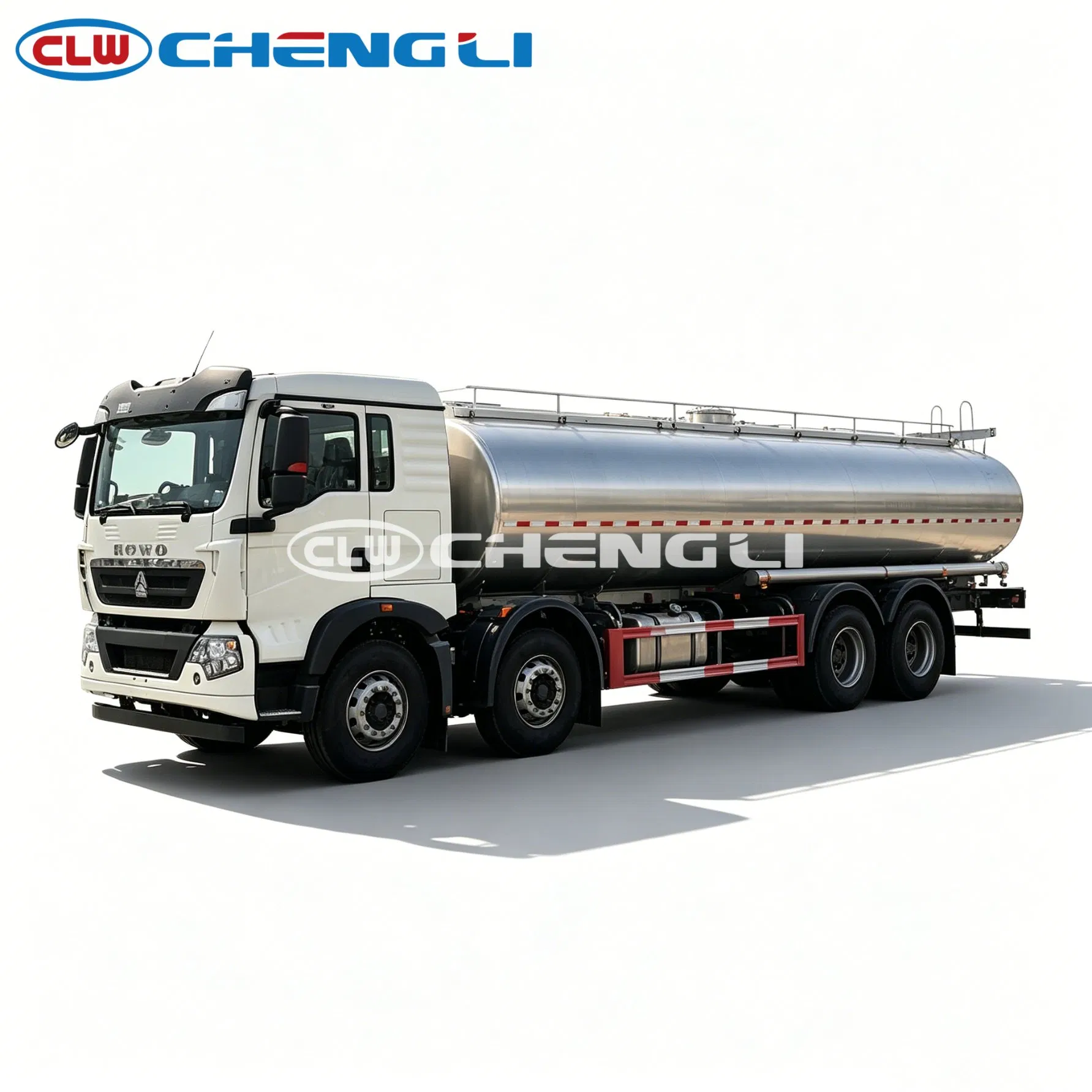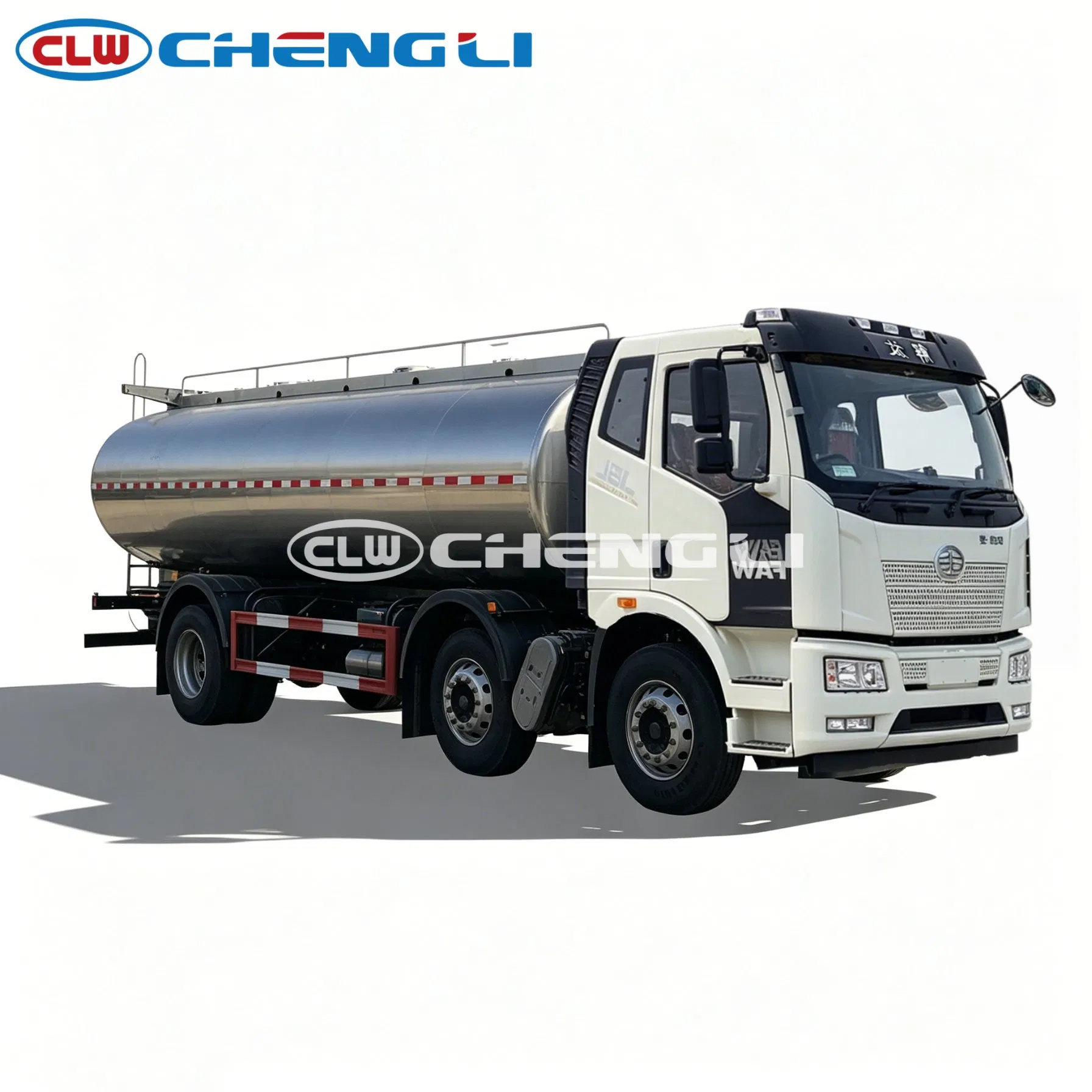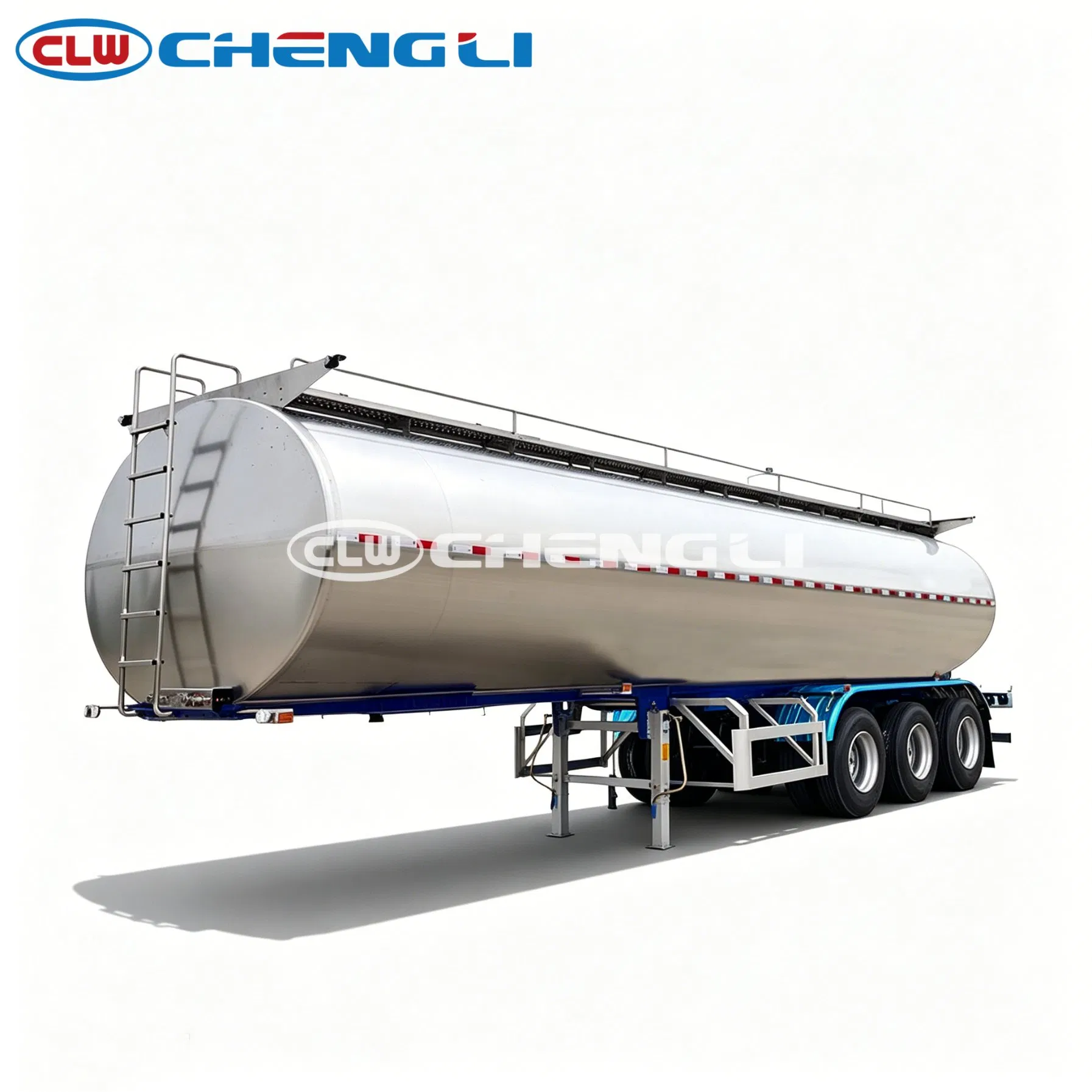
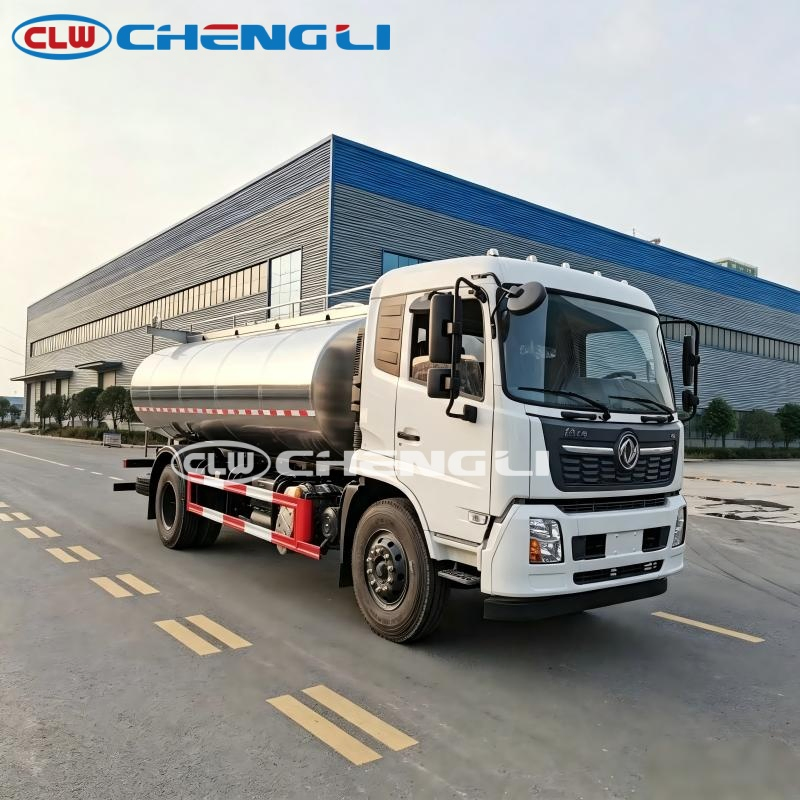
Milk tankers are built in 304 stainless steel because it resists corrosion from milk and from the caustic and acid solutions used in cleaning, and a polished interior leaves bacteria few places to hide. Our milk tank trucks run from 3,600 L on a 4x2 Dongfeng to 22,000 L (water-filled) on an 8x4 HOWO, plus a 32,200 L semi-trailer.
Why milk tankers use 304 stainless steel
Milk is mildly acidic, and the tank sees alkaline and acid cleaning solutions after every load. Carbon steel would rust, and aluminum is attacked by strong caustic, so 304 austenitic stainless steel (roughly 18% chromium and 8% nickel) is the default material for dairy tanks. Every milk tank we build uses 304 food-grade stainless steel with a mirror-polished interior. The smoother the milk-contact surface, the less fat and protein cling to it and the faster a cleaning cycle brings it back to bare metal.
Two of our bodies go further on shell construction. The Dongfeng 13,000 L three-compartment milk tanker and the 22,000 L HOWO use a 3 mm SUS304-2B inner tank inside a 1 mm stainless outer cover. 2B is a smooth cold-rolled mill finish. The outer cover protects the insulation.
304 or 316?
316 stainless adds molybdenum, which improves resistance to chlorides. It costs more and is rarely needed for raw milk. If your cleaning chemicals are chloride-based, or you intend to haul salty products such as brine, raise it at quotation. All the milk tanks we currently list are 304.
Insulation: what it does and what it does not do
A milk tanker is insulated, not refrigerated. Raw milk is normally chilled on the farm, typically to around 4 °C (39 °F), and the tanker's job is to slow heat gain until the milk reaches the plant. The tank has no cooling unit of its own, so milk loaded warm arrives warm. For finished dairy products that need active cooling, a refrigerated truck is the right vehicle, not a milk tanker.
All our milk tanks use polyurethane foam between the inner tank and the outer skin. On the 13,000 L and 22,000 L bodies the insulation is 70 mm of sprayed polyurethane plus 10 mm of rubber-plastic material. Thicker insulation slows temperature rise, but it adds weight and width, and overall width is capped by road rules in most markets, so every extra millimeter of foam comes out of tank diameter or length.
How much the milk warms over a route depends on ambient temperature, time on the road, how full each compartment is and how often manholes are opened. For long routes or hot climates, tell us your longest trip time and peak ambient temperature so the insulation can be discussed against that duty.
CIP cleaning and the hygiene details to specify
Clean-in-place (CIP) means the tank is cleaned without anyone climbing inside. The dairy's CIP station pumps cleaning solution into the tank, rotating spray devices cover the walls, and the solution drains back for recirculation. A typical cycle is a water pre-rinse, an alkaline wash to remove fat and protein, an intermediate rinse, an acid wash to remove mineral deposits, and a final rinse or sanitizing step. Chemicals, temperatures and contact times are set by the dairy's hygiene plan, not by the tanker.
What the tanker must provide is coverage and drainage. On the 13,000 L Dongfeng, each of the three compartments has its own 360° rotating cleaning ball, and the 22,000 L HOWO also carries a rotating CIP system. On our other milk tanks, CIP equipment is optional and manholes give cleaning access. Points worth checking:
- One spray device per compartment, with no shadowed corners behind partitions
- A tank floor that falls toward the outlet so milk and wash water drain completely
- Food-safe piping without dead legs where milk can sit between loads
- Outlet size and coupling type that match the plant's receiving hose; our 13,000 L and 22,000 L tanks use a 51 mm outlet with customizable fittings
- Manhole seals and valve gaskets in materials your cleaning chemicals will not attack
Hygiene rules for milk transport differ by country. Specify the hygiene standard your market requires and confirm it at quotation.
Compartments and collection routes
An undivided tank is the simplest to clean and gives the most volume for the tank weight. Compartments earn their place when a truck collects from several farms and the dairy wants loads kept apart, for example to test each supplier's milk before it is mixed or to separate milk of different grades. They also limit surge: a half-empty single tank lets milk slosh fore and aft under braking.
Our compartment options are two on the 3,600 L and 17,100 L trucks; three on the 6,900 L, 13,000 L, 15,700 L and 18,800 L trucks; and four on the 22,000 L truck and the 32,200 L semi-trailer. The HOWO 8x4 22,000 L four-compartment milk tank truck adds stainless anti-surge partitions inside the tank. The trade-off is more manholes, valves and spray devices to maintain and slightly less usable volume. Tell us how many farms a truck visits per round and whether loads must stay separate; that decides compartment count better than tank size alone.
Milk tanker capacity: tank volume vs rated payload
Milk weighs about 1.03 kg/L, slightly more than water, and the exact figure varies with fat content. A tank filled to its nominal volume therefore often weighs more than the chassis is rated to carry. On a milk tanker, rated payload sets the real load and tank volume sets the ceiling. The table compares our current milk tankers.
| Tank volume | Drive and chassis | Rated payload | Milk mass if full (about) | Milk within rated payload (about) |
|---|---|---|---|---|
| 3,600 L (about 950 US gal) | 4x2 Dongfeng, Quanchai 136 hp | Confirm at quotation | 3,710 kg | Confirm at quotation |
| 6,900 L (about 1,820 US gal) | 4x2 Dongfeng, Yuchai 190 hp | Confirm at quotation | 7,110 kg | Confirm at quotation |
| 13,000 L water-filled (about 3,430 US gal) | 4x2 Dongfeng Tianjin, Cummins 169 kW | 10,300 kg | 13,390 kg | 10,000 L |
| 15,700 L (about 4,150 US gal) | 6x4 FAW 263 hp or Dongfeng Cummins 259 hp | 15,000–15,065 kg | 16,170 kg | 14,560–14,630 L |
| 17,100 L (about 4,520 US gal) | 8x4 Sinotruk HOWO, 341 hp | 17,165 kg | 17,610 kg | 16,670 L |
| 18,800 L (about 4,970 US gal) | 8x4 FAW, 292 hp | 18,865 kg | 19,360 kg | 18,320 L |
| 22,000 L water-filled (about 5,810 US gal) | 8x4 Sinotruk HOWO, 257 kW | 17,100 kg | 22,660 kg | 16,600 L |
| 32,200 L (about 8,510 US gal) | 3-axle semi-trailer | 32,200 kg | 33,170 kg | 31,260 L |
On the 17,100 L, 18,800 L and 32,200 L bodies the gap between volume and payload is under 3%. On the 13,000 L and 22,000 L tanks, whose capacity is stated water-filled, rated payload allows only about 10,000 L and 16,600 L of milk, so treat the larger figure as vessel size, not as a milk load. Legal limits in your country may also be lower than the chassis rating, so check gross weight and axle-load rules for your routes before choosing a tank size.
At the small end, our 6,900 L Dongfeng 4x2 insulated milk truck is 6,900 mm long and the 3,600 L truck is 5,995 mm, short enough for farm lanes and tight yards. Confirm their payload for your registration class at quotation.
What drives milk tanker price
We do not publish milk tanker prices, because the same tank volume can be built several ways. These are the factors that move a quotation:
- Chassis brand, drive and engine. A 4x2 Dongfeng and an 8x4 HOWO sit in different price classes before any tank goes on. Emission level matters too; our milk trucks can be supplied from Euro 2 to Euro 6, and higher stages cost more.
- Tank volume and stainless thickness. Stainless steel is the most expensive material on the vehicle, so shell thickness, tank length and a stainless outer cover all add cost.
- Insulation specification. Foam thickness and extra layers such as rubber-plastic material.
- Compartments. Each extra compartment adds a partition, manhole, valve and spray device.
- CIP and fittings. Spray balls per compartment, outlet size, coupling standard and valve type.
- Truck or semi-trailer. A trailer moves the most milk per trip but needs a tractor head.
- Freight and destination. Shipping method, destination port and any local modifications.
Compare quotes line by line, not by tank volume alone.
What to confirm before ordering a milk tanker
Milk collection often sits inside a wider food supply chain; our cold-chain and food logistics vehicles cover the rest of that fleet. For the tanker itself, settle these points first:
- Milk load per trip in kilograms and liters, and the legal gross weight and axle loads on your routes
- Truck or semi-trailer, drive type and a chassis brand you can service locally
- Number of compartments and whether loads from different farms must stay separate
- Insulation thickness, based on your longest trip time and peak ambient temperature
- CIP spray devices per compartment and compatibility with the dairy's CIP station
- Outlet diameter, coupling standard and valve type matched to the plant's receiving line
- Emission level and left- or right-hand drive for registration
- The hygiene standard your market requires, confirmed in writing at quotation
FAQ
How much does a milk tanker cost?
Price depends on configuration, so we quote per specification rather than from a price list. For a useful quotation, send the milk volume per trip, the chassis or tractor you prefer, compartment count, CIP requirement, emission level and destination port. Two quotes for the same nominal tank size can differ widely when one includes a thicker shell, extra insulation and a spray ball in every compartment and the other does not.
What does water-filled capacity mean on a milk tanker?
Water-filled capacity is the volume the tank holds when filled to the brim with water, a measurement of the vessel itself. Effective volume usually refers to the working volume you can fill in service. Neither tells you the legal load. Multiply liters by roughly 1.03 to get the mass of milk, then compare it with the rated payload and the axle limits on your roads.
How long does an insulated milk tanker keep milk cold?
There is no single figure, because warming depends on outside temperature, trip length, fill level and how often the tank is opened. A full compartment warms more slowly than a half-full one, and pre-chilled milk loaded quickly holds its temperature better. Plan routes so milk reaches the plant within the time your dairy's quality rules allow, and ask us to discuss insulation against your worst-case trip.
Should I choose a milk tanker truck or a milk tank semi-trailer?
A rigid truck suits farm collection: it turns tighter, fits small yards and can serve many short stops. Our 32,200 L semi-trailer suits bulk transfers from collection centers to processing plants, where roads are good and each trip should move as much milk as possible. It needs a matched tractor head. Our guide to semi-trailer types covers axles, kingpins and tractor matching.
Can a milk tanker carry water or other food liquids?
A 304 stainless insulated tank can physically hold other food liquids such as water or juice. The risks are cross-contamination and taste carry-over, and many dairies will not accept milk from a tank that has carried other products. If you plan mixed use, agree the cleaning procedure with your customers and local authority first, and specify seals and gaskets suited to every product you will carry.
Choose a milk tanker by the milk mass you move per trip and the roads you drive, then set compartments, insulation and CIP around your dairy's routine. Browse our milk tanker trucks from 3,600 L to 22,000 L, or send us your route, milk volume and destination market and our team will propose a configuration.