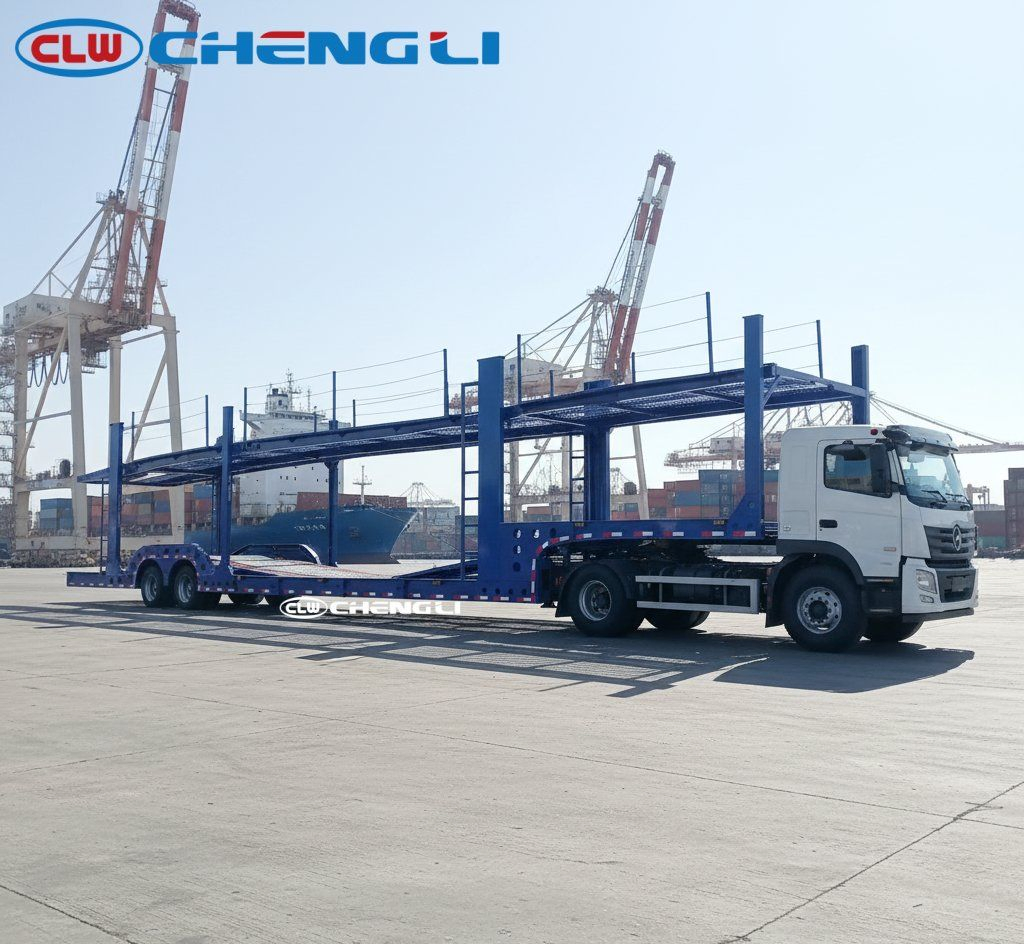
One car or eight: that is the first split between car carrier types. Single-car carriers, either an open flatbed or an enclosed body, move one vehicle with maximum protection and flexibility. Multi-car carriers stack vehicles on two hydraulic decks, like our two-deck semi-trailer rated for up to eight passenger cars and 30,000 kg. Between them sit rigid multi-car trucks and enclosed multi-car trailers, which we do not currently list.
Car carrier types at a glance
The right type depends on how many vehicles move per trip, how much protection they need and where they are loaded and delivered.
| Type | Cars per trip | Protection | Loading | Best for |
|---|---|---|---|---|
| Flatbed (rollback) carrier truck | 1 | Open | Tilting deck or hydraulic ramps | Recovery, dealer transfers, non-running cars |
| Enclosed single-car carrier truck | 1 | Fully enclosed | Hydraulic platform lowered to the ground | High-value, new-energy and display vehicles |
| Rigid multi-car truck | 2 to 4, depending on size | Open | Ramps and a tilting upper deck | Short regional dealer runs (we do not currently list this type) |
| Two-deck car carrier semi-trailer | Up to 8 passenger cars on our model | Open | Rear ladder, hydraulic upper and lower decks | Factory, port and dealer distribution in volume |
Single-car carriers: open flatbed vs enclosed body
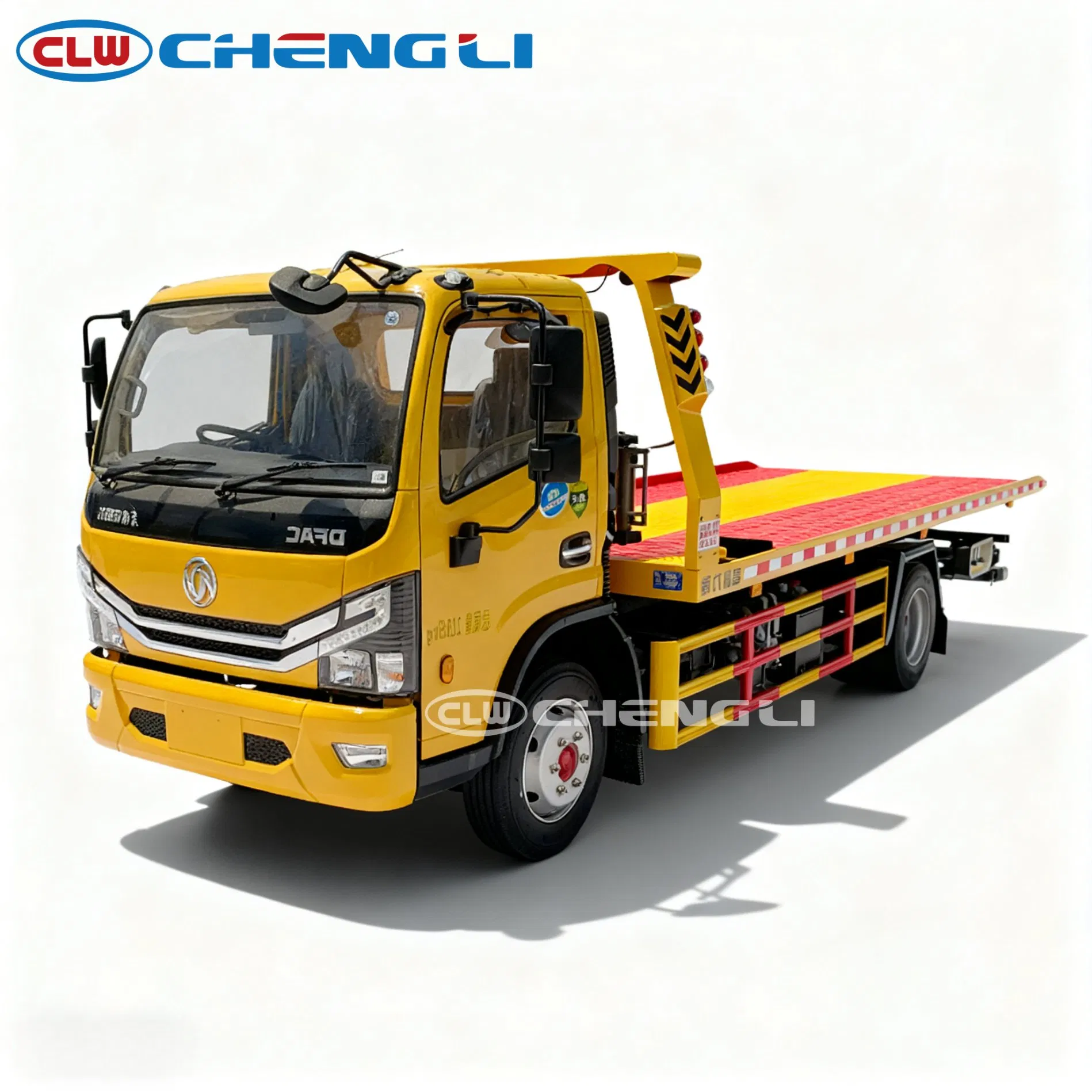
An open flatbed is the simplest way to move one car. Our Dongfeng 4x2 flatbed tow truck has a 6.5 m patterned-steel deck rated for 1.5 t, hydraulic ramp options and a rear wheel-lift, so it handles both planned transfers and breakdowns. It is cheap to run and loads a car anywhere with a flat, firm surface. The trade-off is exposure: the car travels in rain, dust and road spray, in full view.
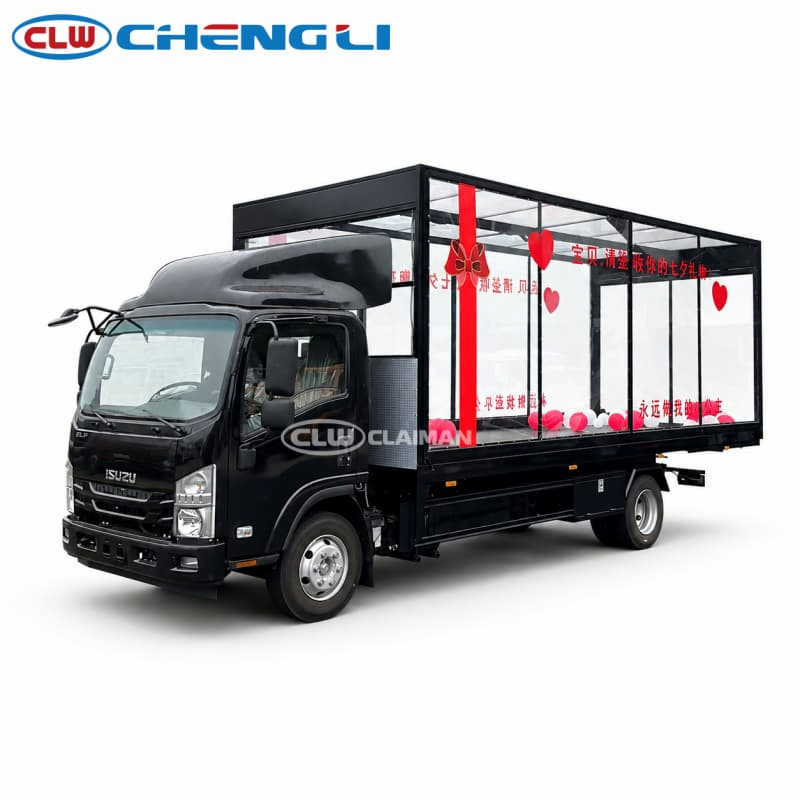
An enclosed carrier trades flexibility for protection. The Isuzu CC-1 enclosed single-car carrier puts the vehicle inside a steel-framed body with transparent panels and full-side hydraulic wing doors, on a 4x2 chassis 6,995 mm long with a 4,475 mm wheelbase. Its loading platform lowers hydraulically to ground level, so the car drives on almost flat instead of up a ramp, and the controls work from both sides of the truck. The transparent body also lets the car be shown at a handover or exhibition without unloading. Confirm the car's weight and dimensions against the final build, since the body is designed around one vehicle size class.
Two-deck car carrier semi-trailers
Volume moves on trailers. Our 8-car two-deck car carrier semi-trailer is 18,000 × 2,550 × 3,960 mm, with a 15,000 kg curb weight, a 30,000 kg rated payload and a 45,000 kg gross weight on two axles with leaf springs and ABS. Ten hydraulic cylinders move the upper and lower decks, and eight columns in HG70 low-alloy steel carry the upper structure. Both decks use perforated Q235 steel with a central grid, and extensions of 1.5 m on the lower deck and 1.2 m on the two-section upper deck add length for longer cars.
The trailer has no onboard engine; the towing tractor supplies hydraulic power for the decks. It is an easy point to miss at ordering, and it is covered below under tractor matching.
Deck space, height and weight: which limit comes first?
On a car carrier, weight is rarely the first limit. Passenger cars typically weigh about 1.2 to 2 t, so eight cars at an average 1.5 t come to about 12 t, well under the trailer's 30,000 kg rating. Deck length and loaded height run out first.
- Length: car length decides how many fit per deck, which is why the deck extensions matter. Eight compact sedans fit where six large SUVs may not.
- Height: the trailer stands 3,960 mm tall, and cars on the upper deck set the loaded height. Many markets limit vehicles to about 4 m, so tall vehicles usually go on the lower deck, and the loading plan decides which car goes where.
- Weight: check it when the load is mostly pickups, large SUVs or electric vehicles, whose batteries add mass, and check axle loads rather than just the total.
- Combination length: an 18,000 mm trailer plus a tractor head is long. Check the length limit and any car-transporter permits on your routes before ordering.
Loading angles, ramps and hydraulics
Low cars scrape on steep ramps. A sports car or a lowered electric sedan with little ground clearance needs a shallow approach, which is why a platform lowered to the ground, as on the enclosed Isuzu, is the safest way to load one. On the two-deck trailer, cars drive up a manual loading ladder; tilting the deck sections hydraulically reduces the angle at each transition. Ask for the approach angle at every ramp and deck joint if you move low vehicles regularly.
Once loaded, every car is strapped at its wheels, not by the body or suspension. The perforated decks give anchor points for wheel straps and let rain, snow and dirt drop through instead of pooling under tires.
Matching the tractor to a car carrier trailer
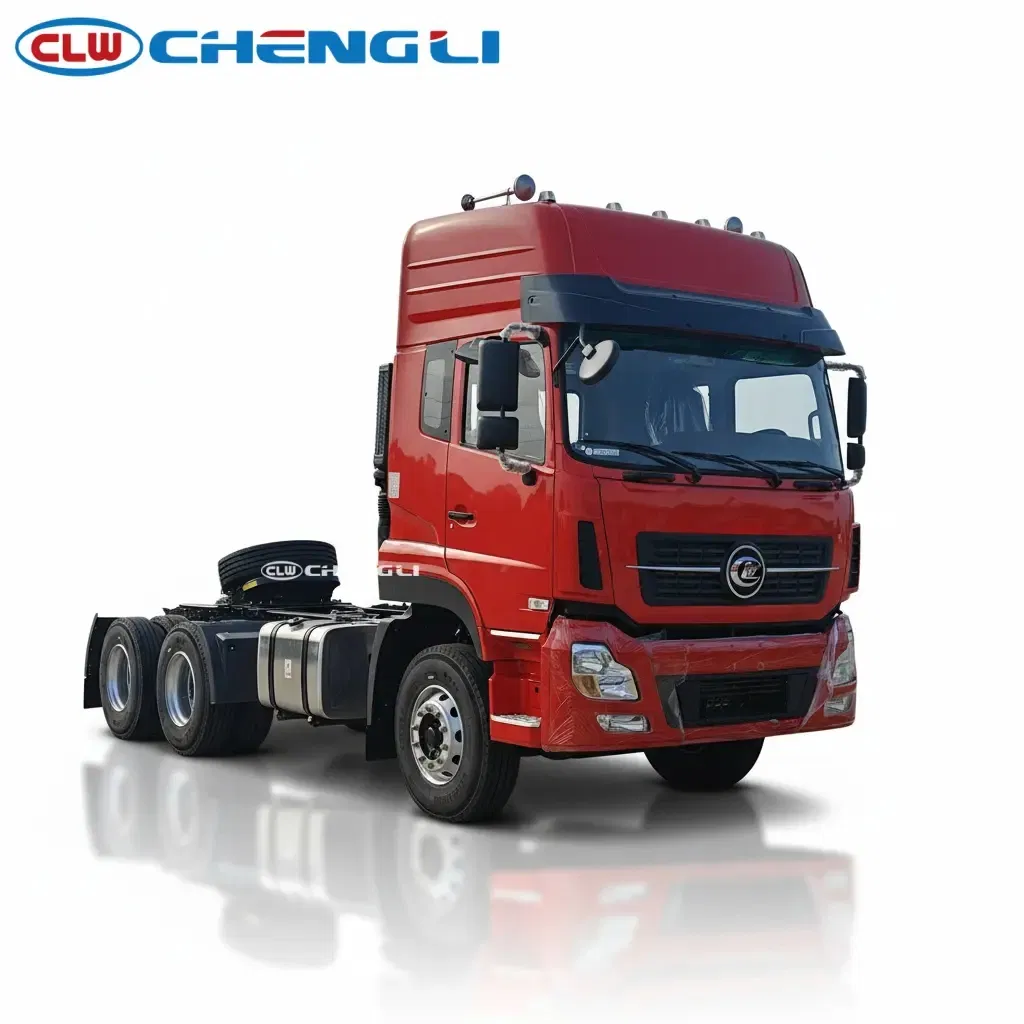
A car carrier trailer needs more from its tractor than a drawbar pull. Specify a power take-off and hydraulic pump on the tractor to drive the deck cylinders, with hydraulic connections at the back of the cab. Check fifth-wheel height and kingpin size against the trailer, and confirm that the cab roof clears the trailer's front overhang in turns. Because a car carrier rarely runs at full weight, tractor choice follows your roads and fleet more than the trailer rating; our comparison of 4x2 and 6x4 tractor heads covers that choice. If you already run tractors, send their specifications and our service and support team will check the hydraulic and coupling match.
How to specify a car carrier
- Vehicle mix: the length, height, weight and ground clearance of the largest and lowest cars you carry.
- Cars per trip: one, a few or up to eight, and whether that number must hold for SUVs as well as sedans.
- Protection: open deck or enclosed body, based on vehicle value and the roads and weather on the route.
- Loading sites: dealer yards, ports or factory lots, and whether a flat hard surface is available at both ends.
- Route limits: vehicle height, combination length and axle loads in every country on the route.
- Tractor supply: power take-off, hydraulic pump and couplings to operate the decks of a trailer.
- Tie-downs: wheel strap sets and anchor points for each car position.
FAQ
How many cars can a car carrier truck hold?
It depends on the type. A flatbed or enclosed carrier truck holds one car. Rigid multi-car trucks usually carry two to four. Our two-deck semi-trailer is rated for up to eight passenger cars, with the actual number set by car length and height. Large trailers used for long-haul distribution in some markets carry more, but we do not currently list them.
What is the difference between a car hauler and a car carrier?
Nothing technical. Car hauler is the usual American term, while car carrier, car transporter and auto transporter are common elsewhere. All describe trucks or trailers built to move vehicles. What matters for specification is the same: cars per trip, open or enclosed body, loading method and the height and length limits on your routes.
Is an enclosed car carrier worth the extra cost?
For high-value, collector, prototype or new-energy vehicles, usually yes. An enclosed body keeps out rain, road grit and stones and keeps the car out of sight. For used cars, fleet transfers and recovery, an open flatbed does the job at lower cost and weight. Many operators run both and assign vehicles by value.
Can a tow truck be used as a car carrier?
A flatbed tow truck can carry one car and often does for dealer transfers. Its deck rating, 1.5 t on our Dongfeng flatbed, must cover the vehicle's actual weight, which rules out some large SUVs and pickups on light chassis. For regular multi-car deliveries, a dedicated carrier moves more vehicles per trip and per driver.
Choose by cars per trip and vehicle value first, then check deck length, loaded height and route limits before weight. Compare current builds in our car carrier range, then send your vehicle mix, routes and destination market through our contact page, and our engineers will propose a carrier and tractor configuration.