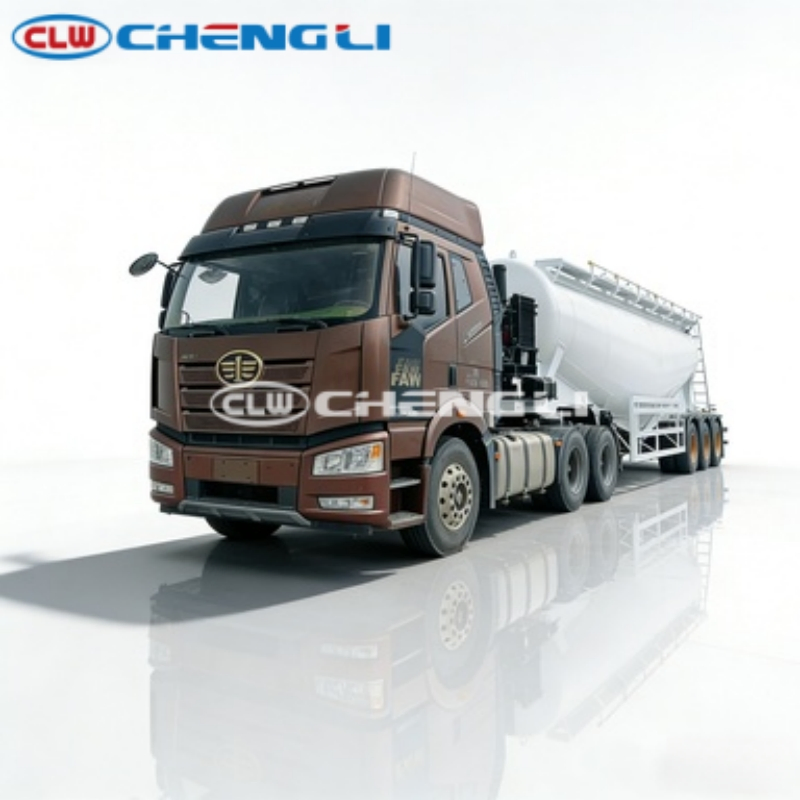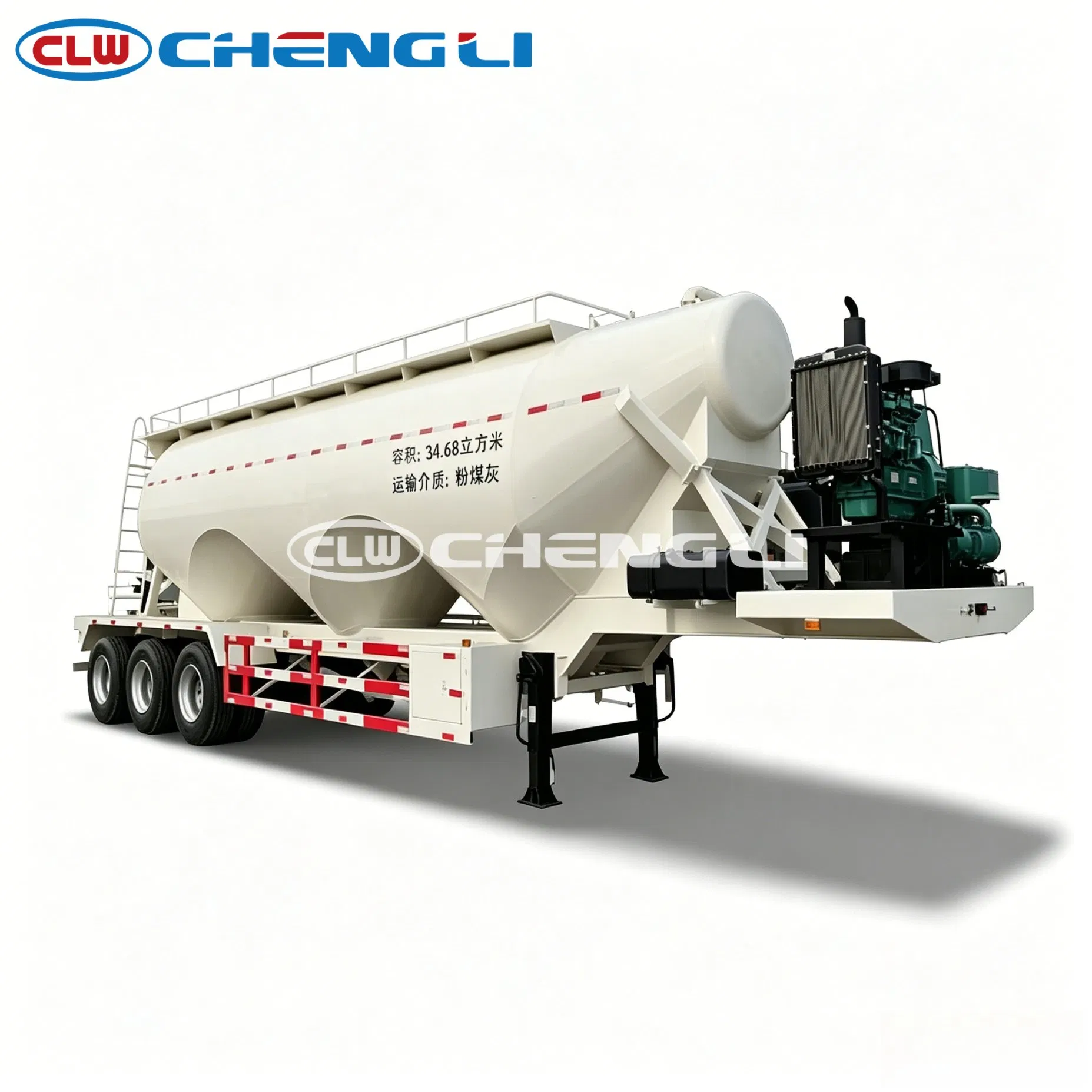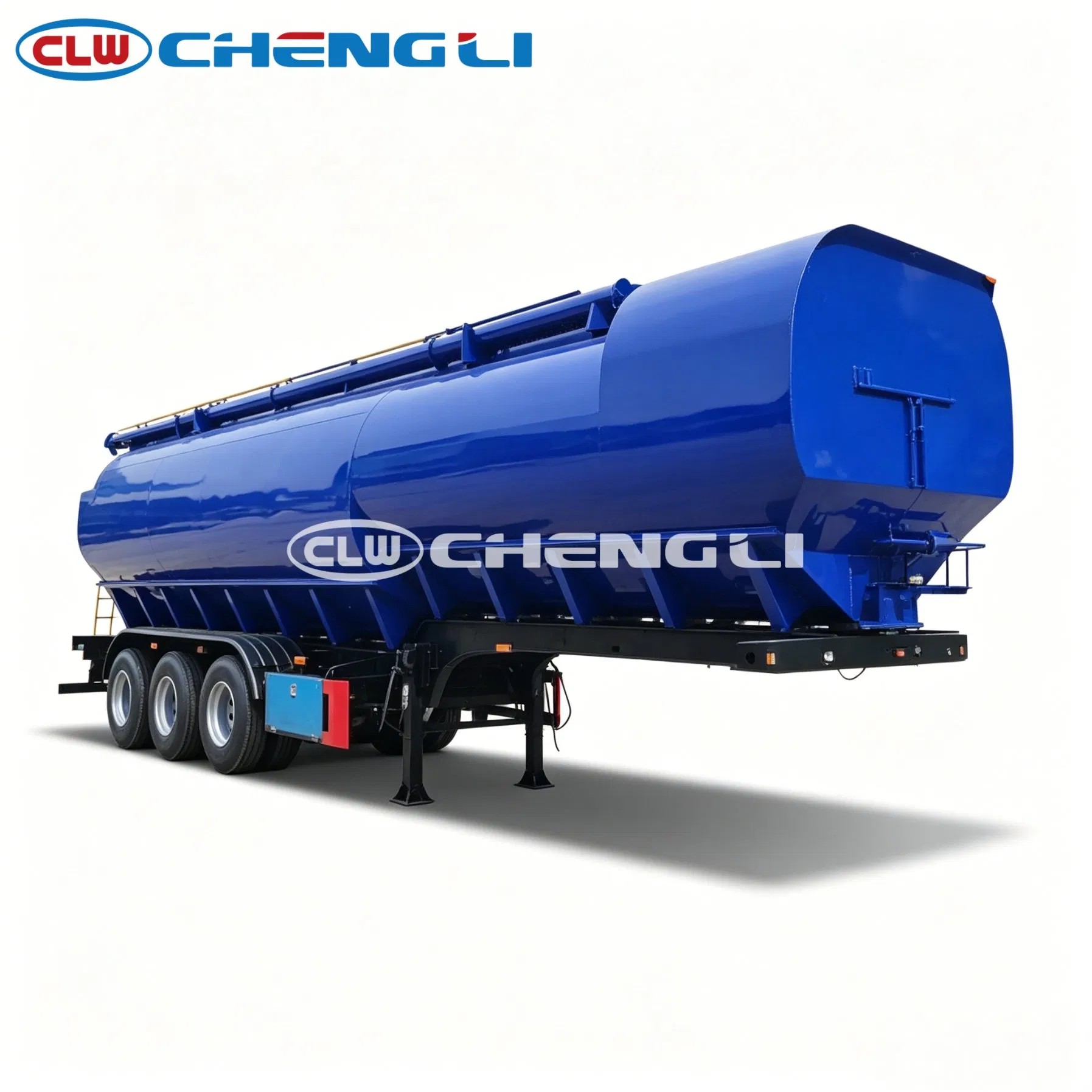
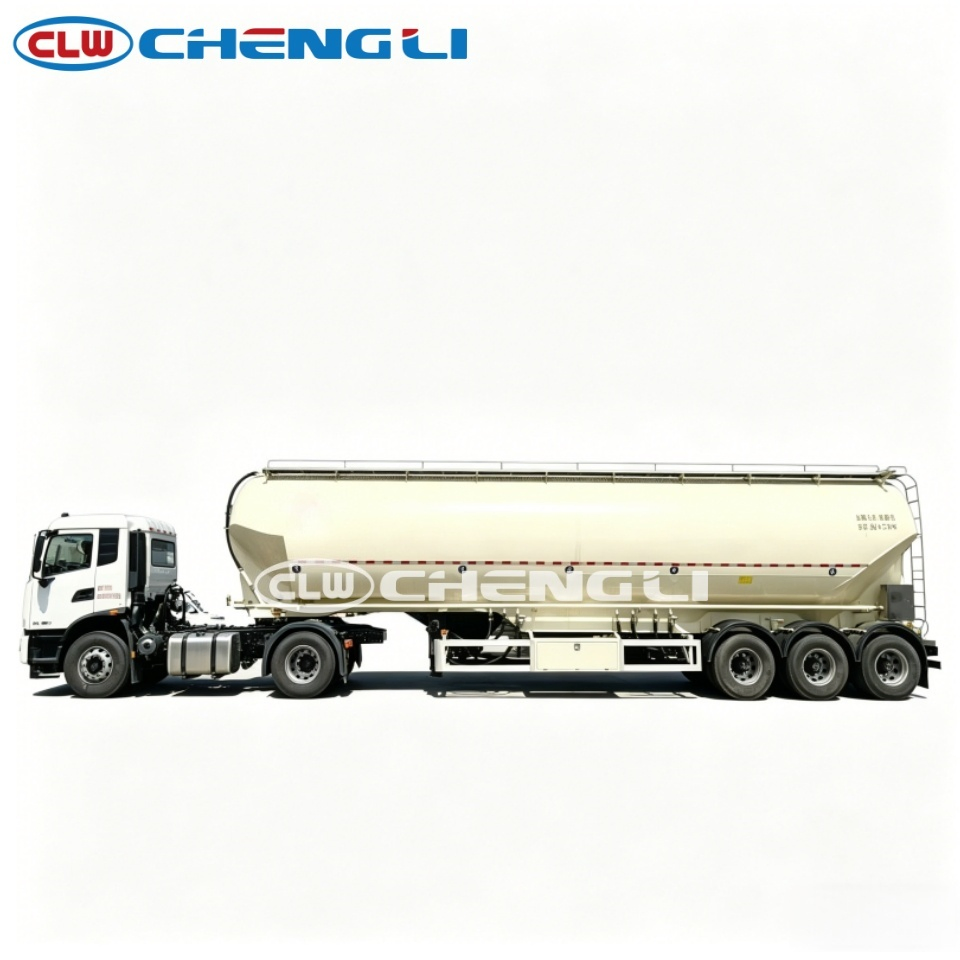
Three things separate a flour trailer from a cement trailer and a feed trailer: the density the tank is sized for, the steel it is built from and the way it unloads. Our cement tanks hold 35–45 m³ of heavy powder in wear-resistant steel; flour tanks hold 40–60 m³ in 304 stainless steel; feed trailers hold 58–60 m³ and mostly unload by auger.
Dry Bulk Trailer Types at a Glance
All three are three-axle or two-axle tank semi-trailers pulled by a tractor head, and all unload without tipping. The table sets our current builds side by side.
| Item | Flour and powder tank | Cement tank | Feed tank |
|---|---|---|---|
| Tank volume | 40–60 m³ | 35–45 m³ | 58–60 m³ |
| Rated load | 25–30 t | 46–50 t | 27.7–32.8 t |
| Tank material | 304 food-grade stainless steel | 610L high-strength wear-resistant steel | Carbon steel; 304 stainless on the pneumatic version |
| Discharge | Pneumatic, 0.2 MPa, 7 m hose | Pneumatic, 0.2 MPa, 7 m hose; DN150 valve on the 35 m³ | Four augers, or pneumatic |
| Stated residue | Below 0.1% | Below 0.2% | Below 0.1% |
| Curb weight | 9,500–10,500 kg | 7,250–8,200 kg | 9,500–11,750 kg |
| Overall length | 12,950 mm | 9,430–10,300 mm | 9,000–12,950 mm |
Match the Trailer to the Density of Your Powder
A tank is sized so that a full load of the intended cargo reaches the rated load at about the same time. Divide rated load by volume and you get the density the trailer is designed for. That single number explains most of the differences between the three types.
| Trailer | Volume | Rated load | Design density |
|---|---|---|---|
| Three-cone cement tank | 35 m³ | 46,000 kg | about 1.31 t/m³ |
| Three-axle cement tank | 45 m³ | 50 t | about 1.11 t/m³ |
| Stainless powder tank | 40 m³ | 25–30 t | about 0.63–0.75 t/m³ |
| Stainless flour tank | 50 m³ | 30 t | about 0.60 t/m³ |
| Stainless flour tank | 60 m³ | 30 t | about 0.50 t/m³ |
| Two-axle feed trailer | 58 m³ | 27,700 kg | about 0.48 t/m³ |
| Feed trailer, electric auger | 59.3 m³ | 28,250–28,700 kg | about 0.48 t/m³ |
Cement is heavy, generally about 1.3–1.5 t/m³, so a cement tank is short and compact and reaches its rated load before it looks full. Flour, starch and feed are much lighter, so their tanks are long and large. Put cement in a 60 m³ flour tank and it would pass the rated load at well under half full; put flour in a 35 m³ cement tank and you would carry only about half the rated load. Weigh a cubic meter of your own product before choosing volume.
Note that rated loads of 46–50 t on our cement trailers are above the legal gross and axle limits in many countries. The legal load in your market, not the trailer rating, decides how much you can haul on the road.
Tank Material: Stainless, Wear-Resistant or Carbon Steel
Each cargo attacks the tank in a different way. Flour, sugar and starch are food, so our 50 m³ stainless steel flour tank semi-trailer and its 40–60 m³ sister models use 304 food-grade stainless steel, which cleans easily and does not rust into the product.
Cement is abrasive rather than corrosive. Our three-axle cement semi-trailer with an optional 45 m³ tank and the 35 m³ three-cone tank use 610L high-strength wear-resistant steel, which stands up to years of powder sliding along the cones and pipes, and keeps curb weight down to 7,250–8,200 kg.
Standard feed trailers use carbon steel, which is strong and simple to repair and suits dry pelleted feed. Where hygiene rules are strict, our 60 m³ feed semi-trailer uses 304 stainless steel with pneumatic discharge.
Pneumatic vs Auger Discharge
Flour and cement trailers unload by air. Compressed air fluidizes the powder so it flows out through the discharge line like a liquid; our tanks work at a discharge pressure of 0.2 MPa through a 7 m hose, straight into a silo. Several of our 50–60 m³ flour trailers carry their own screw compressor with dedicated cooling; others take air through an external supply valve, so confirm where the air comes from on your build. For how fluidizing and cone design work, see our guide to how a bulk cement tanker unloads.
Feed trailers mostly use augers, because air at speed can break pellets. Our 32.8 t three-axle feed semi-trailer with four augers has a 9 m top auger with hydraulic lift and 180° rotation, controlled by wireless remote, with a three-auger hydraulic version as an alternative. That lets the driver place feed into a farm silo inlet without a blower line. The trade-off is tare weight: our feed trailers weigh 9,500–11,750 kg empty, against 7,250–8,200 kg for the cement tanks.
Can One Trailer Haul Flour, Cement and Feed?
In practice, no. Food and feed must not be carried in a tank that has held cement or other non-food powders, and cleaning a pneumatic tank back to food standard is slow and hard to verify. Density also works against it: a cement tank is too small for flour, and a flour tank is too large and too lightly rated for cement.
Similar products can share a tank. A stainless flour trailer can carry other food powders such as starch or sugar if cleaning between loads meets your food-safety plan. A cement trailer can often carry fly ash or lime if the density suits. Ask us before planning a cross-use, and tell us what the tank will carry first.
What to Confirm Before Ordering
- The products you will carry and a measured bulk density for each, in t/m³.
- Legal gross weight and axle loads for tractor and trailer in your market.
- Tank material: 304 stainless for food, wear-resistant steel for cement, carbon steel or stainless for feed.
- Discharge method, pressure and hose length, and the silo inlet height at delivery sites.
- Air source for pneumatic trailers: trailer-mounted compressor, tractor-mounted compressor or site air.
- Axle count, axle brand and rating, suspension type and kingpin size to match your tractor heads.
- Cleaning access and hatches if the trailer will carry more than one food product.
FAQ
What is a dry bulk trailer?
It is a tank semi-trailer for free-flowing solids such as cement, flour, fly ash, sugar or feed. The cargo is loaded from the top and unloaded without tipping, usually by compressed air through a hose or by augers. The tank shape, material and volume are set by the density and type of product it is built to carry.
How much cement does a 35 m³ tank carry?
Our 35 m³ three-cone cement semi-trailer is rated for 46,000 kg, which matches its volume at about 1.31 t/m³. On the road, the legal limit usually decides: take your country's gross vehicle weight for a tractor and three-axle trailer, subtract the tractor and the trailer's 7,250 kg curb weight, and the rest is your legal cement load.
Is a flour tanker trailer the same as a powder tank semi-trailer?
Largely, yes. Powder tank is the general term; flour tanker describes one of its main uses. Our flour and powder trailers share the same 12,950 mm length, 304 stainless tank and 0.2 MPa pneumatic discharge, with 40–60 m³ tanks and multi-cone options. Specify the actual product so the tank volume and cone layout suit it.
Two axles or three axles for a feed semi-trailer?
Our two-axle 58 m³ feed trailer runs at 35,000 kg gross with 10 t axles and a 27,700 kg payload, and is only 9,000 mm long, which helps on farm roads. The three-axle 32.8 t trailer runs at 42,000 kg gross on 13 t axles. Choose by your legal gross limit and how tight the farm entrances are.
Start from the product and its density, then choose the steel and the discharge system; the volume and axles follow. Browse our semi-trailers for current dry bulk builds and send us your products, densities and legal weight limits. Our engineers will size a trailer to your loads, whether they supply construction and mining sites or food and feed mills.