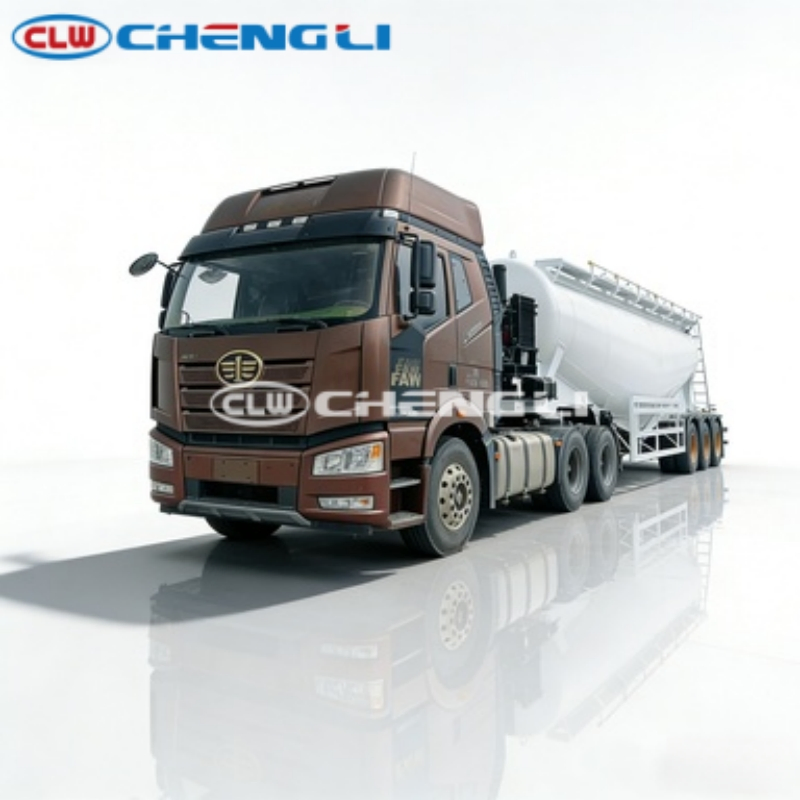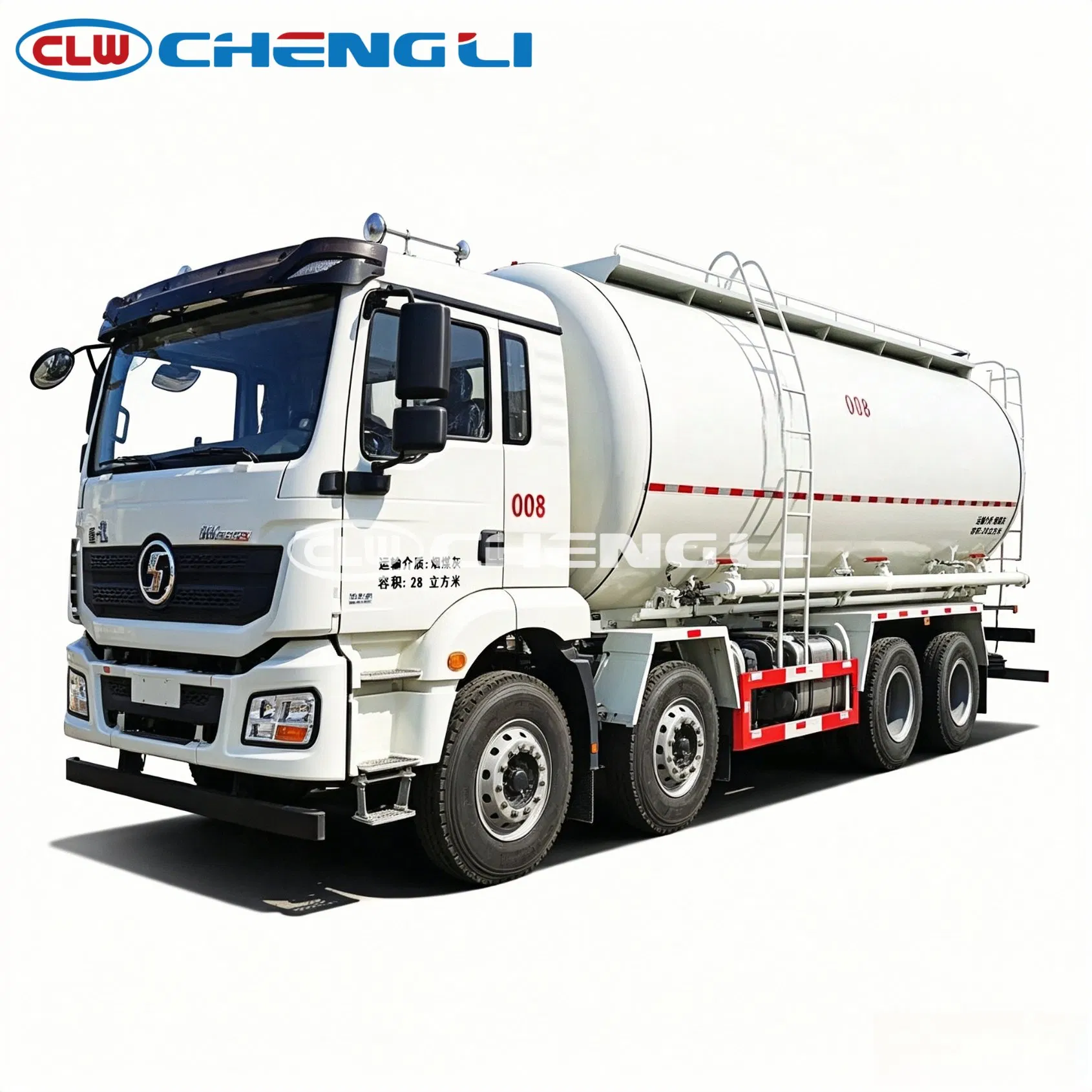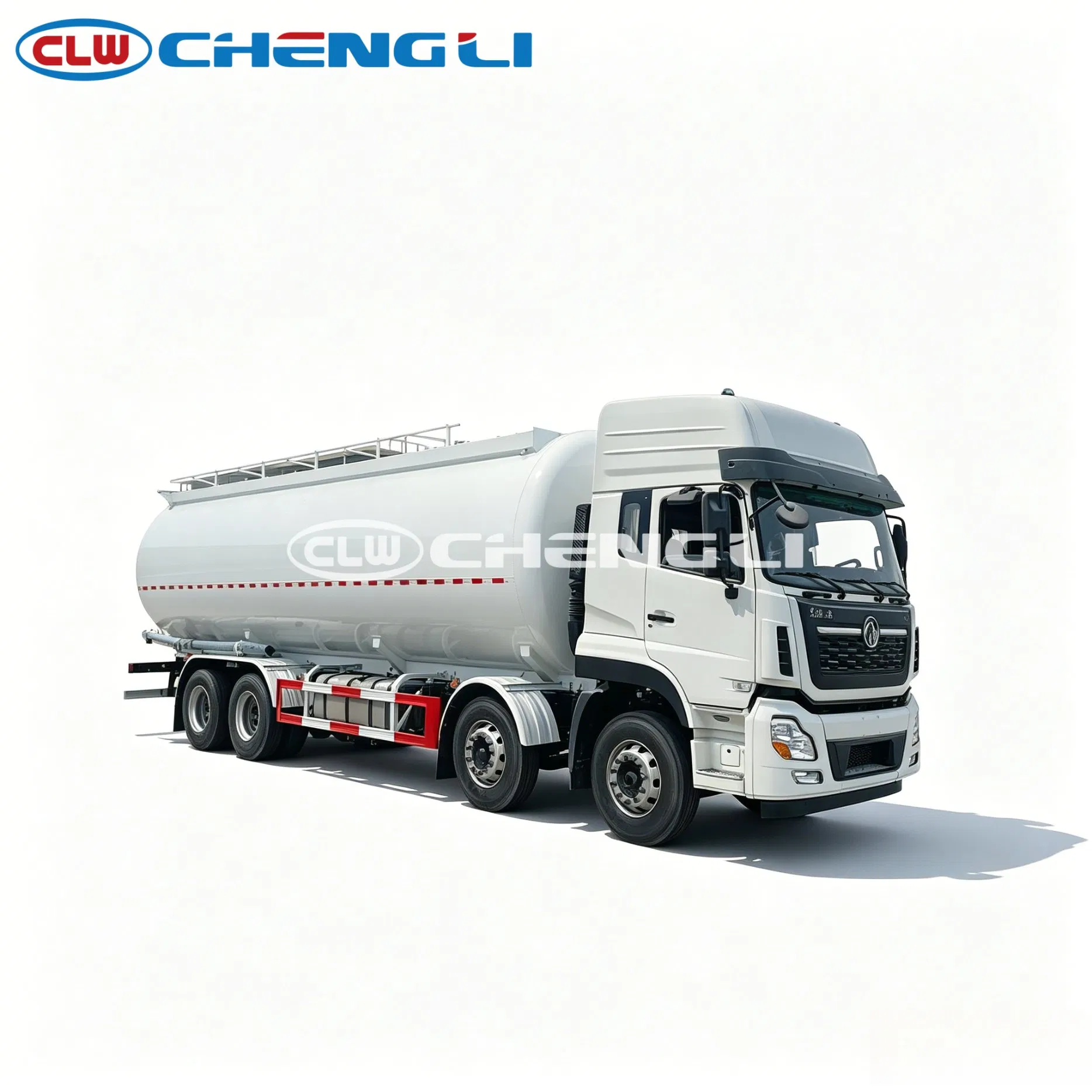
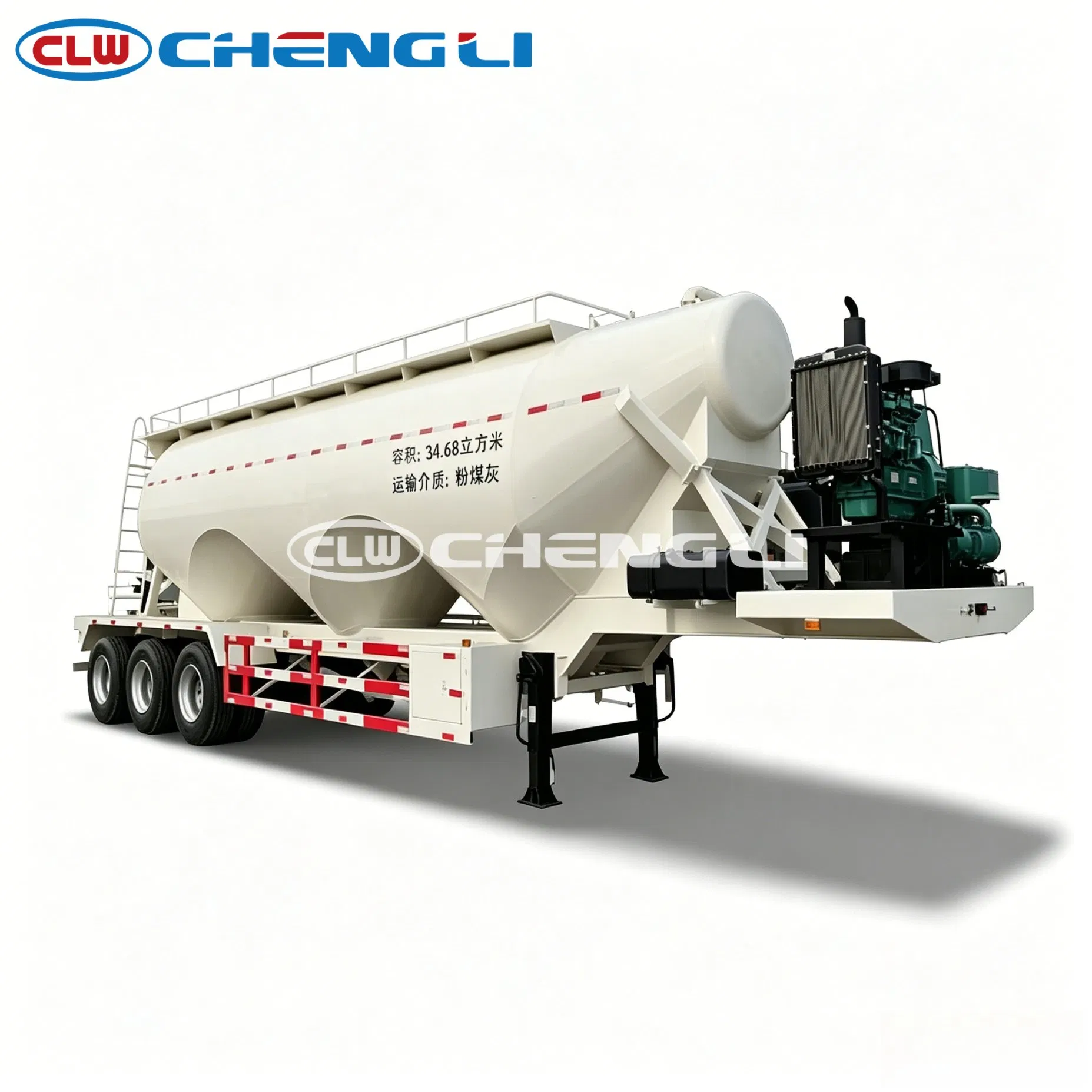
Air does the unloading: a compressor pressurizes the sealed tank, fluidizing beds at the bottom of each cone aerate the cement, and the powder flows out through the discharge pipe to the silo at about 0.2 MPa (29 psi). Our published rigid cement tankers carry 30 m³ nominal capacity, our powder tank semi-trailers 35 m³ to 60 m³ (optional), and our 35 m³ cement trailer is rated for 46,000 kg.
How pneumatic unloading works, step by step
A bulk cement tanker is a pressure vessel on wheels. Nothing tips and no auger turns; air is the only moving medium. The sequence at the silo is the same on every pneumatic tanker in our range:
- Connect. The driver couples the discharge hose to the silo inlet and connects the air line to the tank's air valve.
- Fluidize. Air enters chambers under the fluidizing beds, porous air pads lining each cone, and passes up into the cement. The separated particles behave almost like a liquid.
- Pressurize. With the manholes closed, pressure builds to the working discharge pressure, 0.2 MPa (2 bar) on our tanks.
- Discharge. The operator opens the discharge valve and the air stream carries aerated cement down the cones, through the pipe and hose, into the silo.
- Clear and vent. Air keeps running briefly to blow the hose clean, then the tank is vented before any manhole or coupling is opened.
Pressure alone does not move cement. A pressurized tank with a poorly aerated load pushes air through a channel in the powder and leaves the rest behind, so cone angle and bed condition matter as much as compressor size.
Where the air comes from
Truck-mounted screw compressor
The Shacman 8x4 30 m³ cement truck has an air compressor and a wear-resistant steel tank with a fluidized bed. Its reinforced discharge hose is 7 m long. Keep conveying air and powder dry to limit caking in the tank and lines.
Trailer-mounted diesel unit
Our 35 m³ three-cone cement tank semi-trailer carries a 4102 diesel unit rated at 38 kW as part of its unloading equipment, so unloading does not depend on the tractor.
External air supply
The three-axle cement semi-trailer with an optional 45 m³ tank has no engine. Air enters through an aluminum alloy supply valve from a tractor-mounted or plant compressor. The trailer is simpler to maintain, but every tractor or delivery point must be able to supply air.
Inside the tank: cones, fluidizing beds and residue
The tank floor is divided into cones, each with a fluidizing bed feeding the discharge line; steep walls stop powder settling in corners. Our 35 m³ cement trailer uses three cones. Both rigid tankers and several stainless trailers use multi-cone bodies with closed internal partitions, so two materials can travel separately.
At the outlet, verify discharge valve size, anti-clogging equipment and inspection access on the selected rigid truck or trailer. Our cement trailers leave a typical residual rate below 0.2%, the stainless multi-cone trailers below 0.1%. On a 46,000 kg load, 0.2% is less than 92 kg.
Tank material follows the cargo. Cement and fly ash are abrasive, so our cement trailers use 610L high-strength wear-resistant steel. Flour and feed go in 304 stainless steel, which cleans easily and does not rust. A tank that has hauled cement should not go back to food.
Tank volume vs cement weight: why cubic meters mislead
Loose bulk cement weighs about 1.3–1.5 t/m³, so a large tank is usually full by weight long before it is full by volume. Divide the rated load by the density to get the cement volume the tanker can carry within its rating.
| Model | Tank volume | Rated load | Tank material | Full tank of cement | Cement volume at rated load |
|---|---|---|---|---|---|
| Shacman rigid cement tanker, 4 axles | 30 m³ nominal | 16.9 t | Wear-resistant steel | Depends on cement density | Load by weight |
| Dongfeng rigid cement tanker, 4 axles | 30 m³ nominal | 16.8 t | Wear-resistant steel | Depends on cement density | Load by weight |
| Three-cone cement semi-trailer | 35 m³ | 46,000 kg | 610L steel | about 46–53 t | about 31–35 m³ |
| Cement semi-trailer | 45 m³ (optional) | 50 t | 610L steel | about 59–68 t | about 33–38 m³ |
| Multi-cone powder semi-trailer | 50 m³ | 30 t | 304 stainless steel | about 65–75 t | about 20–23 m³ |
The 35 m³ three-cone trailer is the closest match for cement: 46,000 kg in 35 m³ is about 1.31 t/m³, so a full tank sits at the rating. The 45 m³ trailer has headroom for lighter fly ash, but dense cement fills only about 33–38 m³ before its 50 t limit. A 50 m³ stainless trailer rated at 30 t is sized for flour and feed at roughly 0.5–0.7 t/m³, not cement.
Our 30 m³ rigid cement tankers use wear-resistant steel and have rated payloads of 16.8–16.9 t. Dense cement can reach the weight limit well before the tank is full, so plan each load by mass and axle limits.
Rigid powder tanker or bulk cement trailer?
A rigid tanker keeps compressor, chassis and tank in one unit: one registration and one driver; our 30 m³ Dongfeng and Shacman rigid trucks are about 10 m long, which helps in tight plant yards. It suits short, frequent runs of lighter powders. A bulk cement trailer carries 46 t to 50 t of rated load on three axles in our range, and the tractor can be uncoupled for other work while the trailer waits. The trade-off is length and tractor matching: the three-cone trailer takes a 50# (2 in) or 90# (3.5 in) kingpin. Our guide to semi-trailer types and how to choose one covers axles, suspension and tractors. For batching plants and road projects, see our construction and mining vehicle page.
What to confirm before ordering
- The material and its bulk density: cement, fly ash, dry mortar, flour or feed.
- Rated payload and gross weight under your registration and axle-load rules, not only tank volume.
- Air source: truck compressor, trailer diesel unit or external supply, and whether your silos and tractors can provide air.
- Discharge valve size (for example DN150), hose length (4 m or 7 m on our current models) and the silo inlet height and coupling.
- Working pressure of 0.2 MPa, plus the safety valve, pressure gauge and pressure-vessel inspection your market requires; specify the standard and confirm it at quotation.
- Tank material (610L steel for cement, 304 stainless for food-grade powders) and whether you need a washout system.
- Number of cones and compartments, and whether you will carry two materials on one trip.
- For trailers, kingpin size, landing gear rating (28 t on our 45 m³ trailer) and ABS; for rigid trucks, axle layout and cab.
FAQ
How much cement does a bulk cement trailer hold?
It depends on rated load more than tank size. At about 1.3–1.5 t/m³, a trailer rated for 46,000 kg carries roughly 31–35 m³ of cement, which is why our three-cone cement trailer uses a 35 m³ tank. A bigger tank, such as our optional 45 m³ version, adds space for lighter powders but not tonnage.
How long does it take to unload a powder tanker?
There is no single figure. Unloading time depends on compressor air delivery, discharge pipe diameter, hose length, silo inlet height and how dry the cement is. A DN150 outlet and a short, straight run to the silo both help. Give us your silo height and daily delivery count and we will size the air system to match.
Can a flour tanker carry cement?
Not as a routine. Our 304 stainless flour trailers are rated for 30 t, so a 50 m³ tank would carry only about 20–23 m³ of cement, and abrasive cement wears the tank and pipework. Cement residue also contaminates food cargo afterward. Order a wear-resistant steel cement tank for cement work.
What is pneumatic tanker capacity measured in?
Two numbers: tank volume in cubic meters (35 m³ is about 1,236 cu ft) and rated load in kilograms or tonnes. Volume tells you how much low-density powder fits; rated load tells you how much any cargo may weigh. For cement the rated load is almost always the limit, while for flour or plastic pellets volume usually runs out first.
What maintenance does the pneumatic system need?
Most wear happens in rubber and fabric parts. Keep spare seals, discharge hoses and control valves on hand, check fluidizing beds for tears or blocked pores, drain moisture from the air system, and have the safety valve and gauge inspected at the interval your inspector sets. A torn bed lets powder into the air chamber and slows every later delivery.
Choose by cargo weight first and tank volume second: a 35 m³ cement trailer rated at 46,000 kg for dense cement, larger stainless tanks for flour and feed, and a rigid tanker for short runs of light powder. Compare our bulk cement tankers and powder tankers, then send us your material, silo height and destination market and our engineers will propose a configuration.