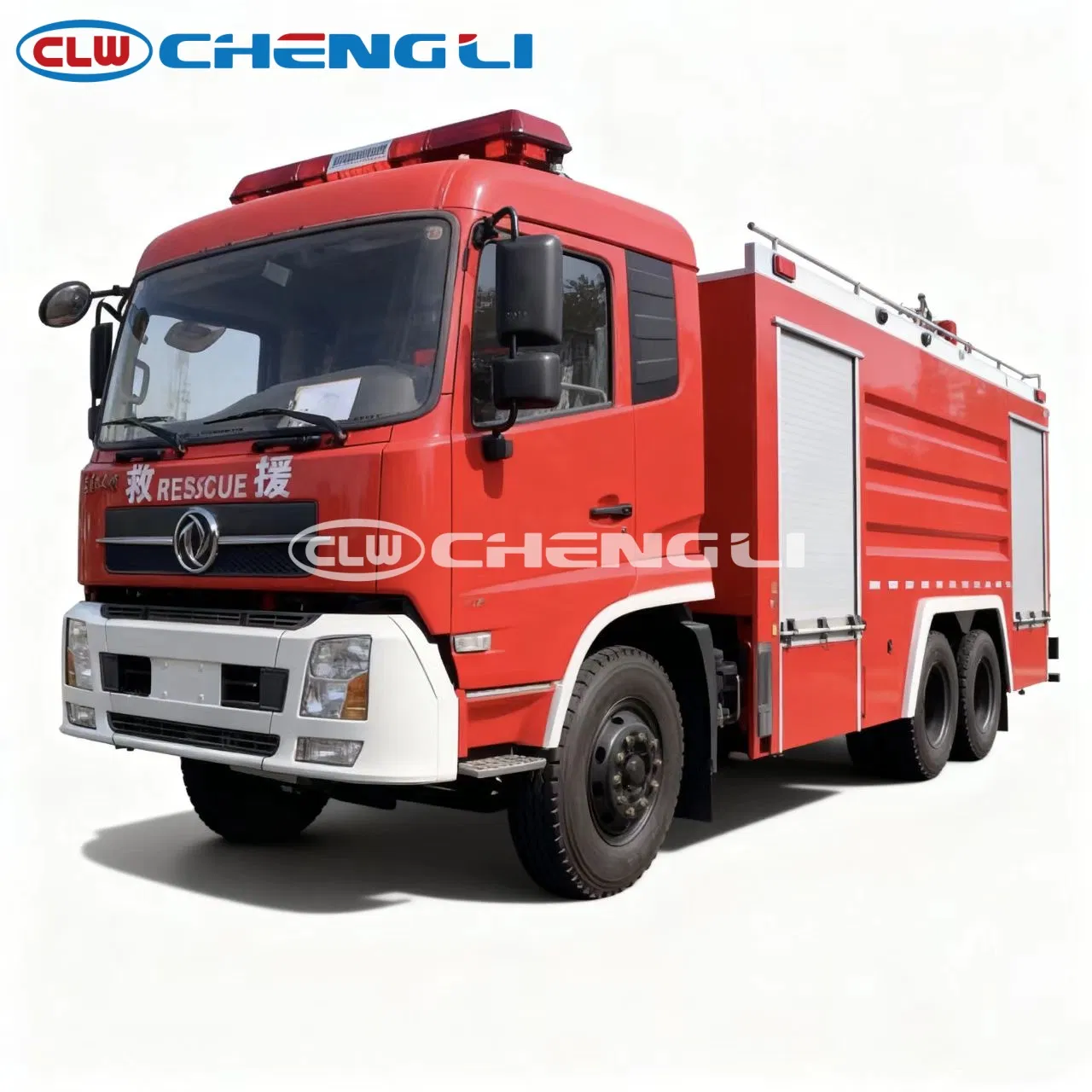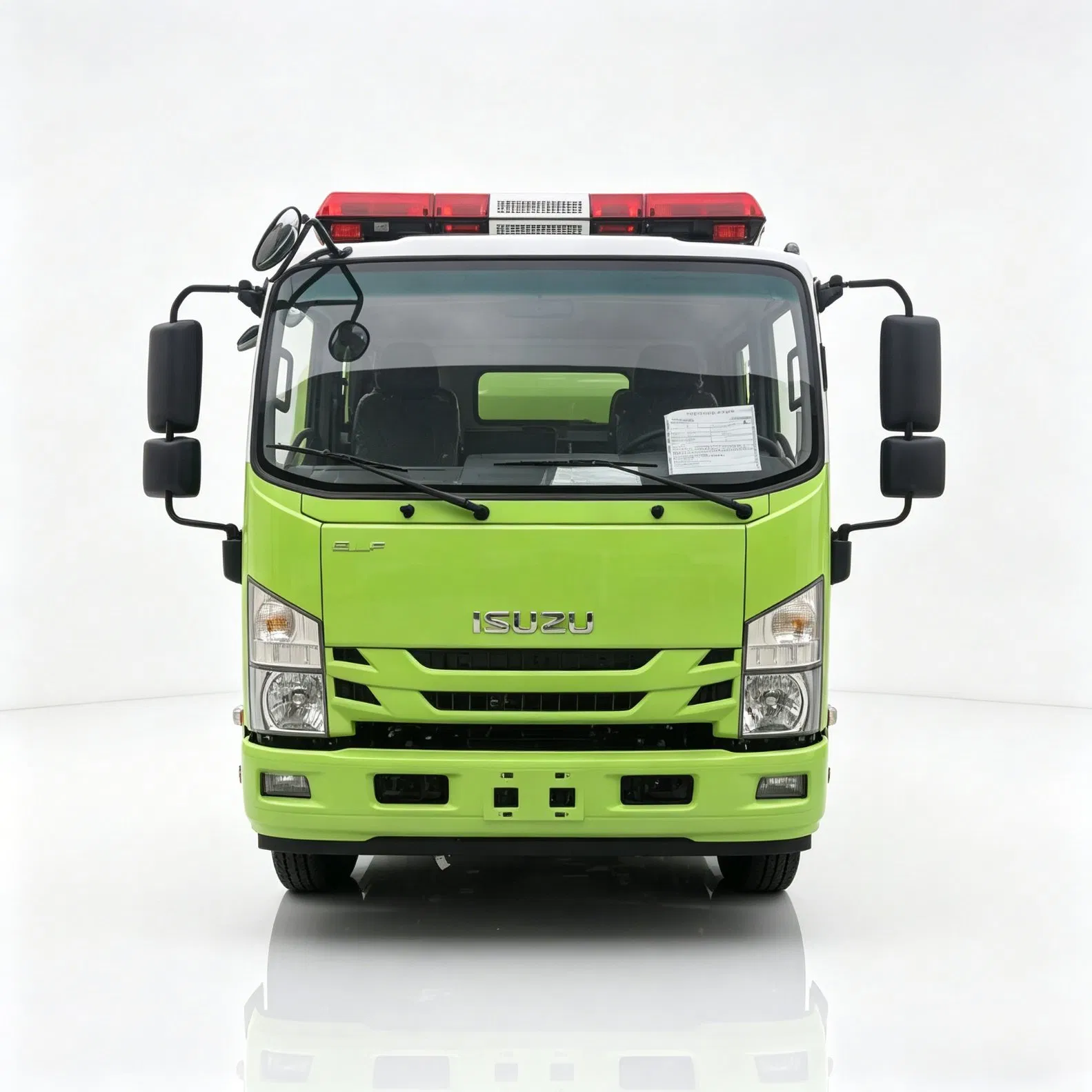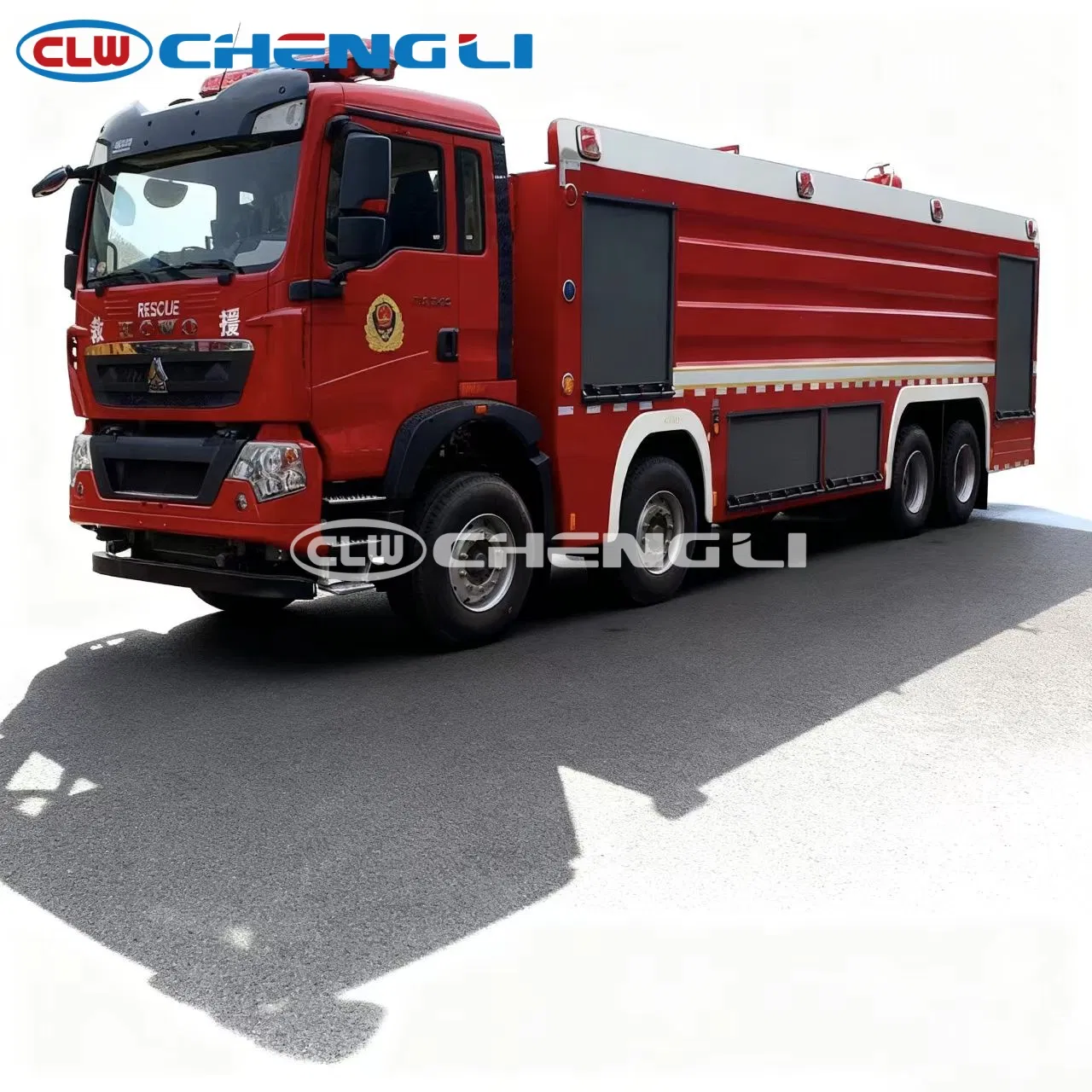
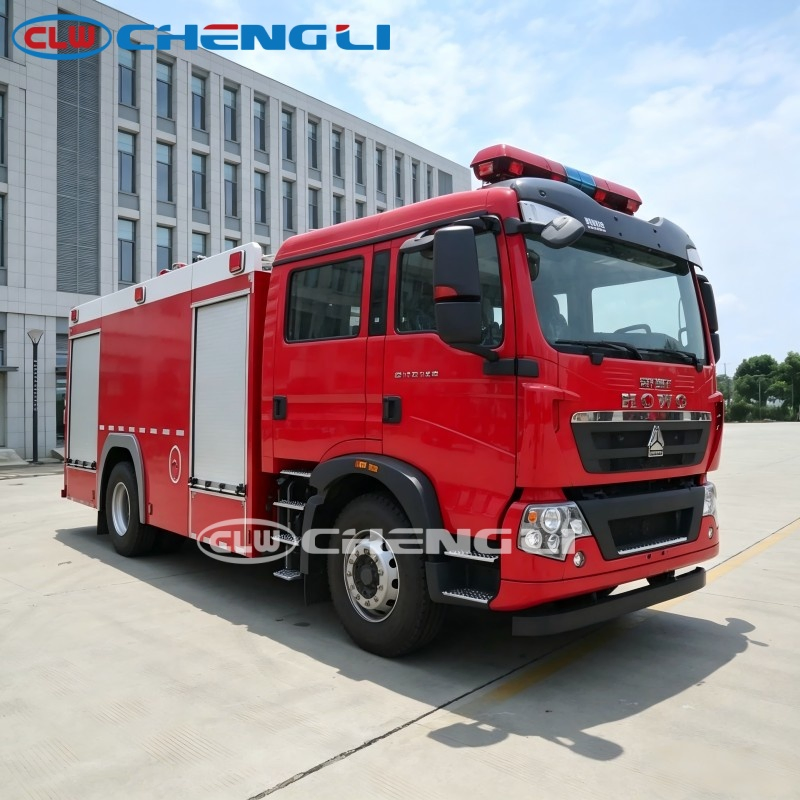
A fire truck's tank is measured in liters but used in minutes: our fire trucks carry from 850 L of water on a compact Dongfeng Tuyi 4x2 to 25,000 L on a HOWO 8x4, and the 3,000 L tank on our Isuzu Elf, emptied through its 30 L/s pump, lasts about 100 seconds at full flow. Chassis size sets the volume; pump flow sets the clock.
Fire truck water tank sizes by chassis
Water capacity tracks chassis size closely, because water weighs about 1 kg per liter and every liter has to fit inside the legal payload. The table lists our water-tank fire trucks from smallest to largest, with US gallons rounded (1 US gal = 3.785 L).
| Truck | Water tank | US gal (approx.) | Drive | Pump or monitor rating |
|---|---|---|---|---|
| Dongfeng Tuyi mini pumper | 850 L | 225 | 4x2 | – |
| BAIC fire pickup | 1,200 L | 317 | 4x4 | – |
| Isuzu and JMC light pumpers | 2,000 L | 528 | 4x2 | – |
| Dongfeng mini fire truck | 2,100 L | 555 | 4x2 | CB10/20 pump, 20 L/s monitor |
| Dongfeng and Foton light pumpers | 2,500–2,600 L | 660–687 | 4x2 | – |
| Isuzu Elf pumper | 3,000 L | 793 | 4x2 | 30 L/s at 1.0 MPa |
| Dongfeng pumpers | 4,000 L | 1,057 | 4x2 or 4x4 | – |
| Dongfeng fire and sprinkler truck | 7,000 L nominal | 1,849 | 4x2 | CB10/30 pump |
| HOWO water tank truck | 8,150 L | 2,153 | 4x2 | CB10/60 pump |
| Dongfeng fire sprinkler truck | 9,290 L | 2,454 | 4x2 | – |
| HOWO water tender | 12,000 L | 3,170 | 6x4 | – |
| HOWO heavy water tender | 25,000 L | 6,604 | 8x4 | – |
The range falls into three bands. Light 4x2 and 4x4 trucks carry 850–4,000 L and work as first-attack units in narrow streets, villages and forest tracks. Medium 4x2 trucks carry 7,000–9,290 L on chassis from about 12 t to 19 t GVW. Three- and four-axle trucks start at 12,000 L, as on our 12,000 L HOWO 6x4 water tender, and reach 25,000 L on an 8x4.
How long does a fire truck's water last?
The rule is simple: discharge time (s) = tank volume (L) ÷ flow (L/s). Pump ratings on our trucks are given in L/s at a working pressure, usually 1.0 MPa, and the tank empties fastest when the full rated flow goes through the roof monitor.
| Truck | Water tank | Rated flow | Time at full flow |
|---|---|---|---|
| Dongfeng 4x2 mini fire truck | 2,100 L | 20 L/s (PS8/20 monitor) | about 105 s (1.8 min) |
| Isuzu Elf 4x2 pumper | 3,000 L | 30 L/s (CB10/30) | about 100 s (1.7 min) |
| Dongfeng 4x2 fire and sprinkler truck | 7,000 L | 30 L/s (CB10/30) | about 233 s (3.9 min) |
| HOWO 4x2 water tank truck | 8,150 L | 60 L/s (CB10/60) | about 136 s (2.3 min) |
| HOWO 8x4 water and foam truck | 20,900 L | 100 L/s at 1.0 MPa | about 209 s (3.5 min) |
Chinese fire pump codes read as pressure and flow: CB10/30 means 1.0 MPa and 30 L/s, the rating of the pump on our Isuzu Elf 3,000 L pumper. A bigger pump does not buy more time: the HOWO 4x2 8,150 L water tank truck runs dry sooner than the 7,000 L Dongfeng because its CB10/60 pump flows twice as much. And working flow changes the picture; for example, two handlines drawing about 8 L/s together would stretch the Isuzu's 3,000 L to roughly six minutes.
Water tank vs foam tank: how the split works
On our water-and-foam trucks the foam tank takes between one-eighth and two-fifths of the total liquid volume. The split reflects the job: a municipal pumper needs water first, while a truck for fuel depots or chemical plants needs enough concentrate to blanket a spill.
| Truck | Water | Foam | Foam share of total |
|---|---|---|---|
| CLW 4x2 water and foam truck | 7,000 L | 1,000 L | 12.5% |
| HOWO 8x4 water and foam truck | 21,000 L | 4,000 L | 16% |
| HOWO 4x2 water and foam truck | 7,530 L | 2,000 L | 21% |
| HOWO 4x2 water and foam truck | 6,000 L | 2,059 L | 26% |
| Mercedes Arocs 8x4 foam truck | 12,600 L | 5,500 L | 30% |
| HOWO 4x4 water and foam truck | 3,080 L | 2,020 L | 40% |
Foam concentrate is proportioned into the water stream, typically at 3% or 6% for Class B foam, so a foam tank goes much further than its volume suggests. At 3%, the 2,000 L foam tank on our HOWO 7,530 L truck could make about 66,700 L of foam solution, but the truck's own water produces only about 7,760 L of solution and uses about 230 L of concentrate. The remaining concentrate only pays off when a hydrant, tender or open water feeds the pump. Where we specify foam tank material it is stainless steel, such as 304 on the 20,900 L HOWO 8x4, because many concentrates corrode plain carbon steel. For how foam, dry powder and rescue units divide the work, see our overview of fire truck types and their agents.
What limits tank size: payload, axles and handling
Every 1,000 L of water adds about 1 t. On the 25,000 L HOWO 8x4 (42,450 kg GVW), water makes up about 59% of gross weight; on the 12,000 L HOWO 6x4 (27,300 kg GVW) about 44%; on the 850 L Dongfeng Tuyi (4,050 kg GVW) about 21%. The larger that share, the more the tank governs braking, cornering and tire wear.
That load also moves. Baffles break up surge under braking, and a half-full tank, the state a truck drives back in, surges more than a full one. Before choosing the largest tank a chassis can take, check nominal volume against rated payload and the axle loads you can register locally.
Matching tank size to your water supply
Hydrant-covered cities. A 2,000–4,000 L light pumper holds the first line for roughly 1–2 minutes at 30 L/s while the crew connects to a hydrant; maneuverability matters more than volume, hence our short-wheelbase 4,000 L Dongfeng.
Rural areas and industrial parks. Where hydrants are sparse, 7,000–12,000 L on a medium 4x2 or a 6x4 buys several minutes of attack while a water shuttle starts.
Water shuttles and large sites. 8x4 trucks with 20,900–25,000 L carry water to the scene and feed other pumpers; the HOWO 8x4 with a 100 L/s pump can also fight fire directly.
Forest and off-road work. Our 4x4 trucks carry 1,200–4,400 L, trading volume for ground clearance and traction on unpaved tracks. For planning a mixed fleet across these roles, see our page on vehicles for fire and emergency services.
What to confirm before ordering
- Usable water volume versus nominal tank volume, and whether a full tank stays within the chassis rated payload and axle loads.
- Pump model, rated flow and pressure, for example CB10/30 at 30 L/s and 1.0 MPa, plus priming time from draft (not more than 50 s on our HOWO 8,150 L truck).
- Monitor flow and reach, and whether the monitor can run from hydrant supply as well as from the tank.
- Foam tank size, concentrate type, proportioning ratio (3% or 6%) and foam tank material.
- Water tank material, anti-corrosion treatment and baffle layout.
- Drive and wheelbase (4x2, 4x4, 6x4 or 8x4) against the streets, bridges and tracks the truck must reach.
- The fire apparatus standard your authority requires; specify it and confirm it at quotation.
FAQ
How many gallons does a fire truck hold?
Across our fire trucks, water tanks run from about 225 US gal (850 L) on a mini pumper to about 6,600 US gal (25,000 L) on an 8x4 tender. When comparing quotes, check whether gallons are US or imperial: an imperial gallon is 4.546 L, so the same tank reads about 17% fewer imperial gallons.
What is a typical foam tank capacity?
On our water-and-foam trucks the foam tank ranges from 1,000 L to 5,500 L, and the Isuzu Elf light pumper offers 200, 500 or 1,000 L options. A bigger foam tank only helps if water supply keeps up, since each liter of concentrate needs about 32 L of water at 3%.
Can a fire truck pump more water than its tank holds?
Yes. The tank is only the first supply. Once a hydrant, a water tender or open water is connected, the pump can flow continuously at its rated output, and the tank becomes a buffer that keeps the lines charged while hoses are changed. That is why hydrant inlets, suction hose and priming time matter as much as tank volume in areas with good water supply.
Why is fire truck water tank size sometimes given in kilograms?
Some ratings on Chinese-built fire trucks express the tank as the mass of water carried, for example 2,100 kg or 8,150 kg. Because water weighs about 1 kg per liter, the figure converts directly: 8,150 kg is about 8,150 L or 2,153 US gal, and the same logic lets you read a kilogram rating straight against payload.
Is a bigger water tank always better?
No. Extra volume brings more axles, a longer wheelbase and a wider turning circle. A 25,000 L 8x4 cannot reach alleys that a 2,500 L 4x2 enters easily, and it takes longer to refill. It is often better to pair small first-attack pumpers with one large tender than to put an oversized truck in every station.
Size the tank for how long you must flow before resupply arrives, size the pump for how hard you need to hit the fire, and pick the chassis that carries both within its axle ratings. Compare the full range of water and foam fire trucks by capacity, then tell us your water supply, target tank volume and destination market and our engineers will propose a configuration.