A fire truck pump is rated by two numbers: the flow it delivers and the outlet pressure it holds while delivering that flow. On our fire trucks, rated flow runs from 20 L/s on a 2,100 L mini truck to 100 L/s on a 20,900 L 8x4 water and foam truck, almost always at 1.0 MPa (10 bar). Where the pump sits on the chassis then decides how it is driven, operated and serviced.
What do the numbers on a fire pump mean?
Every pump rating is a pair. Flow alone says nothing, because a centrifugal pump moves more water at low pressure and less at high pressure. A rating such as "30 L/s at 1.0 MPa" means the pump can sustain 30 liters per second while the discharge pressure stays at 1.0 MPa under test conditions.
Flow units
Chinese and European specifications use liters per second (L/s) or liters per minute (L/min). North American specifications use US gallons per minute (gpm). The conversion is simple: 1 L/s = 60 L/min, or about 15.85 US gpm. A 60 L/s pump therefore moves 3,600 L/min, or about 950 gpm.
Pressure units
1.0 MPa equals 10 bar, or about 145 psi. Most municipal pumpers in China and Europe are rated at normal pressure around 1.0 MPa. High-pressure stages, used for hose reels and fog nozzles, work at 4.0 MPa (40 bar) or more but deliver much smaller flows.
Reading a CB10/60 code
Chinese vehicle fire pumps carry a model code that states the rating directly. In CB10/60, "CB" marks a vehicle-mounted fire pump, "10" is the rated outlet pressure in units of 0.1 MPa (so 1.0 MPa), and "60" is the rated flow in L/s. Monitors follow a similar pattern: a PS8/50 is a water monitor rated at 0.8 MPa and 50 L/s. When you compare quotations, these codes tell you more than an engine horsepower figure does.
Fire pump flow ranges on our fire trucks
The table shows pumps fitted to fire trucks in our current range. Flow grows with the water tank, but not in a straight line: a small truck with a 30 L/s pump can still run two attack lines, while the largest trucks carry pumps sized to feed roof monitors and supply other appliances.
| Truck | Water tank | Fire pump | Rated flow | L/min / US gpm |
|---|---|---|---|---|
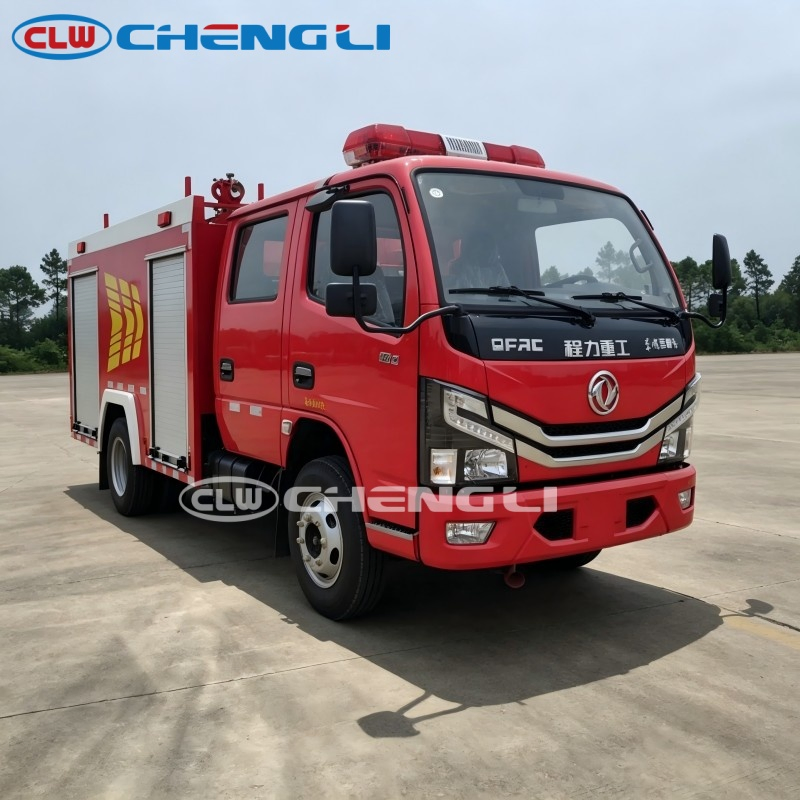
| Dongfeng 4x2 mini fire truck | 2,100 L | CB10/20 | 20 L/s | 1,200 / about 317 |
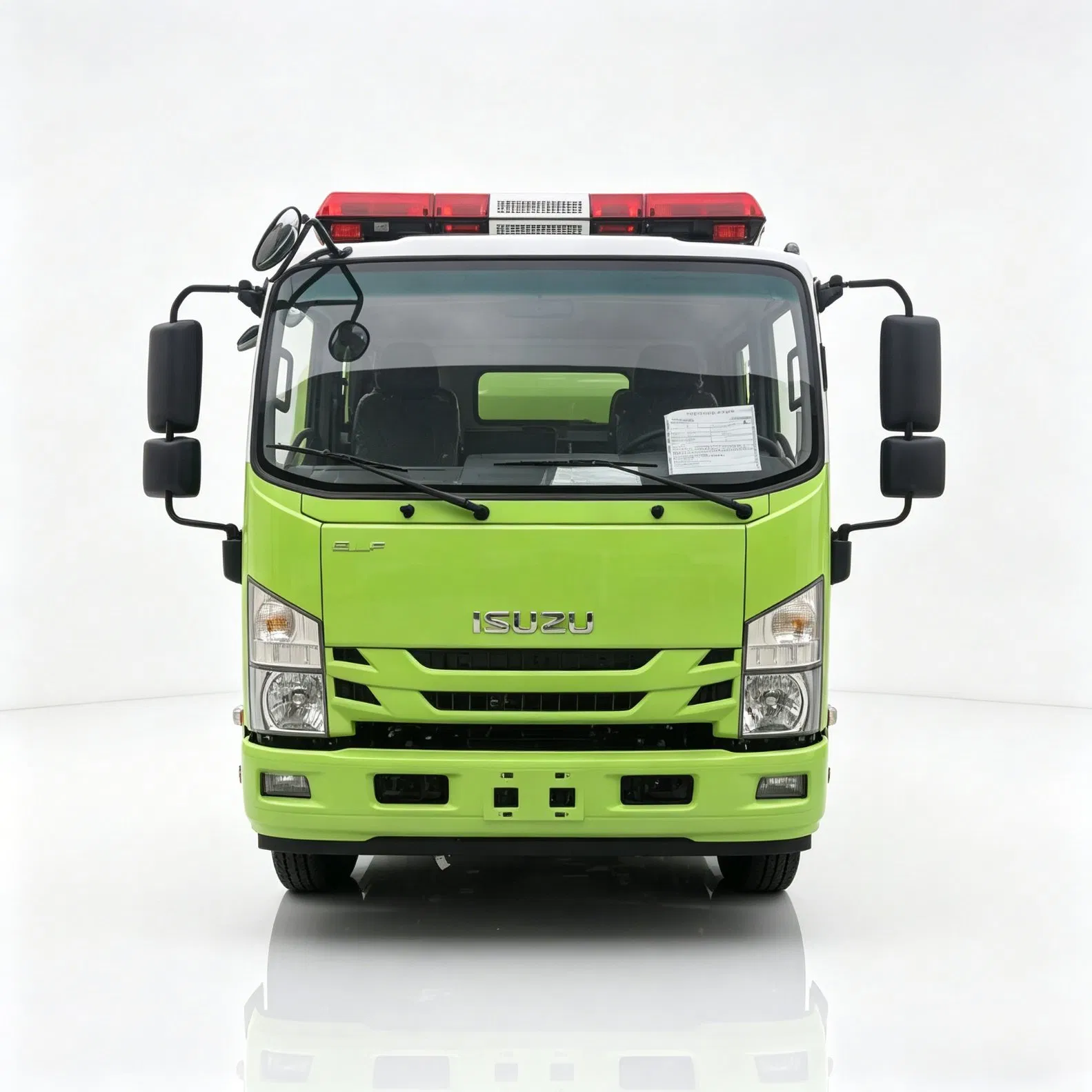
| Isuzu Elf 4x2 water fire truck | 3,000 L | CB10/30 (CB10/40 optional) | 30 L/s at 1.0 MPa | 1,800 / about 476 |
| Dongfeng 4x2 fire sprinkler truck | 7,000 L | CB10/30 | 30 L/s | 1,800 / about 476 |
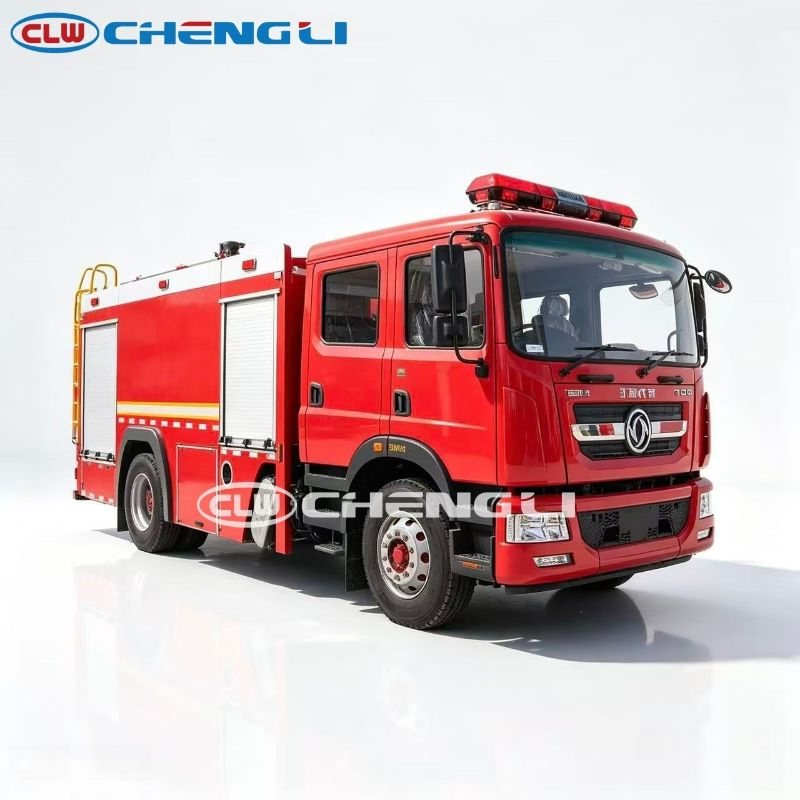
| Dongfeng 4x2 water and foam truck | 5,850 L | CB10/40 | 40 L/s | 2,400 / about 634 |
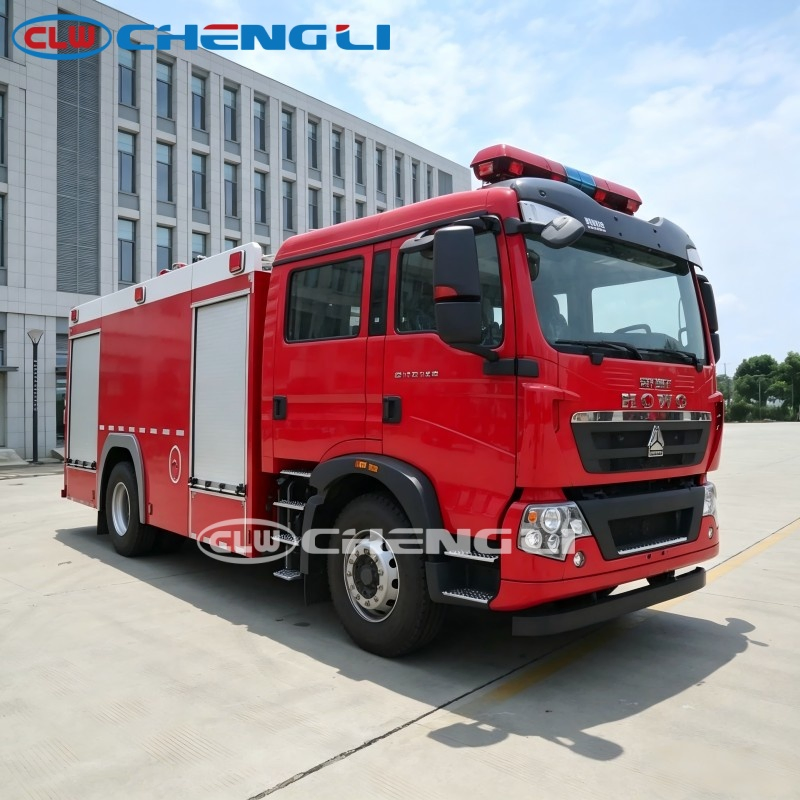
| HOWO 4x2 water tank fire truck | 8,150 L | CB10/60 | 60 L/s | 3,600 / about 951 |
| HOWO 8x4 water and foam truck | 20,900 L | Rear-mounted | 100 L/s at 1.0 MPa | 6,000 / about 1,585 |
Two points stand out. First, 30 L/s is the workhorse rating for light and medium 4x2 trucks carrying 3,000 L to 7,000 L, such as our Isuzu Elf 3,000 L fire truck. Second, the step from 60 L/s to 100 L/s comes with the move to an 8x4 chassis, because a pump that size needs both the engine power to drive it and the water to feed it.
How long does the tank last at full flow?
A pump rating is also a clock. Divide tank volume by flow and you get the time the truck can work on its own water before it needs a hydrant, a relay or a tanker shuttle.
| Water tank | Pump flow | Time to empty at rated flow |
|---|---|---|
| 2,100 L | 20 L/s | about 1 min 45 s |
| 3,000 L | 30 L/s | about 1 min 40 s |
| 7,000 L | 30 L/s | just under 4 min |
| 8,150 L | 60 L/s | about 2 min 15 s |
| 20,900 L | 100 L/s | about 3 min 30 s |
Crews rarely run a pump flat out, because a single hand line flows only part of the rated capacity. Still, the table explains a common mistake: buying the largest pump for a small tank. Without a hydrant, a 60 L/s pump on a 3,000 L truck would empty it in 50 seconds. For rural areas with few hydrants, a larger tank with a moderate pump usually does more useful work than the reverse. In cities with dense hydrant networks, a higher-rated pump pays off, because the tank only covers the first few minutes before a hydrant line is connected.
Pressure, hose length and monitor reach
Pressure is what gets water to the nozzle. Every meter of hose and every meter of height costs pressure, so pump outlet pressure must exceed the nozzle pressure by the friction and elevation losses along the line. As a rule of thumb, each 10 m of height costs about 0.1 MPa before friction is counted.
Monitors show flow and pressure working together. The PS8/20 monitor on our Dongfeng mini truck delivers 20 L/s at 1.0 MPa. The PS8/30 on our Dongfeng 7,000 L sprinkler truck reaches at least 60 m, and the PS8/50 on the HOWO 8,150 L fire truck with CB10/60 pump reaches beyond 70 m with 360° rotation. On the Isuzu Elf, the water monitor reaches at least 45 m and the foam monitor at least 40 m, because aerated foam solution carries a shorter distance than a solid water stream.
If your crews fight fires in tall buildings, high-pressure capability matters more than raw flow. If they fight fires in warehouses, fuel depots or open ground, flow and monitor reach matter more.
Front, midship or rear-mounted: where should the pump sit?
Pump position changes how the truck is driven, operated and maintained.
- Rear-mounted pumps sit behind the water tank in a rear compartment, driven by a power take-off (PTO) and drive shaft from the chassis gearbox. This is the standard layout on Chinese-built fire trucks, including our CB10/30 Dongfeng sprinkler truck and the 100 L/s HOWO 8x4 20,900 L water and foam truck. The operator panel, suction inlets and outlets are grouped at the back, and the pump is easy to reach for service.
- Midship pumps sit between the cab and the body, with operator panels on the sides of the truck. They are common on North American pumpers. They keep the pump close to the engine but use body length that could otherwise hold tank or locker space.
- Front-mounted pumps sit ahead of the radiator, driven from the engine crankshaft. They suit brush trucks and small rural units that draft from open water, but they lengthen the front overhang and expose the pump in a collision.
For most export buyers, rear-mount is the practical choice: it fits the chassis without cab changes and keeps the pump clear of the engine bay. Our current fire truck range uses rear-mounted pumps; we do not currently list front-mount or midship pump layouts.
Matching the pump to the chassis and engine
The pump takes its power from the truck engine, so the chassis must have power to spare. Hydraulic power equals flow times pressure: 60 L/s at 1.0 MPa is 60 kW of water power, and with a typical centrifugal pump efficiency of 60–70% the pump draws roughly 85–100 kW at the shaft. A 100 L/s pump at the same pressure needs roughly 140–170 kW.
That explains the pairings in our range. The 2,100 L mini truck with a 20 L/s pump runs on an 85 kW (115 hp) engine. The HOWO 8,150 L truck with its CB10/60 pump has a 257 kW (349 hp) engine. The 100 L/s HOWO 8x4 uses a 338 hp engine. Engine power is only half the check: the PTO and gearbox must also be rated for continuous duty at the pump's input torque, because fire pumping can run for hours.
Priming is the other chassis-side detail. When drafting from open water, a vacuum primer clears air from the suction hose. Our HOWO 8,150 L truck primes in 50 s or less, and the Dongfeng 7,000 L sprinkler truck uses a piston-type vacuum pump. If your crews draft from rivers, ponds or open tanks, ask for the priming time and maximum suction lift in writing.
What to confirm before ordering
- Rated flow together with the pressure it is rated at, for example 40 L/s at 1.0 MPa, not flow alone.
- Whether you need a high-pressure stage for hose reels, and its flow and pressure.
- Pump position and which side the operator panel should face.
- Number and size of suction inlets and outlets, and the coupling type used in your market.
- Priming system type and priming time at your expected suction lift.
- Monitor model, rated flow and reach, and whether it handles foam.
- Engine power, PTO rating and engine cooling for continuous pumping.
- The pump test standard your market requires, such as EN 1028 or NFPA 1901, confirmed at quotation.
FAQ
What is a good pump capacity for a small fire truck?
For 2,000–4,000 L trucks on light 4x2 chassis, 20–30 L/s at 1.0 MPa is typical. That supports one or two attack lines from the tank and keeps the pump within the power the chassis can spare. Our 2,100 L Dongfeng mini truck uses a 20 L/s CB10/20 pump, and our 3,000 L Isuzu Elf uses a 30 L/s CB10/30 with a 40 L/s option.
How do I compare a CB10/40 pump with a 1,000 gpm rating?
Convert both to the same unit. A CB10/40 is rated at 40 L/s, which is 2,400 L/min or about 634 US gpm, at 1.0 MPa (about 145 psi). A 1,000 gpm pump moves about 63 L/s. NFPA pumper ratings are taken at 150 psi net pump pressure, close to 1.0 MPa, so the two figures can be compared once the units match.
Does a bigger pump need a bigger water tank?
Not always, but both should match the water supply. Where hydrants are close, a large pump with a modest tank works well, because the tank only bridges the first minutes. Where water must be carried, the tank sets the limit: a 30 L/s pump on a 7,000 L tank works for close to four minutes at full flow, and much longer at real nozzle flows.
Can one pump deliver both water and foam?
Yes. On water and foam trucks, the fire pump supplies water and a proportioner draws foam concentrate from the separate foam tank into the stream, typically at 3% or 6% depending on the concentrate. Our 5,850 L Dongfeng water and foam truck pairs a CB10/40 pump with a 1,950 L foam tank. Confirm the proportioner type and ratio range at quotation.
Why is the monitor flow lower than the pump flow?
The pump also feeds hose outlets, and the monitor is sized for the flow the crew wants on one stream. On our HOWO 8,150 L truck, the CB10/60 pump feeds a PS8/50 monitor, which leaves capacity for hand lines while the monitor is running.
Choose the pump by the water supply your crews will have and the work they do: moderate flow on a larger tank for rural and industrial sites, higher flow where hydrants are dense or monitors do most of the work. You can compare complete configurations across our fire truck range and see how they fit wider fleets on our fire and emergency services page. Send your tank size, chassis preference, pump rating and destination market through our contact page, and our team will propose a matching configuration.