An insulated aerial truck carries two kinds of voltage figures: the line voltage it is built to work on, and the higher test voltages its boom section, bucket and liner must withstand for a set time. On our 18 m unit, for example, the rating is 35/66 kV and the insulating boom section is tested at 105 kV for 1 minute. Read both before you buy.
What Makes an Aerial Truck Insulated
A standard aerial work platform is a steel boom with a steel or aluminum basket. It lifts people, and it conducts electricity from basket to chassis to ground without any difficulty. An insulated unit breaks that path. Part of the boom is made from fiberglass-reinforced plastic (FRP), the bucket is FRP rather than metal, and a separate liner sits inside the bucket. Hydraulic hoses and leveling components that cross the insulating section are non-conductive as well, because one steel-braided hose would bridge the gap.
The point is to keep the worker from becoming a route between a conductor and earth. The insulation does nothing for contact between two phases, or between a phase and a grounded crossarm, at bucket level. That is why insulated trucks are always used together with gloves, sleeves, cover-up and a work procedure, never instead of them.
Most trucks in our aerial work platform range are not insulated. They are the right tool for street lights, signs and de-energized lines, and the wrong one for anything live.
Rated Line Voltage vs Test Voltage
The rated line voltage is the system the truck is intended for, expressed as the nominal voltage of the line. The test voltage is what the insulating parts are subjected to at the factory, and it is deliberately higher. A third number, the test duration, completes the rating: 1 minute and 5 minutes are both common, and a figure without a duration is incomplete.
The two insulated trucks we currently build show how differently the same idea can be specified.
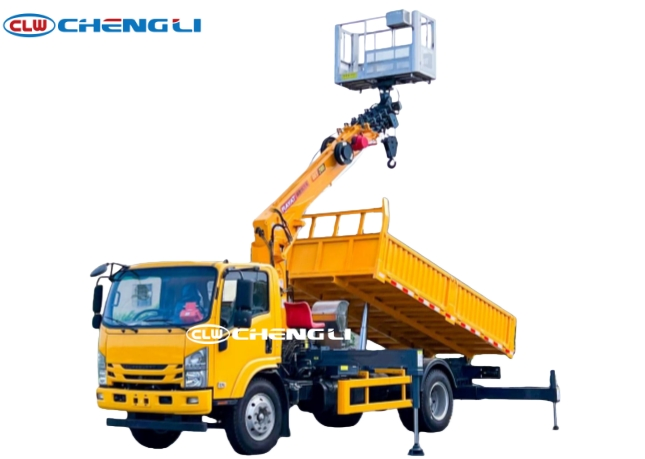
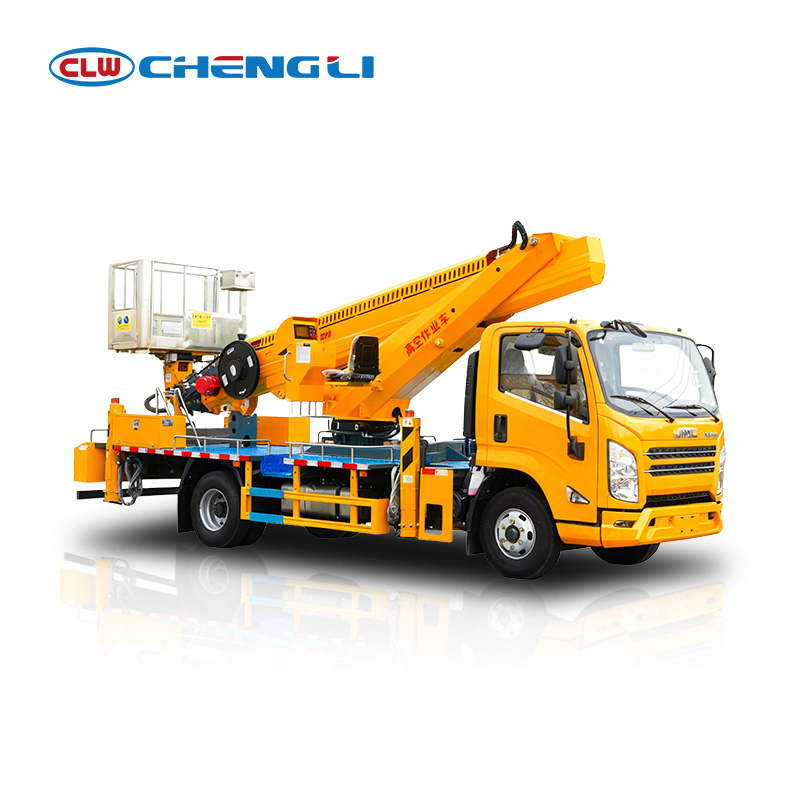
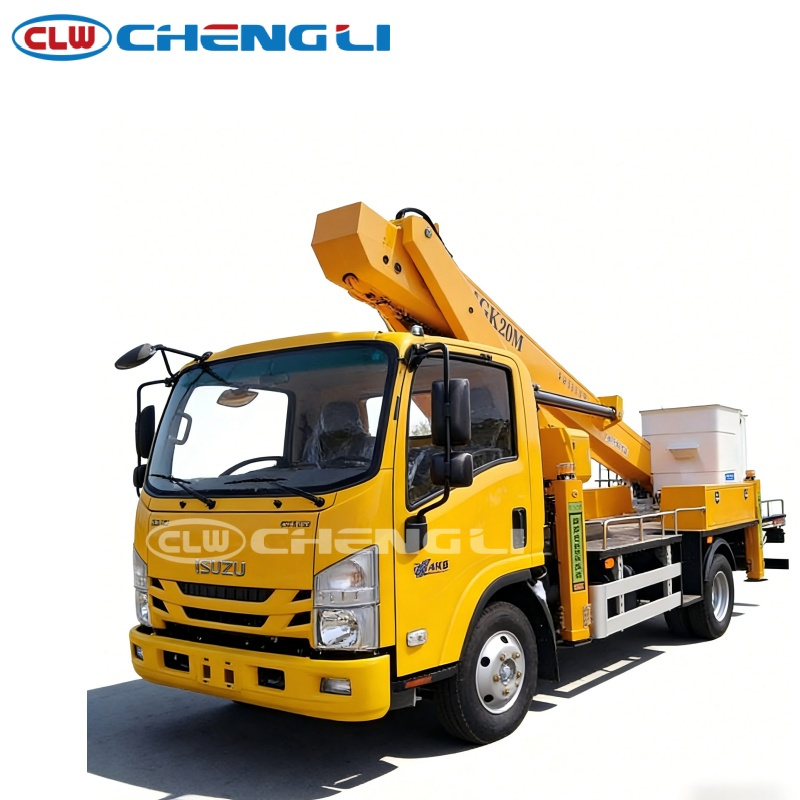
| Item | 18 m insulated truck with tipping bed | Isuzu 21 m insulated platform |
|---|---|---|
| Working height | 18 m | 21 m |
| Rated bucket load | 280 kg | 220 kg |
| Rated line voltage | 35/66 kV | No line class; basket rating only |
| Insulating boom section test | 105 kV, 1 min (FRP upper section) | Not part of the rating |
| Bucket test | 20 kV, 5 min | 45 kV test voltage |
| Bucket liner test | 50 kV, 5 min | Not part of the rating |
| Lifting device test | 100 kV, 1 min | Not part of the rating |
| Chassis | 4x2, 11,995 kg GVW | Isuzu 4x2, 7,300 kg GVW |
The 18 m insulated aerial truck with a tipping cargo bed has four separate test figures, each tied to a component. The Isuzu 21 m insulated platform has one: a 45 kV test voltage on the basket. Both are insulated, but they are not interchangeable. A basket-only rating protects against brush contact at the bucket; it does not cover the boom as a path to ground.
Which Parts Are Tested and Why
Insulating boom section
This is the main barrier between the bucket and the truck. On the 18 m unit it is the FRP upper section, tested at 105 kV for 1 minute. Its exposed insulating length is what matters, so a telescopic boom must be extended far enough to bring the full FRP section out before live work starts. Dirt, moisture and scratches on the surface all lower what it can withstand.
Bucket and liner
The FRP bucket is structural; it carries the 280 kg rated load. The polyethylene liner inside it is the electrical layer, which is why the liner on that truck is tested higher (50 kV for 5 minutes) than the bucket shell (20 kV for 5 minutes). A liner with a drain hole, a crack or a bolt through it is no longer a liner. Inside dimensions of 1.05 × 0.73 × 1.10 m shrink to 1.01 × 0.68 × 1.10 m with the liner fitted, which matters for two people in winter clothing.
Lifting device at the boom tip
Line crews lift insulators, crossarms and small transformers with a jib at the bucket. On the 18 m truck this auxiliary device handles up to 490 kg and has its own 100 kV, 1-minute test, because a conductor resting on a metal jib would otherwise bypass the bucket insulation.
Lower boom and chassis
Some designs add an insulating insert in the lower boom to protect people standing beside the truck if the boom touches a line. We do not currently list a truck with a rated chassis insert, so treat the vehicle body and outriggers as conductive and keep ground staff clear.
Live-Line Methods and the Truck Each One Needs
Three work methods are in general use. With hot sticks, the worker stays at a distance and handles the conductor through insulating tools; the truck is a work position and its insulation is secondary protection. With rubber gloves, the worker touches the conductor through gloves and sleeves, and the insulating boom and liner are a required second barrier. In bare-hand work, common on transmission lines, the worker is bonded to the conductor inside a conductive bucket liner and the boom alone holds the full line-to-ground voltage.
Gloving on distribution lines is where most insulated bucket trucks are used, and it is the duty a 35/66 kV class truck with a tested boom section and liner is built for. A basket-rated platform such as the 21 m Isuzu suits jobs near low-voltage conductors, street-light circuits and telecom work on shared poles, where the risk is accidental contact rather than planned handling of a live phase.
Standards Buyers Usually Reference
Utilities write the insulation requirement into the tender by naming a standard. In North America that is ANSI A92.2, which covers vehicle-mounted elevating and rotating aerial devices and sorts insulating units into Categories A, B and C; Category C units are rated 46 kV and below and are the usual choice for distribution gloving work. Internationally, IEC 61057 covers aerial devices with an insulating boom for live working above 1 kV AC.
These documents differ in test voltages, durations and leakage-current limits, so a test figure quoted under one cannot be read across to another. Specify the standard, category and line voltage your utility requires and confirm them at quotation, along with the test report you expect to receive with the truck.
Keeping the Rating After Delivery
A dielectric rating describes the truck on the day it was tested. Road film, hydraulic oil mist and UV exposure degrade FRP surfaces, and water inside a hollow boom is worse than water outside it. Crews should wipe the insulating section before live work, keep it waxed or coated as the operating manual instructs, and stop work in rain or fog.
Periodic electrical retesting is normal practice, with the interval set by the utility or local regulation. Plan for it at purchase: ask how the boom is to be positioned for the test, where the test electrodes attach, and what leakage current is acceptable. Use only the dielectric hydraulic oil named for the unit, and replace liners rather than repairing them.
Mechanical limits still apply while all this is going on. The 18 m truck reaches 11.6 m of radius with 100 kg in the bucket and 10.6 m with the full 280 kg, and the 21 m platform needs its outriggers set to a 4,050 mm by 4,900 mm footprint. Our guide to working height, outreach and basket load explains how to read those figures.
What to Confirm Before Ordering
- Nominal voltage of the lines your crews work on, and whether the work is live or de-energized.
- Work method: hot stick, rubber glove or bare-hand.
- The standard and category your utility or regulator names in its rules.
- Which components carry a rating: boom section, bucket, liner, jib, lower boom insert.
- Test voltage and duration for each component, and the test report format.
- Bucket rated load with the liner fitted, for the number of workers plus tools and cover-up.
- Jib or auxiliary lifting capacity for the heaviest item handled at the pole top.
- Working height and radius at full bucket load, and outrigger span against your road widths.
FAQ
Is an insulated bucket truck safe to touch while the boom is near a live line?
No. The insulation sits between the bucket and the truck, not between the truck and the ground. If the lower boom or chassis contacts a conductor, the vehicle body can become energized, and anyone standing beside it and touching it is at risk. Ground staff should stay clear, and the truck should be grounded or barricaded according to the utility's procedure.
Does a fiberglass bucket make a truck insulated?
Not on its own. An FRP bucket on a steel boom gives limited protection against brushing a low-voltage conductor, and only if the bucket has been tested. Work on energized distribution lines calls for a tested insulating boom section and a bucket liner as well. Ask which components were tested, at what voltage and for how long.
How often should the boom be dielectrically tested?
The interval is set by the standard or utility rule that applies in your market, and many fleets also retest after any repair to the boom, bucket or hydraulic lines that cross the insulating section. Daily visual checks and cleaning come on top of that. Keep each test record with the vehicle file so the rating can be shown on request.
Can an insulated aerial truck work in the rain?
Live-line work from an insulated boom is normally stopped in rain, fog or heavy mist, because a continuous film of water on the FRP surface can carry current along the boom. The truck can still be used as an ordinary aerial platform on de-energized lines in wet weather, within its wind and stability limits.
What is the difference between a 45 kV basket and a 35/66 kV truck?
The first figure is a test voltage applied to one component; the second is a line voltage class for the whole insulating system. Our Isuzu 21 m platform has an insulated basket with a 45 kV test voltage. Our 18 m truck is rated for 35/66 kV lines, with separate tests of 105 kV, 100 kV, 50 kV and 20 kV on its boom section, lifting device, liner and bucket.
Start from the line voltage and the work method, then match the rated components to them; height and basket load come second. If you are equipping power, road and utility fleets, send us your line voltage, work method and required standard, and our engineers will propose a boom, bucket and chassis configuration.